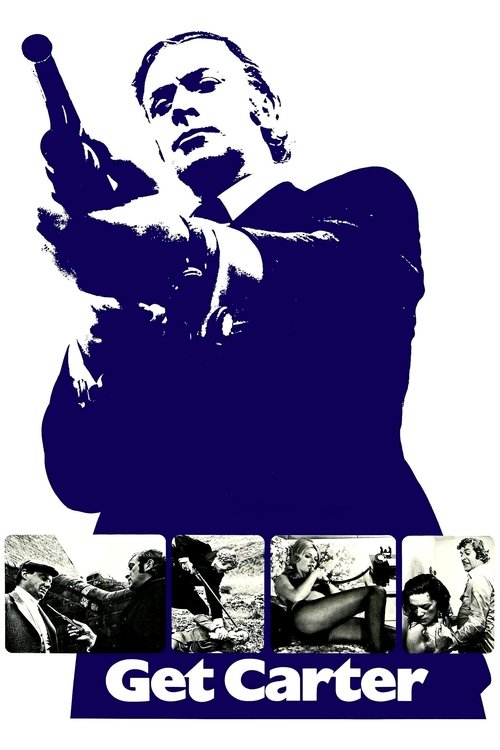
Get Carter
1971 · Mike Hodges
For when you want your crime stories pitch-black and unsentimental — no charm, no redemption, just a man following a thread to the end. Definitely challenge over comfort; save it for a night you're up for something stark.
What it's about
Jack Carter, a London gangster, comes home to Newcastle to bury his brother — and refuses to accept the official story that the death was suicide. Working alone through pubs, betting shops, and the local rackets, he starts turning over rocks that powerful people would rather leave undisturbed. What he finds pulls him into the city's pornography trade and a reckoning he can't walk away from.
The experience
Cold, hard, and mesmerizing — a revenge story stripped of all sentiment, moving with a quiet, methodical menace. It's grim rather than fun, and its bleakness is exactly the point; the chill stays with you.
Performances
Michael Caine, cast brutally against his charming image, gives arguably his most unsparing performance — a killer whose politeness is scarier than most actors' rage.
The craft
Shot on location in Newcastle and Gateshead, the film has a documentary grit rare for its time — real streets, real decay, real weather — framed with a cool, watchful precision that came from director Mike Hodges's background in current-affairs television. The sense of place is so strong the city becomes a character.
Why it matters
Widely regarded as the foundation stone of modern British crime cinema, it replaced the genre's old cheekiness with hardness and grit, and virtually every serious British gangster film since works in its shadow.
Snapshot
Get Carter is the foundational text of modern British crime cinema: a cold, methodical revenge thriller in which a London gangster returns to his native North-East to bury his brother and uncover the truth behind a death the authorities have filed as accident or suicide. Adapted by Mike Hodges from Ted Lewis's 1970 novel Jack's Return Home and headlined by Michael Caine in his most unsentimental performance, the film strips the gangland picture of its earlier whimsy and class-comic charm, replacing it with documentary grit, sexual squalor, and a protagonist whose competence is indistinguishable from cruelty. Shot largely on location in Newcastle upon Tyne and Gateshead, it fuses the investigative eye of British current-affairs television — Hodges's training ground — with the propulsion of the American hardboiled tradition. Coolly received and even morally censured on release, it has since been canonized as one of the greatest of all British films, its imagery (the Gateshead multi-storey car park, the coal-blackened beach at the climax) and its tone of affectless violence shaping crime filmmaking for half a century.
Industry & production
The film was produced by Michael Klinger, a figure who had moved from the disreputable end of the British exhibition and production trade (Soho clubs, the early Polanski features Repulsion and Cul-de-Sac) toward more ambitious commercial fare. It was made for MGM, then operating through its British arm at a moment when the major American studios that had bankrolled the 1960s British boom were retreating; Get Carter sits at the tail end of that Hollywood investment in British production. Michael Caine was by 1970 a major international star coming off The Italian Job and Alfie, and his participation was central to the project's financing and to its conception: Caine has long described his motivation as a desire to show the British gangster as he actually was — brutal, unglamorous — in deliberate reaction against the lovable-rogue tradition.
Mike Hodges was a first-time feature director, hired on the strength of his television work. The shoot was economical and fast, conducted on real Tyneside locations rather than studio sets, which both lowered costs and dictated the film's texture. Precise budget and box-office figures are not something I can state with confidence and I will not invent them; the broad record is that the film performed modestly in its initial release and was regarded as a commercial disappointment relative to its later reputation, gaining its stature through revival and reassessment rather than first-run success.
Technology
Get Carter is a product of conventional 35mm color production of its era, but its technological interest lies in how little it leans on apparatus. Hodges and his cinematographer worked extensively with available and practical light in real interiors — boarding-house bedrooms, pubs, betting parlors, a ferry — rather than the heavily lit studio look that dominated British features of the preceding decade. This reliance on faster color stock and location shooting, increasingly viable by 1970, is what gives the film its drab, true-to-life palette of grays, browns, and weak northern daylight. The handheld and shoulder-mounted camerawork in several sequences draws directly on the lightweight, mobile shooting practices that documentary and television units had refined through the 1960s. There is no technological showmanship here; the innovation is the application of a reportage toolkit to a fiction feature.
Technique
Cinematography
The photography is by Wolfgang Suschitzky, an Austrian-born émigré with deep roots in documentary and still photography. His work on Get Carter is among the most admired aspects of the film. Suschitzky favours a flat, observational frontality and a muted, almost photojournalistic color register that refuses to prettify Tyneside or its people. Exteriors are dominated by industrial geometry — terraced streets, the High Level Bridge, the quayside, the brutalist car park — and the camera frequently treats Carter as a small, dark figure moving through a landscape that dwarfs and ultimately consumes him. Interiors are cramped and unflatteringly lit. The compositions repeatedly isolate Caine, emphasizing both his predatory focus and his alienation from the world he came from.
Editing
The cutting (the editor of record is John Trumper) is patient and controlled rather than flashy, building tension through duration and juxtaposition. The film's most celebrated montage is its pre-credit and opening movement — Carter's train journey north, his face set against the passing country — set to Roy Budd's theme, which establishes rhythm and dread before a word of plot is delivered. Throughout, the editing favours an icy procedural pacing that mirrors Carter's own method: it watches, accumulates, and then strikes.
Mise-en-scène / staging
Hodges stages the film as a kind of fiction-documentary, populating frames with real locations and faces and letting the squalor speak for itself: the seedy boarding house, the pub sing-along, the porn-film screening, the gangster's country house. Violence is staged with a deliberate lack of choreography or relish — abrupt, ugly, often quickly over. The recurring use of vertical industrial spaces (stairwells, the multi-storey car park from which Cliff Brumby is hurled, the towering coal-spoil chute at the close) turns the North-East's working architecture into instruments of death.
Sound
Beyond Roy Budd's score, the soundscape is keyed to realism — regional accents, pub noise, the mechanical din of industry. Dialogue is laconic and clipped, in keeping with Carter's affect. The contrast between the cool electronic-jazz theme and the grim diegetic world is a key source of the film's unsettling tone.
Performance
Caine's performance is the film's engine: watchful, soft-spoken, and frightening precisely because of its restraint. He plays Carter as a man whose charm is a weapon and whose violence is administrative. Around him, Ian Hendry brings bruised menace as Eric Paice; the cast includes Britt Ekland and Geraldine Moffat in sexually charged roles, Bryan Mosley as the doomed Brumby, and — in a piece of inspired casting — the playwright John Osborne as the smooth crime boss Cyril Kinnear, his theatrical authority lending the underworld an unexpected gentility. The supporting playing leans toward naturalism, reinforcing the film's grounded register.
Narrative & dramatic mode
The film is a revenge tragedy in the clothing of a detective story. Carter's investigation supplies the forward motion — interviewing, intimidating, and following leads through his brother Frank's world — but the deeper movement is toward self-destruction. The narrative withholds and then delivers a central obscenity: the discovery that Frank's teenage daughter Doreen has been drawn into a pornographic film, which Carter takes as the explanation and justification for his brother's death. This revelation converts the procedural into a vendetta, and Carter's methodical clearing of the board (Brumby, Kinnear's operation, Margaret, Eric) proceeds with the inevitability of tragedy. The mode is hardboiled and fatalistic: there is no redemption and no restoration of order, only the completion of a killing spree that ends with the killer himself struck down.
Genre & cycle
Get Carter belongs to the gangster/revenge thriller, but it self-consciously breaks from the dominant British strain of crime film. Where earlier British pictures had tended toward either the caper's comic glamour or the Ealing-adjacent moral universe, Hodges imports the bleakness and moral nullity of American noir and hardboiled fiction and grafts it onto a recognizably British provincial setting. It can be read as the British answer to the contemporaneous wave of harder American crime films, and it effectively inaugurates a cycle of grim, regional British gangster pictures. Its near-contemporaries in the early-1970s British crime cycle (Villain, Sitting Target) share its appetite for unsparing violence, but Get Carter became the cycle's defining work.
Authorship & method
The film is the product of a tight creative partnership. Mike Hodges wrote as well as directed, and his authorial signature — investigative coldness, structural control, an interest in institutions and corruption — derives directly from his apprenticeship in current-affairs and arts television (notably investigative-journalism programming and the arts strand on which he worked). He approached the material as a reporter as much as a dramatist, which accounts for the film's documentary surface. Michael Caine functioned as more than star: his conviction about portraying a genuinely vicious working-class gangster shaped the film's ethics and tone. Wolfgang Suschitzky's documentary-trained eye gave the film its distinctive realism, while Roy Budd's score — built around a spare, insistent theme combining harpsichord-like keyboard textures, electric bass and percussion — supplied its cool, modern pulse; Budd's music is itself widely regarded as a landmark of British film scoring. The source author, Ted Lewis, is the often under-acknowledged origin point: his novel Jack's Return Home established the plot, the Northern setting, and the affectless protagonist that Hodges faithfully transposed.
Movement / national cinema
Get Carter stands at a hinge in British cinema. It inherits the location realism and class attention of the British New Wave / "kitchen-sink" films of the late 1950s and 1960s, but it discards their humanism and reformist sympathy. The result is a distinctly British genre cinema that is regional, working-class, and unromantic — a counter-tradition to the metropolitan, often London-centred crime picture. Its commitment to Newcastle and Gateshead as specific, lived-in places (rather than interchangeable urban backdrops) gives it a documentary regionalism that few British features of its moment matched, and it has become inseparable from the cultural image of the North-East.
Era / period
The film is firmly of 1970–71: a moment when the foreign capital that had fueled "Swinging London" filmmaking was withdrawing, when censorship was loosening enough to permit its frank sexual content and graphic violence, and when a broader cultural disillusion had displaced 1960s optimism. Its visible world — industrial decline, brutalist redevelopment, the porn and protection rackets at the margins of a fading economy — registers the early-1970s British mood with unusual acuity. The Tyneside it captures, much of it since demolished, makes the film a near-archival record of a vanished urban landscape.
Themes
The dossier's central concerns are revenge, complicity, and the corruption beneath ordinary surfaces. Carter is no avenging hero; the film insists that he is part of the same criminal economy that destroyed his brother and his niece, and his vendetta is driven as much by wounded proprietorship and rage as by justice. Family, and its betrayal, runs throughout — the ambiguous paternity of Doreen, the squalid exploitation of women, the perversion of kinship into pretext for slaughter. The film is also about place and return: the impossibility of going home, the way Carter's roots both enable his investigation and pull him toward his end. And it is about the pornography of violence itself — the literal pornographic film at the plot's center mirrors the film's own unblinking gaze, implicating the viewer in its appetite for spectacle.
Reception, canon & influence
On release the film drew a divided and frequently hostile critical response; its violence and bleakness offended some reviewers, and it was regarded in some quarters as a coldly amoral exercise. It was not the immediate triumph its later reputation might suggest. Over subsequent decades, however, critical opinion reversed comprehensively. Get Carter came to be ranked among the finest British films ever made, regularly appearing near the top of polls and surveys of British cinema, with Caine's performance and Suschitzky's photography singled out for praise.
The influences on the film run backward to American hardboiled fiction and noir, to Ted Lewis's source novel, and to the location-realist tradition of the British New Wave and of British documentary and investigative television. Its legacy forward is enormous. It established the template for the modern British gangster film and is a clear ancestor of the late-1990s and 2000s wave of British crime cinema — the work of Guy Ritchie and the broader "geezer" genre — even as those films often borrowed its iconography while inverting its grim seriousness into style. Its imagery has become cultural shorthand: the Gateshead "Get Carter" car park became a landmark partly through the film before its demolition, and Roy Budd's theme has had an independent afterlife. A 2000 American remake relocating the story and starring Sylvester Stallone (with a cameo by Caine) is generally regarded as a failure that underscored, by contrast, the specificity and force of the original. Get Carter's deepest influence, though, is tonal: it legitimized a strain of affectless, morally unconsoling violence in popular cinema and proved that a genre thriller could carry the weight of social observation and tragedy.
A Deleuzian reading
A man sits on a train going north.
The full Deleuzian reading of Get Carter →
Reception
British critics in 1971 largely sniffed at it as seedy and gratuitously violent, and it faded fast — but decades of reappraisal turned it into the cornerstone of British crime cinema, landing in the BFI's Top 100 British films and being crowned the greatest British film ever by Total Film in 2004.
How Get Carter was received, from release to now →
Influences: the films it descends from and the films it influenced
- Point Blank (1967) — Supplies the template of an emotionally vacant avenger methodically working his way up a criminal hierarchy — Carter inherits Lee Marvin's affectless relentlessness and the procedural revenge-quest structure.
- Le Samouraï (1967) — Establishes the cool, minimalist professional defined by watchful gesture and diegetic spareness that informs Carter's controlled affect and the film's restrained, music-light surfaces.
- Night and the City (1950) — Location-shot nocturnal noir framing a doomed hustler against real urban architecture — the direct forebear of Suschitzky's figure-in-landscape staging of Carter against Newcastle.
- The Naked City (1948) — Pioneers documentary-style on-location crime shooting and semi-procedural observation, the journalistic surface Hodges and Suschitzky transpose onto the gangster thriller.
- Saturday Night and Sunday Morning (1960) — British New Wave Northern working-class location realism and unsentimental class observation that Hodges imports wholesale into a genre frame.
- This Sporting Life (1963) — Hard Northern industrial location texture and brutal, inarticulate working-class masculinity — the New Wave forebear of the film's grim regional physicality.
- Hell Is a City (1960) — Proves the gritty Northern-English location police thriller with a documentary realist surface before Hodges, modeling regional crime shot among real streets and crowds.
- Underworld U.S.A. (1961) — Tabloid-brutal personal-revenge gangster narrative with cold, affectless violence — the hardboiled ancestor of Get Carter's revenge-tragedy spine.
- The Ipcress File (1965) — Extends Caine's laconic-understatement persona — the watchful, terse professional — from the spy genre into pitiless British noir.
- Brighton Rock (1948) — Suschitzky shoots provincial England as location fact — boarding houses, seafronts, industrial edges — around a protagonist drained of interiority, and Hodges twice converts Brighton Rock's vertiginous drop into structure: the multi-storey car park throw and the terminal coastal ending.
- The Long Good Friday (1980) — The canonical heir: a genre thriller carrying social and political observation through a charismatic working-class crime boss and bursts of affectless brutality.
- The Limey (1999) — Explicit homage — an English working-class avenger (Stamp) methodically ascending a criminal chain, with fractured procedural editing extending Carter's revenge architecture.
- Sexy Beast (2000) — Carries forward the working-class gangster realism punctuated by sudden, unchoreographed brutality and affectless menace that Carter legitimized.
- Dead Man's Shoes (2004) — A Northern-English revenge tragedy of cold, methodical, morally unconsoling violence — direct descendant of Carter's revenge-quest spine and regional location realism.
- Lock, Stock and Two Smoking Barrels (1998) — The 'geezer' heir that borrows Carter's hard-man iconography and argot while inverting its grim seriousness into stylized, comic genre play.
- Gangster No. 1 (2000) — Builds an affectless, brutally cold British gangster ascent on the hardboiled fatalism and unsentimental violence Carter pioneered.
- Croupier (1998) — Hodges' own return to cool, observational, fatalistic genre filmmaking with a watchful detached protagonist, extending the investigative-coldness authorship of Carter.
- Snatch (2000) — Hodges established the handheld intimacy in confined British spaces — narrow stairwells, cramped bedrooms, low-ceilinged pubs — as the cinematographic idiom of the British crime film, and fixed the working-class dialect performance of morally ruthless men as the genre's performance register.
- Layer Cake (2004) — Established the cool, affectless British crime register Vaughn revives — a self-possessed professional moving through grimy underworld locations shot with detached, observational restraint rather than melodrama.
- King of New York (1990) — The cold, procedural gangster who moves through the city dispensing violence with affectless calm — its clinical detachment and editing that snaps from quiet to brutality prefigures Ferrara's languor-to-violence rhythm.
- Mona Lisa (1986) — Founds the British gangland location-naturalism that grounds Jordan's romanticism — real streets, sex trade, and class texture photographed with documentary specificity rather than studio noir.
- A Bittersweet Life (2005) — The implacable, impeccably-dressed enforcer moving through a corrupt organization toward his own annihilation — the doomed-lone-killer arc rendered with chilly composure.
- Performance (1970) — Contemporaneous British underworld picture with genuine class authenticity and real menace, establishing alongside Carter the serious modern British gangster milieu.
- Villain (1971) — Same-year British gangster centered on a vicious working-class boss (Burton), extending the brutal contemporary London-underworld realism in parallel with Carter.
- Le Cercle Rouge (1970) — Hodges deployed in parallel with Melville the lone professional defined entirely by personal honor in a world without moral architecture, using telephoto lenses to observe criminal milieu with emotional detachment, and constructing a fatalistic revenge procedural that ends in the professional's destruction by forces indifferent to his competence.
- The Italian Job (1969) — The contemporaneous Michael Caine British-crime film working the same star and milieu in a harder, unsentimental register — the dark mirror of Croker's swagger.
- The Killers (1964) — Extends the impassive professional executing methodical violence across a cold investigative trek, descending from the hard 1960s crime cinema Marvin's killer fed.
Similar films
- The Long Good Friday (1980) — influence & lineage
- Performance (1970) — influence & lineage
- Point Blank (1967) — influence & lineage
- Out of the Past (1947) — shared sensibility
- The Maltese Falcon (1941) — shared sensibility
- Shaft (1971) — shared sensibility
- Chinatown (1974) — shared sensibility
- The Man from London (2008) — shared sensibility
All the films related to Get Carter →