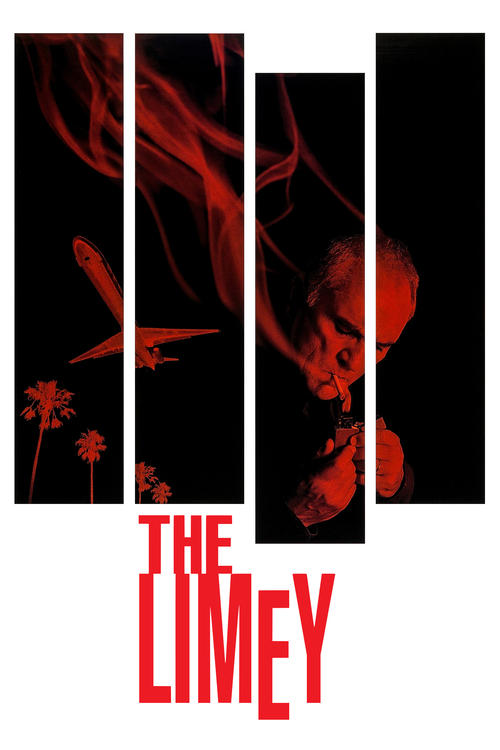
The Limey
1999 · Steven Soderbergh
When you want a lean crime picture with a brain — something stylish you can chew on for days rather than a comfort watch. Ninety-ish minutes, zero fat.
What it's about
Wilson, a flinty English ex-con fresh out of a long prison stretch, flies to Los Angeles to find out how his estranged daughter died. His questions lead toward Terry Valentine, a rich, aging record producer coasting on leftover sixties cool, and the hired muscle keeping Valentine comfortable. It's a revenge mission, but also an old man's reckoning with everything he missed while he was inside.
The experience
Cool, spare, and strange in the best way — scenes splinter and repeat, dialogue drifts across images out of order, so the simple plot feels like memory itself working through grief. Bursts of hard violence punctuate a mood that's more mournful than pulpy.
Performances
Terence Stamp is magnetic as Wilson, all Cockney rhyming slang and coiled menace with real sorrow underneath; Peter Fonda plays Valentine as a man made entirely of borrowed sixties glamour, and the casting of both — icons of that era — is half the film's meaning.
The craft
Soderbergh takes a B-movie revenge plot and rebuilds it through radical elliptical editing: time folds, conversations fragment, and flashbacks to Wilson's youth use actual footage of a young Terence Stamp from a 1960s film. Sun-blasted L.A. photography makes the city look alien through the outsider's eyes. It's a masterclass in how cutting alone can turn genre into elegy.
Why it matters
A landmark of Soderbergh's late-nineties resurgence and a touchstone for anyone interested in how editing can transform a thriller — its reputation has only grown since release.
Snapshot
The Limey is Steven Soderbergh's spare, formally radical revenge thriller, a film whose simple genre armature — an English ex-convict comes to Los Angeles to find out how his daughter died and to punish whoever is responsible — is dismantled and reassembled into a meditation on memory, regret, and the long shadow of the 1960s. Terence Stamp plays Wilson, a hard, laconic Cockney just out of a long stretch in prison, who arrives in a sun-blasted, alien Los Angeles to investigate the death of his estranged daughter Jenny, and whose path leads inexorably toward Terry Valentine (Peter Fonda), a wealthy, aging record producer living off the residue of his counterculture cool. On the page this is a lean B-movie premise; on the screen Soderbergh treats it as an occasion for a sustained experiment in elliptical editing, in which dialogue floats free of the images it accompanies, scenes are intercut with their own pasts and futures, and the whole is suffused with the melancholy of men looking back on lives that did not turn out as promised. The casting of Stamp and Fonda — two icons of 1960s cinema — turns the film into a reckoning with that decade itself, and the inspired use of footage of the young Stamp from Ken Loach's Poor Cow (1967) folds a real cinematic past into Wilson's memory. Commercially modest on release, The Limey has become one of the most admired films of Soderbergh's career and a touchstone for how genre material can be charged with formal daring and emotional depth.
Industry & production
The Limey arrived at a pivotal moment in Steven Soderbergh's career. After his sensational 1989 debut with sex, lies, and videotape, which won the Palme d'Or at Cannes and helped inaugurate the American independent boom of the 1990s, Soderbergh had spent much of the decade in a wilderness of commercially unsuccessful and formally restless work — Kafka, The Underneath, Schizopolis. His comeback had begun the previous year with Out of Sight (1998), the Elmore Leonard adaptation that restored his standing as a director of intelligent, stylish entertainment. The Limey belongs to this resurgent phase, immediately preceding the one-two of Erin Brockovich and Traffic in 2000 that would bring him Oscar success and full industry rehabilitation.
The film was written by Lem Dobbs, a screenwriter with whom Soderbergh had worked on Kafka, and was produced by Scott Kramer and John Hardy. It was financed and released through Artisan Entertainment, the company then enjoying its own moment of visibility after the phenomenon of The Blair Witch Project that same year. As a mid-budget genre picture built around an unconventional lead, The Limey was never positioned as a wide commercial play; it received a limited release and performed modestly at the box office, finding its larger audience subsequently on home video and through the steady accumulation of critical esteem. Precise grosses are not the substance of the film's reputation, and I won't invent figures; what matters is that the picture was a critical success and a commercial also-ran, a pattern that has attended much of Soderbergh's more adventurous work.
The film is also notable for the lasting public friction it generated between director and writer. The DVD audio commentary, in which Soderbergh and Dobbs discuss the film together, became famous for its candor: Dobbs voices considerable frustration at the liberties Soderbergh took with his screenplay, particularly the radical restructuring of the material in the cutting room. That documented disagreement is unusually frank for a commercial release and has become part of the film's lore, illuminating the gap between the conventional revenge script Dobbs wrote and the fractured art film Soderbergh assembled from it.
Technology
The Limey is a 35mm film production of the late 1990s and makes no claim to technological novelty in capture; its innovations are entirely in method and montage rather than apparatus. What is technically salient is the film's commitment to naturalistic location shooting in and around Los Angeles, and its exploitation of the specific quality of Southern Californian light — the hard, flat brightness of the daytime city and the haze of its hills and freeways. The film's most distinctive "technology" is in the editing room: Soderbergh and his editor constructed the picture's elliptical, time-scrambled texture through cutting choices that detach sound from image and rearrange chronology, a procedure that depends on craft and conception rather than on any novel equipment. To claim particular technical innovations beyond this would be invention; the film's radicalism is one of form, not hardware.
Technique
Cinematography
The cinematography is by Ed Lachman, one of the most distinguished American cinematographers of his generation, whose naturalistic instincts give the film its grounded, observational surface even as the editing fragments it. Lachman renders Los Angeles in unglamorous, sunstruck clarity — the city as a place of glass, concrete, freeways, and bleached light, profoundly foreign to the gray England that Wilson carries inside him. The photography distinguishes registers: the present-tense Los Angeles material is bright and exposed, while the inserted memories and the Poor Cow footage carry the grain and warmth of an irretrievable past. The handheld, watchful camera often holds on Stamp's weathered face, and the film repeatedly frames Wilson as a solitary, out-of-place figure dwarfed by the horizontal sprawl of the city. Lachman's restraint is essential to the film's balance: the imagery itself is sober and concrete, which allows the editing's temporal play to register as the operation of a remembering mind rather than as mere stylistic flourish.
Editing
Editing is The Limey's defining achievement and the locus of its authorship. Working with editor Sarah Flack, Soderbergh constructed the film as an associative, non-linear weave in which time is treated as fluid and subjective. Dialogue from one moment plays over images from another; conversations are heard as voice-over across scenes that precede or follow them; a single exchange may be intercut with its own aftermath or with fragments of memory. The effect is to render the film as if from inside Wilson's grief-saturated consciousness, where past and present coexist and the dead daughter is always present. Soderbergh has spoken of his debt to the modernist editing of the European art cinema, and the film is frequently and rightly compared to the temporal experiments of Alain Resnais, whose Last Year at Marienbad and Hiroshima mon amour pioneered exactly this kind of subjective, memory-driven montage. The crucial point is that this radical form was largely arrived at in the cutting room, transforming Dobbs's more linear script — the source of the writer's documented unhappiness — into something closer to a tone poem on loss. The editing is not decoration; it is the film's argument about how memory and regret actually work.
Mise-en-scène / staging
The staging draws a sustained contrast between Wilson and the world he has entered. Wilson, in his plain dark clothes and contained, coiled physicality, is a figure of old-world criminal hardness set against the soft, sunlit affluence of Valentine's Los Angeles — the modernist house cantilevered over a canyon, the parties, the music-industry sheen. Terry Valentine's environment is one of tasteful wealth purchased with the cultural capital of the 1960s, and the production design makes his home a glass display case of a man who has monetized his own youth. Against this stand the grittier spaces of Wilson's investigation: warehouses, a garment-district sweatshop, the criminal undersides of the city. The film's most famous staging gesture is its handling of violence: in one celebrated sequence, Wilson walks into a warehouse, the camera stays outside, gunfire is heard, and he walks back out — the carnage withheld, the man's lethal competence conveyed by ellipsis rather than display. This economy is of a piece with the film's whole method, which prefers implication to spectacle.
Sound
Sound is inseparable from the editing in The Limey, because so much of the film's structure consists of dislocated voices — lines of dialogue lifted out of their scenes and laid across other images, so that speech becomes a kind of memory or premonition rather than synchronous exchange. This desynchronization of voice and image is the film's signature sonic device. The score is by Cliff Martinez, Soderbergh's regular composer, whose spare, ambient, electronic textures supply an undertow of melancholy and unease without underlining the action; Martinez's music is atmospheric rather than dramatic, a wash of feeling consistent with the film's interior, remembering mode. Period popular music is also deployed pointedly, evoking the 1960s milieu that both Wilson and Valentine carry with them. The overall sound design favors a contemplative, slightly hallucinatory register that supports the film's treatment of time as subjective and porous.
Performance
Performance anchors the film's formal adventurousness in human weight. Terence Stamp gives one of the defining performances of his later career as Wilson: a study in stillness and contained menace, his hard blue stare and clipped Cockney delivery — laced with rhyming slang that baffles the Americans around him — conveying a lifetime of violence and a grief he can barely articulate. Stamp makes Wilson both frightening and bereft, a man whose code of vengeance is also a desperate attempt to mean something to a daughter he failed. Peter Fonda is his perfect counterweight as Terry Valentine: charming, weak, evasive, a man who has coasted on the glamour of the 1960s and curdled into something hollow and corrupt. The pairing is itself a piece of meta-casting — two faces of 1960s cinema set against each other decades on — and both actors play with full awareness of what their presence signifies. The supporting ensemble is strong and texturing: Luis Guzmán as Eduardo, the wary friend who helps Wilson; Lesley Ann Warren as Elaine, an actress who knew Jenny and supplies the film's notes of tenderness; Barry Newman as Valentine's hard-edged head of security; and Nicky Katt and Joe Dallesandro — another 1960s underground icon — in further roles that thicken the film's web of period resonance.
Narrative & dramatic mode
The Limey's dramatic mode is the revenge thriller turned inside out — the genre's forward-driving machinery of investigation and retribution suspended in a reflective, elegiac frame. The plot is elemental: a father seeks the truth of his daughter's death and moves to avenge it. But Soderbergh refuses the genre's usual momentum, continually interrupting the present with memory and anticipation so that the film feels less like a chase than like a man turning his loss over and over in his mind. The true subject is not whether Wilson will reach Valentine but what Wilson is reckoning with along the way: his absence as a father, the years lost to prison, the irrecoverability of the daughter he is too late to know. The narrative's emotional climax, when it comes, deliberately deflates the expected cathartic violence of the revenge form, substituting recognition and exhaustion for triumph. This is a tragedy of belatedness in genre clothing, and its power comes from the friction between the brutal simplicity of its plot and the complexity of feeling Soderbergh's form wraps around it.
Genre & cycle
The film is a neo-noir revenge thriller, and it participates knowingly in several traditions at once. Its premise — a hardened English criminal loose in an alien America — recalls the transatlantic crime cinema of the late 1960s and 1970s, and the film is frequently and pointedly linked to John Boorman's Point Blank (1967), another fractured, time-bending revenge picture about a single-minded man cutting through a corrupt criminal-corporate world; The Limey can be read as a conscious homage to and reworking of Boorman's film. It also belongs to the broader cycle of art-inflected American genre filmmaking of the late 1990s, in which directors used the revenge or crime template as a vehicle for formal experiment. And through its casting it joins a particular strain of films that mine the iconography of the 1960s for elegiac purposes, turning the faces and music of that decade into a commentary on aging, disillusion, and the commercialization of rebellion. Within Soderbergh's own filmography it sits among his most personal and experimental works, a counterpart to the slicker Out of Sight and a precursor to the formal restlessness that runs throughout his later career.
Authorship & method
The Limey is unmistakably a Steven Soderbergh film, and it crystallizes his characteristic method: taking genre material and subjecting it to formal reinvention, particularly through editing and the manipulation of time. Soderbergh — who has often operated as his own cinematographer and editor under pseudonyms on later projects — is fundamentally a montage-driven filmmaker, and The Limey is among the purest demonstrations of his belief that a film's meaning is made in the assembly. The decisive creative act here was the transformation of Lem Dobbs's linear revenge screenplay into an elliptical, memory-structured collage, a reworking that occurred substantially in postproduction and that, by the writer's own documented account on the DVD commentary, departed sharply from his intentions. The film thus stands as a vivid case study in the tension between screenwriting and directorial authorship.
The key collaborators each contributed decisively. Cinematographer Ed Lachman supplied the grounded, sunstruck naturalism that keeps the film's experiments legible and felt. Editor Sarah Flack executed and helped shape the temporal weave that is the film's signature. Composer Cliff Martinez provided the ambient, melancholic score that is inseparable from the film's reflective mood. And screenwriter Lem Dobbs furnished the spare, hard-boiled architecture and dialogue without which there would be nothing for Soderbergh to deconstruct. Above all, the film's authorship is a collaboration between director and his two lead actors, whose iconic histories Soderbergh treats as raw material: the meaning of The Limey is bound up with who Terence Stamp and Peter Fonda are, and the inspired importation of the young Stamp from Poor Cow makes the actor's own cinematic past into the film's text.
Movement / national cinema
The Limey is a product of American independent and specialty cinema at the turn of the millennium, made by the filmmaker most identified with the 1990s indie movement that sex, lies, and videotape had helped launch. Yet its aesthetic allegiances are transatlantic and historically deep: the film consciously draws on European modernist cinema — the memory-montage of Alain Resnais above all — and on the international art-genre crossovers of the late 1960s, exemplified by Boorman's Point Blank. Its very subject is partly transnational, built on the collision between an English criminal and the American city, and its casting reaches back to the British and American cinema of the 1960s through Stamp and Fonda. The film is thus best understood not as an expression of a national school but as a knowing synthesis: an American independent director importing the techniques of European art cinema and the iconography of 1960s English and American film into a contemporary Los Angeles genre picture.
Era / period
The film is set in the present of the late 1990s, but it is haunted throughout by the 1960s, and that doubled temporality is its essential condition. Wilson and Valentine are both men of that earlier decade — Wilson's youth glimpsed in the Poor Cow footage, Valentine's identity built entirely on his role in the era's music culture — and the film is, at its core, about what became of the 1960s and the people who lived it. Valentine embodies the decade's co-optation and decay: the counterculture impresario aged into a wealthy, compromised, frightened man, his idealism long since converted into real estate and self-preservation. The contemporary Los Angeles of the film, with its music-industry money and sunlit affluence, is the landscape on which that betrayal has played out. The film's elegiac charge comes precisely from this distance between the 1960s as promise and the late 1990s as aftermath, a reckoning the casting makes literal and personal.
Themes
The governing theme of The Limey is memory and irrecoverable time — the way grief collapses past and present, and the way a life is reckoned too late. Wilson's quest is propelled by vengeance but powered by remorse: he is a father seeking to do something for a daughter he can no longer reach, and the film's fractured form is the formal expression of a mind that cannot stop returning to what is lost. Around this orbit several interlocking concerns. There is the theme of fatherhood and failure — Wilson's absence, his imprisonment, the years he cannot give back. There is the theme of the 1960s and its disillusion, the decade's idealism curdled into Valentine's hollow wealth and corruption, a generational reckoning made flesh by Stamp and Fonda. There is the theme of displacement and foreignness — the Englishman adrift in Los Angeles, his very language a barrier, a stranger in a landscape that cannot accommodate his old-world hardness. And there is the film's quiet interrogation of revenge itself: the genre promises that violence will resolve grief, and The Limey gently, devastatingly suggests that it cannot. Beneath all of it runs an unsentimental tenderness toward men who have wasted their lives and arrived too late at understanding.
Reception, canon & influence
The Limey was received warmly by critics on its 1999 release, who singled out Terence Stamp's commanding performance, Soderbergh's audacious editing, and the resonant pairing of Stamp and Fonda; the film's commercial performance was modest, in keeping with its specialized profile, but its critical standing has only grown in the years since. It is now widely regarded as one of Soderbergh's finest and most distinctive films, a key work of his late-1990s resurgence, and a frequently cited example of how editing can transform genre material into something formally and emotionally complex. Stamp's Wilson is routinely counted among the great performances of his long career, and the film has acquired a durable cult and critical following.
Influences on the film run backward to several clear sources: the time-fractured revenge cinema of John Boorman's Point Blank (1967); the subjective memory-montage of Alain Resnais and the European modernist tradition that Soderbergh has acknowledged; the hard-boiled crime fiction underlying Lem Dobbs's screenplay; and, most literally, Ken Loach's Poor Cow (1967), whose footage of the young Terence Stamp Soderbergh repurposed as Wilson's memories, making one film's past the raw material of another's. The casting of Stamp, Fonda, and Joe Dallesandro draws deliberately on the meanings these performers accrued in 1960s cinema.
Its influence forward is felt first within Soderbergh's own work, where the film's confidence in elliptical, time-bending construction anticipates the formal experimentation that runs through his later filmography. More broadly, The Limey became a reference point for filmmakers and critics interested in how nonlinear editing and sound-image dislocation can deepen a conventional genre story, and it is regularly invoked in discussions of the late-1990s vogue for fractured narrative. It also stands as a model of generative meta-casting — of building a film's meaning out of its actors' own cinematic histories. Its most lasting legacy may simply be as a demonstration, much studied by editors and directors, that the revenge thriller, that most mechanical of forms, can be remade into an elegy.
A Deleuzian reading
There's a face in *The Limey* that doesn't belong to it.
The full Deleuzian reading of The Limey →
Reception
A box-office blip in 1999 (it grossed barely $3M) with respectful-but-muted reviews, it's since climbed into the top tier of Soderbergh's filmography — now routinely called one of his very best and a high-water mark for the '90s revenge picture.
How The Limey was received, from release to now →
Influences: the films it descends from and the films it influenced
- Point Blank (1967) — The acknowledged structural template: fractures a linear revenge plot into subjective flash-cuts, letting a near-somnambulant avenger drift through architecturally cold spaces propelled by memory rather than chronology.
- Poor Cow (1967) — Literal raw material — Soderbergh lifted Loach's documentary-grained 1967 footage of the young Terence Stamp and reinserted it as Wilson's own remembered past, making one film's image-bank the memory-track of another.
- Hiroshima mon amour (1959) — Founding model for the subjective memory-montage Soderbergh acknowledges: present-tense images involuntarily interrupted by the past, with voice-over decoupled and floated free of the frame it ostensibly accompanies.
- Last Year at Marienbad (1961) — Source of the technique of repeating and contradicting a fragment across the cut, and of letting spoken dialogue play over images from a different moment — the sound-image dislocation that organizes The Limey.
- The Pawnbroker (1964) — Pioneered the subliminal flash-cut — frames of traumatic memory spliced into the present for a fraction of a second — the grammar Sarah Flack's edit uses to render Wilson's grief as intrusion.
- Petulia (1968) — Splinters a present-tense drama with unsignaled flash-forwards and flashbacks (shot by Nicolas Roeg), demonstrating that fractured assembly could deepen character interiority rather than just signal trauma.
- Performance (1970) — Associative, match-on-meaning editing that fuses gangland menace with dissolving identity — the British-crime-meets-art-montage hybrid The Limey extends, plus the 60s underworld iconography.
- Get Carter (1971) — Supplies the spare hard-boiled architecture beneath Lem Dobbs's script: the laconic, implacable English avenger arriving as a foreign body in hostile territory to settle a death.
- Don't Look Now (1973) — Elliptical premonitory cross-cutting and sound bridges that scramble before/after into a single grief-saturated continuum — the elegiac-fracture register The Limey adopts wholesale.
- Out of Sight (1998) — Immediate companion experiment: Anne V. Coates's freeze-frames and time-shuffled flash-forwards apply the same elliptical playfulness to genre, alongside the cool meta-casting of iconic stars.
- Get Shorty (1995) — Extends the post-Get Shorty/Out of Sight strain of cool-criminal cinema with fractured, beat-driven editing and a charismatic stillness in the lead, carrying forward 'cool as a form of power.'
- sex, lies, and videotape (1989) — Soderbergh's self-editing pushed to its formal extreme, fracturing conversation across time so that editorial rhythm, not plot, carries the drama — the debut's editing instinct radicalized.
- Solaris (2002) — Direct descendant of the method: Cliff Martinez's ambient score over an elliptical memory-collage reconstructing a lost partner, grief edited as non-linear recurrence rather than narrated flashback.
- 21 Grams (2003) — Shatters a grief-and-vengeance melodrama into deliberately disordered shards, extending The Limey's proof that nonlinear assembly can intensify a genre story's emotional charge.
- Drive (2011) — Inherits the Cliff Martinez ambient-melancholic score laid over neo-noir, and the staging of revenge as elegy where violence arrives by ellipsis and silence rather than spectacle.
- Traffic (2000) — Soderbergh's immediately preceding film, which he also shot himself under the Peter Andrews pseudonym, was the laboratory for fragmented non-linear editing and available-light handheld intimacy; Traffic systematizes that approach into the per-strand color-differentiation architecture at larger scale.
- Confessions of a Dangerous Mind (2002) — Time-fractured associative editing, with dialogue and sound sliding across temporal planes, is the Soderbergh-school grammar Clooney imports wholesale.
- Ocean's Eleven (2001) — Pushes the time-scrambled grammar — dialogue laid over non-matching images, scenes replayed out of order — that becomes the con-concealing montage method here.
- Contagion (2011) — Soderbergh's elliptical, time-fractured cutting that trusts the viewer to assemble chronology — the nonlinear-editing instinct behind Contagion's timeline jumps and its closing Day-1 origin reveal.
- Che: Part Two (2008) — Soderbergh's own laboratory for the circular cut: a film that ends by returning to an image already seen and re-reading it, the editorial move he reserves for Che's final shift to the captive's POV and the boat sailing away from Cuba.
- The Underneath (1995) — Soderbergh's earlier time-fractured neo-noir, an explicit rehearsal in cross-cutting timelines and color-coded temporality that he then perfected as pure memory-collage in The Limey.
- Jackie Brown (1997) — Parallel act of generative meta-casting — building meaning from Pam Grier's and Robert Forster's 70s screen histories — to turn a mechanical crime story into a melancholy elegy for aging.
- Memento (2000) — Contemporaneous reordering of a revenge thriller — its reversed structure making memory itself the plot mechanism — part of the same late-90s/2000 fractured-narrative moment The Limey crystallized.
- Snatch (2000) — Soderbergh's fragmented editing — intercutting present and past within single dialogue scenes, disorienting chronological sequence through purely editorial means rather than title cards — represents an independent parallel solution to the non-linear crime narrative problem Ritchie was working simultaneously.
- Spy Game (2001) — Shares the turn-of-millennium vogue for cutting memory as associative, fragmentary flashback rather than linear exposition — chronology shattered and reassembled emotionally.
- Layer Cake (2004) — Parallel neo-noir that grafts a British criminal onto fractured, elliptical editing and existential cool, sharing Layer Cake's surface-glossed treatment of the genre's hardman archetype.
- Ocean's Twelve (2004) — Sibling experiment in associative, radically elided cutting where dialogue floats free of its image; the structural cousin to Twelve's elided-heist editing.
- Go (1999) — Pushes the same-year crime film toward associative, time-scrambled editing — cutting dialogue against displaced images of other moments — extending the cycle's faith in the cut as the primary storytelling instrument.
Similar films
- Point Blank (1967) — influence & lineage · often watched together
- Out of Sight (1998) — influence & lineage · often watched together
- Memento (2000) — influence & lineage
- sex, lies, and videotape (1989) — often watched together
- Black Bag (2025) — often watched together
- Traffic (2000) — shared sensibility
- Kiss Me Deadly (1955) — shared sensibility
- Blow-Up (1966) — shared sensibility