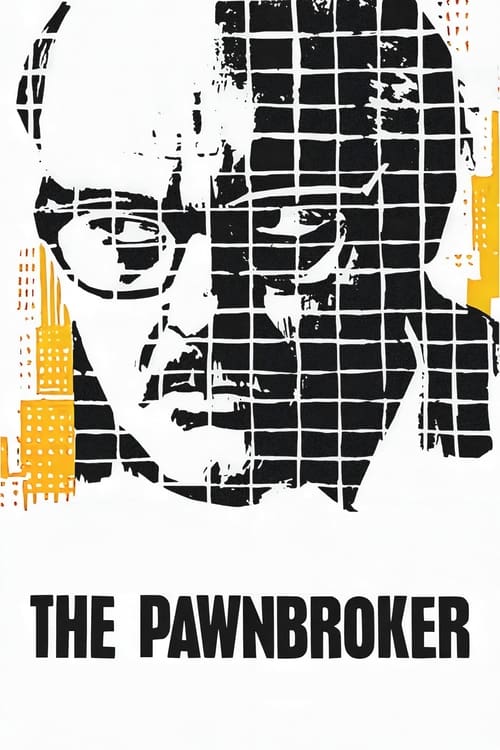
The Pawnbroker
1965 · Sidney Lumet
For when you want to be shaken, not soothed — a serious, demanding film to sit with and talk about after. Definitely challenge, not comfort.
What it's about
Sol Nazerman survived a Nazi camp that took his wife and children; twenty years on, he runs a pawnshop in Spanish Harlem, sealed off behind the counter's cage, treating everyone who enters with the same numb contempt. As the anniversary of his family's death approaches, the memories he has walled out begin forcing their way back in, and the neighborhood around his shop refuses to stay at arm's length.
The experience
Harsh, jagged, and emotionally punishing in the way it means to be — memory keeps ambushing both Sol and you in sudden flashes. It's a film about numbness that refuses to let you stay numb.
Performances
Rod Steiger's Sol is one of the towering performances of the 1960s: a man playing deadness itself, so that every hairline crack in the armor lands like an explosion.
The craft
Sidney Lumet and editor Ralph Rosenblum pioneered the subliminal flash-cut — memory intruding in bursts of a few frames before you can brace for it — a technique that changed how movies show trauma. Boris Kaufman's stark black-and-white New York and a young Quincy Jones's jazz score complete one of the most formally daring American films of its decade.
Why it matters
One of the first American films to confront the Holocaust through a survivor's consciousness, and a landmark that helped break the Production Code's grip; its flash-cut editing echoes through decades of films about memory and trauma.
Snapshot
The Pawnbroker is one of the first American films to confront the Holocaust directly through the consciousness of a survivor, and it remains among the most formally radical Hollywood pictures of its decade. Adapted from Edward Lewis Wallant's 1961 novel, it follows Sol Nazerman (Rod Steiger), a former professor who survived a Nazi camp that killed his wife and children, and who now runs a pawnshop in Spanish Harlem as a numbed, contemptuous man insulated against feeling. Across a few days marked by the approaching anniversary of his family's death, intrusive memories break through his defenses until a final act of violence in the shop forces him back into the pain of being human. Directed by Sidney Lumet at the height of his early New York period, shot by Boris Kaufman, scored by a young Quincy Jones, and cut by Ralph Rosenblum, the film is remembered both for Steiger's lacerating central performance and for a flash-cutting technique that imported European modernism into American narrative cinema. It is also a landmark in the collapse of the Production Code, having secured a seal despite scenes of nudity that the Code formally prohibited.
Industry & production
The film was an independent production assembled outside the major studios, produced by Roger Lewis and Philip Langner under the aegis of Ely Landau's production operation, with the Landau organization central to financing and packaging. This places it within the early-1960s ecology of New York–based independent filmmaking that operated in parallel to, and increasingly in tension with, Hollywood's studio system — a milieu Lumet himself had helped define since 12 Angry Men (1957). Shooting took place largely on location in New York City, in and around Harlem and other recognizable Manhattan settings, a choice consistent with the era's move toward authentic urban exteriors and away from soundstage reconstruction.
The film's most consequential industrial legacy concerns censorship. The Pawnbroker contains brief scenes of bare-breasted nudity — most pointedly in a moment where a Black woman exposes herself to Nazerman, triggering a flashback to his wife's sexual humiliation in the camp. The Production Code Administration initially refused its seal of approval. On appeal, the Motion Picture Association granted an exception on the grounds that the nudity was integral to the film's serious dramatic purpose rather than exploitative. The decision is widely cited by historians as a precedent-setting crack in the Code's authority, part of the chain of erosions that culminated in the Code's replacement by the MPAA rating system in 1968. The exact release chronology reflects this fraught path: the film premiered and circulated in 1964 (including a festival showing) before its wider American release in 1965, the date by which it is most commonly cataloged.
Technology
Technologically, The Pawnbroker belongs to the black-and-white, location-shot idiom of mid-1960s American realism rather than to any frontier of equipment. It was photographed in monochrome at a moment when color was becoming the commercial default, a choice that reads as deliberately austere and aligned with the documentary-inflected seriousness of the subject. The decisive technical dimension of the film is not its capture but its assembly: the editing exploits the basic capacity of the medium to juxtapose extremely short shots — sometimes only a few frames — to simulate involuntary memory. This is a technique of montage rather than of apparatus, and its novelty in an American studio-adjacent feature is what makes the film technically notable. Location sound and the integration of a jazz-oriented score round out a production that drew its force from method and craft rather than from any new machinery.
Technique
Cinematography
Boris Kaufman's black-and-white photography is fundamental to the film's authority. Kaufman — who had shot Jean Vigo's L'Atalante and Zéro de conduite in France, and who won an Academy Award for On the Waterfront (1954) — brought a European pedigree (he was a brother of the Soviet filmmaker Dziga Vertov) and a long collaboration with Lumet to the project. His images render the pawnshop as a literal cage: the camera repeatedly frames Nazerman behind the wire mesh and bars of the shop, visually equating the ghetto storefront with the camp behind it. Harlem exteriors are observed with an unsentimental, near-documentary directness, while the interiors are claustrophobic and graphite-toned. The cinematography's restraint is purposeful, supplying a stable, watchful surface against which the film's editorial ruptures register all the more violently.
Editing
Ralph Rosenblum's editing is the film's signature achievement and its most-imitated feature. Drawing on the precedent of Alain Resnais — whose Hiroshima mon amour (1959) had used the interpenetration of present and remembered time — Rosenblum built a system of "flash cuts": fragments of camp memory inserted at first for only a handful of frames, almost subliminally, then extended and repeated until they bloom into sustained flashbacks. The technique mimics the structure of traumatic intrusion, in which the past erupts unbidden and accelerates beyond the survivor's control. The famous subway sequence, in which the lurching of a present-day train summons the memory of a cattle car, exemplifies the method. Rosenblum later discussed the construction of these sequences in his memoir When the Shooting Stops... The Cutting Begins, and the film is routinely credited with naturalizing this modernist montage strategy for American narrative cinema.
Mise-en-scène / staging
Lumet stages the film around enclosure and proximity. The pawnshop is a pressurized chamber where supplicants press objects and stories across the counter at Nazerman, and the blocking continually traps Steiger within frames-within-frames — grilles, bars, the cashier's cage. The human geography of the surrounding neighborhood, the petty criminals and desperate customers, is staged as a continuous siege on Nazerman's deliberately maintained indifference. The film's controlling visual idea is the rhyme between two systems of confinement, the Nazi camp and the American ghetto, and Lumet's staging keeps that analogy present without ever stating it as a thesis.
Sound
Quincy Jones's score is among the earliest major Hollywood assignments for the composer, and an important credit in the slow integration of Black musicians into film scoring. The music is jazz-inflected and urban, binding the film to its Harlem setting while modulating toward something colder and more interior in the memory passages. Beyond the score, the film's sound design participates in the flashback architecture: aural cues — a sound in the present matched to a sound in the past — frequently act as the bridge that triggers Rosenblum's visual cuts, so that hearing and seeing collaborate in the mechanics of involuntary recall.
Performance
Rod Steiger's Sol Nazerman is the film's center of gravity and one of the defining performances of American screen acting in the 1960s. Trained in the Method milieu, Steiger plays numbness as an active, effortful suppression rather than mere flatness — a man working continuously to feel nothing, so that each crack in the surface costs him visibly. The performance earned an Academy Award nomination for Best Actor and, earlier, recognition at the Berlin International Film Festival, where Steiger was honored. The supporting cast deepens the film's moral field: Jaime Sánchez as Jesus Ortiz, the young Puerto Rican assistant who wants Nazerman as a mentor; Brock Peters as the gangster Rodriguez whose money underwrites the shop; Geraldine Fitzgerald as Marilyn Birchfield, a social worker who tries to reach Nazerman; and Thelma Oliver and Linda Geiser in the roles bound up with the film's contested nudity.
Narrative & dramatic mode
The film operates in a mode of psychological realism continually fractured by subjective interruption. Its present-tense story is small and almost anti-dramatic — a few days in a pawnshop, a mounting series of pressures — but its true action unfolds in the collision between that present and the eruptive past. The narrative withholds the full content of Nazerman's memories at first, doling them out in escalating fragments so that the audience reconstructs the catastrophe at roughly the pace that Nazerman is forced to re-experience it. This is a dramaturgy of breakdown rather than of plot: the question is not what will happen but whether Nazerman's defenses will hold, and at what cost they break. The climax — in which Ortiz is killed shielding Nazerman during a robbery, and Nazerman impales his hand on the receipt spike — converts the film's accumulated numbness into a single image of pain reclaimed, a deliberately stigmata-like gesture that returns him, agonizingly, to the human community he had renounced.
Genre & cycle
Nominally a drama, The Pawnbroker sits at the intersection of several cycles. It belongs to the strain of socially serious, location-shot New York realism that Lumet pioneered, and to the broader mid-century tradition of the "problem picture." More importantly, it is a foundational entry in the cinema of the Holocaust — specifically the cinema of survival and aftermath, as distinct from films depicting the camps directly. By placing a survivor inside ordinary American life and dramatizing the persistence of trauma years later and an ocean away, it helped establish a template that later survivor narratives would follow. It also participates, through its Harlem setting and its triangulation of Jewish, Black, and Puerto Rican experience, in the era's reckoning with American racial and economic injustice.
Authorship & method
The dossier's authorship belongs first to Lumet, whose method — forged in live television and the New York theater — favored intensive rehearsal, location authenticity, and performance as the primary engine of meaning. Lumet's recurrent preoccupations, with conscience, institutional pressure, and the moral isolation of the individual, are all legible here. He worked, crucially, with a team of frequent or formidable collaborators. The screenplay, by Morton S. Fine and David Friedkin, adapts Wallant's novel, preserving its central conceit of memory's intrusion while translating its interiority into cinematic terms. Boris Kaufman's cinematography and Ralph Rosenblum's editing were not merely executional but constitutive of the film's design — Rosenblum's flash-cutting in particular is arguably co-authorial, since the film's meaning is produced at the cut. Quincy Jones's score completes the collaborative signature. The film is thus best understood as the convergence of a director's moral seriousness with an editor's formal invention and a cinematographer's disciplined eye.
Movement / national cinema
The film is an American work decisively shaped by European modernism. Its national identity is rooted in the New York independent and realist tradition, but its formal vocabulary is borrowed from the French and broader European art cinema of the late 1950s — above all Resnais's investigation of memory and time. The Pawnbroker can be read as a hinge between two cinemas: it carries the social-realist DNA of postwar American drama while absorbing the temporal experimentation of the European New Waves, and in doing so it helped prepare American audiences and filmmakers for the more fragmented, subjective storytelling that would flourish later in the decade and into the New Hollywood.
Era / period
Arriving in 1965, the film stands at a threshold. The Production Code was visibly failing, the studio system was contracting, and independent New York production was ascendant; The Pawnbroker's censorship battle was itself one of the events that pushed the industry toward the 1968 rating system. Culturally, it appeared as American consciousness of the Holocaust was deepening — the Eichmann trial had concluded only a few years earlier — and as the civil rights movement made the film's Harlem setting and its cross-racial moral economy urgently contemporary. The film belongs unmistakably to this transitional mid-1960s moment, formally adventurous, socially engaged, and institutionally disruptive.
Themes
The film's governing theme is the survival of trauma and the moral cost of psychic anesthesia. Nazerman has chosen numbness as a strategy of survival, reducing the world to commerce and treating every human appeal as a transaction; the film asks whether such self-protection is itself a kind of death. Bound to this is the theme of complicity and money: the pawnshop launders the proceeds of exploitation, and Nazerman's deliberate refusal to know the source of his security implicates him in the very systems of dehumanization he survived. The persistent visual analogy between camp and ghetto raises the film's most provocative and debated idea — the continuity of oppression across history and geography, and the danger of a survivor becoming indifferent to the suffering of others. Finally, the climactic stigmata image foregrounds a theme of redemptive pain: the recovery of feeling, however unbearable, as the precondition of remaining human.
Reception, canon & influence
Critically, The Pawnbroker was received as a serious and formally daring work, with Steiger's performance singled out for sustained praise; his Best Actor Academy Award nomination and his Berlin Festival recognition mark the high points of its institutional reception. The film has since been absorbed into the canon on three grounds: as a milestone in Holocaust cinema, as a landmark in the dismantling of the Production Code, and as a showcase for an editing technique that altered the grammar of American film.
Its influences run backward to Wallant's source novel and, formally, to Resnais and the European art cinema's treatment of memory and time, filtered through Lumet's and Rosenblum's sensibilities and Boris Kaufman's long apprenticeship in both French and American traditions. Its forward legacy is substantial. The flash-cut representation of intrusive memory became a widely adopted convention for depicting trauma and recollection on screen, and Rosenblum's account of building those sequences became a touchstone of editing pedagogy. As one of the earliest American films to dramatize a survivor's continuing inner catastrophe, it helped license the later, larger body of Holocaust-aftermath cinema. And as the test case that won a Production Code seal despite prohibited content, it occupies a permanent place in the institutional history that led to the modern rating system. The film's enduring reputation rests on this rare convergence: a work that is at once a major performance piece, a formal innovation, and an industrial turning point.
A Deleuzian reading
Watch where Lumet puts the wire.
The full Deleuzian reading of The Pawnbroker →
Reception
A sensation in 1965 — Rod Steiger's performance was hailed as a career peak and the film felt shockingly adult for Hollywood — and today it's honored (National Film Registry, 2008) as a pioneer of American films about Holocaust survivors, even if some now find its symbolism heavy-handed.
How The Pawnbroker was received, from release to now →
Influences: the films it descends from and the films it influenced
- L'Atalante (1934) — Kaufman's formative cinematography for Vigo trained the poetic, water-and-light location monochrome and the lyrical handling of confined interiors that resurface in his framing for Lumet.
- Battleship Potemkin (1925) — Lumet and editor Ralph Rosenblum's flash-cut intrusions of Holocaust memory into the Harlem present transplant Eisenstein's dialectical collision principle into psychological trauma — involuntary montage as cognitive shock — extracting the stone-lions figure from political rhetoric and re-embedding it as the topology of involuntary recall.
- Schindler's List (1993) — Beyond reviving location monochrome for the subject, it stands on the license The Pawnbroker won — the first American film to dramatize the Holocaust's continuing inner catastrophe — for serious Holocaust cinema.
- In the Heat of the Night (1967) — Quincy Jones's score directly continues his Pawnbroker approach — jazz-rooted, source-blurring scoring threaded through a socially charged American drama.
- The Exorcist (1973) — Lumet pioneered subliminal single-frame flash cuts in American mainstream cinema as a technique for intrusive psychological violation of the narrative surface, which Friedkin directly weaponizes for horror by splicing the Captain Howdy demon face below the viewer's conscious notice.
- The Night Porter (1974) — Pioneered subliminal flash-frame intrusions of concentration-camp memory into the present, the editing device Cavani's associative montage extends into a love story.
- Equus (1977) — Source of Lumet's subliminal flash-cut flashback grammar — traumatic memory intruding in accelerating bursts — which returns as the editing strategy of Equus's blinding climax.
- The Limey (1999) — Pioneered the subliminal flash-cut — frames of traumatic memory spliced into the present for a fraction of a second — the grammar Sarah Flack's edit uses to render Wilson's grief as intrusion.
- Slaughterhouse-Five (1972) — Introduced subliminal flash-frame intrusions of concentration-camp trauma erupting into the present, the associative-cut vocabulary of post-traumatic memory the film inherits wholesale.
- They Shoot Horses, Don't They? (1969) — Pioneers the subliminal flash-cut intrusion — momentary images puncturing the present — the editing grammar Fredric Steinkamp redeploys as the film's flash-forward dread.
- Lenny (1974) — Ralph Rosenblum's subliminal flash-cuts — memory intruding in frames-long bursts with no optical marking of the transition — established the American grammar for the unsignposted associative intercut Alan Heim uses to collide bit, bust, and testimony.
- Hiroshima mon amour (1959) — The brief, involuntary inserts of past horror that puncture a present-tense scene — memory cutting in as a flash rather than a dissolve — is the editing grammar Lumet and Rosenblum directly adapted for Nazerman's recollections.
- Night and Fog (1955) — Resnais's montage strategy of cross-cutting the camp's present emptiness against archival atrocity established the camp/aftermath juxtaposition that The Pawnbroker internalizes inside one survivor's mind.
- October: Ten Days That Shook the World (1928) — Eisenstein's intellectual montage and theory of meaning-produced-at-the-cut, including near-subliminal single-frame collisions, is the theoretical ancestor of Rosenblum's escalating flash-frame technique.
- On the Waterfront (1954) — Shot by Boris Kaufman, it set the template — high-contrast black-and-white location monochrome of working New York plus Method performance as the engine of meaning — that Kaufman carried straight into The Pawnbroker.
- 12 Angry Men (1957) — Lumet's own prior film built its tension from enclosure — a single airless room shot with tightening lenses and frames-within-frames — the confinement staging he reprises in the pawnshop's cage.
- Elevator to the Gallows (1958) — Miles Davis's improvised jazz scoring of a nocturnal urban drama is the model for using modern jazz as psychological undercurrent that Quincy Jones extends in The Pawnbroker.
- The Manchurian Candidate (1962) — Frankenheimer's fragmented brainwashing/dream montage, where reality and traumatic implant interleave in the same scene, is a near-contemporary sibling experiment in subjective fracture.
- La Jetée (1962) — Marker renders memory as a string of arrested fragments intruding on the present — a sibling pursuit of trauma-as-image-flash, achieved through near-still montage rather than motion.
- Don't Look Now (1973) — Roeg's associative, premonitory flash-cutting — splintering chronology so an image from another time stabs into the cut — is the direct descendant of Rosenblum's intrusive-memory editing.
- Easy Rider (1969) — Its premonitory flash-forward inserts and flash-frame scene transitions adopt The Pawnbroker's subliminal-cut vocabulary as a marker of New Hollywood editing freedom.
- The Conversation (1974) — Walter Murch's sound design carries forward The Pawnbroker's aural-flashback bridge — letting a sound from memory or obsession lead and overlap the cut — as the structuring device of subjective recall.
- Jacob's Ladder (1990) — Lyne's single-frame subliminal inserts of traumatic and infernal imagery are a textbook extension of Rosenblum's flash-frame method, weaponized for horror and combat trauma.
Similar films
- 12 Angry Men (1957) — influence & lineage
- Schindler's List (1993) — influence & lineage
- Memento (2000) — influence & lineage
- The Hustler (1961) — shared sensibility
- Judgment at Nuremberg (1961) — shared sensibility
- Son of Saul (2015) — shared sensibility
- The Pianist (2002) — shared sensibility
- Dog Day Afternoon (1975) — shared sensibility