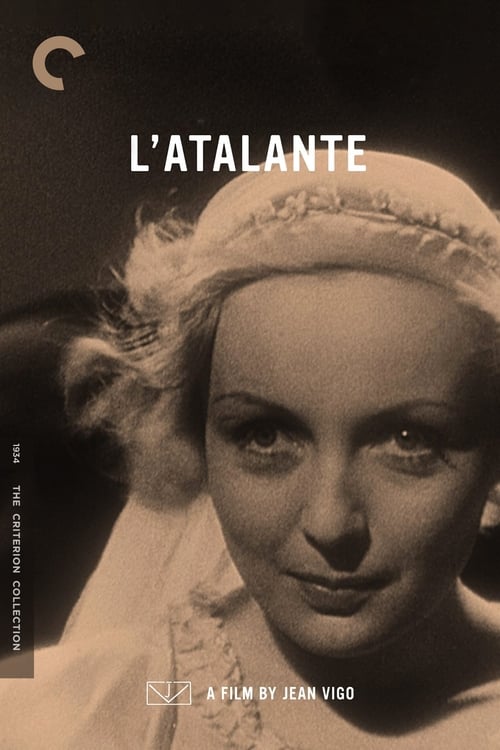
L'Atalante
1934 · Jean Vigo
For a contemplative night when you want beauty and feeling rather than plot — when you're in love, missing someone, or want to be reminded why people call films poetry. A short, soulful watch that rewards full attention.
What it's about
A young village bride marries a canal-barge captain and moves onto his boat, the L'Atalante, sharing close quarters with a gruff, tattooed old first mate and a cabin boy. As the barge works its way along the waterways of France, her restlessness and curiosity about Paris strain the marriage, and the film follows the newlyweds through desire, jealousy, separation, and the ache of missing someone.
The experience
Tender and strange in equal measure — earthy scenes of working-boat life keep giving way to sudden bursts of dreamlike, sensual imagery, including some of the most haunting underwater moments ever filmed. It's gentle, funny, and quietly devastating about what it feels like to love someone.
Performances
Michel Simon is unforgettable as the old mate Père Jules — a shaggy, cat-covered force of nature whose cabin full of souvenirs is a whole life in one room — and Dita Parlo gives the bride a luminous mix of innocence and hunger for the world.
The craft
Jean Vigo, working from the thinnest of stories, fuses gritty realism about working-class river life with eruptions of the surreal — mist, water, and light photographed so sensuously the canal itself seems to dream. Mutilated by distributors on release, it survived through decades of loving restoration.
Why it matters
Vigo's only completed feature — he died at twenty-nine just after its release — it grew from commercial disaster into a fixture near the top of greatest-films polls and a wellspring for generations of filmmakers drawn to its blend of realism and reverie.
Snapshot
L'Atalante is the only feature-length film completed by Jean Vigo, a director who died of tuberculosis at twenty-nine, weeks after its disastrous commercial release. From the slenderest of narrative pretexts — a newlywed barge captain, his restless bride, an eccentric old mate, and a cabin boy adrift on a canal barge — Vigo built one of cinema's enduring poems of married love, desire, jealousy, and reconciliation. Its reputation has only grown across the decades; the film now sits routinely among the highest entries on critics' polls of the greatest films ever made, and its history is inseparable from the story of its butchery by distributors and its long, piecemeal restoration. It is at once a tender realist study of working-class life on the waterways of France and a film prone to sudden eruptions of the surreal and the erotic — the most famous being Jean's underwater vision of his wife floating in her wedding dress. L'Atalante is the rare canonical work whose greatness was almost entirely posthumous.
Industry & production
L'Atalante was produced by Jacques-Louis Nounez, a businessman who had backed Vigo's previous medium-length film Zéro de conduite (1933), and distributed through Gaumont-Franco-Film-Aubert (GFFA). The project originated not with Vigo but as an assignment: Nounez offered Vigo a banal scenario by Jean Guinée, a sentimental story of newlyweds on a barge, as a deliberately commercial, uncontroversial subject after the scandal and banning of the anarchic, anti-authoritarian Zéro de conduite. Vigo, working with collaborator Albert Riéra, substantially rewrote the material, retaining the basic situation while deepening and complicating it.
Shooting took place over the winter of 1933–34, much of it on location along the canals near Paris and on a real barge, under conditions of considerable hardship. The cold was severe, and Vigo — already gravely ill with tuberculosis — directed at times from a stretcher or while bundled against the weather, his health deteriorating throughout the production. This biographical fact is well documented and bears directly on the film's texture of physical immediacy and improvisation.
The film's post-production and release became a notorious case of studio interference. Anxious about its commercial prospects and its slow, unconventional rhythms, the distributor recut the film, shortened it, and — in an act emblematic of the era's philistinism — reportedly interpolated a popular song of the moment, "Le Chaland qui passe" ("The Passing Barge"), retitling the film after it in some prints to capitalize on the tune's popularity. This mutilated version flopped. Vigo, by then bedridden, died on 5 October 1934. He never saw the film exhibited in anything resembling his intended form.
Technology
L'Atalante was made with the sound-film technology of the early 1930s, only a few years into the transition from silent cinema in France. The equipment of the period — heavy cameras, optical sound recording, the constraints of location sound — shaped the production, though Vigo and his collaborators worked against those constraints rather than submitting to them. Much of the film was shot on location and on water, a logistically demanding choice given the bulk and immobility of contemporary cameras and the difficulty of synchronous sound recording outdoors; substantial portions of the soundtrack were therefore handled in post-production. The film is monochrome, shot on the orthochromatic and panchromatic stocks of the day. No single technological innovation is claimed for L'Atalante; its distinction lies in the expressive deployment of available means, particularly the underwater photography and the supple, mobile camerawork achieved with period equipment.
Technique
Cinematography
The cinematography is by Boris Kaufman, the Russian-born cameraman (younger brother of the Soviet filmmakers Dziga Vertov and Mikhail Kaufman) who had shot all of Vigo's films. Kaufman's images for L'Atalante are among the glories of 1930s cinema: a fluid blend of poetic realism and lyrical abstraction. He renders the misty, gray-green world of the canals — fog, water, wet stone, the cluttered intimacy of the barge's cabin — with a tactile, documentary truthfulness, while remaining capable of pure visual poetry. The celebrated underwater sequence, in which Jean searches for the image of Juliette and sees her drifting toward him in her bridal gown, is the film's most reproduced image and a triumph of Kaufman's craft. The location work, with its natural light and unglamorous textures, anticipates the visual ethos of postwar realism. Kaufman would later emigrate to the United States and win an Academy Award for his cinematography on Elia Kazan's On the Waterfront (1954) — itself, fittingly, a film of working life on the water.
Editing
The editing, credited to Louis Chavance, serves Vigo's characteristically associative, mood-driven sense of rhythm rather than a tight cause-and-effect economy. The film moves in a manner closer to reverie than to conventional plotting, lingering on incident and atmosphere, allowing sequences to breathe. It is important to note here that the film's editing history is doubly fraught: the cut released in 1934 was not Vigo's, having been shortened and rearranged by the distributor, and what we now regard as "the film" is the product of successive restorations across the twentieth century — most significantly the 1990 reconstruction and later digital restorations — that attempted to recover Vigo's intended structure from surviving materials. Claims about Vigo's precise editorial intentions must therefore be made with caution; the definitive authorial cut does not survive in unambiguous form.
Mise-en-scène / staging
Vigo's staging fuses the documentary and the dreamlike. The cramped, junk-filled cabin of Père Jules — crowded with bric-a-brac, mementos, cats, a severed hand preserved in a jar, photographs and curios gathered from a life at sea — is one of the most richly imagined interiors in cinema, a space that characterizes its inhabitant through pure accumulated stuff. Against this density Vigo sets the open, foggy spaces of the canal and the rooftops of the barge, where Juliette stands looking outward toward a Paris she longs to see. The staging repeatedly contrasts confinement and longing: the barge as both marital haven and prison. Vigo's handling of the erotic is frank and physical for its time, particularly in the parallel sequence of Jean and Juliette, separated, writhing sleepless in their respective beds — desire rendered through the body rather than through dialogue.
Sound
The soundtrack mixes dialogue, ambient noise, and music in ways that were progressive for early French sound cinema, though it must be understood through the lens of the film's compromised release. The original score was composed by Maurice Jaubert, whose music is integral to the film's emotional fabric; the distributor's insertion of "Le Chaland qui passe" over Jaubert's work was precisely the kind of vandalism that later restorations sought to reverse. Vigo's general approach to sound was non-naturalistic and selective, treating it as an expressive element rather than mere accompaniment to the image — consistent with the practice of the most adventurous directors of the early sound era.
Performance
The performances are central to the film's warmth and strangeness. Michel Simon, already a major figure of French cinema, gives an unforgettable performance as Père Jules, the tattooed, weather-beaten old mate — by turns grotesque, comic, tender, and childlike. It is one of the great character performances of the period, generous and unpredictable, anchoring the film's eccentric humanity. Dita Parlo brings luminous vulnerability and sensual presence to Juliette, the young bride torn between marital love and a hunger for the wider world. Jean Dasté, a recurring Vigo collaborator, plays the captain Jean with a brooding, inarticulate intensity. Louis Lefèvre completes the small ensemble as the cabin boy. The interplay among these four, confined to the barge, generates the film's domestic drama.
Narrative & dramatic mode
The narrative is deliberately minimal: a young couple marry, set off on the husband's barge, quarrel as the wife grows bored and curious about Paris, separate when she leaves the boat and he, wounded and proud, sails on without her, and are finally — after mutual misery — reunited through the intervention of Père Jules. This slender arc is less a plot than an armature for a study of feeling. The dramatic mode is that of lyrical realism shading into the oneiric: long passages of observed daily life are punctuated by moments of heightened sensation and frank symbolism. The film's true subject is the rhythm of intimacy — attraction, irritation, jealousy, absence, and the physical ache of separation — rather than event. Its emotional climax is achieved not through action but through the famous underwater image and the bodily longing of the separated lovers.
Genre & cycle
Nominally a romance and comedy-drama, L'Atalante resists genre categories. It belongs to no commercial cycle of its moment; it stands somewhat apart even from the poetic realist films with which it is often grouped. Its comedy is largely embodied in Michel Simon's Père Jules; its romance is unsentimental and carnal; its drama is interior. If it has generic kin, they are the films of waterway and working life, and the broader European tradition of the lyrical art film. The marketing attempt to fold it into the popular chanson culture of the day, via "Le Chaland qui passe," was a category error that the film's whole sensibility resists.
Authorship & method
L'Atalante is unmistakably an auteur's film, the work of a director with a singular sensibility, achieved through a tight circle of trusted collaborators. Jean Vigo (1905–1934), son of the anarchist militant Miguel Almereyda (Eugène Bonaventure de Vigo), brought to the film a temperament shaped by political radicalism, personal suffering, and a poetic, anti-authoritarian imagination already visible in Zéro de conduite and the documentary À propos de Nice (1930). His method on L'Atalante combined location realism with improvisation and an openness to the unplanned, working closely with a small team. The cinematographer Boris Kaufman was his essential visual collaborator across his whole body of work. The composer Maurice Jaubert, one of the leading film composers of 1930s France, supplied a score of great delicacy. The editing was credited to Louis Chavance, and Vigo developed the screenplay with Albert Riéra from Jean Guinée's original story. The actors — especially Michel Simon, Dita Parlo, and Jean Dasté — were active creative partners in shaping the film's tone. The crucial qualification to any account of Vigo's authorship is that he was denied final control of the released film and died before its fate could be contested; the L'Atalante we revere is partly a reconstruction of an authorial intention that the historical record preserves only imperfectly.
Movement / national cinema
L'Atalante is a landmark of French cinema and is frequently associated with poetic realism, the loose tendency in 1930s French film — exemplified by Marcel Carné, Jean Renoir, and Julien Duvivier — that married realist, often working-class settings with a heightened, melancholic, atmospheric lyricism. Vigo's film both belongs to and exceeds this tendency; its blend of documentary observation and frank surreal-erotic imagery makes it sui generis. Vigo's roots also lie partly in the avant-garde and the documentary impulse (his À propos de Nice is a city symphony in the Vertovian mode, a connection reinforced by Kaufman's family link to Dziga Vertov). The film thus sits at a crossroads of French realism, European poetic cinema, and the experimental tradition.
Era / period
The film is a product of the early French sound era and of the politically turbulent 1930s, the years of economic depression and rising tensions that would culminate in the Popular Front. Its world is that of the laboring poor — bargemen, peddlers, the unglamorous infrastructure of the canals — depicted with neither condescension nor false uplift. The brief, electric music-hall sequence in which a peddler dances with and tempts Juliette situates the film against the urban entertainment culture of the period and Juliette's yearning for its glamour. The technological moment — cinema only a few years into sound — conditions both the film's form and the industrial pressures that mangled its release.
Themes
The film's governing theme is married love in its full ambivalence: the collision of romantic union with the realities of confinement, boredom, and the persistence of individual longing. Desire is rendered with unusual physical candor — the sleepless, separated bodies; the underwater vision of the beloved. Water is the film's pervasive symbol, at once the medium of the couple's shared life, the element of separation, and the site of vision and reunion; Père Jules's lore holds that one sees the face of one's true love by opening one's eyes underwater, and the film literalizes this superstition into its most transcendent image. Other threads run throughout: the tension between rootedness and wanderlust, home and the wider world; the grotesque vitality of Père Jules as a figure of accumulated experience and bodily candor; and a current of anti-bourgeois, anarchic feeling inherited from Vigo's background and his earlier work.
Reception, canon & influence
The contemporary reception was, by the standard accounts, a catastrophe. The distributor-mutilated version released in 1934 failed commercially and made little critical impact, and Vigo's death weeks later sealed the film's initial obscurity. Its rehabilitation came posthumously and gathered force across the following decades, as critics and filmmakers — and successive restorations returning toward Vigo's apparent intentions — recovered the film and elevated it. By the latter half of the twentieth century L'Atalante had become a fixture of the canon, regularly appearing near the summit of international critics' polls of the greatest films, and Vigo himself a near-mythic figure, the brilliant artist cut down before his promise could be fulfilled, his name attached to the Prix Jean Vigo for innovative French filmmaking.
Looking backward, the influences on the film include the documentary and city-symphony tradition (visible in À propos de Nice and in Kaufman's lineage to Vertov), the emerging poetic realism of French cinema, and the broader European avant-garde's openness to surreal and erotic imagery. Looking forward, L'Atalante's legacy is diffuse but profound. It is repeatedly cited as a touchstone by directors associated with the French New Wave and after — filmmakers drawn to its fusion of location realism, emotional truth, improvisatory freedom, and poetic transcendence. Its model of a personal, lyrical cinema rooted in the textures of real places and ordinary lives, yet open to the dreamlike, has informed art cinema across national traditions. Boris Kaufman's photographic style carried forward into American realist cinema. Where the historical record is genuinely thin is in attributing specific, documented lines of direct imitation; the film's influence is better understood as a pervasive exemplar of what intimate, poetic, auteurist filmmaking can be than as a catalog of explicit homages. That a single completed feature, made under such duress and so badly served on release, should occupy this place in film history is itself the measure of its achievement.
A Deleuzian reading
He tells her early on: dunk your head under the water and you'll see the face of the one you love.
The full Deleuzian reading of L'Atalante →
Reception
In 1934 the distributor butchered it — recut, retitled 'Le Chaland qui passe' after a pop song shoved into the soundtrack — and it flopped; decades of restorations later it's a fixture near the top of Sight & Sound's greatest-films polls.
How L'Atalante was received, from release to now →
Influences: the films it descends from and the films it influenced
- À propos de Nice (1930) — Vigo and Boris Kaufman's own city-symphony documentary — hidden-camera handheld capture of real faces and streets — supplied the unstaged location-photography method L'Atalante grafts onto fiction.
- Zéro de conduite (1933) — The slow-motion dormitory procession scored with Jaubert's music recorded and played backwards is the exact associative-reverie/non-naturalistic-sound technique L'Atalante reprises for Jean's underwater vision of Juliette.
- Man with a Movie Camera (1929) — Shot by Mikhail Kaufman, brother of L'Atalante's Boris Kaufman; the family's kino-eye discipline of seizing unrehearsed reality is the photographic schooling Boris brought to the canal-side footage.
- Sunrise (1927) — Murnau's fusion of location-built realism with frank dream imagery, organized around married-love ambivalence and a near-drowning on the water, prefigures Vigo's marriage-water-temptation architecture.
- Un Chien Andalou (1929) — The Surrealist license for erotic dream-logic cut associatively against realist space underwrites L'Atalante's candidly sensual, non-literal imagery of desire.
- Le Quai des Brumes (1938) — Carné extends the poetic-realist waterfront of doomed lovers and reuses Maurice Jaubert's delicate scoring to wrap working-class romance in fatalistic atmosphere.
- Le Jour se lève (1939) — Another Jaubert score plus the staging of confinement-vs-longing — a man trapped in a room aching for an absent woman — formalizes L'Atalante's cabin claustrophobia into structure.
- On the Waterfront (1954) — Boris Kaufman's Oscar-winning photography carried Vigo's poetic realism of working docks, fog and river-edge labor directly into American cinema.
- 12 Angry Men (1957) — Kaufman lenses a single cramped interior with lengthening focal lengths and rising heat — the cluttered-confinement staging of the cabin pushed to its expressive extreme.
- The Pawnbroker (1964) — Kaufman's flash-cut subliminal inserts of memory are the associative-reverie editing of L'Atalante's superimposed longing translated into modernist montage.
- The 400 Blows (1959) — Truffaut, an open Vigo devotee, fuses improvisatory location Paris with lyrical-realist tenderness toward an outsider, extending the Zéro/L'Atalante method into the New Wave.
- The Night of the Hunter (1955) — Laughton stages a river journey as oneiric fairy tale, deploying water-as-symbol and dreamlike non-naturalism in the lyrical-realist register Vigo pioneered.
- Les Amants du Pont-Neuf (1991) — Carax, a self-declared Vigo heir, sets erotically candid lovers against the Seine, reviving poetic realism's water symbolism and improvisatory romantic transcendence.
- Beau Travail (1999) — Denis builds meaning from associative, near-wordless montage of bodies and water and a non-naturalistic music-driven rhythm, the lyrical-realist-oneiric mode inherited from Vigo.
- The Life Aquatic with Steve Zissou (2004) — Pioneers the boat-as-enclosed-melancholy-world, treating the crewed vessel as a poetic, lyrically aquatic microcosm of longing and loss.
- Long Day's Journey Into Night (1962) — Kaufman's apprenticeship under Vigo — the fog-and-water poetic-realist haze that becomes the film's foghorn-shrouded coastal gloom.
- Pather Panchali (1955) — Vigo's lyrical fusion of poetic imagery with everyday poverty — finding transcendence in the ordinary (water, light, small wonder) — prefigures Ray's famous train-and-telegraph-wires reverie that lifts realism into poetry.
- Boudu Saved from Drowning (1932) — Michel Simon's earthy, improvised, physically anarchic performance and real Seine-side shooting are the same actor-and-river craft Vigo channels into Père Jules and the barge.
- Toni (1935) — Location-shot lyrical realism using non-professional textures and ambient regional life pursues the same documentary-rooted poetry as L'Atalante in the same moment.
- Modern Times (1936) — Vigo concurrently builds emotionally weighted proletarian sequences around synchronized score and physical performance rather than spoken dialogue, using Boris Kaufman's deep full-figure staging to make working-class bodies the primary expressive instrument—a parallel strategy of letting music and gesture carry meaning that sound cinema had largely reassigned to speech.
- Limite (1931) — Boris Kaufman's soft silver photography plus the vessel-as-closed-world premise, in which interior longing surfaces as literal superimposition — the underwater apparition is Limite's dissolve grammar carried into sound.
Similar films
- The Lovers on the Bridge (1991) — influence & lineage
- The 400 Blows (1959) — influence & lineage · often watched together
- 12 Angry Men (1957) — influence & lineage · often watched together
- Un Chien Andalou (1929) — influence & lineage · often watched together
- On the Waterfront (1954) — influence & lineage · often watched together
- The Night of the Hunter (1955) — influence & lineage · often watched together
- Man with a Movie Camera (1929) — influence & lineage · often watched together
- Jeanne Dielman, 23, quai du Commerce, 1080 Bruxelles (1976) — often watched together
All the films related to L'Atalante →