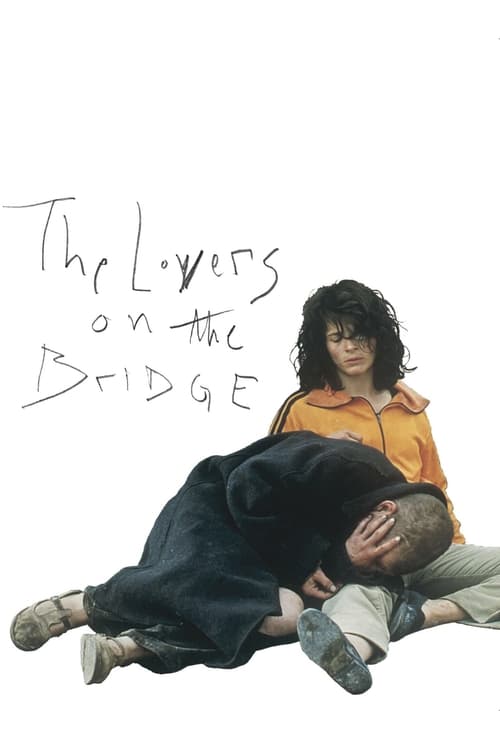
The Lovers on the Bridge
1991 · Leos Carax
For when you want romance at full volume — obsessive, beautiful, and unsafe — and you're ready to be swept up rather than soothed. This is a challenge and a rush, not a cozy night in.
What it's about
On Paris's oldest bridge, closed for repairs and turned into a makeshift shelter, two young vagrants collide: Alex, a would-be circus performer numbed by alcohol and sedatives, and Michèle, a painter from a comfortable background now living rough as a degenerative condition slowly takes her sight. Their romance grows out of mutual dependence in the city's blind spot, played against fireworks, the Seine, and a Paris that seems to exist only for them.
The experience
Delirious and physical — it swings between gutter-level squalor and moments of ecstatic, almost reckless spectacle. It's a love story that feels dangerous rather than sweet, and it leaves you a little breathless and a little bruised.
Performances
Denis Lavant is astonishing as Alex, acting with his whole scarred, acrobatic body, and Juliette Binoche matches him with a raw, unglamorous ferocity far from her usual poise. Together they make dependence look like both love and affliction.
The craft
Leos Carax stages intimacy at operatic scale — a Bastille-night fireworks sequence, waterskiing on the Seine, fire-breathing on the bridge — on a production so ambitious it became legendary in its own right, including a massive rebuilt set of the Pont-Neuf. It's one of the great big-screen experiences of French cinema: image and music surging together at maximum intensity.
Why it matters
Its notoriously runaway production made it one of the most expensive French films of its era and nearly sank Carax's career, but it has since been embraced as a landmark of ecstatic, romantic filmmaking and the crowning panel of his Alex trilogy.
Snapshot
Les Amants du Pont-Neuf is Leos Carax's third feature and the closing panel of his so-called "Alex trilogy," in which Denis Lavant plays a scarred, feral young man named Alex across three films (Boy Meets Girl, 1984; Mauvais Sang, 1986; and this). Set on Paris's oldest bridge, closed for restoration, it stages a delirious romance between Alex, a homeless would-be circus performer numbed by drink and pills, and Michèle (Juliette Binoche), a painter from a bourgeois background living rough as a degenerative eye condition steals her sight. The film is at once an intimate two-hander about mutual dependence and a work of operatic spectacle — a Bastille-night fireworks sequence, waterskiing on the Seine, fire-breathing — realized at a scale that turned the production into one of the most notorious and expensive undertakings in modern French cinema. It is the definitive statement of Carax's romantic maximalism and a landmark of the 1980s style tendency critics named the cinéma du look.
Industry & production
The making of Les Amants du Pont-Neuf is inseparable from its meaning; the production's collapse and resurrection became part of its legend. Carax secured permission to shoot on the actual Pont-Neuf during a scheduled period of restoration, a narrow window that dictated the shoot. When Denis Lavant injured his hand (widely reported as a thumb injury), filming stalled, the permit lapsed, and the real-bridge shoot became impossible. Rather than abandon the film, the production rebuilt the Pont-Neuf and its surrounding stretch of the Seine and Paris skyline as a vast open-air set in the south of France, near Montpellier (at Lansargues). This full-scale reconstruction, together with repeated shutdowns as financing evaporated and had to be reassembled, stretched the shoot across roughly three years, from 1988 to 1991.
The result was a budget that ballooned far beyond its origins as a comparatively modest project. Reported figures vary and should be treated with caution — the record here is genuinely muddy — but the film is routinely cited among the most expensive French productions of its era, with sums commonly placed in the range of a hundred-odd million to as much as 160 million francs. What is not in dispute is that the cost was ruinous relative to its commercial prospects: the film underperformed at the French box office and did not recoup, and its financial troubles passed through multiple producers and rescue arrangements. I will not attach specific producer names or exact grosses to this account, because the surviving documentation is inconsistent and much of it is anecdotal. What can be said plainly is that the picture's excess was real, was central to its reception, and nearly ended Carax's career; he would not complete another feature for years.
An important epilogue belongs to distribution. The film was slow to reach some markets, and its United States theatrical release came only later in the decade (1999), championed by critics who treated it as a rediscovered masterwork. That belated arrival reframed a French cause célèbre about money into an international story about an uncompromised romantic vision.
Technology
The film's technological signature is not optical trickery but the audacity of building reality at scale. Its central "effect" is the replica set — a constructed Paris that allowed Carax total control over a public monument he could never have commanded in situ. Pyrotechnics drive the celebrated fireworks sequence, timed to the Revolutionary imagery of a Bastille celebration; the water sequences (waterskiing on the Seine) and Lavant's fire-breathing are achieved through physical performance and practical staging rather than compositing. Shot on 35mm film in the tradition of Carax and his cinematographer, the picture privileges in-camera spectacle, real light sources, and human risk over the emerging digital tools of the period. In this sense its "technology" is closer to that of silent-era showmanship — pyrotechnics, stunt work, monumental sets — than to the effects cinema of its own decade.
Technique
Cinematography
The images are the work of Jean-Yves Escoffier, Carax's regular director of photography (he had shot Boy Meets Girl and Mauvais Sang). Escoffier's style here fuses grit and rapture: the squalor of rough sleeping — chapped skin, dirt, the blue cold of a stone bridge at night — is rendered with the same voluptuous attention as the film's set pieces. Color and light are pushed toward the expressive, with saturated night skies, the reds and golds of fire and fireworks, and a painterly regard for faces (fitting for a heroine who is a painter losing her sight). The camera is highly mobile and often physically bound to the actors, so that the visual style enacts the lovers' abandon rather than merely observing it.
Editing
Editing is credited to Nelly Quettier, a key Carax collaborator (she cut Mauvais Sang and would later cut Holy Motors). Her work modulates between two registers the film depends upon: long, breath-held observation of two bodies in close quarters, and bursts of ecstatic acceleration in the spectacle sequences. The fireworks-and-dance passage is the clearest showcase — a montage of movement, music, and light that lifts the film out of naturalism into pure kinetic euphoria before returning it to the hard ground of the street.
Mise-en-scène / staging
The bridge is the film's entire world, and staging exploits its constraint: a narrow stone stage over water, with the lovers pressed into a shared, exposed space. Carax choreographs the couple's physical business — sleeping, drinking, stealing, performing — with a dancer's sense of the frame, and repeatedly turns the bridge into a proscenium for spectacle. The reconstructed set makes possible a control of geography, sky, and river that grounds the film's lyrical flights in a concrete, believable place.
Sound
The soundtrack is eclectic and compiled rather than governed by a single wall-to-wall orchestral score; the film juxtaposes classical music with contemporary popular tracks, most memorably in the fireworks sequence, where music, pyrotechnics, and movement fuse. (Specific track attributions circulate widely but inconsistently, so I refrain from itemizing them here.) Ambient sound — water, wind, the city — anchors the film's naturalist scenes, so that the eruptions of music register as ruptures of feeling.
Performance
The film lives or dies on its two leads, and both give career-defining work. Denis Lavant's Alex is a creature of pure physicality — contorted, acrobatic, self-lacerating — and Lavant reportedly performed the demanding physical feats himself, including the fire-breathing, lending the character a genuinely dangerous, unfaked corporeality. Juliette Binoche, already a rising star, submits to squalor and vulnerability with fearless commitment, playing a woman defined by what she is losing (her sight, her class, her former love). Their scenes together have the charged intimacy of two people with nothing left but each other.
Narrative & dramatic mode
The dramatic mode is amour fou — mad love as a total, consuming state — rather than conventional romance. The narrative is loose and episodic, organized less by plot mechanics than by the intensifying bond between two damaged people. Its turns are melodramatic in the strongest sense: Michèle's family circulates notices across Paris announcing that a cure for her blindness has been found; Alex, terrified of losing her, acts to keep the news from reaching her, and the consequence is catastrophe and imprisonment. The film's structure moves from squalid naturalism through ecstatic spectacle to a fable-like resolution — reunion and a final plunge from the bridge into the river, and a barge carrying the lovers onward. This late turn toward the mythic and redemptive is deliberate, converting a story of degradation into a romance of deliverance.
Genre & cycle
Nominally a drama and a romance, the film belongs to the 1980s French cycle critics labeled the cinéma du look — the tendency associated with Jean-Jacques Beineix (Diva, Betty Blue) and Luc Besson (Subway, Nikita), marked by high-gloss style, youthful and marginal protagonists, spectacle, and an emphasis on surface and sensation. Carax is the movement's most exalted and least commercial figure, and Les Amants du Pont-Neuf is often read as both the apotheosis and the transcendence of the tendency: it deploys the cycle's spectacle and romanticism at maximum intensity while pursuing an emotional and formal seriousness that pushes beyond mere style.
Authorship & method
Carax (a near-anagram of his given names, Alexandre Oscar) wrote and directed the film solo, and it is the culmination of the intensely personal cycle built around Lavant's Alex — a barely concealed alter ego. His method here is one of total commitment and refusal to compromise the image in his head, even at the cost of financial catastrophe; the decision to rebuild the Pont-Neuf rather than restage or downscale is the defining artistic choice of his career. His key collaborators are the load-bearing pillars of that method: cinematographer Jean-Yves Escoffier, whose imagery gives the film its fusion of grime and grandeur; editor Nelly Quettier, who shapes its oscillation between stillness and ecstasy; and above all his actors, Denis Lavant and Juliette Binoche, whose physical and emotional exposure Carax treats as the film's true medium. On the question of a single credited composer, the film's reliance on compiled and pre-existing music makes it more accurate to speak of Carax as musical curator than to name a scoring author.
Movement / national cinema
This is emphatically a French film about the most French of subjects — Paris and romantic passion — made within the cinéma du look moment but haunted by deeper national lineages. Carax is heir to the French New Wave's politique des auteurs and to Jean-Luc Godard in particular (the romanticism, the citational impulse, the primacy of the couple), and behind that to the poetic realism of the 1930s and to Jean Vigo, whose L'Atalante — its lovers, its river, its barge — resonates powerfully in Carax's ending. The film thus sits at the confluence of France's high cinephile tradition and its glossy 1980s reinvention.
Era / period
Though released in 1991, the film is a product of the late 1980s in both its making and its imagery: the Bastille festivities that light its central sequence evoke the Revolutionary bicentennial celebrated in 1989, situating the romance against a moment of national spectacle. It arrives at the tail end of the cinéma du look decade, and its very excess reads as a kind of terminal statement — the style pushed until it broke the economics that produced it. Its later international release at the end of the 1990s gave it a strange second life, out of period, as a rediscovered classic.
Themes
The governing theme is love as both salvation and destruction — a mutual dependence between two people whose bond is inseparable from their damage. Sight and blindness structure the film with unusual directness: Michèle, a painter, is losing the sense on which her art and her perception of the world depend, and Alex's love becomes entangled with the threat that her recovered sight will restore her to a world without him — a theme that speaks directly to any atlas of lines of sight and ways of seeing. Around this turn the film's other preoccupations: homelessness and social invisibility (the lovers are among Paris's discarded); the mythic charge of the city and its monuments; degradation and redemption; and the surrealist ideal of amour fou, love pursued past reason to the point of ruin and rebirth.
Reception, canon & influence
Contemporary French reception was inseparable from the scandal of the budget; the film's cost and commercial failure dominated much early discussion, and it did not perform at the box office in proportion to its expense. Critical opinion, however, increasingly regarded it as a work of extraordinary ambition and beauty, and its reputation rose over the following years — decisively so with its belated international release (in the US in 1999), where critics embraced it as a masterpiece and it became a touchstone of passionate, uncompromised filmmaking.
Its backward lines of influence are legible and often acknowledged: the surrealists' cult of amour fou (the world of Breton); the French New Wave and Godard's lovers-on-the-run romanticism; the poetic realism and, specifically, Jean Vigo's L'Atalante, whose river-and-barge imagery Carax echoes; and the physical, silent-cinema tradition of the performing body that Lavant embodies. Its forward legacy runs first through Carax's own career — after the long silence that followed the film's troubles, he returned with Pola X (1999) and, most influentially, Holy Motors (2012) and Annette (2021), works that extended his union of the corporeal and the operatic (and continued his collaboration with Lavant). More broadly, Les Amants du Pont-Neuf endures as a byword for the auteur's total commitment to a vision — invoked whenever cinema's romantic maximalism, or its capacity for ruinous, monument-building excess in the service of feeling, is discussed. Its precise measurable influence on other filmmakers is harder to document than its stature as an object of devotion, and I flag that the strongest claim the record supports is one of enduring cult and critical canonization rather than a traceable school of imitators.
Reception
In 1991 it was infamous less as a film than as a fiasco — a runaway production whose budget ballooned into one of the most expensive French films ever made, and which couldn't earn it back. It then sat unreleased in the US for eight years (finally arriving in 1999), by which point the reappraisal had begun; today it's widely canonized as one of the great reckless romantic films of the '90s.
How The Lovers on the Bridge was received, from release to now →
How to watch The Lovers on the Bridge: what to notice on a first viewing
- Watch how physically extreme Lavant's movement is throughout. Lavant performs Alex as pure physicality, contorted and acrobatic, doing his own stunts including the fire breathing, so the danger reads as real. The unfaked physical risk is what makes the romance feel dangerous rather than merely passionate.
- Notice how the same voluptuous light covers squalor and spectacle. Escoffier photographs the grit of rough sleeping and the fireworks set pieces with equally saturated color, refusing to separate beauty from degradation. Treating both registers with the same visual love is the film's whole argument about the lovers.
- Watch the bridge become a stage for every kind of scene. Carax choreographs sleeping, drinking, stealing, and performing across the same narrow stone bridge, turning its length into a proscenium the lovers keep reusing. Confining the whole world to one bridge makes the couple's isolation and their bond the same fact.
- Notice the editing shift from stillness into sudden acceleration. Quettier cuts between long, breath held observation of the two bodies and bursts of kinetic euphoria in the spectacle sequences, especially the fireworks passage. The rhythm itself swings between the couple's exhaustion and their moments of pure release.
- Listen for classical music colliding with contemporary tracks. The soundtrack juxtaposes classical pieces with popular music rather than following one score, so the eruptions of music register as ruptures of feeling against the ambient street sound. The mixed soundtrack keeps you from settling into one comfortable mood for long.
The whole guide to watching The Lovers on the Bridge, with the keys for a rewatch →
Influences: the films it descends from and the films it influenced
- L'Atalante (1934) — Carax directly echoes Vigo's Seine-and-barge poetic realism — lovers on the water and the submerged-body imagery — fusing documentary grime with lyrical fantasy.
- Les Enfants du Paradis (1945) — The boulevard staged as a theatrical proscenium and Barrault's mime — the silent performing body as narrative medium — is the tradition Lavant's corporeal performance descends from.
- City Lights (1931) — The tramp-and-blind-flower-girl romance, structured on sight/blindness and a hoped-for cure and carried by silent physical pantomime, is reworked through Binoche's failing eyesight.
- L'Âge d'Or (1930) — Supplies the Surrealists' amour fou — obsessive passion that is socially destructive and anti-bourgeois — as the film's narrative engine.
- Pierrot le fou (1965) — Model for lovers-on-the-run romanticism, jump-cut editing energy, saturated fireworks-and-color set pieces, and a self-immolating finale.
- Boudu Saved from Drowning (1932) — Renoir's vagrant plunged into and fished from the Seine establishes the tramp-on-the-river as location realism about a social outcast.
- Sunrise (1927) — The silent city-couple melodrama staged with expressionist night light and pure corporeal emotion against nocturnal spectacle prefigures Carax's fusion of grime and grandeur.
- Betty Blue (1986) — Cinéma du look amour fou — doomed maximalist lovers whose passion escalates into madness and self-destruction against high-color surfaces.
- Holy Motors (2012) — Extends the Lavant collaboration by making the transforming actor's body — appointment after appointment — the film's true medium.
- Annette (2021) — Carries the union of the corporeal and the operatic into a fully sung musical maximalism, the compiled-eclectic instinct becoming a through-composed score.
- Boy Meets Girl (1984) — Origin of the Lavant 'Alex' alter-ego and of Escoffier's grainy monochrome Paris nightscapes that the Pont-Neuf film culminates.
- Mauvais Sang (1986) — Immediate predecessor in the Alex cycle — Lavant's sprinting/dancing body (the Bowie 'Modern Love' run) and Escoffier's saturated color treated as pure corporeal cinema.
- Diva (1981) — Founding cinéma du look text — advertising-glossy surface, neon-Paris spectacle, and youthful marginals — the movement Carax is grouped within.
- Subway (1985) — Cinéma du look staging of a Parisian underworld, privileging stylized surface and marginal youth over narrative causality.
- Fitzcarraldo (1982) — The auteur's ruinous, monument-building production excess — physically building/hauling the real thing rather than faking it — mirrors Carax's insistence on rebuilding the Pont-Neuf full-scale.
- Heaven's Gate (1980) — The byword for uncompromised, budget-destroying full-scale replica-set construction and commercial catastrophe later redeemed by critical canonization — the exact arc of Carax's film.
- Rendez-vous (1985) — Extends the Binoche persona launched here into à-fleur-de-peau amour fou, pushing the restless camera and color-as-emotion register of romantic obsession to operatic scale.
Similar films
- Children of Paradise (1945) — influence & lineage
- L'Âge d'or (1930) — influence & lineage
- Pierrot le Fou (1965) — influence & lineage
- Happy Together (1997) — same viewing thread · often watched together
- Blue Is the Warmest Color (2013) — same viewing thread
- Heaven's Gate (1980) — influence & lineage · often watched together
- Titane (2021) — often watched together
- Limite (1931) — often watched together
All the films related to The Lovers on the Bridge →
Watch it with: curated runs of related films
- Love Against the Grain — A run of films where desire refuses the shape its world demands — opera stages, drought-struck Taipei, an honor-bound Lahore household, drenched Buenos Aires — and burns brighter, and more dangerously, for the refusal.