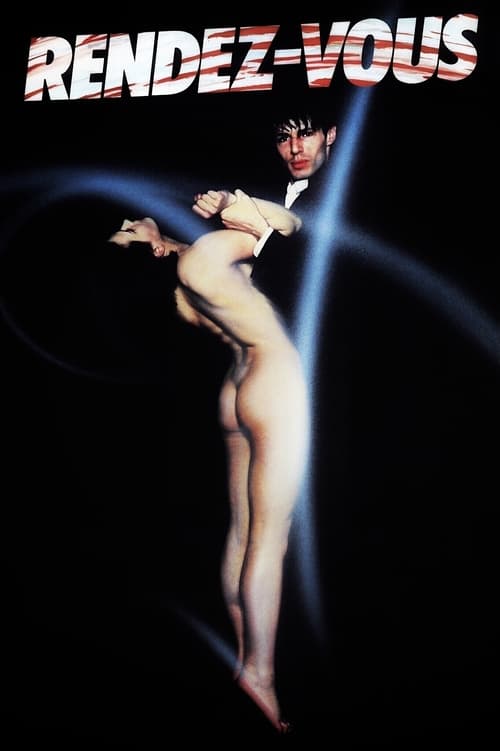
Rendez-vous
1985 · André Téchiné
For when you want something intense and adult — a film about passion that actually feels risky, best watched alone late at night when you're ready to be shaken rather than soothed.
What it's about
Nina, a young actress from the provinces, arrives in Paris hungry for a career and finds herself pulled between three men: a gentle real-estate agent who offers safety, a volatile performer who lives on the edge of self-destruction, and an aging theater director who casts her as Juliet. As rehearsals for Romeo and Juliet begin, the lines between grief, desire, and performance start to dissolve. It's a backstage story where the offstage drama is the dangerous one.
The experience
Feverish and raw — it runs on erotic tension, sudden violence of feeling, and a mounting sense that art is being forged out of damage. It unsettles more than it comforts, and it doesn't let you look away.
Performances
This is the film that launched Juliette Binoche: barely in her twenties, she's fearless and completely exposed, playing a woman who is at once naive and unstoppable. The role announced one of the great screen actresses of her generation.
The craft
Téchiné directs with a hot, restless energy — Paris at night, cramped apartments, the theater as a haunted house — fusing romantic melodrama with something almost gothic. The film's power is in its atmosphere: bodies, rain, stage light, and the constant hum of danger.
Why it matters
It won Téchiné the Best Director prize at Cannes in 1985 and stands as the launching point of Juliette Binoche's career, a landmark of intense, adult French filmmaking in the mid-eighties.
Snapshot
Rendez-vous is André Téchiné's feverish, fatalistic chronicle of a young provincial actress consumed by Paris, the theater, and the men who circle her. Nina (Juliette Binoche, in the role that launched her) arrives to chase a career and is drawn into a triangle that is really a quadrangle: Paulot, a tender real-estate agent who wants to settle her; Quentin, a self-destructive performer who works the live-sex circuit and treats sex as a wound; and Scrutzler, an aging theater director haunted by his own past who casts Nina as Juliet. The film fuses backstage melodrama with something closer to the gothic — a story about how grief, performance, and desire bleed into one another until a private mourning becomes the engine of an actress's art. It earned Téchiné the Best Director prize at the 1985 Cannes Film Festival and is generally regarded as the film on which both Binoche and the mature, romantic-modernist Téchiné fully arrived.
Industry & production
Rendez-vous belongs to the French art-cinema economy of the mid-1980s, a period when auteur projects of this scale were typically assembled from a combination of producer equity, distributor advances, and the support structures (Avance sur recettes, broadcaster pre-sales) that sustained French production. It was a French-language feature aimed first at the domestic theatrical market and the festival circuit, and its Cannes selection and directing prize functioned exactly as such a film hoped: as the principal engine of its visibility and export. Precise budget and box-office figures are not reliably documented in the English-language record, and I will not invent them.
The film sits at a hinge in Téchiné's career. After a run of cooler, more theoretically inflected works in the 1970s — Souvenirs d'en France, Barocco, Les Sœurs Brontë — he had begun moving toward a warmer, more emotionally direct register with Hôtel des Amériques (1981). Rendez-vous consolidated that turn and re-established him commercially and critically. Its most consequential production fact is its casting: Téchiné took the largely unknown Binoche and built the film around her, and the gamble defined her early stardom.
Technology
Technologically the film is conventional for its moment: a 35mm color production using standard professional equipment of the early-to-mid 1980s, finished photochemically. There is no special-format, optical, or process innovation at issue here; the film's ambitions are entirely in the domain of style and performance rather than apparatus. What matters technically is craft applied to ordinary tools — naturalistic location shooting in Paris interiors and streets, available and practical light pushed toward expressive ends, and a soundtrack built for emotional saturation rather than spectacle.
Technique
Cinematography
The photography is by Renato Berta, the Swiss cinematographer whose career spans Godard, Resnais, Rohmer, Malle (Au revoir les enfants) and a long association with Téchiné. Berta's work here is mobile and nervous, attentive to the way bodies move through cramped apartments, theater wings, and night streets. The visual world is one of saturated, slightly unreal color and restless framing, with the camera prone to following and circling characters rather than holding them at a fixed distance. The look serves the film's emotional logic: Paris is rendered less as documentary fact than as a charged, dreamlike field in which Nina is perpetually a little lost. The lighting leans toward the nocturnal and the theatrical, repeatedly placing characters at thresholds — doorways, windows, the edge of a stage — where private and public selves collide.
Editing
The cutting is brisk and elliptical, advancing the story by jumps rather than smooth transitions, so that time compresses and relationships shift between scenes without explanatory connective tissue. This elliptical method is characteristic of Téchiné and central to the film's headlong feeling: scenes begin in medias res and end before they resolve, and the audience is asked to keep pace with emotions that move faster than information. The editing also manages the film's most difficult formal task — the interpenetration of "life" and "stage," memory and present — by cutting between registers in ways that deliberately blur which is which.
Mise-en-scène / staging
Téchiné came to cinema from criticism and never lost a theorist's interest in framing, and Rendez-vous is saturated with the theme of theater as both subject and method. The staging is literally theatrical — much of the drama turns on rehearsal, performance, and the playing of Romeo and Juliet — and Téchiné exploits the doubling relentlessly: the proscenium, the backstage, the live-sex stage where Quentin performs, and the apartment rooms are all arenas where people perform versions of themselves. The film stages desire as something acted out, and its mise-en-scène keeps insisting on the porous boundary between role and self. Interiors are cluttered, lived-in, and slightly claustrophobic; the theater spaces are cavernous and shadowed, charged with the past.
Sound
The score is by Philippe Sarde, one of the most prolific French film composers of the era and a recurring Téchiné collaborator. Sarde's music pushes the film toward the operatic, underlining its melodramatic and romantic-gothic dimensions and lending the love-and-death material a lush, mournful coloration. Sound design otherwise favors the intimacy of voices, breath, and the acoustic of theatrical spaces; the film's aural texture supports its overall movement from naturalism toward heightened, almost feverish feeling.
Performance
Performance is the film's true medium — appropriately, since it is a film about actors. Juliette Binoche makes Nina at once opaque and incandescent, carnal and childlike, and the role's demand that she be permeable to the men around her becomes, in her hands, a study of an actress learning to convert experience into art. Lambert Wilson is the film's dark star as Quentin, all damaged glamour and self-annihilating intensity. Wadeck Stanczak gives Paulot a bruised gentleness as the man offering ordinary love. And Jean-Louis Trintignant, as the director Scrutzler, supplies the film's gravity: a man whose grief and guilt have hardened into a kind of theatrical priesthood, and through whom the story's tragic backstory is delivered. The ensemble's interplay — tender, cruel, theatrical, raw — is what the film is finally about.
Narrative & dramatic mode
The dramatic mode is melodrama raised to a high pitch and crossed with the gothic. The narrative is organized less by plot mechanics than by emotional escalation and by the recurrence of a buried trauma: Scrutzler's past — bound up with Quentin and with the earlier staging of Romeo and Juliet — returns to claim the present, and Nina becomes the figure through whom an old mourning is replayed and, perhaps, exorcised. The film moves through love affairs, a self-destructive death, and the approach of an opening night, treating these not as discrete events but as a single rising current. Its governing idea is romantic and almost mythic: that great performance is born from real suffering, that the actress must be wounded to be true. The storytelling is deliberately elliptical and associative, prioritizing intensity over clarity.
Genre & cycle
On its surface Rendez-vous is a drama-romance and a backstage theater film, but it draws its real energy from the love-and-death tradition — Romeo and Juliet is not merely the play within the film but its template. It belongs to a recognizable cycle in 1980s French cinema of stylish, emotionally extravagant auteur melodramas, and within Téchiné's own filmography it inaugurates the romantic-novelistic vein — interlaced relationships, family and erotic entanglements, the provincial-and-Paris axis — that he would develop across the following decades. It also participates in the perennial subgenre of films about theater and performance, using the conceit to interrogate the relation between art and life.
Authorship & method
Rendez-vous is a signature Téchiné film and a key document of his method: the conversion of melodramatic, even lurid material into something formally sophisticated and emotionally serious through elliptical editing, mobile camerawork, and an actor-centered approach. A former Cahiers du cinéma critic, Téchiné directs as someone perpetually conscious of cinema's and theater's artifice, yet here he commits fully to feeling.
The film's most historically significant collaboration is the screenplay, co-written by Téchiné with Olivier Assayas — an early and formative screenwriting credit for the future director, then emerging from the same Cahiers milieu. The pairing brought a younger, edgier sensibility to Téchiné's romanticism, and the partnership continued on subsequent projects. The other key collaborators are cinematographer Renato Berta, composer Philippe Sarde, and the cast led by Binoche, Wilson, Stanczak, and Trintignant. The film is credited to editor Martine Giordano, a frequent Téchiné collaborator; readers seeking exact technical credits should confirm against the film's titles, as English-language documentation of the crew is uneven. The authorial vision is unmistakably Téchiné's, but Rendez-vous is best understood as the meeting of his mature romanticism with Assayas's sharper modern edge.
Movement / national cinema
The film is squarely a work of French national cinema, made by a director of the post-New Wave generation — critics-turned-filmmakers who inherited the Cahiers legacy without belonging to the original nouvelle vague. Téchiné absorbed the New Wave's self-consciousness about form and its love of cinema's own history, but redirected those instincts toward emotional and novelistic ends rather than playful deconstruction. Rendez-vous thus stands as a representative 1980s French art film: auteur-driven, literate, formally assured, and oriented toward the festival and export markets that sustained such cinema.
Era / period
Made and set in the mid-1980s, the film is contemporary to its moment — a portrait of young people drifting through a Paris of small apartments, theaters, and marginal performance economies. It captures a particular early-1980s mood of erotic risk and romantic fatalism, and it arrives at a transitional point both for its director (consolidating his romantic turn) and for French cinema (the generation of Cahiers critics fully established as filmmakers). The period texture is naturalistic in its surfaces but heightened in its emotional weather.
Themes
The film's central theme is the inextricability of art and life — the conviction that performance feeds on real desire, grief, and death, and that to act truthfully is to be permeable to suffering. Around this cluster others: desire as a destabilizing, even fatal force; the double of Eros and Thanatos figured through Romeo and Juliet; the city as a place where the young remake themselves and lose themselves; and mourning that refuses to stay buried, returning through repetition and re-staging. Identity in Rendez-vous is perpetually performed, and the film is fascinated by the thin, dangerous membrane between playing a role and being claimed by it.
Reception, canon & influence
Critically, Rendez-vous was the film that re-positioned Téchiné at the front rank of French directors, and its Best Director prize at the 1985 Cannes Film Festival is the central fact of its reception. Just as importantly, it announced Juliette Binoche: this is widely cited as her breakthrough, the role that set her on the path to international stardom. For Olivier Assayas, the screenplay was a formative early credit on the way to his own directing career.
Looking backward, the film's influences are legible: the Romeo and Juliet template and the broader love-and-death tradition; the backstage theatrical film; the New Wave inheritance of cinephile self-awareness that Téchiné turned toward romantic-melodramatic ends; and a strain of gothic-romantic storytelling about haunting and repetition. Looking forward, Rendez-vous effectively launched the mature Téchiné manner — the interlaced relationships, elliptical construction, and emotionally charged naturalism — that he would extend across acclaimed later films, and it stands at the head of the Téchiné–Assayas collaboration. Its largest legacy may simply be Binoche herself, whose subsequent career gives the film an outsized retrospective importance. Within film history it is firmly canonized as a key 1980s French auteur work and as the picture on which one of cinema's major directors and one of its major actresses each came fully into focus.
A Deleuzian reading
Watch where Téchiné keeps putting Nina.
The full Deleuzian reading of Rendez-vous →
Reception
It won Téchiné the Best Director prize at Cannes in 1985, where its feverish intensity divided critics; today it's remembered less as a prize-winner than as the film that announced Juliette Binoche to the world.
How Rendez-vous was received, from release to now →
Influences: the films it descends from and the films it influenced
- Vertigo (1958) — The gothic eros-thanatos engine of a survivor compulsively re-staging a dead beloved supplies Rendez-vous its buried-trauma-repetition structure, where desire is inseparable from a revenant who must be conjured again and again.
- Les Enfants du paradis (1945) — The template of the backstage-theater film in which the playhouse becomes the arena for love-and-death, and an actor's stage role bleeds into real passion, is the genre frame Téchiné inherits and modernizes.
- Opening Night (1977) — An actress literally haunted by a dead admirer during rehearsals models theater-as-method: filming rehearsal, breakdown, and performance as one unbroken emotional continuum rather than discrete scenes.
- The Conformist (1970) — Bertolucci's saturated, near-unreal expressionist color and restless gliding camera demonstrate the lush melodramatic mise-en-scène Téchiné and Berta use to dignify lurid material; Trintignant's interiorized gravity is also imported.
- L'Amour fou (1969) — Rivette's interleaving of a theatrical rehearsal with the lovers' real disintegration establishes rehearsal-as-method and the elliptical braiding of staged art and lived collapse that Rendez-vous compresses.
- Jules et Jim (1962) — The New Wave's cinephile-romantic lyricism — interlaced love triangle, propulsive mobile camera, elliptical leaps, and an eros-thanatos ending — is the post-Cahiers inheritance Téchiné bends toward melodrama.
- Persona (1966) — An actress's identity dissolving off-stage anchors the art-and-life theme, treating performance and self as a single porous membrane that Rendez-vous reworks through its haunted ingénue.
- Written on the Wind (1956) — Sirk's elevation of 'lurid' melodrama into formally serious cinema via saturated color and emotional excess is the conversion strategy — feeling fully committed to despite ironic self-awareness — at the core of Téchiné's method.
- Barocco (1976) — Téchiné's own earlier gothic melodrama of doubling, revenants, and saturated unreal color is the direct authorial precursor whose lurid romanticism Rendez-vous refines into mature form.
- Irma Vep (1996) — Assayas turns the art-and-life and backstage-cinema material of the Téchiné collaboration reflexive, dramatizing a film shoot where role and self collapse — the screenwriter's sensibility now directing its own subject.
- Cold Water (1994) — Assayas extends the mobile restless camera and elliptical, emotionally charged naturalism he helped script into his own signature handheld lyricism of adolescent rupture.
- Les Roseaux sauvages (1994) — The mature Téchiné manner that Rendez-vous launched — interlaced relationships, elliptical construction, and emotionally charged naturalism — reaches full flower in this ensemble of intertwined desires.
- Ma Saison préférée (1993) — Carries forward the elliptical cutting and gliding camera applied to charged family melodrama, the same buried-feeling-erupting structure transposed from lovers to siblings.
- Clouds of Sils Maria (2014) — Closes the Téchiné–Assayas–Binoche circle: Binoche as an aging actress rehearsing a role that mirrors her life makes the art-and-life, theater-as-method theme explicit, three decades on from her breakthrough here.
- Mauvais Sang (1986) — Carax casts the same just-broken-through Binoche inside a post-New-Wave romanticism of saturated unreal color and eros-thanatos intensity, the cinéma-du-look counterpart to Téchiné's charged melodrama.
- Les Amants du Pont-Neuf (1991) — Extends the Binoche persona launched here into à-fleur-de-peau amour fou, pushing the restless camera and color-as-emotion register of romantic obsession to operatic scale.
Similar films
- Jules and Jim (1962) — influence & lineage
- Clouds of Sils Maria (2014) — influence & lineage
- The Lovers on the Bridge (1991) — influence & lineage
- L'Amour fou (1969) — influence & lineage
- Children of Paradise (1945) — influence & lineage
- Betty Blue (1986) — shared sensibility
- Three Colors: Blue (1993) — shared sensibility
- Last Tango in Paris (1972) — shared sensibility