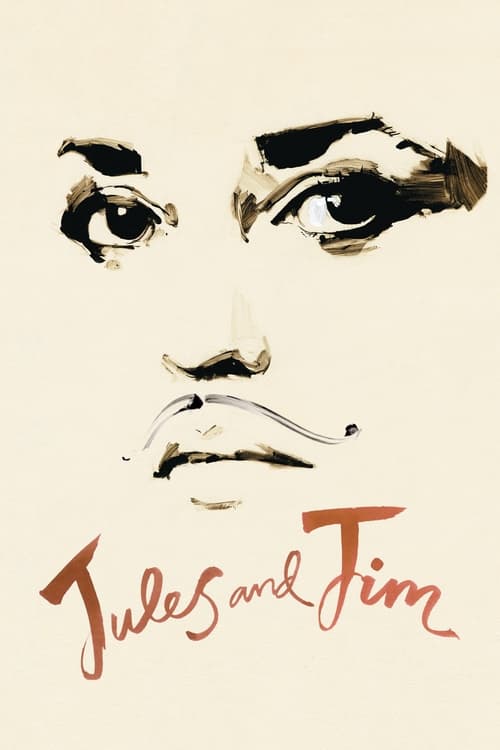
Jules and Jim
1962 · François Truffaut
For when you want to be swept up — a film to fall in love with, and a bittersweet one to sit with after. Perfect for a rainy evening when you're in the mood for romance that's beautiful but refuses to be simple.
What it's about
In bohemian Paris just before the First World War, a shy Austrian writer and his exuberant French best friend both fall for Catherine — impulsive, magnetic, and constitutionally incapable of belonging to anyone. The film follows the three of them across two decades, through marriage, war, and every attempted arrangement of love and friendship, as they try to invent a way of living together that the world has no name for.
The experience
It starts giddy — racing narration, jump cuts, sun-dappled bicycle rides — and slowly deepens into melancholy without ever losing its lightness. You come out feeling like you've lived through twenty years with these people: exhilarated, then quietly heartbroken.
Performances
Jeanne Moreau as Catherine is one of the great screen performances — capricious, radiant, and impossible to pin down, she makes you understand exactly why two men would reorganize their lives around her. Oskar Werner brings a gentle, aching patience to Jules that anchors the whole film.
The craft
Truffaut throws the whole toolkit at the screen — freeze-frames, newsreel inserts, swooping camera moves, a narrator who tells you decades in a sentence — and somehow it all feels effortless rather than showy. Raoul Coutard's black-and-white photography and Georges Delerue's wistful score give it the texture of a remembered dream.
Why it matters
The film that cemented Truffaut's international reputation and became one of the French New Wave's most beloved exports, its freewheeling style and frank treatment of a three-way love echoing through decades of romantic cinema.
Snapshot
Jules and Jim is François Truffaut's third feature and the film that secured his international reputation as the French New Wave's most emotionally generous auteur. Adapted from Henri-Pierre Roché's semi-autobiographical novel (1953), it traces a two-decade friendship between an Austrian writer (Jules, played by Oskar Werner) and a Frenchman (Jim, played by Henri Serre), and the woman — Catherine, played by Jeanne Moreau — who reshapes and eventually destroys the equilibrium between them. Shot in black and white by Raoul Coutard and released in France in January 1962, the film combines the formal restlessness of the Nouvelle Vague with an unusual warmth and literary sweep, rendering it at once a stylistic manifesto and a deeply felt elegy for friendship, freedom, and irretrievable time.
Industry & production
The film was produced by Truffaut's own company, Films du Carrosse, in co-production with SEDIF. Films du Carrosse — named in homage to Jean Renoir's La Carrosse d'or — had been established partly to give Truffaut control over the conditions of his filmmaking, a direct response to the industrial habits of the cinéma de qualité he had attacked in his polemical Cahiers du Cinéma criticism.
Roché's novel had not been widely translated or read when Truffaut discovered it. Roché himself died in 1959, just after Truffaut had secured the rights, so the two men corresponded but never collaborated on the adaptation. The screenplay was written jointly by Truffaut and Jean Gruault, who would become a frequent collaborator (later working with Truffaut on L'Enfant sauvage and L'Histoire d'Adèle H., and with Alain Resnais on Mon Oncle d'Amérique). Gruault's literary background helped translate Roché's dense, aphoristic prose style into something filmable without collapsing it into conventional dialogue. The finished script preserves much of Roché's narration, delivered in the film by voice-over — a choice that keeps the viewer at a slight, melancholy distance from events that feel simultaneously intimate and past.
Casting Jeanne Moreau was central to the project's conception. Moreau, already an international star after Louis Malle's Ascenseur pour l'échafaud (1958) and Les Amants (1958), brought an authority and erotic complexity to Catherine that the role demanded. Oskar Werner, the Austrian stage actor, was cast partly for his nationality — Jules is explicitly Austrian, a foreigner in Paris — and the slight formality of Werner's manner suited the character's remove. Henri Serre, a less established actor, was cast as Jim partly to allow Werner and Moreau to anchor the film's emotional weight.
Technology
Coutard shot the film in black and white on 35mm, using the lightweight Cameflex camera that had become the Nouvelle Vague's instrument of choice. The Cameflex allowed handheld movement and rapid repositioning impossible with the heavier studio cameras of the qualité tradition. For the archive-footage sequences — Truffaut integrates newsreel footage of pre-war Paris and, later, of Nazi book-burning — different film stocks and frame rates are visible, a deliberate texture of historical documentation layered against the staged material.
The film also includes passages of still photography: Truffaut uses a series of photographs — of Catherine's face in motion, captured mid-expression — as a formal device that anticipates the freeze frame. The kinship between photography and cinema, between the arrested moment and the unspooling of time, is structurally embedded in the film's technology.
Technique
Cinematography
Coutard's work on Jules and Jim is distinguished from his concurrent collaboration with Godard by its greater warmth and tonal stability. Where À bout de souffle courts visual rawness, Coutard here modulates light with greater control — the exteriors of the Rhine valley and the idyllic scenes at the country house achieve a period softness without reverting to the prettiness of conventional historical films.
The most celebrated single image in the film is the freeze frame of Catherine's face: caught mid-laugh, mid-movement, the frame locks and Delerue's score swells beneath it. This was among the earliest uses of the photographic freeze within narrative cinema as an expressive (rather than merely technical) device, and it became one of the defining images of the Nouvelle Vague. Coutard also employs irises — a technique from silent cinema — and variable film speed, accelerating the bicycle chase to a joyful blur, literalizing the sensation of a life briefly unconstrained.
Editing
Claudine Bouché edited the film. The editing is among the most sophisticated of the Nouvelle Vague cycle: it is elliptical in its handling of time — decades collapse across single cuts — but unhurried within scenes, allowing conversations and silences their full weight. The episodic structure of Roché's novel demanded an editor comfortable with temporal jump cuts that are emotional rather than disorienting. Bouché achieves this by using Subor's voice-over as a continuous thread, tying together sequences that otherwise belong to entirely different years and emotional registers.
Mise-en-scène / staging
Truffaut stages the three leads with deliberate asymmetry: Catherine rarely occupies a settled position in the frame. She enters, crosses, exits, stands apart. The house in the Rhine valley — the film's central domestic space — is photographed to feel provisional, like a campsite rather than a home. The famous bicycle sequence, in which Catherine races Jim across a bridge and wins, is staged in long shot and allowed to unfold almost in real time, resisting the temptation to edit for emphasis: the joy is in the duration.
The sequence involving the stone statue — Jules and Jim, before meeting Catherine, become enchanted by a photograph of an ancient sculpture on a remote Adriatic island whose archaic smile resembles no living woman they know — is staged with the reverence of a pilgrimage. When Catherine appears, the match between her face and the statue's expression is not shown directly but implied through the men's reactions: Truffaut resists the cheap confirmation shot.
Sound
Georges Delerue's orchestral score is one of the finest of the French New Wave, and one of the most imitated. Its central theme — warm, modal, built on woodwinds and strings — recurs across the film's decades with slight variations that encode the changing emotional temperature. Delerue's scoring was predominantly post-synchronous, in keeping with the production practices of the period.
The song "Le Tourbillon de la vie," performed by Jeanne Moreau in a café sequence, was written and composed by Serge Rezvani (also known by the pseudonym Bassiak) — not by Delerue — and became separately famous as a piece associated with Moreau's persona. Its lyrics about love as a spinning gust of wind ("un tourbillon") function as a gloss on the film's entire argument.
Performance
Moreau's performance is the film's irreducible center. She plays Catherine not as a femme fatale in any conventional genre sense but as a person whose absolute need for freedom destroys everything around her — including herself — while generating genuine wonder in those she loves and abandons. The performance is behavioral and specific: Catherine's impulsive mustache (she draws one on her own face), her leap into the Seine, her silences, all register as lived idiosyncrasy rather than symbolic gesture.
Werner brings an interior, watchful quality to Jules; his scenes late in the film, watching Catherine pursue Jim, are among the most difficult in the New Wave — a man choosing to preserve a friendship over a marriage, accepting a configuration of loss he cannot name.
Narrative & dramatic mode
The film is structured as a retrospective chronicle, bracketed by the narrator's voice-over in the past tense. Events are organized episodically, the episodes linked by the passage of time and the shifting geometries of the triangle rather than by conventional cause-and-effect plotting. World War I — in which Jules and Jim fight on opposite sides — enters the narrative as interruption and ellipsis; the war is not dramatized but summarized, its human cost registered in the men's anxiety about killing one another on the battlefield. This compression is both a formal choice and a moral one: the war is refused the dramatic inflation it usually receives.
The ending is among the most austere in French cinema. Catherine drives her car off a bridge into the river below, with Jim as passenger. Jules, watching, cannot intervene. The narrator's account of the disposal of their ashes is delivered in a flat, factual register that intensifies rather than diminishes the grief.
Genre & cycle
Jules and Jim belongs to the Nouvelle Vague cycle of the early 1960s, but it sits at an angle to the movement's most characteristic works. It is more novelistic than À bout de souffle, less politically oblique than Resnais, less systematically ironic than early Chabrol. It participates in the New Wave's project of rehabilitating and transforming certain American genre conventions — here, the romantic triangle — while drawing heavily on the French literary tradition. The film has also been placed within a loosely defined cycle of post-war European films about the impossibility of bourgeois domestic life, alongside works by Bergman, Antonioni, and Resnais.
Authorship & method
By 1962 Truffaut had established the politique des auteurs not only as a critical position but as a production strategy: Films du Carrosse was designed to replicate the conditions of personal authorship at the level of industrial organization. Jules and Jim is his most elaborately literary film to this point — its debt to Roché's prose style is audible in the narration — but it is also the film where his characteristic tenderness for his characters most fully overrides the cooler irony of his critical training.
Jean Gruault's contributions to the screenplay are difficult to isolate at this remove, but the adaptation's fidelity to Roché's elliptical time structure is likely owed in part to Gruault's novelistic instincts. Coutard's cinematography, Delerue's score, Bouché's editing, and Moreau's performance constitute a genuinely collective achievement, and Truffaut was forthcoming in acknowledging these collaborations.
Movement / national cinema
Jules and Jim is canonical Nouvelle Vague, produced within the movement's self-conscious moment of institutional formation — the period between Les Quatre Cents Coups (1959) and the dispersal of the group's energies in the mid-1960s. Its freedom with time, its handheld aesthetic, its literary voice-over, its refusal of the studio system's polish, all align it with the movement's stated program. Yet it is also the Nouvelle Vague film most deeply in dialogue with classical French cinema — with Renoir especially, whose generosity toward fallible characters, whose outdoor textures, and whose interest in the instabilities of bourgeois amour are pervasive presences. Truffaut has spoken of Renoir as his primary cinematic father.
Era / period
The film is set between approximately 1912 and 1933: from the carefree pre-war years in Paris through the post-war Rhine valley idyll, ending in the early Nazi period. A brief sequence of Nazi book-burning — rendered in documentary footage — appears not as historical commentary but as atmospheric darkening, a sign that the world the characters inhabit is being consumed from without at the same moment Catherine's internal flame consumes from within. The film was made at a moment of Algerian War-era political tension in France, though Jules and Jim does not address this directly.
Themes
The film's central preoccupation is the incompatibility of absolute freedom with lasting love, and the violence this incompatibility inflicts on those who genuinely care for one another. Catherine insists on a liberty that cannot be institutionalized in marriage or managed by fidelity; the two men, who love her and love each other, cannot provide the conditions her nature demands without destroying their own. The film neither condemns Catherine nor romanticizes her; Truffaut holds both responses simultaneously.
Time and memory are equally central: the voice-over's elegiac distance frames the entire film as already lost, already mourned. The archive footage, the freeze frames, the photographs, and the irises are all formal inscriptions of time as both passage and arrest.
The friendship between Jules and Jim — male friendship as a primary bond, surviving sexual rivalry, war, and mutual betrayal — is treated with a seriousness unusual for the period. The film asks whether friendship can survive love, and answers: barely, and at enormous cost.
Reception, canon & influence
Backward — influences on the film: Truffaut cited Jean Renoir repeatedly as his primary influence, and the debts here are structural as well as tonal — the country-house sequences, the fluid social comedy, the refusal to assign villain status. Max Ophüls' influence on the camera's capacity for lyrical movement is also detectable. The American screwball comedy of the 1930s, with its quick-witted, ungovernable women, informs Catherine's construction without determining it. The silent cinema techniques — iris, freeze, acceleration — are deliberate archaeological recoveries.
Critical reception: The film opened to strong notices in France and was rapidly taken up by international critics as evidence that the Nouvelle Vague was not confined to Godard's urban cool. Moreau's performance was widely praised as a career-defining achievement. Some critics noted a tension between the film's feminist implications — Catherine as a fully autonomous subject — and its narrative, which punishes her freedom with death; this debate has intensified over subsequent decades.
Forward — legacy and influence: The film's influence on romantic cinema is pervasive but often unacknowledged. The ménage-à-trois triangle, the melancholy retrospective narrator, the freeze frame as expressive punctuation — all became available as grammar for subsequent filmmakers. Paul Mazursky's Bob & Carol & Ted & Alice (1969) owes something to the film's emotional geography. Bertolucci's The Dreamers (2003) is in direct dialogue with it. Wes Anderson has cited Truffaut broadly. Delerue's score was itself influential on a generation of European film composers working in the warm orchestral mode.
The film is firmly canonical: it appears on major critical lists and is a standard text in film education worldwide. Its place in the Nouvelle Vague pantheon is second only to À bout de souffle in frequency of citation, and for many critics it is the superior achievement — the movement's technical energy in the service of genuine feeling rather than formal demonstration.
A Deleuzian reading
The image everyone keeps is the one that stops.
The full Deleuzian reading of Jules and Jim →
Reception
No flop-to-classic story here — it was acclaimed almost instantly in 1962 and made Jeanne Moreau an international icon, even as its ménage à trois scandalised censors (the Catholic Legion of Decency condemned it in the US). What's shifted is the reading: once received as a bittersweet hymn to free love, it's now just as often discussed as a clear-eyed autopsy of it.
How Jules and Jim was received, from release to now →
Influences: the films it descends from and the films it influenced
- La Règle du jeu (1939) — Truffaut inherits Renoir's ensemble staging method in which the camera tracks multiple characters simultaneously without assigning moral weight to any of them, and his tonal practice of holding comedy and tragedy in the same scene without resolving the tension — the country-house sequences in both films share this ambivalent register directly.
- Partie de campagne (1936) — Renoir's use of natural exterior light and river-location shooting to construct pastoral sequences whose visual beauty intensifies the melancholy of transient happiness directly models Truffaut's Rhine valley and country-house photography, where Coutard's soft outdoor exposures perform the same elegiac function.
- Bringing Up Baby (1938) — Hawks's screwball triangle — two men whose friendship is reorganized by a woman who seizes narrative initiative and controls the plot through comic aggression — is the structural template for Catherine's role; the fast overlapping dialogue rhythm of Hawks's ensemble scenes also enters Jules and Jim's conversational texture.
- Hiroshima mon amour (1959) — Resnais's method of integrating newsreel documentary footage with staged narrative material to create temporal layering directly precedes Truffaut's embedding of Nazi book-burning newsreels as historical texture within the retrospective chronicle, using archival grain against staged image as a deliberate tonal contrast.
- Les 400 coups (1959) — Truffaut's freeze-frame ending — Antoine locked in motion at the sea — established the device as an expressive rather than technical tool in his own practice; Jules and Jim extends it by deploying the freeze mid-narrative, arresting Catherine's face at peak joy rather than at a terminal moment, converting the technique from punctuation to lyric declaration.
- À bout de souffle (1960) — Raoul Coutard developed the Cameflex handheld grammar — rapid repositioning, spontaneous tracking, available-light exposure — on this film immediately before Jules and Jim; Truffaut inherits the cinematographic language wholesale and applies it with warmer tonal control, substituting Godard's rawness for a period softness that the screwball register demands.
- Tirez sur le pianiste (1960) — Both films deploy Georges Delerue's orchestral score as ironic counterpoint — sentimental music set against dissonant or violent action — share Coutard's Cameflex handheld work, and toggle between wry comedy and abrupt tragedy using the same tonal grammar developed across Truffaut's first three features.
- Le Plaisir (1952) — Truffaut, who wrote Cahiers criticism advocating for Ophüls's camera as instrument of desire, translates Le Plaisir's fluid tracking-shot grammar and literary-register narrator seaming temporal ellipses directly into New Wave idiom, the crane shots following the trio rhyming with Ophüls's ballroom mobility.
- Children of Paradise (1945) — Truffaut, an avowed admirer despite the New Wave's anti-tradition-of-quality polemic, sustains the romantic triangle governed by fate and missed timing.
- Elvira Madigan (1967) — Widerberg deploys freeze frames and slow-motion variable speed as expressive devices for ecstatic and elegiac moments in a doomed romance, inheriting Jules and Jim's formal vocabulary — the freeze as an act of love for the image — and extending it into a Scandinavian pastoral where arrested motion serves the same function as Delerue's swelling score.
- Bonnie and Clyde (1967) — Penn translates Jules and Jim's expressive use of freeze frame and variable film speed — deployed here in the climactic ambush — into the American New Hollywood register, transmitting the technique through the French New Wave's influence on the film school generation; the freeze-before-death is a direct formal quotation of Truffaut's mid-narrative arrest of Catherine's face.
- Il Conformista (1970) — Storaro elaborates Coutard's Cameflex mobile-camera aesthetic into a more painterly chiaroscuro grammar, while the retrospective chronicle structure — a man reviewing the compromises of a life during a decisive journey — develops Jules and Jim's model of organizing historical period through intimate personal reckoning across a span of years.
- Badlands (1973) — Holly's retrospective voice-over — emotionally detached from events being depicted, creating ironic distance between the narrator's affect and the violence she is describing — is a direct formal inheritance from Jules and Jim's narratorial mode, where the off-screen voice knows more than the characters and maintains a melancholy remove from the present tense of each scene.
- Days of Heaven (1978) — Malick's romantic triangle narrated retrospectively by a detached voice (Linda Manz), combined with Néstor Almendros's natural-light location cinematography that turns landscape into elegiac register, extends Jules and Jim's structural and visual model into the American prairie — the chronicle of doomed love observed at a temporal remove through a narrator's retrospective consciousness.
- Y Tu Mamá También (2001) — Cuarón inherits Jules and Jim's narratorial device of an omniscient retrospective voice-over that interjects future information about the characters' fates mid-scene — the narrator intrudes to tell us what will happen to each figure after the journey ends — converting Truffaut's literary chronicle structure into a picaresque road-movie form.
- The Dreamers (2003) — Bertolucci stages a three-body dynamic among cinephiles in 1968 Paris and integrates archival film clips into the narrative as found-footage texture — characters physically inhabit the films they love — while the handheld Cameflex-lineage camerawork constitutes a deliberate formal tribute to Jules and Jim's technique of embedding cinema history within a retrospective romantic chronicle.
- Election (1999) — The New Wave template of clipped freeze-frames and braided over-narration as commentary, the editorializing grammar Payne and editor Kevin Tent borrow to interrupt and judge their characters mid-action.
- Silkwood (1983) — Composer Georges Delerue's restrained, lyrical scoring that comments without swelling — the anti-sentimental musical discipline he brings to Silkwood.
- Amélie (2001) — The breathless omniscient voiceover cataloging characters' tastes and fates, plus freeze-frames and rapid associative montage, is the direct template for Amélie's narrator listing likes and dislikes.
- Rendez-vous (1985) — The New Wave's cinephile-romantic lyricism — interlaced love triangle, propulsive mobile camera, elliptical leaps, and an eros-thanatos ending — is the post-Cahiers inheritance Téchiné bends toward melodrama.
- Cold War (2018) — Decade-spanning love triangle told in episodic leaps, bridging years through brisk narration and elliptical compression rather than continuous plotting — the fragmented-melodrama scaffolding Cold War compresses to 88 minutes.
- Ma nuit chez Maud (1969) — Rohmer extends the Nouvelle Vague romantic triangle into a chamber structure organized around explicitly articulated philosophical positions, sharing the retrospective voice-over mode and the bourgeois-intellectual register in which characters debate love and freedom as ethical categories rather than merely experiencing them.
- Les Deux Anglaises et le Continent (1971) — Truffaut and Jean Gruault structurally invert Jules and Jim — one man between two women — using the identical retrospective chronicle form, the same Delerue orchestral score, and the same practice of integrating letters and diary entries as voice-over continuity across temporal ellipsis; the film is a deliberate formal mirror of its predecessor.
- Contempt (1963) — Georges Delerue's score for Jules and Jim established his leitmotif method — a recurring melodic theme assigned to a character's emotional register and reprised at the moment of loss — which Godard then commissioned for Contempt, where Delerue's 'death' theme functions as the film's emotional spine, marking each stage of Camille's withdrawal before dialogue acknowledges it.
- Vivre Sa Vie (1962) — Coutard's mobile lateral tracking and the splicing of newsreel document into fiction, the shared Coutard/New Wave camera grammar.
- Diary of a Chambermaid (1964) — Showcases Moreau's strategic, guarded irony as a performance mode — a watchful woman managing the men around her.
- King of Hearts (1966) — Showcases Georges Delerue's lyrical, waltzing scoring that gives bittersweet tonal swerves their emotional signature — the same composer-as-co-author voice de Broca (Truffaut's former assistant) relies on.
- The Unbearable Lightness of Being (1988) — A lyrical free-love triangle treated with buoyant tonal lightness against a darkening historical tide — the same play of erotic lightness versus political weight.
Similar films
- Shoot the Piano Player (1960) — influence & lineage
- Hiroshima Mon Amour (1959) — influence & lineage
- Breathless (1960) — influence & lineage
- The Mother and the Whore (1973) — shared sensibility
- Elevator to the Gallows (1958) — shared sensibility
- Céline and Julie Go Boating (1974) — shared sensibility
- Take It All (1963) — shared sensibility
- The 400 Blows (1959) — shared sensibility
All the films related to Jules and Jim →