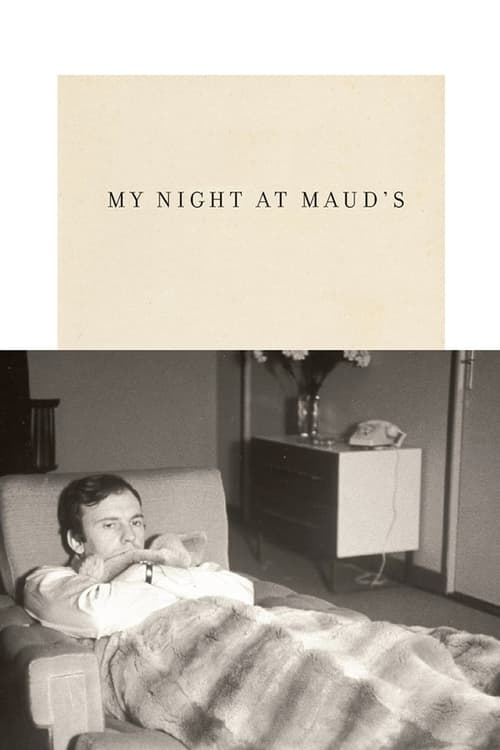
My Night at Maud's
1969 · Éric Rohmer
For a quiet winter night when you want grown-up conversation instead of plot — when eavesdropping on brilliant, slightly dishonest people flirting sounds like the perfect evening. A gentle challenge: it asks patience and rewards it.
What it's about
A devout Catholic engineer in wintry Clermont-Ferrand has privately decided to marry a blonde stranger he's only seen at Mass. Then an old Marxist friend introduces him to Maud — a witty, recently divorced freethinker — and a snowy Christmas night traps him in her apartment, where conversation about faith, chance, love, and Pascal becomes its own kind of seduction. The whole film hangs on what he'll do with a vow no one else knows he's made.
The experience
It's almost all talk, and the talk is electric — flirtation conducted through philosophy, with every polite sentence hiding a move. Unhurried and dryly funny, it keeps a low hum of erotic and moral tension going for two hours without a single raised voice.
Performances
Jean-Louis Trintignant makes self-righteousness fascinating — you can watch him rationalize in real time — while Françoise Fabian's Maud is warm, amused, and quietly devastating, seeing through him faster than he sees himself.
The craft
Rohmer builds a whole drama out of dialogue and glances, staged with mathematical precision, and Néstor Almendros shoots the snowbound provincial city in crisp black and white that makes an apartment at midnight feel like the center of the world. Nothing is wasted; the framing tells you who's winning each exchange.
Why it matters
The film that turned Rohmer from respected critic into internationally celebrated director, and the breakout of his 'Six Moral Tales' cycle — proof that a movie made of conversation could be gripping. Its DNA is in every talk-driven romance since.
Snapshot
My Night at Maud's (Ma nuit chez Maud) is the film that turned Éric Rohmer, after a decade and a half of criticism and marginal filmmaking, into an internationally recognized auteur. The third entry in his cycle of "Six Moral Tales" (Six contes moraux) by the director's own numbering, it dramatizes a single moral predicament with almost mathematical rigor: a devout Catholic engineer, having silently resolved to marry a blonde stranger he has glimpsed at Mass, is detained overnight in the apartment of a freethinking divorcée and must decide what fidelity to an unspoken vow actually requires. Around this slender situation Rohmer builds a film made almost entirely of talk — about Pascal, probability, grace, Marxism, love, and self-knowledge — shot in austere black and white in wintry Clermont-Ferrand. The result is one of the defining "conversation films" of world cinema: intellectually dense yet sensuous, comic yet morally serious, and a foundational text for every later filmmaker who believed two people talking in a room could carry a feature.
Industry & production
The picture emerged from Les Films du Losange, the production company Rohmer had co-founded with Barbet Schroeder, the small artisanal outfit that made the Moral Tales possible outside the conventional studio economy. Although Rohmer conceived Maud's as the third tale in the series, he was forced to shoot it out of sequence. He wanted Jean-Louis Trintignant — by the late 1960s a major star — for the lead, and the story's Christmas setting in Clermont-Ferrand demanded a specific winter shoot. Unable to secure Trintignant and the timing earlier, Rohmer made La Collectionneuse (1967) first, then returned to Maud's once the actor and the season aligned. The film was shot around Christmas to capture genuine snow and the cold gray light of the Auvergne.
By the standards of Rohmer's earlier work the production was modest but no longer shoestring; Trintignant's participation and the growing reputation of the Losange enterprise gave it more visibility, and the project drew co-financing support from sympathetic quarters of the French art-cinema milieu (Pierre Cottrell is associated with the production as producer). The exact financing arrangements are the kind of detail that is reported inconsistently, and I won't overstate them.
Commercially and in terms of prestige the film was a breakthrough. It was selected at Cannes in 1969, was named France's official submission for the Academy Award for Best Foreign Language Film for that year, and subsequently received a second Oscar nomination for Best Original Screenplay (1970) — a rare double recognition for a small French art film and confirmation that Rohmer's talk-driven cinema had broken through to a wide international audience.
Technology
The most consequential technological decision was to shoot in black and white in 1969, when color had become the commercial default. Working with cinematographer Néstor Almendros, Rohmer chose monochrome deliberately, for an austerity and tonal gravity suited to the film's Pascalian, wintry mood; Almendros later discussed his preference for natural light and unfussy means, and Maud's exemplifies that ethic. The production relied on available and practical light wherever possible, lightweight equipment, and direct location sound, all of which kept the crew small and the shooting intimate — an approach that descended from New Wave practice but which Rohmer refined into a settled house style rather than a youthful gambit.
Technique
Cinematography
Almendros's black-and-white photography is the film's visual signature: a register of soft grays, snow-flattened exteriors, and interiors lit to feel lived-in rather than dramatized. The camera is restrained, favoring patient framing over emphasis, so that the long centerpiece in Maud's apartment unfolds with a quiet attentiveness — the white expanse of Maud's bed becoming the most charged object in the frame precisely because the lighting refuses to sensationalize it. The exteriors of Clermont-Ferrand, the snow, the empty streets, and Trintignant's car nosing through winter weather give the moral argument a concrete, almost documentary ground.
Editing
Cut by Cécile Decugis, Rohmer's regular editor, the film is built from long takes and sparing cuts that follow the rhythm of conversation rather than imposing a tempo on it. Editing here is a matter of letting scenes breathe to their natural length; the famous overnight sequence is sustained well past the point a more conventional film would have trimmed it, and that duration is the point — the talk has to outlast the viewer's expectation of where it will go.
Mise-en-scène / staging
The staging is grounded in real locations: the Michelin-town milieu of Clermont-Ferrand (Pascal's birthplace, pointedly), a Catholic church during Mass, the café where the old friends reunite, and above all Maud's apartment, with its modern furnishings and that central bed. Rohmer composes the three-way conversation among Jean-Louis, Vidal, and Maud as a kind of chamber drama, the actors arranged so that ideological and erotic positions are also physical positions in the room. The snow outside and the warmth inside form the film's basic moral geography: the cold of resolve versus the comfort of temptation.
Sound
The soundtrack is built on direct, recorded location sound and the human voice. Consistent with Rohmer's lifelong suspicion of non-diegetic scoring — he generally refused to underline emotion with music — the film carries little or no added score, letting silence, footsteps, and conversation do the work. (I won't assert specific musical cues from memory, as the record on that point is easy to misremember.) The effect is a heightened plainness in which every spoken sentence registers.
Performance
The acting is the film's true special effect. Trintignant plays Jean-Louis with a controlled, slightly evasive reserve — a man whose Catholic principle is never quite distinguishable from vanity and self-protection. Françoise Fabian's Maud is the performance that lingers: worldly, lucid, generous, and quietly wounded, she gives the libertine position more dignity and intelligence than the script's protagonist can muster. Antoine Vitez brings a dry, theatrical wit to Vidal, the Marxist friend who sets the Pascalian wager in motion, and Marie-Christine Barrault, as the devout Françoise whom Jean-Louis has chosen, grounds the film's final movement. The ensemble makes abstract debate feel like lived behavior.
Narrative & dramatic mode
Maud's follows the template of the Moral Tales: a man committed (here only privately) to one woman is tempted by a second, more available and more interesting woman, and the drama lies in how he talks himself through — and out of — that temptation. The mode is first-person and retrospective, organized around the male protagonist's consciousness, though Rohmer here uses voiceover more sparingly than in some other tales, letting dialogue carry the interiority. Crucially, the "plot" is almost entirely verbal: the action is a series of conversations, and the suspense is moral and intellectual rather than situational. The film's structure rhymes ideas with events — the cocktail of chance and choice debated over Pascal's wager is then enacted in Jean-Louis's own hesitations — and the ironic ending reframes everything that came before, exposing the gap between the hero's high principles and the workings of accident in his life.
Genre & cycle
Nominally a romance-comedy-drama, the film belongs most precisely to Rohmer's self-defined genre of the conte moral — a literary form he originated in prose and then filmed. The cycle's unifying conceit (a tempted man, an alternative woman, a return) makes each entry a variation on a theme, and Maud's is widely regarded as the cycle's intellectual summit. More broadly it helped establish the "talk film" or comedy of ideas as a viable genre in art cinema: a film whose pleasures are conversational, where wit and argument substitute for incident.
Authorship & method
Éric Rohmer (born Maurice Schérer) was the eldest and most classically literary of the Cahiers du Cinéma critics-turned-directors; he edited Cahiers from 1957 to 1963 and came to sustained feature filmmaking later than Godard, Truffaut, or Chabrol. His method was singular: he wrote the Moral Tales first as literary prose, treating the films as adaptations of his own texts, which gave the dialogue its density and finish. On set he worked with a small crew, natural light, location sound, long takes, and a refusal of conventional dramatization, trusting actors to inhabit the written speech as behavior rather than recitation.
His key collaborator here is cinematographer Néstor Almendros, whose partnership with Rohmer (begun on La Collectionneuse) defined the look of this period and who would go on to a celebrated international career. Editor Cécile Decugis shaped the conversational rhythm. The casting of Trintignant, Fabian, Vitez, and Barrault was itself an authorial act — Rohmer needed performers who could make philosophy sound like talk. There is no composer of note, by design.
Movement / national cinema
The film is a product of the French New Wave (Nouvelle Vague), specifically its Cahiers wing, but Rohmer occupies its most conservative and classical position. Where Godard fractured form, Rohmer pursued transparency, literary refinement, and moral seriousness rooted in his Catholicism. Maud's shows the New Wave maturing past its iconoclastic phase into something more measured and durable — proof that the movement's ethic of small crews, real locations, and personal authorship could yield not just youthful experiment but a sustained, mandarin body of work.
Era / period
Released in 1969, in the immediate wake of May 1968, Maud's is conspicuously a film of ideas rather than barricades. Its central debate between Catholic faith and Marxist materialism, staged between two old friends, registers the era's ideological temperature without taking to the streets; the film's interest is in how belief governs private conduct rather than public revolution. That apparent detachment is itself a period statement — an insistence, amid political ferment, on the older European traditions of moral philosophy, Jansenist rigor, and the examined conscience.
Themes
At its core the film is about chance versus providence and the difficulty of self-knowledge. Pascal's wager — the rational gamble on God's existence — supplies the governing metaphor, doubled by the protagonist's profession (an engineer at home with probability) and by a plot that turns on coincidence. Rohmer threads Catholic ideas of grace, fidelity, and obligation against the worldly lucidity Maud represents, and lets the contrast expose his hero's self-deception: Jean-Louis's piety functions as much to flatter and protect him as to bind him. Other persistent themes — the difference between desire and decision, the morality of the choices we pretend not to be making, and the comedy of intellectual men rationalizing their appetites — recur across the Moral Tales but are nowhere sharper than here. The final irony quietly indicts the whole apparatus of principle the film has so eloquently rehearsed.
Reception, canon & influence
The film was a critical triumph and Rohmer's commercial breakthrough, the work that carried his name beyond France. Its twin Oscar nominations — Best Foreign Language Film and, the following year, Best Original Screenplay — signaled an unusually broad embrace for so cerebral a picture, and it was widely praised by leading critics of the day as proof that a film of pure conversation could be gripping. It remains a fixture in the canon of postwar European art cinema and is frequently named among the finest French films of its era.
The influences on the film run backward into literature and philosophy more than cinema: Blaise Pascal above all (the Pensées and the wager), the Catholic-Jansenist intellectual tradition, the French moralists, and Rohmer's own critical formation at Cahiers. The classical restraint owes to his temperamental distance from the New Wave's more radical impulses.
Its legacy forward is enormous and specific. My Night at Maud's is a touchstone for the entire modern lineage of talk-driven, intellectually playful cinema: Richard Linklater's Before trilogy descends directly from its faith that walking-and-talking can be dramatic; Whit Stillman's mannered comedies of overarticulate young people, Noah Baumbach's verbal naturalism, and Hong Sang-soo's recursive conversations over wine all carry Rohmer's DNA. More generally, the film helped legitimize the idea that moral and philosophical argument could be the substance, not the seasoning, of narrative film — a permission that independent and art cinema has drawn on ever since.
A Deleuzian reading
A woman's bed sits white and plain in the middle of a gray room, and a man has decided, before he ever entered, not to lie down in it.
The full Deleuzian reading of My Night at Maud's →
Reception
The talky, no-budget sleeper that made Rohmer an international name at nearly 50 — a genuine arthouse hit in 1969 that earned two Oscar nominations, and it's never really left the canon since, anchoring the Six Moral Tales as their most revered entry.
How My Night at Maud's was received, from release to now →
Influences: the films it descends from and the films it influenced
- Diary of a Country Priest (1951) — Establishes the Jansenist-Catholic interiority and anti-theatrical direction Rohmer adopts — actors delivering literary text flatly as behavior rather than performance, refusing conventional dramatization of a spiritual crisis.
- Pickpocket (1959) — Models the first-person moral self-justification — a protagonist narrating and rationalizing his own conduct — that Rohmer formalizes as the structuring device of the entire Moral Tales cycle.
- Gertrud (1964) — Demonstrates a feature built almost entirely from long, sustained two-person conversations held in static takes, proving talk itself can carry dramatic tension — the formal precedent for Maud's chamber dialogues.
- Winter Light (1963) — Austere, near-scoreless chamber treatment of a crisis of religious faith conducted through dialogue, prefiguring Rohmer's wager between belief and doubt as conversational drama.
- Voyage to Italy (1954) — The Cahiers touchstone for location shooting, direct sound and undramatized real-time observation of a couple — the neorealist naturalism Rohmer inherits through his critical formation.
- The Rules of the Game (1939) — Renoir's deep-focus ensemble staging and humane irony toward characters' self-deceptions supplies the moralist's detached-but-warm gaze Rohmer turns on Jean-Louis.
- Through a Glass Darkly (1961) — Rohmer applies the Strindbergian two-character chamber-drama grammar to French Catholic spiritual crisis: Néstor Almendros's close-ups of two people in a single room explore faith and desire through the same compressed-space, dialogue-as-existential-crisis structure Bergman derives from Strindberg.
- Le Plaisir (1952) — Rohmer's literary-register first-person narration creates the same ironic gap between what the voice retrospectively claims and what the images reveal that Le Plaisir's Jean Servais achieves: pleasure narrated with knowing retrospective distance, desire structured through the discrepancy between prose and image.
- My Dinner with Andre (1981) — Takes Rohmer's wager — that a single sustained conversation can be the whole drama — to its logical limit, an entire feature of two men talking at a table.
- Metropolitan (1990) — Transposes Rohmer's drawing-room debates to Manhattan's young intelligentsia, with overarticulate characters arguing morality and Pascalian wagers in chamber-scaled rooms.
- Before Sunrise (1995) — Directly descends from the faith that walking-and-talking is itself dramatic, staging an extended courtship as real-time philosophical conversation in long takes.
- Before Sunset (2004) — Sustains a near-real-time single conversation through unbroken long takes, extending Rohmer's principle that moral and romantic reckoning happens in talk, not action.
- Right Now, Wrong Then (2015) — Carries Rohmer's DNA in recursive, wine-soaked conversations and ironic structural patterning that expose a man's romantic self-deception.
- Frances Ha (2012) — Extends Rohmer's verbal naturalism — overarticulate young people whose self-image is revealed through the gap between what they say and what they do.
- Days of Heaven (1978) — Néstor Almendros carries forward the natural-light aesthetic he forged with Rohmer, shooting in available and magic-hour light as a continuation of that craft.
- Force Majeure (2014) — The Moral Tale structure — bourgeois characters confined by Alpine weather, forced into extended dialogue that is really philosophical negotiation about ethics and self-image — is the architectural template Östlund applies: the ski resort as Rohmer pressure cooker, Tomas as a man whose stated values and revealed instincts refuse to align.
- Toni Erdmann (2016) — Ade cited Rohmer; his conversational cinema locates all dramatic action in the behavioral nuances of extended dialogue scenes where social performance and private desire are inseparable, providing the formal model for Toni Erdmann's talk-based sequences with no score to signal emotional valence.
- Drive My Car (2021) — Extended moral-philosophical conversation in intimate enclosed spaces treated as the entire dramatic event; the intellectualised grammar of self-justification through spoken exchange that Hamaguchi inherits and transposes into Chekhovian register.
- Certified Copy (2010) — The dialogue-driven philosophical examination of love, where extended talk between two people — not plot — is the cinema, a direct precedent for the two-hander's intellectual texture.
- Slacker (1990) — Treats sustained philosophical conversation as the film's central event rather than connective tissue — the Rohmerian conviction that talk IS action that underwrites Slacker's torrent of monologue.
- La Collectionneuse (1967) — The Moral Tale that launched the Néstor Almendros partnership, fixing the natural-light look and the first-person narrating-protagonist template that Maud's perfects.
- Claire's Knee (1970) — Same Moral Tales cycle and method — written first as prose, shot with small crew and location sound, advancing the structure of a man talking himself into and out of desire.
- Masculin Féminin (1966) — New Wave conversation film built on interview-like exchanges and direct location sound, a contemporary instance of dialogue-as-substance from the same Cahiers milieu.
- Jules and Jim (1962) — Rohmer extends the Nouvelle Vague romantic triangle into a chamber structure organized around explicitly articulated philosophical positions, sharing the retrospective voice-over mode and the bourgeois-intellectual register in which characters debate love and freedom as ethical categories rather than merely experiencing them.
- Vivre Sa Vie (1962) — Makes extended direct-sound philosophical conversation the dramatic substance of the scene, the Rohmerian counterpart to the Parain dialogue.
Similar films
- My Dinner with Andre (1981) — influence & lineage
- Gertrud (1964) — influence & lineage
- The Rules of the Game (1939) — influence & lineage
- Diary of a Chambermaid (1964) — shared sensibility
- Stolen Kisses (1968) — shared sensibility
- Jules and Jim (1962) — shared sensibility
- Amour (2012) — shared sensibility
- Elevator to the Gallows (1958) — shared sensibility
All the films related to My Night at Maud's →