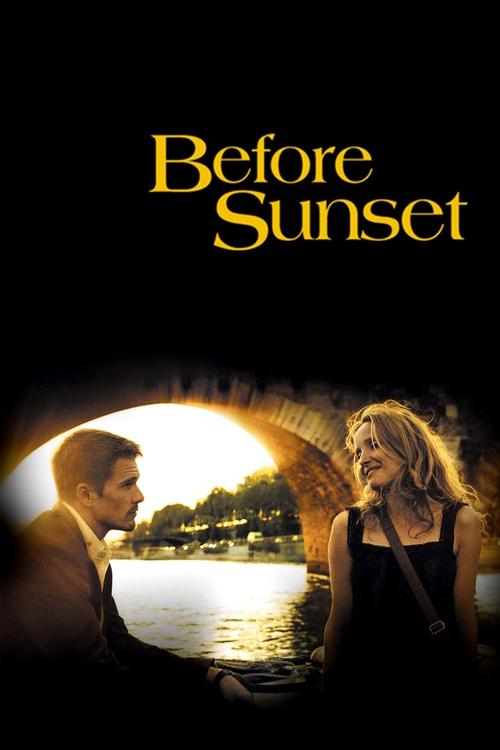
Before Sunset
2004 · Richard Linklater
For when you want to feel the ache of the road not taken — a talky, grown-up romance for a quiet evening, ideally with someone whose 'what if' you still think about. It's comfort and heartbreak in the same glass.
What it's about
Nine years after one unforgettable night in Vienna, Jesse is a published author on a European book tour, and the novel he's promoting is about that night. At his final reading, in a Paris bookshop, Celine walks in. He has a flight to catch in a few hours, so they walk — through gardens, into a café, along the Seine — talking around the one question neither wants to ask first: what happened to the life they almost had together.
The experience
It plays out in something close to real time, one continuous conversation that starts light and polite and slowly cuts closer to the bone. The tension isn't whether something will explode — it's watching two people perform composure while falling apart, and it leaves you wrung out in the gentlest possible way.
Performances
Ethan Hawke and Julie Delpy co-wrote the script with Linklater (earning an Oscar nomination for it), and it shows: they inhabit Jesse and Celine so completely that the line between acting and confession seems to vanish. Delpy in particular gets a late stretch that ranks among the great sustained pieces of screen acting.
The craft
Linklater shoots the whole thing in long, unbroken Steadicam takes that trail the pair through Paris like a discreet third companion, so the city becomes the film's only set and the conversation its only engine. At barely eighty minutes there's not a wasted breath — the editing is essentially invisible because there barely is any. No spectacle, but the dialogue rewards total attention.
Why it matters
Widely considered one of the great sequels in any genre, it turned a one-off indie romance into an ongoing decades-spanning project about time and love, and cemented Linklater's reputation as American cinema's patient chronicler of how people change.
Nine years after Before Sunrise, Richard Linklater reconvened Jesse and Celine for eighty minutes of Paris afternoon — and made one of the great sequels in any genre, a film about what time does to romantic possibility. The conceit is severe: the story unfolds in something close to real time, a single flowing conversation through gardens, cafés, and a bateau-mouche on the Seine, sustained by long Steadicam takes that trail the pair like a discreet third companion. Ethan Hawke and Julie Delpy earned screenplay credit alongside Linklater (and an Oscar nomination), and their fingerprints are everywhere — the dialogue has the layered evasions of people performing composure while falling apart. Where Sunrise was about the intoxication of connection, Sunset is about regret, compromise, and the terrifying question of whether a life can be redirected in one afternoon. The centerpiece of Linklater's durational trilogy — cinema's most patient longitudinal study of a relationship — it closes on one of the most quoted final exchanges of its era, a cut so perfectly timed it feels like held breath.
A Deleuzian reading
He's at a table in the back of a Paris bookshop, taking questions about his novel.
The full Deleuzian reading of Before Sunset →
Reception
Adored on arrival in 2004 — a sequel nobody demanded that critics immediately ranked above the original — and its stature has only climbed since, now routinely called one of the greatest sequels ever made and, for many, the peak of the whole trilogy.
How Before Sunset was received, from release to now →
Influences: the films it descends from and the films it influenced
- Before Sunrise (1995) — The originating installment whose Hawke–Delpy–Linklater co-writing method — actors drafting their own dialogue into a single overnight walk-and-talk — is the exact template Before Sunset extends nine years later.
- My Dinner with Andre (1981) — Proves a feature can run almost entirely on unbroken two-person conversation in near-real-time, the dialogue-as-structure gambit Linklater inherits and puts in motion on foot.
- Cléo from 5 to 7 (1962) — Pioneers the real-time clock structure of a woman wandering Paris streets in continuous present tense, the durational city-walk architecture Before Sunset compresses into 80 minutes.
- My Night at Maud's (1969) — The Rohmerian 'moral tale' of talk — extended, literate romantic negotiation where nothing happens but conversation reveals everything — is the direct forebear of the film's articulate erotic circling.
- Rope (1948) — The foundational experiment in disguising real-time continuity through long unbroken takes, the technical ancestor of Linklater and DP Lee Daniel's sustained Steadicam walking shots.
- Journey to Italy (1954) — Models the drama of a couple wandering foreign locations while their history surfaces in real space, the location-as-relationship-map staging Before Sunset runs through Paris.
- Scenes from a Marriage (1973) — Establishes long dialogue scenes of two lovers maintaining composure while emotional collapse leaks through the words — the 'composure under collapse' performance register Delpy hits in the car.
- Two for the Road (1967) — Tracks a couple across years of a relationship, using the passage-of-time-between-encounters structure that the Before films turn into a decade-spaced trilogy.
- Slacker (1990) — Linklater's own roving, dialogue-driven long takes that follow characters through a city establish the ambulatory talk-cinema grammar he refines into the Before method.
- The Mother and the Whore (1973) — Compressed to a single unbroken afternoon in long ambulatory takes with no score, it perfects the real-time verbal-intimacy device — talk in continuous duration standing in for an entire relationship's history.
- A Summer's Tale (1996) — Pushes the Rohmer method to a near-real-time, roughly continuous walking conversation whose entire drama is what two people evade and confess in dialogue.
- Before Midnight (2013) — The next durational installment, extending the same collaborative-screenplay real-time walk-and-talk into a marriage's fatigue, including a bravura unbroken car conversation.
- Boyhood (2014) — Pushes Linklater's passage-of-time obsession to its limit by literally shooting the same actors over twelve years, the durational-form logic the Before trilogy incubated.
- Medicine for Melancholy (2008) — Openly Before-indebted single-day walk-and-talk romance through San Francisco, using continuous strolling dialogue and location to carry a fleeting two-person connection.
- Weekend (2011) — Compresses a romance into a short window of naturalistic, mostly-improvised two-hander conversation ending on ambiguous separation, inheriting the dialogue-driven brief-encounter structure.
- In Search of a Midnight Kiss (2007) — A single-night walking conversation across a city between two strangers-becoming-lovers, transposing the Before formula's real-time ambulatory talk to Los Angeles.
- Past Lives (2023) — Supplies the reunion-years-later structure that is Past Lives' engine: lovers meeting again after a long gap, the entire drama generated by the gap between who they were and who they became, and an ending suspended on an unresolved choice.
- Blue Moon (2025) — Establishes the Hawke collaboration's near-real-time grammar where screen time equals story time, carried on long walk-and-talk takes and sustained two-shots rather than cutting for incident.
- Rye Lane (2023) — Compresses the walk-and-talk romance into a single unbroken afternoon in near-real-time, using long tracking takes that follow the couple through actual streets — the compressed single-day timeframe Rye Lane adopts wholesale.
- People We Meet on Vacation (2026) — Sustains a reunion-after-years romance almost entirely through walk-and-talk two-shots that trust performers over coverage, the actor-forward staging-of-intimacy the seed shares.
- Materialists (2025) — Linklater's real-time, conversation-as-plot construction — extended walking two-shots edited to preserve the unbroken rhythm of two people talking — models the patient, dialogue-carried editing Materialists uses in place of event.
- 96 (2018) — Supplied the exact structural template: former lovers meeting years later for one brief window, the reunion freighted with the unlived life between them and staged as a single continuous interval.
- Certified Copy (2010) — A couple walks and talks through a Tuscan town in near-real-time as their relationship's reality grows ambiguous — the same conversation-as-relationship-architecture, with an even more destabilizing held ending.
- Columbus (2017) — Builds its drama from two people walking and talking through a city's architecture in long composed takes, extending the same location-anchored dialogue craft into an elegiac register.
- Locke (2013) — Sustains an entire feature in strict real-time on talk alone — a man on the phone in a moving car — a rigorous test of the same dialogue-carries-everything principle.
- Peter Hujar's Day (2025) — Long-take real-time conversation sustains a feature on walk-and-talk alone, the long-take-modulation-of-talk technique that keeps a dialogue film alive.
- Dreams (2024) — Makes near-real-time conversation the sole narrative engine, sustaining naturalistic two-shots of two people talking — the formal wager Dreams makes on dialogue.
- Little French Fish (2020) — Near-real-time Paris stroll whose present-tense courtship is deepened by the ticking clock of a single afternoon in a shared but foreign city.
- Mikey and Nicky (1976) — Descendant of the 'behavior over plot across one continuous span' model, using long-take, near-real-time conversation to let two people reveal themselves through speech rhythm alone.
- Happy Hour (2015) — Real-time durational two-shot conversation as the entire architecture of the film — sustained talk between people walking and sitting, filmed to preserve the unbroken flow of exchange.
Similar films
- Before Sunrise (1995) — influence & lineage · same viewing thread · often watched together
- Before Midnight (2013) — influence & lineage · same viewing thread · often watched together
- Boyhood (2014) — influence & lineage
- Slacker (1990) — influence & lineage
- Columbus (2017) — influence & lineage · same viewing thread
- Lost in Translation (2003) — same viewing thread
- Leaving Las Vegas (1995) — often watched together
- Paris, Texas (1984) — shared sensibility
All the films related to Before Sunset →
Watch it with: curated runs of related films
- Strangers Who Walk and Talk — Watch these back to back for the particular magic of two people, a city, and a few borrowed hours of talk that may not outlast the night.