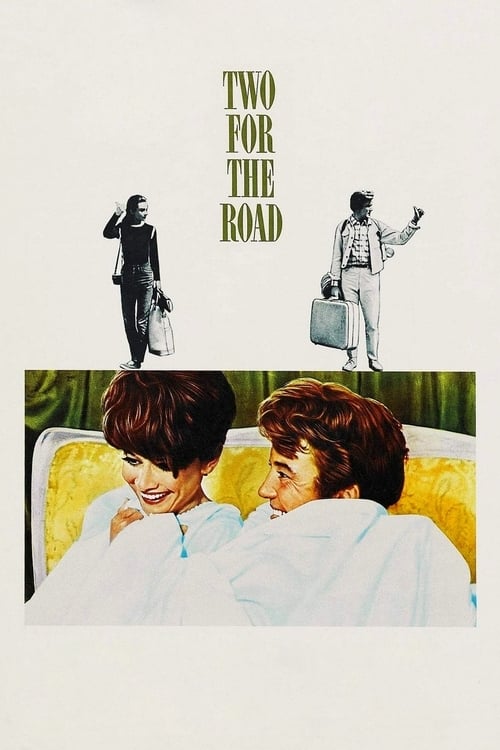
Two for the Road
1967 · Stanley Donen
For date night with teeth, or when you want a grown-up film about love that's honest without being bleak — romantic and funny, but bring someone you can talk with afterward.
What it's about
An architect and his wife drive south through France toward a rich client's villa, twelve years into a marriage that has curdled into elegant bickering — and the road keeps dissolving into every other trip they've taken along the same route. As students hitchhiking and falling in love, as broke newlyweds in a dying sports car, as trapped guests of an insufferable American family, as a prosperous couple flirting with infidelity: the film shuffles a whole marriage out of order, so courtship and betrayal and reconciliation seem to be happening all at once.
The experience
Sparkling on the surface and quietly devastating underneath — the banter is fast and genuinely funny, but the time-jumping keeps setting young hope right next to older disappointment, and the cumulative effect is deeply moving. You come out feeling like you've lived a whole relationship in two hours.
Performances
Audrey Hepburn, in what's often reported to be her own favorite of her performances, ages from gawky student to disenchanted wife with astonishing range beyond her gamine image, and Albert Finney matches her with prickly, wounded charm; the chemistry makes even the fights feel like love.
The craft
Frederic Raphael's screenplay dismantles a marriage into five road trips and reassembles them out of sequence — a daring structure for a 1967 studio picture — and Stanley Donen cuts between eras on visual rhymes that make time travel feel effortless. Henry Mancini's score, one of his loveliest, binds it together, and the sun-drenched French countryside is a pleasure on a big screen.
Why it matters
A landmark of nonlinear storytelling in mainstream romance whose fractured-timeline portrait of a marriage echoes through decades of later relationship dramas, and the boldest formal experiment of Donen's career.
Snapshot
A married couple drive south through France toward a client's villa, and the road they are on keeps turning into other roads they have traveled — as students hitchhiking, as newlyweds in a failing MG, as reluctant guests in an American family's station wagon, as a prosperous, bored, adulterous pair in a white Mercedes. Frederic Raphael's original screenplay dismantles a twelve-year marriage into five journeys along more or less the same route and reassembles them out of order, so that courtship, betrayal and reconciliation happen simultaneously rather than sequentially. Stanley Donen, twenty years past On the Town and four past Charade, directed it as his most formally aggressive film; Audrey Hepburn, in the performance she is most often reported to have named her own favorite, plays a woman who ages from gawky sunburned girl to hardened wife inside a single cut. Albert Finney, imported from the British New Wave, gives the film its abrasion. Two for the Road is the point at which the glossy transatlantic romantic comedy absorbed the syntax of European modernism and came out as something colder, funnier and more durable than either.
Industry & production
The film belongs to the runaway-production economy of the mid-1960s: American money, British creative personnel, French locations. Donen produced it himself through his own company and released through Twentieth Century-Fox, an arrangement consistent with his career since the late 1950s, when he left the MGM contract system for independent production based in England (Indiscreet, The Grass Is Greener, Charade, Arabesque). By 1966 that model — a star-driven picture shot in Europe against blocked or advantageous foreign earnings — was standard practice, and Fox in particular was heavily invested in overseas production.
Principal photography took place on location in France in 1966, largely in the south — the Riviera, Saint-Tropez and the Provençal roads between — with a predominantly British crew supplemented by French technicians, including art direction by Willy Holt. The shoot's logic was itself a production constraint: because the five time strands share geography, many locations had to be dressed and shot in multiple period configurations, with continuity managed not by chronology but by cross-reference.
Casting was the film's most consequential industrial decision. Hepburn had been the studio-era ideal of the elegant, sexually unthreatening star; Finney, off Saturday Night and Sunday Morning and Tom Jones, carried the class anger and physical immediacy of the British New Wave. Pairing them was a deliberate collision of two production cultures. Personal circumstances surrounding the shoot — the strain in Hepburn's marriage to Mel Ferrer, and persistent reports of a closeness between the two leads — have been recounted in biographies for decades; they are best treated as widely repeated accounts rather than established fact, and the film does not need them to explain its candor.
Commercially, Two for the Road did not repeat the broad popular success of Charade. Precise figures vary between sources and are not reliable enough to quote. Its awards profile was narrow but pointed: Raphael's screenplay drew the film's Academy Award nomination, in the same span of years in which he won for Darling (1965) and adapted Far from the Madding Crowd (1967).
Technology
Shot in 35mm Panavision anamorphic and processed in DeLuxe Color, the film uses the widescreen format against type. The 2.35:1 frame had been developed for spectacle; here it is used almost entirely for two people in a car, a restaurant booth, or a hotel room — a horizontal format turned into an instrument for measuring the distance between two faces.
The more important technological condition is mobility. By 1966, lighter blimped cameras, faster color stock and improved location sound practice had made it feasible to shoot a large-format color picture almost entirely away from studio stages, in moving vehicles and on public roads. Two for the Road is structurally dependent on that: the film's premise — the same highway across a decade — only works if the highway can actually be filmed, repeatedly, in real light, at real speed. The car interiors, the roadside breakdowns, the beaches and the campgrounds are the picture's principal sets.
The other technology on display is fashion, which the film treats as an information system. Hepburn's wardrobe broke, for the first time since Sabrina, from exclusive reliance on Hubert de Givenchy. Under the supervision of Clare Rendlesham, then a fashion editor, Donen dressed her instead in contemporary ready-to-wear from the London and Paris avant-garde — Mary Quant, Foale and Tuffin, Michèle Rosier, Ken Scott, and Paco Rabanne, whose linked-disc dress is the film's most cited garment. The decision is not decorative. Because the narrative is unsignposted, costume and car function as the film's timecode.
Technique
Cinematography
Christopher Challis, whose training ran back through the Powell and Pressburger unit and who had already shot The Grass Is Greener and Arabesque for Donen, gives each stratum a distinct light temperature without ever announcing it: the hitchhiking sequences are blown-out, sunburned, hand-held-feeling; the MG honeymoon is warmer and closer; the Mercedes present is cooler, harder, more reflective — glass, chrome, sunglasses, swimming pools. Long lenses compress the couple against traffic and crowds; wide compositions strand them at opposite ends of the scope frame in hotel rooms. Challis shoots a great deal of the film in genuine exteriors with available light, which was still a notable choice for a color star vehicle, and the grain and flare that result read now as documentary texture inside a comedy.
Editing
This is the film's argument. Cut by Richard Marden, with Madeleine Gug on the French side, Two for the Road moves between eras without dissolves, titles, narration or any of the conventional flashback grammar. Transitions are made on graphic and gestural rhymes — a road, a door, a turn of the head, a line of dialogue answered a decade later by a different version of the same person. The most celebrated device has cars from different periods occupying the same stretch of tarmac, the couple effectively passing themselves. Elsewhere the film cuts on repeated business: the recurring gag of Mark's mislaid passport, the recurring question of who is driving, the recurring meal at which nothing is said.
The structure is Raphael's, written into the screenplay rather than discovered in the cutting room, and its effect is thematic rather than merely clever. Because the audience always knows more than the characters — we have seen the marriage's later cruelty before we see its first kiss — every tender scene is played over an ironic bass line, and every bitter one is undercut by remembered warmth. Some contemporary reviewers found the shuffling ostentatious. Half a century of imitation suggests the device was load-bearing.
Mise-en-scène / staging
Donen's staging is built around the car as a two-hander stage: fixed seating, forced proximity, no exit, eyes forward. Nearly the whole film is a dialogue for two people who cannot look at each other. Against this he sets a series of contrasting social formations — the student choir group of the earliest journey, the appalling American couple Howard and Cathy Maxwell-Manchester (William Daniels and Eleanor Bron) with their monstrous child, the client Maurice Dalbret (Claude Dauphin) and his circle — each of which functions as a possible future the Wallaces are refusing or becoming. Mark's profession is staged as commentary: an architect who spends the film designing other people's houses while his own domestic arrangement remains a rented room, a tent, a hotel.
Sound
Henry Mancini's score is the film's continuity system. Where the images fragment, the theme recurs — reorchestrated across the strata, so that the same melody is by turns youthful, romantic, elegiac and hollow. It became one of Mancini's most enduring compositions and passed quickly into the jazz and vocal repertoire. Dialogue is handled with unusual overlap and interruption for a studio-financed comedy of the period; the couple talk across each other, finish each other's insults, and the film's most quoted exchange — Mark asking what sort of people sit through an entire meal without speaking, Joanna answering, "Married people" — depends on timing that is closer to Nichols or Godard than to Donen's musicals.
Performance
Hepburn's work here is the least protected of her career. She plays across roughly twelve years without prosthetic aging, doing it through posture, vocal placement and rhythm — the young Joanna talks quickly and leans in; the older one has learned to wait. The performance is also, by the standards of her filmography, frankly sexual and frankly unkind, which is why it has been so persistently cited as her own preference among her roles. Finney is her opposite number in method: loose, improvisatory, physically careless, and allowed to be genuinely unpleasant. Donen reportedly encouraged the two to work at a looser pitch than either had been used to, and the friction between Hepburn's precision and Finney's slouch is visible and productive. Among the supporting cast, Bron and Daniels give the satire its teeth, and a young Jacqueline Bisset appears in the earliest journey.
Narrative & dramatic mode
The film is a comedy of remarriage played as an anatomy. Its dramatic unit is not the scene but the pair of scenes: any given beat acquires meaning from its rhyme in another decade. There is no protagonist in the ordinary sense — the couple is the character, and the film's question is whether that composite entity survives. Causality is deliberately scrambled so that the audience experiences the marriage the way a long-married person remembers one: not as a story but as a set of simultaneous, contradictory impressions.
Tonally it moves without warning between farce (the breakdowns, the Maxwell-Manchesters), erotic comedy, and something close to Antonioni-grade desolation. The ending refuses both the romantic and the tragic option: the couple cross a border still married, still hostile, exchanging an obscenity as an endearment. It is an equilibrium, not a resolution.
Genre & cycle
Two for the Road sits at the intersection of three cycles. It is a late, corrosive entry in the Hollywood romantic comedy, close enough to the remarriage tradition of Cukor and Sturges to be legible against it and clearly working to spoil the formula. It is a road movie several years before the American road cycle of 1969 onward, using the highway as an instrument of memory rather than escape. And it belongs to the mid-sixties jet-set European picture — the Riviera, the sports cars, the international co-production glamour of Charade, Arabesque, and Blow-Up — while treating that glamour as a symptom of decay rather than an attraction.
It arrives in 1967, alongside Bonnie and Clyde, The Graduate, Point Blank and In the Heat of the Night, the year in which American cinema's formal license visibly widened. Donen's film is the veteran's contribution to that shift: not a young director breaking the rules but a studio-trained musical craftsman deciding that the rules had become insufficient.
Authorship & method
Donen's authorship has always been under-argued because his best-known films are collaborations (with Gene Kelly) in a genre criticism was slow to take seriously. Two for the Road is the strongest single case for him as an artist rather than a craftsman: the rhythmic intelligence of the MGM musicals — the ability to cut on movement, to make a gag land on a beat — is transposed wholesale onto a nonlinear drama. The cars are choreographed the way the numbers were.
Frederic Raphael is the film's other author, and arguably its originator. Fresh from the Academy Award for Darling, he brought a novelist's structural ambition and a satirist's ear for the way educated people wound each other. His later career — including the Far from the Madding Crowd adaptation and, three decades on, the screenplay for Kubrick's Eyes Wide Shut — confirms the preoccupation with marriage as a system of concealment.
Challis supplies the visual continuity that keeps the fragmentation legible; Mancini supplies the emotional continuity; Marden and Gug execute the film's central formal wager. Rendlesham's costume program is a co-authorial contribution in the specific sense that without it the audience could not tell the eras apart. It is a film in which the below-the-line departments are doing narrative work.
Movement / national cinema
Nominally an American studio release, the film is in practice Anglo-French. Its cast, crew and sensibility are British; its locations, art department and half its supporting players are French; its financing and distribution are American. That hybridity is the point. The formal vocabulary — the elliptical cutting, the free movement between tenses, the refusal of establishing devices — comes directly from the European art cinema of the preceding decade: Resnais's experiments with memory as an editing problem, Godard's licensing of the jump cut, Antonioni's studies of affluent marital exhaustion. Richard Lester's British films had already begun importing that grammar into English-language comedy. Donen's achievement is to run it through the machinery of a Hollywood star vehicle without the seams showing.
Era / period
The film's twelve-year span is also a period portrait: post-war austerity and student hitchhiking at one end, the consumer boom and international leisure class at the other. Money is the film's quiet antagonist. As Mark's practice succeeds, the couple acquire cars, clothes, a villa client, and a set of habits that make intimacy administratively impossible. The 1967 present is depicted with real suspicion — the fashion the film so lavishly showcases is simultaneously diagnosed as armor. Made at the hinge between the studio era and New Hollywood, and between mid-century marital orthodoxy and the sexual reordering of the late sixties, it treats both marriage and modernity as conditions to be survived rather than celebrated. Hepburn made Wait Until Dark the same year and then largely withdrew from screen acting until Robin and Marian in 1976, which gives Two for the Road a valedictory position in her career it did not have at the time.
Themes
Time is the primary subject — not as nostalgia but as simultaneity. The film argues that a long marriage is not a sequence of stages but a single object viewed from multiple angles, in which the person you fell in love with and the person you now resent are continuously present in the same body. Related to this is the theme of habit: the repeated passport, the repeated route, the repeated argument, all showing how ritual can be alternately a form of love and a form of imprisonment. Infidelity is treated symmetrically and unsentimentally — both partners betray, neither is redeemed by it, and the affairs are shown as symptoms rather than crises. Class and money corrode; the poorer the couple, the funnier and warmer the film. And architecture serves as the governing metaphor: a man who builds structures for others while failing to build one for himself.
Reception, canon & influence
Contemporary reception was respectful and divided. The screenplay drew the film's Academy Award nomination and most of its praise; Hepburn's performance was widely noted as a departure, and drew further awards attention. The recurring reservation concerned the structure, which some reviewers judged a device imposed on material that could have been told straight. The film performed adequately without becoming the popular event Charade had been, and for roughly a decade it occupied the middle distance of Donen's filmography.
Its reputation has risen steadily since. It is now routinely cited among the most acute English-language films about marriage, and as the strongest evidence for Donen's authorship outside the musical. Hepburn's own reported preference for the role has helped keep it in circulation, and Mancini's theme has outlived the film's own visibility, remaining a standard.
Backward, its debts are clear: the remarriage comedy of the 1930s and 40s for its structure of quarrel-as-affection; Resnais and the French modernists for the treatment of memory as montage; Antonioni for the affluent-marriage malaise; the British New Wave for Finney's register and the class-inflected comedy; Lester for the tonal permission.
Forward, its lineage is easier to trace by shape than by documented citation, and that distinction matters. The nonlinear anatomy-of-a-relationship film — Annie Hall (1977), Eternal Sunshine of the Spotless Mind (2004), (500) Days of Summer (2009), Blue Valentine (2010), Marriage Story (2019) — all work the seam Two for the Road opened: intercut a romance's beginning with its end so that each poisons and enriches the other. Whether each of those filmmakers took the device directly from Donen is not something the historical record establishes in every case, and it should not be asserted. What is demonstrable is priority: in 1967, inside a major-studio star vehicle, Two for the Road did it first and did it with a rigor that its descendants have rarely exceeded.
A Deleuzian reading
A white Mercedes comes down a road in France.
The full Deleuzian reading of Two for the Road →
Reception
In 1967 it was a modest performer that critics found tricksy — a Stanley Donen musical-man swerve into fractured European art-film territory. Now it's routinely called one of the great films about marriage, its time-hopping structure looking less like a gimmick and more like a blueprint everyone else borrowed.
How Two for the Road was received, from release to now →
How to watch Two for the Road: what to notice on a first viewing
- Notice a car from a different era share the road. Donen cuts between four decades with no dissolve, caption, or voiceover marking the jump, sometimes putting two versions of the same couple on the same stretch of tarmac. Separate stretches of the marriage get treated as equally present, not as one remembering the other.
- Notice the color and light change with no explanation. Christopher Challis shoots each period at its own temperature, sunburned and blown out for the earliest trip, cool and reflective for the present, and the costumes shift to match. You can tell which marriage you're watching before anyone says a word.
- Watch how often the couple sit side by side in a car. Nearly the whole film happens in fixed car seats, forced proximity, eyes forward, so they talk without ever quite looking at each other. The car traps two people together with no way for either one to leave.
- Listen for the same melody in a different mood. Mancini's theme recurs throughout, but reorchestrated so it sounds young and romantic in one stretch and hollow in another. One tune carries the whole emotional range of the marriage without changing a note of the words.
- Watch how Hepburn's posture changes without any makeup aging. She plays roughly twelve years through vocal placement and rhythm alone, leaning in quickly as the younger woman and learning to wait as the older one. You can tell which marriage you're watching from how she holds her body, not from her face.
The whole guide to watching Two for the Road, with the keys for a rewatch →
Influences: the films it descends from and the films it influenced
- The Awful Truth (1937) — Establishes the remarriage-comedy engine Raphael inherits — a divorce plot in which the couple's cruelest exchanges are the proof of attachment, built from McCarey's on-set improvised business rather than from written plot beats.
- His Girl Friday (1940) — The template for overlapping dialogue as marital combat: interrupted lines layered so neither partner finishes a thought, the rhythm Donen and editor Richard Marden reuse to make the Wallaces' bickering read as intimacy.
- Citizen Kane (1941) — The breakfast-table montage — a marriage compressed into matched two-shots that leap years on a whip pan — is the studio-era precedent for narrating a marriage by ellipsis and repeated staging instead of by scene.
- Journey to Italy (1954) — The direct ancestor of the premise: an English-speaking couple in a car on foreign roads, the marriage audited in available-light real locations with the automobile serving as the confessional two-hander stage.
- Hiroshima mon amour (1959) — Resnais cuts from present to memory on a gesture or object with no optical transition, stripping the flashback of its announcing device — precisely the grammar Donen applies across five journeys on one road.
- Saturday Night and Sunday Morning (1960) — Source of Finney's improvisatory, class-inflected naturalism, imported intact into a Panavision star vehicle so that his roughness abrades Hepburn's studio polish in every two-shot.
- Last Year at Marienbad (1961) — Costume, hair and decor as the sole index of which time stratum you occupy; Marienbad's puzzle logic is what makes Rendlesham's wardrobe program function as the audience's clock.
- La Notte (1961) — Antonioni's anatomy of an affluent marriage — architecture and dead duration doing the work of dialogue, silences blocked into wide compositions — supplies the malaise Donen's late strata dramatize.
- Charade (1963) — Donen's own precedent — Hepburn abroad, French location shooting, and a Mancini theme carrying continuity across tonal swerves; Two for the Road keeps the Mancini apparatus and deliberately discards the Givenchy couture Charade leaned on.
- A Hard Day's Night (1964) — Lester's cut-on-movement gag rhythm and handheld location comedy gave a studio director the permission to fracture a mainstream romance into fragments without losing a general audience.
- Roman Holiday (1953) — Carries the Hepburn-led European-travel romance forward, using continental location shooting as the canvas for a relationship anatomy descended from the holiday-romance cycle.
- Petulia (1968) — Lester takes the device straight back: a marriage anatomized in flash-fragments that intrude mid-scene, with Roeg photographing modern surfaces the way Challis photographed the Riviera.
- Annie Hall (1977) — Carries the structural wager into American comedy — a romance's beginning intercut with its end so each scene is read through its known outcome, the dramatic-irony machine Donen built in 1967.
- Bad Timing (1980) — Pushes the intercutting to its limit, reassembling a relationship from shards in which the cut itself becomes the accusation — the same seam with the comedy surgically removed.
- Eternal Sunshine of the Spotless Mind (2004) — Memory as an editing operation performed on a couple: chronology folded so the first meeting arrives after the breakup, the Resnais-via-Donen grammar with its mechanism made literal in the plot.
- Blue Valentine (2010) — Literalizes the stratified-color scheme — Super 16 for the courtship, digital for the collapse — so the capture format alone tells you which era you are in, the technical heir to Challis's temperature-coded strata.
- Marriage Story (2019) — Front-loads the couple's inventory of affection so that every subsequent scene of legal attrition is poisoned by it — the same irony circuit, run in one direction rather than intercut.
- Before Sunset (2004) — Tracks a couple across years of a relationship, using the passage-of-time-between-encounters structure that the Before films turn into a decade-spaced trilogy.
- (500) Days of Summer (2009) — Intercuts a couple's relationship across multiple non-adjacent timelines so honeymoon euphoria and decay sit in the same montage — the editing logic behind the shuffled-day structure and the Expectations/Reality split.
- People We Meet on Vacation (2026) — The template for the braided dual-timeline travel romance: intercuts the same couple's repeated road trips across years so past and present rhyme within a scene — the exact structural device PWMOV inherits by shuffling annual summer vacations.
- We Live in Time (2024) — Pioneers the intercut-timeline marriage anatomy that Payne's screenplay inherits — sorting a relationship into simultaneous strata (different road trips / different cars-and-clothes) so the audience reconstructs chronology from behavioral and costume cues, exactly the 'withheld time cues' method We Live in Time uses.
- Contempt (1963) — Contemporaneous proof that anamorphic scope is a marriage-collapse format: the wide frame holds two people who refuse to turn toward each other, the same lateral tension Challis exploits inside the car.
- Certified Copy (2010) — The car sustained as the entire two-hander stage — a couple driving Tuscan roads whose shared past may be invented, litigated in windshield-framed dialogue; Donen's staging premise carried to its most rigorous end.
- Darling (1965) — Frederic Raphael's screenplay reapplies Darling's mordant dissection of a relationship, now structured as interwoven non-chronological timelines.
- A Man and a Woman (1966) — Builds an entire marriage out of car interiors as the principal playing space, cutting between time periods on matched windscreen compositions with no optical marking, over a Mancini theme that recurs as the film's only continuity — the same staging and memory-insert logic as Lelouch's Paris–Deauville drives.
Similar films
- Journey to Italy (1954) — influence & lineage · same viewing thread
- Charade (1963) — influence & lineage
- La Notte (1961) — influence & lineage
- Last Year at Marienbad (1961) — influence & lineage
- Annie Hall (1977) — influence & lineage
- Certified Copy (2010) — influence & lineage
- Wild Strawberries (1957) — same viewing thread
- Day for Night (1973) — shared sensibility
All the films related to Two for the Road →
Watch it with: curated runs of related films
- Love, Memory, and the Long Journey — A run of love films where a journey — by car, by rail, or through memory — quietly lays bare what two people are, or were, to each other.