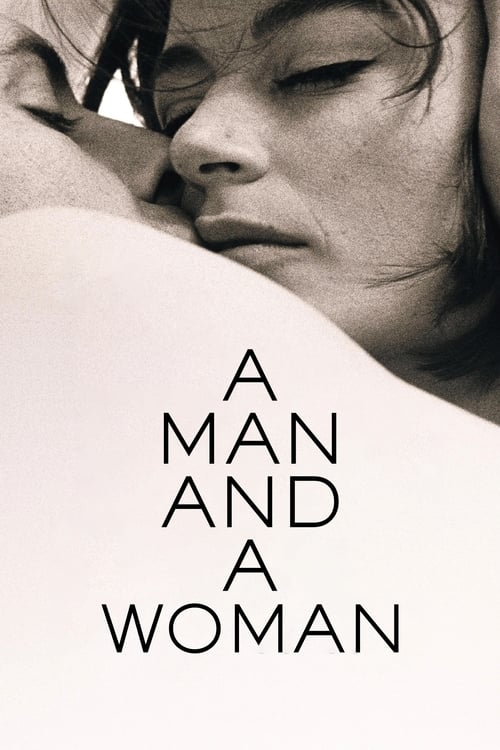
A Man and a Woman
1966 · Claude Lelouch
For a cozy night in when you want to fall in love — or fall back in love with movies. Pure comfort with a melancholy edge, ideal when you're craving something beautiful rather than demanding.
What it's about
A widow and a widower — she a film-industry script supervisor, he a professional racing driver — meet by chance at their children's boarding school in Deauville when she misses her train back to Paris. He offers her a lift, and over successive Sunday drives, beach walks, and shared meals, a courtship slowly assembles itself. Between them stand two dead spouses, remembered in flashes neither can quite put away.
The experience
Swooning, wistful, and almost weightless — it's less a plot than a mood you sink into, all rain-streaked windshields, seaside light, and that endlessly hummable theme. Romantic in the truest sense, with an undertow of grief that keeps the sweetness honest.
Performances
Anouk Aimée and Jean-Louis Trintignant have chemistry so relaxed it barely feels acted — long stretches are just two guarded, grown-up people deciding whether to risk happiness again, and you believe every second.
The craft
Claude Lelouch, a 28-year-old self-taught director, shot it like a jazz improvisation — handheld cameras, shifts between color and monochrome, real weather, real beaches — and Francis Lai's 'chabadabada' theme became one of the most famous pieces of film music ever written. It's a film you feel through texture: engines, surf, and song.
Why it matters
It won the Palme d'Or and two Academy Awards, became a worldwide phenomenon, and set the template for a certain kind of lush, music-driven screen romance for decades after.
Snapshot
Un homme et une femme is the film that proved a movie could be almost nothing but weather, faces, cars and a song, and still conquer the world. Two widowed parents — Anne Gauthier (Anouk Aimée), a film script supervisor whose stuntman husband died on a set, and Jean-Louis Duroc (Jean-Louis Trintignant), a racing driver whose wife killed herself after his crash at Le Mans — meet by chance at their children's boarding school in Deauville when Anne misses her train. He drives her back to Paris. Over successive Sundays a courtship assembles itself out of car rides, beach walks, and the pressure of two absent spouses. The plot could be written on a postcard; the film's real subject is the friction between present desire and remembered love, staged as a collision of images.
Made by a 28-year-old self-taught director on money he largely raised himself after a run of commercial failures, it took the Palme d'Or at Cannes in 1966 (shared with Pietro Germi's Signore & signori) and then the Academy Awards for Best Foreign Language Film and Best Original Screenplay, with nominations for Lelouch's direction and Aimée's performance. It became one of the most widely seen French films ever released internationally, and one of the most critically contested — adored by audiences, distrusted by the critical culture that had produced the New Wave, whose techniques it appeared to have repurposed for seduction.
Industry & production
Lelouch was an outsider to every institution that mattered in French cinema. He had not passed through IDHEC, had not written for Cahiers du cinéma, and had no patron at a major company. Born in Paris in 1937 to a Jewish family, he spent part of the Occupation hidden in cinemas — an origin story he has told often, and one that reads directly into his faith in the movie theater as a place of refuge and feeling. He shot documentary footage in the Soviet Union as a teenager, then earned a living making scopitones, the short music films produced for the visual jukeboxes that flourished in France in the early 1960s. That apprenticeship — images cut to a pre-existing song, three minutes to build a mood — is the single most useful fact about his method.
He founded his own production company, Les Films 13, in 1960, and it produced Un homme et une femme. By the mid-1960s the company was in serious trouble; Lelouch's features, from Le propre de l'homme (1960) through Une fille et des fusils (1965), had failed to establish him. The frequently repeated account of the film's conception — Lelouch, dispirited, sleeping in his car at Deauville and waking at dawn to see a woman walking the beach with a child and a dog — is the kind of anecdote that hardens into legend, but it is the story he has consistently given, and the film's opening imagery corresponds to it.
Production was fast, cheap and improvisatory: a small crew, real locations (Deauville, Paris, Monte Carlo), a shooting schedule measured in weeks rather than months, and no completed screenplay in the conventional sense. Lelouch supplied situations and let Trintignant and Aimée find the dialogue. This was economic necessity converted into aesthetic principle — the same conversion the New Wave had performed a few years earlier, arrived at independently by a filmmaker the New Wave declined to claim.
Technology
The film sits at a precise technological moment. Lightweight 35mm cameras that could be shoulder-operated, fast film stocks, high-quality zoom lenses (the French optical industry's zooms had by then become standard equipment for location work), and portable magnetic recorders had collectively made it possible to shoot a fiction feature with the mobility of a news crew. Un homme et une femme uses that toolkit with unusual completeness: available light, hand-held camera, long focal lengths that let the operator stand back from performers working without marks.
Its most discussed technical feature is the alternation of color, black-and-white and sepia-toned passages. The standard explanation, given by Lelouch himself and repeated throughout the literature, is financial: color stock and the lighting color required were beyond the budget, so interiors were shot in black-and-white while exteriors, where daylight did the work, were shot in color. Lelouch has offered more retrospective aesthetic rationales over the years, and it is fair to say the record blurs necessity and design. What is not in doubt is the result — a film whose changes of register are visible in its emulsion, so that a shift from the gray of a hotel room to the color of a beach registers as a change in emotional temperature before a single line is spoken.
Sound was largely built after the fact, in the French post-synchronisation tradition, which freed the camera further and let music occupy the track almost continuously.
Technique
Cinematography
Lelouch operated much of the camera himself — he is a genuine cameraman-director, not merely a director who supervises — with Jean Collomb among the credited photographic collaborators. The visual signature is a hand-held long lens: figures isolated in shallow focus against dissolved backgrounds of sea, sand, tarmac and rain-streaked glass, the frame breathing slightly with the operator's body. Zooms are used constantly and unapologetically, sometimes to reframe, sometimes as pure rhythmic gesture. Reflections and windshields recur; a great deal of the film is photographed through glass, which both flatters and distances.
Two set-pieces define the look. The night drive from Monte Carlo to Deauville is shot from inside the car, headlights and wipers doing the lighting, the world reduced to smeared abstraction. And the final embrace on the Deauville station platform is taken in a circling, spinning movement that turns the couple into the still center of a whirling world — an image so effective it has been imitated to the point of cliché.
Editing
The cutting, credited to Claude Barrois, is the film's real authorship. Whole passages abandon scene-by-scene construction for montage governed by music: shots of unequal length assembled for cadence rather than continuity, in a form that is recognizably the music video two decades before MTV. Memory is cut in without announcement — no dissolve, no optical marker — so that Anne's dead husband simply appears inside the present tense, and the viewer must sort the strata. The most audacious sequence intercuts a hotel-room attempt at lovemaking with Anne's images of Pierre until the present collapses under the weight of the past.
Mise-en-scène / staging
Staging is largely a matter of choosing places and letting people occupy them: the Deauville seafront in off-season gray, a school courtyard, a restaurant, and above all the automobile interior, which functions as the film's principal room — a two-shot with a moving background, private, forward-directed, and structurally unable to hold still. Lelouch's compositions are casual by design; the performers move, the camera follows, and the frame is corrected on the fly. Props do quiet narrative work: a dog on the beach, a child's drawing, a telegram.
Sound
Francis Lai's score is not accompaniment but co-narrator. Its central device — the wordless scat vocal, the "chabadabada" sung by Pierre Barouh and Nicole Croisille — is among the most recognizable sounds in postwar cinema, and it carries scenes that contain almost no dialogue. Barouh, a committed champion of Brazilian music in France, also contributed "Samba Saravah," his French adaptation of the Baden Powell/Vinícius de Moraes samba, which imports a bossa nova melancholy quite foreign to the French chanson tradition. Elsewhere the track is dominated by engines, wind, surf and the interior hum of the car, with dialogue often reduced to fragments over which the music continues uninterrupted.
Performance
Aimée and Trintignant give two of the great restrained performances of the decade, in large part because they were improvising. Aimée — carrying the aura of Lola, La Dolce Vita and 8½ — plays Anne as watchful and slightly withheld, her warmth always shadowed. Trintignant, whose family included the Formula One driver Maurice Trintignant and who raced himself, brings an unforced credibility to the driving scenes and a characteristic coolness to the courtship: he pursues without pressing. The children (Antoine Sire and Souad Amidou) are directed in an observational, near-documentary register that anchors the adults' stylization.
Narrative & dramatic mode
The film is a two-hander built on symmetry: two bereavements, two children, two professions bound to cinema and risk (a script supervisor, a driver; her husband a stuntman). It proceeds in episodes rather than acts, and its dramatic engine is not obstacle but inhibition — nothing external prevents the affair; the past does. Lelouch withholds a clear ontological frame, so that memory, fantasy and present action share the same visual plane, and at least one sequence can be read either as something that happened or something imagined. The ending is unambiguous in feeling and deliberately unearned in plot terms: he drives all night, she takes the train, they meet. The film's confidence lies in believing that rhythm and music can supply a conviction that narrative logic has not.
Genre & cycle
Formally this is a romantic melodrama — the widow-and-widower story, adult, restrained, closer to Brief Encounter than to farce — dressed in the equipment and manners of the modernist art film. That hybrid is precisely why it traveled. In 1966 the international specialty market had been trained by a decade of subtitled imports to accept ellipsis, hand-held camera and ambiguity; Un homme et une femme delivered those markers while providing a wholly conventional emotional payoff. It belongs to the mid-1960s art-house boom alongside films it otherwise resembles not at all, and it effectively defined a durable commercial category: the beautiful European romance as export product.
Authorship & method
Lelouch is an auteur in the literal, uncomfortable sense — writer (with Pierre Uytterhoeven), producer, camera operator, and shaper of the cut — and yet he was the era's least fashionable candidate for the title, because his instincts were popular rather than critical. His method was to gather material with a documentarian's opportunism and then compose it musically. The key collaborators are correspondingly few and decisive: Uytterhoeven, his long-term writing partner; Barrois in the cutting room; Collomb behind the second camera; and above all Lai, whose themes existed as organizing structures the images were arranged to fit — an inversion of normal practice that follows directly from the scopitone years. Barouh, who also plays Anne's dead husband, went on to found the Saravah label, named for the song he wrote for this film.
Movement / national cinema
The film's relation to the Nouvelle Vague is the central critical problem it poses. Industrially it is New Wave: independent company, tiny budget, real locations, non-institutional director, improvisation. Aesthetically it takes the movement's discoveries — the mobile camera, the elliptical cut, the location sound-world — and points them at emotional gratification rather than at the interrogation of cinema itself. To the Cahiers-descended critical establishment this was appropriation rather than inheritance, and the hostility was lasting; in French criticism lelouchien became shorthand for polished sentiment. That Lelouch stood alongside Godard, Truffaut and others in shutting down the 1968 Cannes festival did not soften the judgment.
Era / period
The film is saturated in the France of the Trente Glorieuses: the Gaullist consumer boom, the private automobile as the emblem of freedom, the weekend at the Normandy coast, boarding schools, motor sport as glamour, advertising as the culture's dominant visual grammar. Its Deauville is off-season, prosperous and slightly melancholy — a leisure landscape available to people with cars. Two years before May 1968, it is a film with no politics whatsoever, which is itself a period fact; its concerns are private, affluent and psychological, and much of the later critical resentment is really an argument about that.
Themes
Grief as an occupying force; the dead as rivals. Motion versus stasis — a man whose profession is speed and a woman whose profession is continuity (the script supervisor is the person who guarantees that the pieces match). Cinema as a haunted medium: both spouses died in or around the making of images, and the film keeps replaying them, which is what film does. Children as the pretext and the alibi for adult connection. And, running under everything, the question of whether a new love is a betrayal or a survival — answered, finally, by fiat and a camera that will not stop turning.
Reception, canon & influence
Reception split along a fault line that has never closed. The Cannes jury and the Academy embraced it; Aimée's performance won her wide recognition, including a Golden Globe; audiences made it an extraordinary international success and one of the most profitable French exports of its generation. Against this, a substantial body of critics — in France largely those formed by the New Wave, in the United States including Pauline Kael among its most pointed detractors — read its beauty as salesmanship, its technique as borrowed, and its emotion as engineered. Both readings are defensible, and the film's durability partly consists in the fact that neither dislodges the other.
Backward, its debts are legible. The lightweight-camera practice descends from cinéma vérité and from Godard's À bout de souffle; the seaside romance saturated with music runs through Demy, whose Lola had already made Aimée the face of that mode; the restrained adult encounter organized around trains and partings is the Brief Encounter tradition; the music imports bossa nova through Barouh; and the whole visual manner is unimaginable without 1960s advertising and photojournalism, which Lelouch never disowned.
Forward, its reach is disproportionate to its ambitions. Francis Lai's score made him internationally bankable and led directly to Love Story (1970), the Oscar-winning American romance often described as this film's transatlantic reformulation. The music-driven montage sequence, cut to a complete song rather than scored to picture, became a standard tool of commercial filmmaking and a direct ancestor of the music video. The station-platform embrace, the couple in the car photographed through rain, and the wordless-vocal love theme entered the general vocabulary of romance — and, inevitably, of advertising, which absorbed the film's grammar within a few years. Lelouch himself returned to it twice, with A Man and a Woman: 20 Years Later (1986) and The Best Years of a Life (2019), the latter reuniting Aimée and Trintignant near the end of both their careers and turning the original into an artifact of memory within its own sequel — an ending the film's preoccupations rather deserved.
A Deleuzian reading
Rain on a windscreen.
The full Deleuzian reading of A Man and a Woman →
Reception
In 1966 it swept the Palme d'Or and two Oscars and became a worldwide phenomenon; cinephile opinion later soured on it as glossy romantic kitsch — Pauline Kael was famously dismissive — though its images and score have proven far more durable than its detractors expected.
How A Man and a Woman was received, from release to now →
How to watch A Man and a Woman: what to notice on a first viewing
- Notice scenes shift between color, black and white, and sepia. Interiors run in black-and-white while daylight exteriors stay in color, the stock itself changing with no explanation offered. The temperature of a scene changes before anyone says a word.
- Watch the background dissolve into blur behind their faces. Lelouch operates a hand-held long lens that isolates the couple in shallow focus against sea, sand, or rain-streaked glass, the frame breathing with his own body. The world around them keeps melting away, leaving only the two people in focus.
- Notice how many scenes happen inside a moving car. The automobile becomes the film's real room, a private, forward-facing two-shot that can never quite hold still. Their courtship happens in the one space that's always moving toward somewhere else.
- Listen for the wordless 'chabadabada' vocal carrying a scene. Francis Lai's scat vocal runs under scenes with almost no dialogue, functioning as narration the actors never have to speak. The music says what these two restrained people won't say out loud.
- Watch Aimée hold warmth back behind a watchful stillness. Both leads were largely improvising, and it shows in a guardedness that never quite resolves into an open face. You're watching two people feel their way toward each other in real time, not deliver written lines.
The whole guide to watching A Man and a Woman, with the keys for a rewatch →
Influences: the films it descends from and the films it influenced
- Brief Encounter (1945) — Establishes the template Lelouch inverts into color and speed: an adult affair whose drama is inhibition rather than external obstacle, metered by train timetables and platform partings, with a single recurring musical theme (Rachmaninov's Second Concerto) carrying the interior monologue the characters cannot speak aloud.
- Elevator to the Gallows (1958) — Henri Decaë's available-light night shooting — Moreau walking the Champs-Élysées lit only by shop windows and passing headlamps, on pushed Tri-X — is the direct precedent for Lelouch's headlight-lit Paris–Deauville drives, where the windscreen and dash instruments become the only practical sources.
- Black Orpheus (1959) — The French-financed romance whose Brazilian score (Jobim and Bonfá) functioned as both structure and export commodity; it opened the channel through which Pierre Barouh imported bossa nova and samba into French cinema, a debt Barouh acknowledged by naming his Saravah label after the song written for this film.
- Hiroshima mon amour (1959) — Invents the unmarked memory insert — past images cut flush into the present with no dissolve, optical or verbal cue — and the intercutting of entwined bodies with recollection, exactly the grammar Lelouch uses for Anne's flashbacks to Pierre during the hotel scene.
- Breathless (1960) — Coutard's handheld Éclair work — operator in a wheelchair, no lights, film stock spliced up from photographic rolls — legitimized the cameraman-author practice Lelouch adopts literally by operating his own camera, and the elliptical car-and-conversation scenes shot from the back seat.
- Lola (1961) — Made Anouk Aimée the face of the seaside-port romance saturated with a recurring composer's theme; Lelouch casts her precisely as that established sign, and reprises Demy's device of letting a Nantes/Deauville promenade be photographed as if the music, not the plot, were dictating camera movement.
- Chronicle of a Summer (1961) — Cinéma vérité's lightweight sync-sound rig and its practice of letting subjects improvise their own biographies to camera is the working method behind Lelouch's unscripted Trintignant–Aimée exchanges, gathered documentarily first and shaped musically afterwards.
- Jules and Jim (1962) — Normalizes stock and format alternation inside a single romance — newsreel inserts, aspect changes, freeze frames — and cuts whole passages to a complete Delerue song ('Le Tourbillon') rather than scoring to picture, the two devices Lelouch industrializes as colour/monochrome/sepia switching and music-led montage.
- The Umbrellas of Cherbourg (1964) — Music-first construction taken to its limit: Legrand's score existed complete before the shoot and the staging was built to playback, the inversion of normal practice that Lelouch — trained on scopitones — repeats by having Francis Lai's themes written as organizing structures the images were then arranged to fit.
- The Graduate (1967) — Surtees' extreme long lenses shooting through aquarium glass, car windscreens and hotel doors, plus the pool/hotel montage cut to complete pre-existing Simon & Garfunkel tracks rather than to picture — the American absorption of Lelouch's glass-barrier long lens and song-length montage block.
- The Thomas Crown Affair (1968) — The glider sequence cut whole to Legrand's 'Windmills of Your Mind' — image edited to fit a finished song — inside a film shot with the gloss, telephoto compression and product-lit surfaces of late-1960s advertising, the commercial idiom Lelouch had already proved could carry a romance.
- Butch Cassidy and the Sundance Kid (1969) — Brackets its narrative in sepia-toned mock-newsreel and drops a self-contained pop-song interlude ('Raindrops Keep Fallin' on My Head') into the middle of it — Lelouch's tonal alternation between monochrome, sepia and color plus the standalone music montage, imported wholesale into a Hollywood A-picture.
- Love Story (1970) — The transatlantic reformulation: Francis Lai was hired to reproduce his own achievement — a wordless theme deployed as the film's structural spine and its marketing — over montages of a couple in snow and cars, winning an Oscar for what is essentially the Lai method transplanted.
- C'était un rendez-vous (1976) — Lelouch reduces his own device to its axiom: the car interior as sole camera position becomes a single unbroken bumper-mounted gyro shot across Paris at dawn, the driving-and-looking grammar of the Deauville runs stripped of everything but its point of view.
- In the Mood for Love (2000) — Builds its entire romance on inhibition-as-engine and on one repeated waltz ('Yumeji's Theme') that governs step-printed inserts of the couple passing each other — Lelouch's structure of a theme recurring until it becomes the narration, plus the habit of framing lovers through glass, doorframes and rain.
- The Best Years of a Life (2019) — Reunites Aimée and Trintignant and cuts the 1966 footage into the present as the memory of a man losing his — literalising the film's own unmarked-memory-insert device by making the original film the flashback material inside its sequel.
- Eyes Full of Sun (1970) — Francis Lai's breakthrough score — a hummed, circling romantic leitmotif carrying the whole emotional arc — is the exact scoring method Lai brings to Boisrond's film.
- Little French Fish (2020) — Tight two-hander romance built on shallow-focus close-ups and improvised-feeling talk between two guarded adults, prioritizing texture over incident.
- Elvira Madigan (1967) — Jörgen Persson's long-lens handheld work in sunlit grass — flare, shallow focus, subjects isolated against dissolved backgrounds — married to one repeated theme (Mozart's K.467) that became the film's brand; the same formula of doomed adult lovers plus a single hummable motif, arrived at independently a year later.
- Two for the Road (1967) — Builds an entire marriage out of car interiors as the principal playing space, cutting between time periods on matched windscreen compositions with no optical marking, over a Mancini theme that recurs as the film's only continuity — the same staging and memory-insert logic as Lelouch's Paris–Deauville drives.
Similar films
- The Umbrellas of Cherbourg (1964) — influence & lineage
- Jules and Jim (1962) — influence & lineage
- Lola (1961) — influence & lineage
- Hiroshima Mon Amour (1959) — influence & lineage
- Breathless (1960) — influence & lineage
- Elevator to the Gallows (1958) — influence & lineage
- Two for the Road (1967) — influence & lineage
- The Young Girls of Rochefort (1967) — shared sensibility