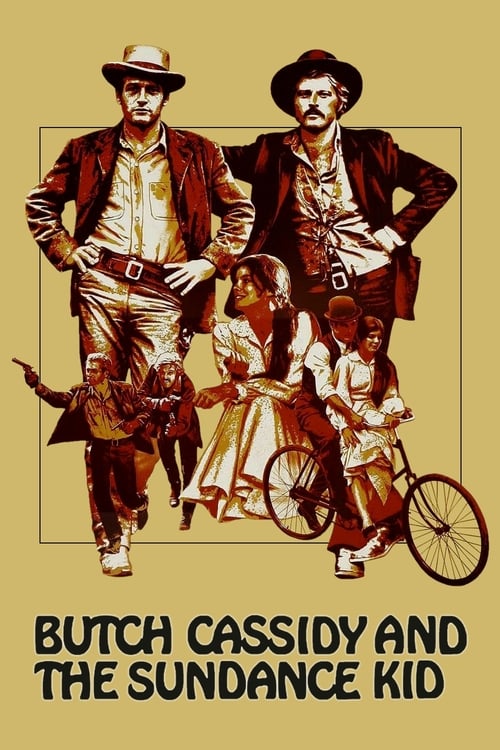
Butch Cassidy and the Sundance Kid
1969 · George Roy Hill
A perfect crowd-pleaser for a night when you want wit, chemistry, and a little ache — comfort viewing with a melancholy spine. Great with company; the one-liners land better out loud.
What it's about
Wyoming, the 1890s: Butch Cassidy is the brains and charm, the Sundance Kid is the fastest gun, and their train-robbing days are numbered because the West itself is closing down. With a relentless posse on their trail, the two outlaws — and the schoolteacher who loves one of them — light out for Bolivia, hoping the old life still exists somewhere.
The experience
Breezy, funny, and secretly heartbreaking — the banter never stops, even as the walls close in. It's an adventure that feels like hanging out with the two most charming men alive, right up until you realize what the film has been telling you all along.
Performances
Paul Newman and Robert Redford invented the modern buddy-movie double act here — Newman's twinkling schemer against Redford's laconic cool — with a chemistry so effortless it became the template everyone else copies.
The craft
William Goldman's Oscar-winning script mixes wisecracks and fatalism in a way mainstream movies simply hadn't before, and Conrad Hall's sun-bleached, sepia-tinged cinematography makes the dying frontier look like a memory in progress. Burt Bacharach's playful score — including that famous bicycle interlude — keeps the doom at arm's length. Gorgeous on a big screen.
Why it matters
A colossal hit that arrived at the hinge between old Hollywood and New Hollywood, it launched the Newman–Redford partnership and set the mold for fifty years of buddy pictures.
Snapshot
George Roy Hill's Butch Cassidy and the Sundance Kid is a revisionist Western comedy that arrives at the precise hinge between the classical Hollywood era and the New Hollywood that would succeed it. Starring Paul Newman as Robert LeRoy Parker ("Butch Cassidy") and Robert Redford as Harry Longabaugh ("the Sundance Kid"), the film follows two real-life outlaws of the Hole-in-the-Wall Gang as the frontier closes around them — driven south to Bolivia by a relentless lawman posse, and ultimately destroyed by a modernity they cannot outpace. William Goldman's script is as responsible for the film's impact as anything behind the camera: its mixture of wisecracking anachronism, elegiac fatalism, and tonal lightness under genuine mortal pressure constituted something new in mainstream American cinema. The film won four Academy Awards and became one of the highest-grossing releases of 1969, while its formal and generic innovations — the buddy pairing, the pop-scored period film, the freeze-frame elegy — filtered deeply into the Hollywood decades that followed.
Industry & production
William Goldman wrote the script on speculation, without a commission, and its sale reportedly set a record price for an original screenplay in Hollywood at the time — a measure of how hot the property seemed once studios read it. 20th Century Fox eventually produced; Paul Monash and John Foreman served as producers.
Casting generated its own legend. The studio and Newman initially envisioned various configurations with Steve McQueen — there was a period when McQueen and Newman were both attached, with debate over which would play which role — but McQueen ultimately did not participate. The choice of Robert Redford for Sundance was the consequential one: Redford was not yet a major star, and the film made him one. The pairing worked in part because Newman and Redford had sharply complementary screen energies — Newman's voluble, forward-leaning charm against Redford's compressed, watchful stillness — and this contrast became the template the buddy film would imitate for decades.
Principal photography took the production to Utah and Colorado for the American West sequences, with the Bolivian material shot largely in Mexico. The locations are used with a combination of picturesque grandeur and a kind of fading light — the West already feels like a world in the past tense.
Technology
Conrad Hall shot the film in Panavision anamorphic widescreen, and his use of the format is inseparable from the film's meaning. The wide frame accommodates the landscape-scale of classical Westerns while Hall systematically softens and warms it: he employed diffusion filtration and overexposure in select sequences to achieve a bleached, sun-fatigued look, particularly as the film moves toward Bolivia, where the palette becomes drier and more washed out.
The film opens with a bravura conceit: a sepia-toned, deliberately degraded silent-film pastiche, with frame-rate drops and title cards, that introduces Butch's heist of the old Sundance rail job. This self-conscious historicizing positions the characters as figures already caught in the amber of a receding past. The move from sepia to full color as the main title arrives signals a collapsing of historical distance — they are simultaneously historical artifacts and living, wisecracking people.
The freeze-frame ending — Butch and Sundance charging out into a Bolivian plaza surrounded by an army, the image locking mid-motion as gunfire continues on the soundtrack — was itself a technological and rhetorical choice with considerable resonance. Rather than showing the outlaws' deaths, Hill and editor John C. Howard stop time at the instant of their last defiant act. The hold on sepia tones in that final image loops back to the opening, sealing the film as a period piece, a memory image, a story already over.
Technique
Cinematography
Hall's cinematography here is less interested in the classical Western's stark beauty than in textural warmth and a certain golden-hour nostalgia. His color palette runs to amber, ochre, and dust. Natural-light sources are favored where possible, lending interiors an intimate, unglamorous quality at odds with the genre's heroic conventions. The "Raindrops Keep Fallin' on My Head" bicycle sequence — shot with an almost home-movie freedom in bright, flat exterior light — demonstrates Hall's tonal flexibility: the sequence is deliberately breezy and tender, a pocket of pure pleasure before the story's grimmer turn. Hall would go on to win Academy Awards for American Beauty (1999) and Road to Perdition (2002), but his work here, which did win the Oscar, represents a key early statement of his approach: cinematography as mood and atmosphere before spectacle.
Editing
John C. Howard's editing follows Goldman's script in its willingness to modulate pace radically. The long central chase — a nearly wordless extended pursuit by the mysterious "superposse" across varied terrain — suspends conventional narrative development in favor of almost abstract duration. The editing here is deliberate to the point of discomfort: the pursuers are never identified, never close, never shaken, and the sequence's length enacts the psychological exhaustion the characters feel. Elsewhere, the editing is loose and conversational, cutting on exchanges of dialogue with a rhythm calibrated to Goldman's comedic timing. The film is structurally loose in a way that classical Hollywood editing would not have tolerated, and this looseness is part of its modernity.
Mise-en-scène / staging
Hill stages action — the bank robberies, the shootouts — with less interest in precision ballistics than in choreographing the comic-heroic personas of his leads. Butch and Sundance are always slightly outmatched by events, improvising around a competence they may or may not actually possess. The staging of the two-against-many confrontations in Bolivia has an almost theatrical quality: the plaza setting, the encircling army, the friends consulting each other in their last moment. Bolivia itself is staged as a kind of diminished echo of the American West — same violence, lesser scale, a comedown that underscores the film's elegiac point.
Sound
Burt Bacharach's score is one of the most discussed sonic decisions in the New Hollywood period. Bacharach was a pop songwriter, not a conventional film composer, and his contribution is deliberately anachronistic: light, melodic, contemporary in feel, refusing the orchestral sweep the genre demanded. The deployment of "Raindrops Keep Fallin' on My Head" — written for the bicycle sequence, performed by B.J. Thomas, a pop song wholly without period flavoring — was understood at the time as either a jarring miscalculation or a brilliant assertion of tonal freedom, depending on the critic. In retrospect it belongs to a broader New Hollywood move toward pop-scored period films (a tendency already visible in The Graduate and Bonnie and Clyde, both 1967). Bacharach won the Academy Award for Original Score; the song also won Best Original Song.
Performance
Newman was already a major star, and he gives Butch the quality of a man who thinks very fast and feels very little anxiety — all confidence on the surface, with an undertow of elegy the script supplies without Newman having to editorialize it. Redford's Sundance is fundamentally reactive, his silence and economy of expression creating space for Newman's verbal energy; but Redford's physical authority and the way he handles the gunfighter sequences establish a credibility the film needs. Katharine Ross as Etta Place — schoolteacher, sometime outlaw companion — is given less by the script, but brings an unusual stillness and intelligence to a role that could have been purely decorative. The three-way dynamic is warmer and less tormented than the triangles in the French New Wave films it distantly resembles.
Narrative & dramatic mode
Goldman's script works by tonal collision: wit in the foreground, fatalism in the structural logic. Butch and Sundance are always one step slower than the world changing around them; the comedy of their banter runs on the energy of men who don't quite register the genre they're in. The "superposse" — the hired lawmen and Pinkerton agents who pursue them relentlessly, never named, barely glimpsed — functions as an almost allegorical force: unstoppable modernity, the end of the outlaw era, arriving in human form. "Who are those guys?" becomes the film's most quoted line because it articulates genuine bafflement at historical inevitability.
The decision to flee to Bolivia rather than make a heroic last stand in the American West is structurally courageous: the film declines its grandest available gesture and replaces it with diminishment, comedy, failure, and finally an off-screen death. The freeze-frame closing refuses catharsis while providing a strange, mournful grace.
Genre & cycle
Butch Cassidy arrives in the same year as Sam Peckinpah's The Wild Bunch — and the juxtaposition is instructive. Both are elegies for the outlaw West, both revisionist, both formally adventurous. Peckinpah's film goes toward violence, trauma, and apocalyptic choreography; Hill's goes toward comedy, warmth, and elision. Together they mark the full range of what the late-1960s revisionist Western could be.
More lastingly, Butch Cassidy codified the buddy film as a Hollywood genre. The pairing of two men — complementary in personality, inseparable in loyalty, both outmatched by the world — becomes a template repeated from The Sting (1973) through innumerable action comedies. The formula is not invented here (road pictures and comedy pairings have long Hollywood genealogies), but it is crystallized here with unusual elegance.
Authorship & method
George Roy Hill is not generally positioned as an auteur in the critical tradition that prizes stylistic signature and thematic obsession. His career is eclectic — Thoroughly Modern Millie (1967), Slaughterhouse-Five (1972), The Sting (1973), The World According to Garp (1982) — and he tends to subordinate directorial personality to the material's tonal demands. What he demonstrably could do was manage tone under pressure, elicit naturalistic performances from major stars, and trust writers and cinematographers of high caliber. His collaboration with Goldman, Hall, Bacharach, and Redford constitutes the creative core of the film.
Goldman, by contrast, has a substantial authorial claim. The script's structure, its voice, its willingness to make a Western in which the heroes are funny and confused and finally dead off-screen, reflects a distinct literary intelligence. Goldman's subsequent books on screenwriting (Adventures in the Screen Trade, Which Lie Did I Tell?) dissected the craft of the Hollywood script from the inside, and Butch Cassidy is the most cited example of his principles in practice.
Conrad Hall's visual signature — warmth, diffusion, a preference for the atmospheric over the spectacular — gives the film a look that became influential in its own right.
Movement / national cinema
The film belongs to what is variously called the New Hollywood or the American New Wave: the period running roughly from Bonnie and Clyde (1967) through Apocalypse Now (1979) in which a generation of filmmakers, emboldened by the collapse of the studio system and the influence of European art cinema, broke with classical Hollywood conventions in genre, narrative, and visual form. Butch Cassidy is in some ways the most mainstream work of this movement — a big-star, big-studio picture — but it participates in the movement's central ambitions: tonal ambiguity, genre revisionism, and a willingness to let protagonists lose.
Era / period
1969 is one of the great years of American filmmaking: Easy Rider, Midnight Cowboy, The Wild Bunch, Medium Cool, Alice's Restaurant all appear in the same year. The country is in profound social and political turmoil, and the cinema of the period reflects, obliquely and variously, that turmoil. Butch Cassidy addresses it through historical displacement: these are men whose way of life is being made obsolete by progress, corporations (the railroad), and the organized violence of the state — themes that resonated in 1969 without requiring explicitness.
Themes
The film's central preoccupation is obsolescence: Butch and Sundance are skilled at a trade — robbery, flight, improvised violence — that the modern world has organized itself to eliminate. The Pinkerton Agency represents corporate, rationalized law enforcement; the railroads represent industrial capital; Bolivia represents the fantasy of escape from a world that has already become too organized for outlaws to operate in. There is no frontier to move to when the West itself is gone.
Friendship as the only stable value in an unstable world is the film's emotional counter to its historical pessimism. Butch and Sundance have no particular ideology, no cause beyond survival and enjoyment; what they have is each other, and the film treats this loyalty with complete sincerity despite the comic mode.
Freedom and its costs: the film is genuinely ambivalent about its protagonists' choices. Their refusal to adapt, to take honest work, to go straight is coded as a kind of authentic freedom — and it kills them.
Reception, canon & influence
Influences on the film: Goldman's script shows clear awareness of the French New Wave — specifically Jules and Jim (Truffaut, 1962) in the triangular relationship and the mixing of tonal registers with tragic subject matter — and of Bonnie and Clyde (Penn, 1967), which had already proven that American genre revisionism and New Wave-influenced form could achieve major commercial success. The classical Western tradition, from Ford through Leone, is the framework against which the film defines itself through contrast: its heroes are not mythic.
Critical reception: Initial critical response was divided. Some reviewers found the tonal mixing, the Bacharach score, and the bicycle sequence too cute or too calculated. The extraordinary box office performance — Butch Cassidy was among the highest-grossing films of its year domestically — made argument about its value somewhat beside the point; audiences found something in it that landed. Goldman's Oscar win (one of four the film received, alongside Hall's cinematography award, Bacharach's score, and the Best Original Song for "Raindrops") indicated that the industry, at least, recognized formal achievement.
Legacy: The film's most consequential formal contribution is probably the freeze-frame ending, which was not invented here but which Butch Cassidy implanted in the popular imagination as the elegiac gesture for a protagonist who cannot be permitted to die on screen. The withholding of the actual deaths — we hear the gunfire over the frozen image — became a model for how to acknowledge tragedy without dwelling in it.
The buddy film as a commercial genre depends substantially on this film. The chemistry between Newman and Redford, and the narrative logic of two male friends whose bond is the story's real subject, was immediately legible to audiences and immediately reproducible by studios. Hill's The Sting (1973), which reunited the pair, was itself a massive commercial success, confirming that the pairing was a genre unto itself.
Goldman's script is taught widely as a model of tonal control and structural economy. His willingness to withhold information (the identity of the superposse, the exact circumstances of the Bolivian ending), to modulate between registers, and to embed genuine pathos in a comic framework became a template for sophisticated popular screenwriting.
The film's pop score established a precedent for anachronistic music in period filmmaking that runs through American Graffiti (1973), the work of Scorsese in the 1970s onward, and into Tarantino's formal use of source music. Using contemporary popular music against period imagery to generate irony, warmth, or a kind of temporal vertigo is now entirely conventional; in 1969 it was a provocation.
Forty years on, Butch Cassidy and the Sundance Kid sits comfortably in the canon of major American cinema — cited regularly in discussions of the New Hollywood, the revisionist Western, and the development of the buddy film. Its pleasures are so well-packaged that the genuine sadness underneath them is easy to miss, which is precisely as Goldman intended.
A Deleuzian reading
"Who are those guys?" Butch keeps asking it, squinting back at a dust cloud that never gets closer and never falls behind.
The full Deleuzian reading of Butch Cassidy and the Sundance Kid →
Reception
Critics were surprisingly sniffy in 1969 — several big reviewers dismissed it as glib and anachronistic — but audiences made it the year's biggest hit, and its four Oscars plus decades of rewatchability settled the argument: it's now the template for the buddy movie, full stop.
How Butch Cassidy and the Sundance Kid was received, from release to now →
Influences: the films it descends from and the films it influenced
- Shane (1953) — Stevens and cinematographer Loyal Griggs established the golden-hour, amber-ochre Western landscape palette — warm, soft-lit, nostalgic — that Conrad Hall inherits and extends through optical diffusion filtration in Butch Cassidy's color scheme.
- The 400 Blows (1959) — Truffaut's final freeze-frame on Antoine Doinel at the shoreline established the freeze-frame as an elegiac suspension of narrative time — a structural device for refusing to resolve a character's fate — that Hill's ending directly appropriates.
- Shoot the Piano Player (1960) — Truffaut's tonal collisions — characters delivering comic non-sequiturs as violence erupts around them, sentimentality and absurdity sharing the same breath — are the French New Wave source Goldman domesticates into Hollywood vernacular for Butch and Sundance's wisecracking fatalism under mortal pressure.
- Ride the High Country (1962) — Peckinpah and cinematographer Lucien Ballard developed the elegiac Western about obsolete gunfighters who cannot survive into modernity, shot in warm CinemaScope compositions — the immediate structural and visual template for Butch and Sundance's historical predicament and the film's landscape photography.
- Bonnie and Clyde (1967) — Penn and cinematographer Burnett Guffey codified the outlaw-buddy film's visual grammar — lyrical pop-music interludes interpolated into genre violence, warm period photography, and death rendered as stylized elegy rather than spectacle — which Goldman's script and Hall's diffusion work inherit and refine.
- The Graduate (1967) — Nichols and editor Sam O'Steen legitimized the anachronistic pop score in American prestige filmmaking — Simon & Garfunkel's contemporary folk-pop playing against images it was not written for — establishing the tonal contract Burt Bacharach's 'Raindrops Keep Fallin' on My Head' directly extends.
- Cool Hand Luke (1967) — Conrad Hall carries his Cool Hand Luke visual grammar directly into this film — anamorphic Panavision, warm-bleached outdoor light, faces exposed against the indifferent landscape — while the rebel-male duo's doomed-by-modernity trajectory extends Luke's narrative logic: charisma and refusal cannot ultimately survive the institution's patient machinery, and the freeze-frame ending quotes Luke's sacrificial irresolution.
- A Man and a Woman (1966) — Brackets its narrative in sepia-toned mock-newsreel and drops a self-contained pop-song interlude ('Raindrops Keep Fallin' on My Head') into the middle of it — Lelouch's tonal alternation between monochrome, sepia and color plus the standalone music montage, imported wholesale into a Hollywood A-picture.
- McCabe & Mrs. Miller (1971) — Altman and cinematographer Vilmos Zsigmond developed Hall's diffusion-filtration, overexposed warm-palette Western photography into a total aesthetic system — grain, color temperature, and lens flare all expressing historical decay — extending the visual logic of Butch Cassidy's Bolivian sequences across an entire film.
- The Sting (1973) — Hill returned Newman and Redford to the same sepia-toned period-pastiche prologue structure with an anachronistic popular-music score (Scott Joplin ragtime arranged by Marvin Hamlisch), with screenwriter David S. Ward systematizing Butch Cassidy's formal experiments — period pastiche, buddy contrast, warm-palette diffusion — into a replicable template.
- Badlands (1973) — Malick extends Goldman's anachronistic-score approach — period pop songs (Carl Orff's Musica Poetica, Mickey & Sylvia's 'Love Is Strange') played with elegiac distance over outlaw-on-the-run imagery — and uses durational episodic editing to generate the same sense of doomed characters already mythologized in the moment they appear.
- Pat Garrett and Billy the Kid (1973) — Peckinpah extended Butch Cassidy's anachronistic-score device by commissioning Bob Dylan's contemporary folk-rock throughout a period Western — deploying a living singer-songwriter to generate the same temporal dislocation Bacharach achieves — while stripping the elegiac outlaw-obsolescence structure to its barest form.
- Thunderbolt and Lightfoot (1974) — Cimino's debut directly inherits the mismatched buddy-heist structure — the experienced, controlled partner (Eastwood) opposite the younger, more emotionally open one (Bridges) — and closes with an elegiac death for the lighter figure, following the Butch-Sundance emotional and structural logic beat for beat.
- Lethal Weapon (1987) — Donner and screenwriter Shane Black industrialized the Newman-Redford contrast model into the buddy-cop formula — the volatile, suicidal partner (Gibson) against the stable, family-grounded one (Glover) — codifying the tonal and emotional template Butch Cassidy's mismatched pairing established as a genre mechanism.
- Thelma & Louise (1991) — Scott and editor Thom Noble's freeze-frame over the car going over the canyon rim directly cites Hill's device — stopping time at the moment of doomed defiance rather than showing impact — applying the buddy-outlaw freeze-frame elegy to a female pair in an explicit structural quotation.
- Road to Perdition (2002) — Hall's earlier sepia-washed, painterly period photography and his romance of doomed male partnership establish the elegiac-Americana palette he refines into Perdition's muted tones.
- Marathon Man (1976) — William Goldman's screenwriting signature — terse ironic dialogue and architecture of withheld information — plus a Conrad Hall collaboration, making it the joint Goldman/Hall template Marathon Man refines for a thriller.
- Sholay (1975) — Model for the wisecracking, mutually-devoted outlaw buddy dynamic—banter under fire, shared petty crime, and a bond ending in sacrificial death—that defines the Jai-Veeru 'Yeh Dosti' friendship.
- Knockin' on Heaven's Door (1997) — The template for the doomed male dyad: two outlaws whose wisecracking mutual ribbing carries the picture while they flee knowingly toward death, chemistry substituting for plot exactly as Schweiger/Liefers' does.
- Easy Rider (1969) — Hopper assembled the film from wall-to-wall contemporary rock and folk songs played non-diegetically over road-movie imagery, extending the anachronistic-pop-score approach Goldman and Bacharach introduced simultaneously — both films treating popular song as elegiac commentary on doomed American outlaw freedom.
- The Wild Bunch (1969) — Released the same year, Peckinpah poses the formal counter-argument to Hill: where Hill uses a freeze-frame to elegize and withhold the outlaws' deaths, Peckinpah uses multi-camera slow-motion editing to hyperbolize and aestheticize them — both are revisionist-Western responses to the same craft problem of rendering outlaw mortality.
- Midnight Cowboy (1969) — Schlesinger extends the mismatched buddy film's emotional grammar — the voluble schemer (Ratso) opposite the quieter, physically capable figure (Joe Buck) — while deploying Harry Nilsson's contemporary songs over period-inflected montage sequences in the same year and tonal register as Butch Cassidy.
- Sanjuro (1962) — Applies Sanjuro's irony-inflected hero formula — supremely capable protagonists who defuse tension with comic banter — to the American Western, with tonal gear-shifts between buddy comedy and sudden violence constituting the same narrative mode Kurosawa developed.
- The Italian Job (1969) — Same-year freeze-frame finale leaving its protagonists eternally suspended at the brink — the period's twin demonstration of the frozen, unresolved ending.
Similar films
- The Sting (1973) — influence & lineage
- The Wild Bunch (1969) — influence & lineage
- Bonnie and Clyde (1967) — influence & lineage
- Shane (1953) — influence & lineage
- Easy Rider (1969) — influence & lineage
- McCabe & Mrs. Miller (1971) — influence & lineage
- Midnight Cowboy (1969) — influence & lineage
- Stagecoach (1939) — shared sensibility
All the films related to Butch Cassidy and the Sundance Kid →
Watch it with: curated runs of related films
- Misfits on the American Backroads — A run of journeys across the American map, each hauling someone who doesn't fit — a con man and his maybe-daughter, a losing family in a yellow bus, two outlaws outrunning the century, and a pair of lovers who eat people — watch them near each other and the road itself starts to feel like the family.