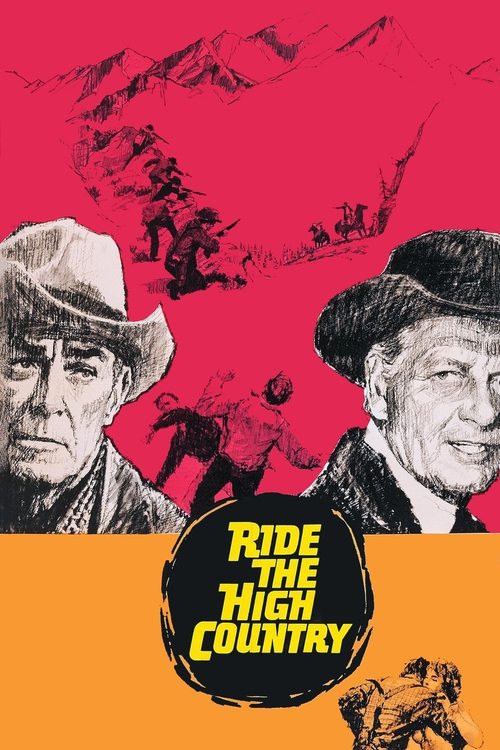
Ride the High Country
1962 · Sam Peckinpah
For when you want a Western with a soul — something rousing on the surface and melancholy underneath, best on an unhurried evening when a line about honor might actually get to you. Comforting in form, quietly devastating in feeling.
What it's about
Two aging ex-lawmen, long past their glory days, take one last job: escorting a gold shipment down from a high Sierra mining camp through bandit country. One means to do the work honestly; his old friend has quietly decided that a lifetime of loyal, underpaid service has earned him the right to steal it. Along the trail they pick up a young woman fleeing a marriage that's turning ugly at the camp, and the job gets complicated in every direction.
The experience
Elegiac and autumnal but never slow — it moves like a lean adventure while carrying real weight about friendship, pride, and getting old. The ending lands with a quiet force that stays with you.
Performances
Joel McCrea and Randolph Scott, two genuine Western stars in the twilight of their careers, play men in the twilight of theirs — the casting is the movie, and both bring a lived-in dignity no younger actor could fake. Mariette Hartley is affecting in her screen debut.
The craft
Peckinpah's second feature already shows his gift for putting moral rot and natural beauty in the same frame: high-country vistas, a genuinely unnerving wedding sequence in a mud-and-canvas mining camp, and dialogue that turns simple lines into credos. The mountain scenery rewards the biggest screen you can find.
Why it matters
Now widely seen as one of the great farewell Westerns and the film that announced Peckinpah as a major director, pointing straight toward his later, bloodier reckonings with the genre.
Snapshot
Ride the High Country is a valedictory Western — a film about old men at the end of an era, made at the end of an era, by an artist at the beginning of one. Sam Peckinpah's second feature follows two aging former lawmen, Steve Judd (Joel McCrea) and Gil Westrum (Randolph Scott), hired to escort a gold shipment down from a high Sierra mining camp. Judd intends to do the job straight; Westrum, embittered by a lifetime of underpayment, plans to steal the gold, and his apprentice Heck Longtree (Ron Starr) is in on the scheme. Along the way they take on the rescue of a young woman, Elsa Knudsen (Mariette Hartley, in her screen debut), from a degraded marriage to one of the feral Hammond brothers at the Coarse Gold camp. The picture braids a meditation on honor, friendship, and obsolescence into a lean adventure that closes with one of the most affecting death scenes in the American Western. Dumped by MGM as the bottom half of a double bill at home, it was embraced by European critics and has since become a touchstone — the hinge between the classical Western of Ford and Hawks and the revisionist mode Peckinpah himself would detonate seven years later with The Wild Bunch.
Industry & production
The film was a modest MGM production overseen by producer Richard E. Lyons, who assembled it as a comparatively inexpensive genre picture. Its most consequential decision was casting: Lyons and Peckinpah secured Randolph Scott and Joel McCrea, two stars whose careers were rooted in the studio-era Western and whose presence carried the weight of that history. The pairing was itself a piece of meaning — audiences brought decades of associations to these weathered faces. The story has often been told that Scott and McCrea initially considered swapping roles before settling into Westrum (Scott) and Judd (McCrea); the film became Scott's last, after which he retired, and a late-career capstone for McCrea.
The production's fate at MGM is the defining fact of its release history. The studio was in the throes of management upheaval during this period, and the new regime had little interest in a black-comic, elegiac Western from a young television director. The film was released in the United States with minimal support, frequently as the lower feature on a double bill, and earned little domestic attention on first release. Its rescue came from abroad and from a handful of American critics: European festival audiences and reviewers responded strongly, and the picture accumulated significant critical prizes on the Continent. (The precise festival record is sometimes reported inconsistently, so specifics should be treated with care; the general fact of strong European recognition against domestic neglect is well established.) That inversion — commercial indifference at home, critical canonization abroad and over time — set the pattern for how the film's reputation would grow.
Technology
Ride the High Country was shot in anamorphic widescreen (CinemaScope) and in Metrocolor, MGM's color process, by cinematographer Lucien Ballard. The CinemaScope frame is integral to the film's design: the wide aspect ratio lets Peckinpah and Ballard set small human figures against the vertical immensity of the High Sierra, and to stage the central relationships horizontally — two men riding abreast, the gulf and the bond between them held in a single composition. Color is used pointedly, with the autumnal mountain palette underscoring the film's themes of lateness and decline; the location work in the Eastern Sierra (the Inyo–Mono high country) supplies a landscape of real altitude and weather rather than a backlot abstraction. This is otherwise a film made with the standard tools of early-1960s studio production; its technical distinction lies in how conventionally available means — scope, color, location — are bent toward an elegiac purpose.
Technique
Cinematography
Lucien Ballard's photography is the film's great visual asset and the start of one of the signature collaborations of Peckinpah's career (Ballard would later shoot The Wild Bunch and others). Ballard composes the widescreen frame for legibility and feeling: the opening movement through a town that has already begun to modernize — a camel, a policeman, an automobile-age intrusion into the West — establishes through composition that Judd belongs to a vanishing order. In the mountains the camera finds the grandeur of the location without lapsing into mere scenery; the high country is both beautiful and indifferent, a moral as well as physical terrain. Ballard's lighting handles the film's tonal range, from the warm domesticity of the Knudsen farm to the lurid, grotesque atmosphere of the Coarse Gold camp and its brothel.
Editing
The film was cut by Frank Santillo, an editor whose rhythmic, montage-influenced approach is often credited with shaping Peckinpah's developing sense of pace. Santillo's cutting is most conspicuous in the action, where rapid, multi-angle assembly compresses and intensifies violence — an early, embryonic version of the kinetic montage Peckinpah would expand into the slow-motion crescendos of his later work. Even outside the gunfights, the editing serves character: the film knows when to hold on a face and when to accelerate, and the control of tempo is part of why the climactic shootout and Judd's death land with such economy.
Mise-en-scène / staging
Peckinpah's staging organizes the film around contrasts of order and squalor. The Knudsen homestead is governed by a rigid, Bible-quoting patriarch (R.G. Armstrong), all repression and scripture; the Coarse Gold mining camp is its inverse — mud, drink, and the predatory Hammond brothers, a clan of grotesques whose squalid wedding and shared claim on Elsa give the film its darkest stretch. Between these poles ride the two old lawmen, whose code is tested by both. The recurring visual motif of two riders moving through landscape — together, then at odds, then reconciled — carries the emotional architecture. Peckinpah stages the men's history physically: in their bodies, their wary courtesy, the ease and the suspicion between them.
Sound
George Bassman's score frames the film with a robust, traditional Western idiom that leans into the elegiac register without overwhelming the drama; the music supports the sense of an era passing rather than commenting ironically on it. Beyond the score, the film's soundscape is largely naturalistic — the report of gunfire, the high-country wind, the clamor of the mining camp — and its restraint matters: the quiet of Judd's death scene, played close to silence, gains its force from the contrast.
Performance
The performances are the film's heart, and they depend on the audience's memory. Joel McCrea plays Steve Judd with an upright, slightly stiff dignity — a man clinging to a code in a world that has stopped paying for it — and his stillness makes the climactic line land. Randolph Scott's Gil Westrum is the more dynamic creation: charming, rueful, corrupted by grievance yet never wholly lost, and Scott plays the slow turn back toward honor with great delicacy. The two veterans' rapport — affectionate, needling, freighted with shared history — is the engine of the picture. Mariette Hartley, in her debut as Elsa, brings a fresh, unguarded quality that the film sets against the brutality around her. The supporting roster is a Peckinpah stock company in formation: Warren Oates and L.Q. Jones among the Hammonds, James Drury as Billy Hammond, John Anderson, John Davis Chandler, and R.G. Armstrong as the stern father — players who would recur throughout the director's later work.
Narrative & dramatic mode
The dramatic mode is elegiac realism shot through with black comedy. The narrative is structured as a journey — up to the mining camp, then the fraught descent with the gold and the rescued bride — but its real movement is moral, tracking Westrum's wavering and eventual return to grace and Judd's steadfastness unto death. The film's tonal control is notable: the Coarse Gold sequences edge into grotesque comedy, while the central friendship is played for genuine pathos. The recurring concern is the relationship between principle and survival — Judd's insistence on doing right not for reward but for self-respect, distilled in his much-quoted line about wanting only to "enter my house justified," words Peckinpah attributed to his own father. The climax resolves the partners' conflict not through a duel between them but through their reconciliation in a shared fight against the Hammonds, ending with Judd's quiet death — a resolution that subordinates spectacle to feeling.
Genre & cycle
Ride the High Country belongs to the "twilight" or "end-of-the-West" Western, a cycle preoccupied with aging gunfighters and the closing of the frontier that runs through pictures like The Gunfighter, The Man Who Shot Liberty Valance (released the same year), and later The Shootist. Within that cycle it is unusually self-aware about its own stars: by casting two emblematic Western actors near the end of their careers, the film makes the genre's obsolescence its subject. It sits at a transitional moment — still recognizably classical in its values and its faith in the code of honor, yet already darkened by the squalor, sexual violence, and moral ambiguity that would define the revisionist Westerns of the later 1960s and 1970s. It is, in this sense, both a late classical Western and a proto-revisionist one.
Authorship & method
This is the film on which Sam Peckinpah's authorial identity first crystallized. Coming off the television series The Rifleman and The Westerner and his debut feature The Deadly Companions (1961), Peckinpah found in this material his enduring obsessions: men out of their time, the corrosion and redemption of loyalty, the violence beneath the frontier myth, and a deep ambivalence about the very codes his heroes live by. The screenplay is credited to N.B. Stone Jr. (the project carried the working/UK title Guns in the Afternoon), but Peckinpah is generally understood to have substantially reworked the script, and the dialogue's moral weight — above all the "justified" line — bears his stamp. His key collaborators here would become career-long ones: cinematographer Lucien Ballard, editor Frank Santillo, and the troupe of character actors (Oates, Jones, Armstrong, Anderson) who recur across his filmography. Producer Richard E. Lyons gave the young director the latitude and the casting coup that made the film possible. The method on display — location shooting, an emphasis on physical and moral texture, montage-driven action, and the use of star iconography as meaning — is the Peckinpah template in nascent form.
Movement / national cinema
The film is a product of the late Hollywood studio system in its period of breakdown, made at MGM as the old machinery of contract production was giving way. It is not affiliated with any formal movement, but it can be read as an American counterpart to the international new waves of the early 1960s in one respect: it interrogates a national genre from within, using the iconography of the classical Western reflexively. Its critical fortunes also tell a transatlantic story — like several American genre films of the era, it was taken more seriously by European cinephiles than by its domestic studio, a pattern that prefigured the auteurist re-evaluation of Hollywood directors then gathering force in French and British criticism.
Era / period
Ride the High Country is set around the turn of the twentieth century, at the moment the frontier is closing — automobiles and modern policing intruding on the world of the horseman. Made in 1962, it stands at a parallel hinge in film history: the classical studio Western was nearing exhaustion, and the genre's revisionist phase was about to begin. The film's doubled sense of lateness — a story about the end of the Old West, made at the end of the old Hollywood — is the source of much of its resonance. Released the same year as Ford's The Man Who Shot Liberty Valance, it belongs to a remarkable late-classical moment in which the Western turned to mourn itself.
Themes
The film's governing theme is integrity in a fallen world — Judd's wish to "enter his house justified," to act rightly for its own sake when honor no longer pays. Around it cluster Peckinpah's enduring concerns: male friendship and its betrayals; loyalty and the temptation of greed; aging and obsolescence, the dignity and the cost of outliving one's era. The Knudsen and Coarse Gold settings dramatize a further theme — the trap of a world that offers women only repression or degradation, with Elsa's flight a search for a third possibility. Beneath all of it runs the question of the frontier myth itself: the film honors the code of the old West while refusing to look away from its brutality, holding admiration and disillusionment in the same frame.
Reception, canon & influence
On release in 1962 the film was effectively buried by MGM in the United States and made little commercial impression. Its reputation was built elsewhere and afterward: European critics and festival audiences championed it, and it earned notable Continental prizes (the specific festival citations are sometimes reported inconsistently and should be checked against primary sources), while perceptive American reviewers singled it out as one of the year's finest. Over the following decades it became firmly canonized — frequently cited among the great Westerns and as the film that announced Peckinpah as a major American director.
Looking backward, the film draws on the classical Western tradition of Ford and Hawks and especially on the "aging gunfighter" strain of the 1950s; the casting of Scott and McCrea consciously invokes — and depends upon — the audience's accumulated memory of their earlier work, much of it (in Scott's case) the lean Budd Boetticher Westerns of the prior decade. Looking forward, its influence is large. It established the themes, the stock company, and the technical collaborators that Peckinpah would carry into Major Dundee, The Wild Bunch, The Ballad of Cable Hogue, and Pat Garrett and Billy the Kid; The Wild Bunch (1969) in particular reads as the violent, expanded fulfillment of this film's elegy for men outliving their world. More broadly, Ride the High Country helped open the path from the classical to the revisionist Western, and its central image — old professionals riding toward a last stand to redeem their own self-respect — became one of the durable templates of the modern genre.
A Deleuzian reading
A man rides into town expecting the town he left.
The full Deleuzian reading of Ride the High Country →
Reception
MGM's new regime dumped it as the bottom half of a double bill in 1962, but European critics crowned it almost immediately — it took first prize at the Belgian film festival and Newsweek named it the year's best film. It's now firmly canonized as one of the great elegiac Westerns and the film where Peckinpah became Peckinpah.
How Ride the High Country was received, from release to now →
Influences: the films it descends from and the films it influenced
- Comanche Station (1960) — The lean two-rider journey structure and Randolph Scott's weathered stoic persona that Peckinpah casts against — RtHC's meaning literally depends on the audience carrying Scott's Ranown-cycle iconography into the role.
- Seven Men from Now (1956) — Boetticher's compressed moral economy — terse exchanges where a man's code is tested on the trail — supplies the dramaturgical model for Scott's tempter-vs-keeper arc and the spare dialogue Peckinpah weights with the 'justified' line.
- The Gunfighter (1950) — Inaugurates the 'aging gunfighter outliving his myth' strain, using a star's worn face as text — the obsolescence-and-reputation theme RtHC inherits wholesale.
- High Noon (1952) — The lone professional upholding a personal code amid a corrupted, indifferent community — the integrity-in-a-fallen-world template, with self-respect as the only reward.
- Shane (1953) — Stevens' staging of order versus squalor (the homestead against the mud-town saloon) and the gunfighter as a fading mythic figure prefigures RtHC's order-vs-squalor blocking and elegiac register.
- Red River (1948) — The two-man generational pairing in tension, and professionalism as the western's true subject, model the Judd/Westrum partnership and the older-mentor/younger-rider dynamic.
- She Wore a Yellow Ribbon (1949) — Ford's elegy for the aging professional facing mandatory retirement — twilight light, valedictory tone, and the obsolescence of a man defined by a vanishing service.
- The Searchers (1956) — Location-rooted landscape grandeur paired with moral ambivalence about the hero, establishing the physical-and-moral 'texture' Peckinpah cites as method over studio gloss.
- Man of the West (1958) — Mann's reformed-outlaw-confronting-his-violent-past structure and the eruption of brutality beneath frontier civility directly anticipate Peckinpah's 'violence beneath the myth.'
- The Lusty Men (1952) — Carries forward the elegiac modern-Western register of superannuated cowboys outlived by their frontier, trading heroic myth for weary craft and dwindling wages.
- The Misfits (1961) — Peckinpah's inaugural elegy for aging frontiersmen outlived by the country they tamed, launching the 1960s obsolescence cycle The Misfits helped legitimize.
- The Man from Laramie (1955) — Inherits Mann's aging, morally compromised protagonists and elegiac tragedy, carrying the wounded-hero ethos into the elegy for the West.
- The Wild Bunch (1969) — The violent, expanded fulfillment of the same elegy — carries over Lucien Ballard's photography, montage-driven action editing, the stock company (Oates, Jones, Johnson), and the old-professionals'-last-stand-for-self-respect template.
- The Ballad of Cable Hogue (1970) — Extends the elegy for a man outliving his world into a gentler register, reusing the Peckinpah stock company and the closing-frontier-obsolescence theme seeded here.
- Pat Garrett and Billy the Kid (1973) — The two-former-comrades-on-opposite-sides structure and the elegiac, integrity-in-a-corrupted-order theme are the mature outgrowth of the Judd/Westrum dynamic, again scored as lament.
- The Shootist (1976) — Builds its entire effect, as RtHC did with Scott/McCrea, on the audience's accumulated memory of an aging star (Wayne) playing a gunfighter facing his own end — star iconography as meaning.
- Monte Walsh (1970) — A direct descendant of the aging-obsolescence strain — cowboys made redundant by the encroaching modern order, riding toward a quiet last stand for dignity.
- Unforgiven (1992) — The canonical late heir: an elegiac revisionist western trading on a star's iconography of age and violence, with self-respect and the corrosion of the code as its moral spine.
- Butch Cassidy and the Sundance Kid (1969) — Peckinpah and cinematographer Lucien Ballard developed the elegiac Western about obsolete gunfighters who cannot survive into modernity, shot in warm CinemaScope compositions — the immediate structural and visual template for Butch and Sundance's historical predicament and the film's landscape photography.
- For a Few Dollars More (1965) — The dual-protagonist structure of two veteran gunfighters with opposing codes forced into reluctant alliance is the direct structural precursor to Manco and Mortimer's rivalry-to-partnership arc; Peckinpah's elegiac framing of professional violence as the occupation of men with no future shapes Leone's treatment of the bounty hunter as tragic type.
- 3:10 to Yuma (2007) — Peckinpah's calibrated counterpoint between two aging gunfighters with divergent moral codes sharing a journey establishes the two-hander dynamic of mutual recognition between principled man and compromised man that Bale and Crowe directly inherit.
- McCabe & Mrs. Miller (1971) — Peckinpah's elegiac framing of Western protagonists as men whose virtues are archaic and whose deaths will pass unmourned established the genre's susceptibility to this mode; Altman extends the device from individual character pathos into a structural critique of the economic forces that produced the frontier itself.
- Pat Garrett & Billy the Kid (1973) — Establishes Peckinpah's elegiac aging-partners structure and farewell-tableau staging, plus the casting of worn veteran actors (McCrea/Scott) as the moral center — the template Pat Garrett reprises with its procession of weathered faces.
- The Death of Robin Hood (2026) — Builds its elegy from two aging gunmen as a paired two-hander riding toward a final reckoning — the veteran-partners chamber structure this film compresses into a single location.
- The Man Who Shot Liberty Valance (1962) — Released the same year, it is the other great closing-frontier elegy — the printed legend versus the squalid truth, the West passing into obsolescence, told through aged star bodies.
- Lonely Are the Brave (1962) — A contemporaneous study of the cowboy as an anachronism crushed by modernity, sharing RtHC's aging-obsolescence and closing-frontier preoccupation.
- Bring Me the Head of Alfredo Garcia (1974) — Peckinpah's own founding statement of aging men clinging to a personal code amid loyalty and betrayal — the moral architecture Bennie carries into debasement.
- El Dorado (1966) — Casts iconic screen veterans as past-their-prime gunmen trading on their own weathered stardom, the self-aware-iconicity performance mode El Dorado builds around Wayne and Mitchum's physical decline.
- One-Eyed Jacks (1961) — Peckinpah's own first full statement of the material he had worked on here in uncredited form: two partners split by one going respectable, the moral argument played in long, unhurried two-shots between aging faces, with the betrayal deferred almost to the last reel.
Similar films
- Shane (1953) — influence & lineage · same viewing thread · often watched together
- The Wild Bunch (1969) — influence & lineage · same viewing thread
- High Noon (1952) — influence & lineage · same viewing thread
- The Man Who Shot Liberty Valance (1962) — influence & lineage · same viewing thread
- Unforgiven (1992) — influence & lineage
- Red River (1948) — influence & lineage
- The Searchers (1956) — influence & lineage
- Pat Garrett & Billy the Kid (1973) — same viewing thread · often watched together
All the films related to Ride the High Country →
Watch it with: curated runs of related films
- Print the Legend — A run of frontier myths and their unmaking — town-taming marshals, aging gunfighters, and the stories the newspapers chose to print instead of the truth.