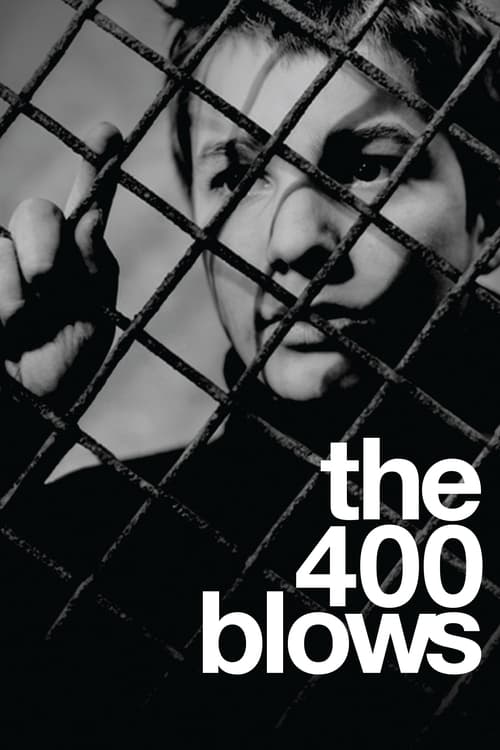
The 400 Blows
1959 · François Truffaut
For when you want to feel your own childhood again — the freedom and the loneliness both. A moving watch rather than a heavy one, and a perfect first step into classic French cinema.
What it's about
Antoine Doinel is twelve, growing up in a cramped Paris apartment with parents who barely notice him and a school that punishes him for everything. He skips class, wanders Montmartre with his best friend René, and improvises small schemes toward some better life — until one of them lands him in real trouble with the law, and the adult world closes in with institutions instead of understanding.
The experience
Tender, alive, and quietly heartbreaking — it moves with the restless energy of a kid on the loose, funny one minute and crushing the next. The streets of Paris in winter black-and-white give it a beauty that softens nothing.
Performances
Jean-Pierre Léaud, discovered at thirteen, gives one of the great child performances in movies — unstudied, watchful, defiant — including an interview scene so natural it feels like documentary.
The craft
François Truffaut shot his own troubled boyhood on real Paris streets with a mobility and honesty that felt revolutionary, favoring long fluid takes and found locations over studio polish. It closes on one of the most famous final images in all of cinema.
Why it matters
A founding film of the French New Wave, it won Truffaut the Best Director prize at Cannes in 1959, launched a five-film cycle following Antoine into adulthood, and permanently changed what a personal, low-budget movie could be.
Snapshot
Les Quatre Cents Coups — the French idiom means roughly "to raise hell," to live recklessly; the English title preserves the numerals but loses the colloquial charge — is François Truffaut's first feature film and one of the founding documents of the French New Wave. Shot in Paris during the autumn and winter of 1958–59, it follows twelve-year-old Antoine Doinel through cycles of petty transgression, institutional punishment, and thwarted flight, ending on one of cinema's most analyzed freeze frames. The film is openly autobiographical, a transposition of Truffaut's own turbulent adolescence onto celluloid, and it introduced Jean-Pierre Léaud, whose face would anchor four further Doinel films across the next two decades. It won the Best Director prize at Cannes in May 1959, screened to international audiences the same year, and has not left the canon since.
Industry & production
Truffaut had spent the preceding years as one of the most combative critics at Cahiers du Cinéma, his 1954 essay "Une certaine tendance du cinéma français" attacking the staid, literary "tradition of quality" that dominated French studio production. The 400 Blows was the practical answer to that polemic — a film made outside the guild structures and prestige habits of mainstream French cinema. Truffaut formed Les Films du Carrosse (named in homage to Jean Renoir's Carrosse d'or) as the production vehicle; the company would remain his home base for the rest of his career.
Financing was modest and partly familial: Truffaut's father-in-law Ignace Morgenstern, a film distributor, provided crucial backing. The production shot on location almost entirely in Paris — the 14th arrondissement streets of Truffaut's own childhood, actual school corridors, a working police station — rather than on the studio lots that "quality" films depended upon. This displacement from the studio into the city was not merely an economic expedient; it was a declaration of method. The film's dedication reads "À la mémoire d'André Bazin," Truffaut's mentor and intellectual father figure, who died of leukemia in November 1958 during the film's production. Bazin's realist aesthetics — his belief that cinema's highest calling was to preserve the ambiguity and density of lived reality — permeate every production choice.
The screenplay was written by Truffaut in collaboration with Marcel Moussy, a television writer experienced with social-realist drama. Moussy's contribution gave the script structural coherence, but the emotional core — Antoine's specific humiliations, his love of cinema and literature, the particular texture of neglect at home — came directly from Truffaut's own life.
Technology
The film was shot in Dyaliscope, a French anamorphic widescreen process yielding an approximately 2.35:1 aspect ratio. The choice is worth noting: an anamorphic wide frame is not the obvious format for a low-budget location film — it demands careful horizontal composition, complicates handheld operation, and requires specific lenses. Truffaut and his cinematographer Henri Decaë embraced the format anyway, and the resulting widescreen image gives the film a visual gravity that sits in productive tension with its improvisational surface. The Parisian streets and cramped apartments become properly cinematic spaces rather than documentary backdrops.
Camera equipment of the period was still relatively cumbersome by later Nouvelle Vague standards; the Éclair Cameflex, which would become a staple of New Wave mobility, was available but not yet ubiquitous. Decaë worked with what he could move efficiently through city streets. Much of the dialogue was post-synchronized — location sync sound recording at acceptable quality remained technically demanding — though the interview sequence late in the film carries the weight of direct, unmediated speech precisely because it appears to have been captured live.
Technique
Cinematography
Henri Decaë was already associated with a more mobile, location-grounded visual practice through his work with Jean-Pierre Melville (Bob le Flambeur, 1956) and Claude Chabrol (Le Beau Serge and Les Cousins, both 1958). On The 400 Blows he brought that sensibility to bear with exceptional tonal control. The Paris winter light is used austerely: the black-and-white image tends toward cool grays and deep shadows in interior scenes, while the street sequences often catch a flat, diffuse daylight that refuses to glamorize. The camera moves fluidly when required — notably in the long, unbroken tracking shot that follows the children's gymnastics class through the city streets — but holds steady and observational during Antoine's interrogations and confinements. The climactic sequence, Antoine's run from the reform school to the sea, is sustained in long shot for much of its duration, the Normandy landscape opening around the boy as space that offers no real answer.
The final image — a zoom-in to freeze frame on Antoine's face as he turns from the waterline — has generated as much critical commentary as almost any single image in French cinema. The freeze arrests the film at the moment of Antoine's supposed freedom, trapping him in the viewer's gaze as thoroughly as every institution has trapped him in the film's narrative.
Editing
The film was edited by Cécile Decugis, one of the key editors working within the New Wave orbit. The cutting on The 400 Blows is not the jump-cut aggression that would characterize Godard's Breathless the following year; it is more classically rhythmic but strategically loose, allowing scenes to breathe past the point where conventional coverage would have intervened with a reaction shot or a cut-away. This restraint serves the film's observational mode: Truffaut is interested in duration, in the accumulation of indignities rather than their punctuation.
Mise-en-scène / staging
The Doinel apartment is a key spatial argument: it is too small, the parents' sleeping area imperfectly curtained off, Antoine's presence a logistical irritant. Truffaut stages the household as a space of perpetual negotiation in which the child has no corner of his own. The classroom is correspondingly overlit and regimented, the teacher's authority arbitrary and easily mocked. Antoine and his friend René move through the city with the particular freedom of children who are not being watched — the freedom, that is, of the abandoned rather than the trusted.
Truffaut's debt to Jean Vigo's Zéro de conduite (1933) is most visible in the school sequences, where institutional authority is shown as simultaneously absurd and injurious. Like Vigo, Truffaut has no interest in reformist critique; the system is not broken and fixable but simply hostile to the inner lives of children.
Sound
Jean Constantin's score is light-footed and largely jazz-adjacent in its percussive passages, stepping back from the image rather than underscoring it sentimentally. Long stretches of the film carry ambient urban sound — traffic, voices, the hum of a city indifferent to one small boy's troubles — without musical accompaniment. The most formally striking sound decision is the interview sequence: a psychologist (heard but never shown) questions Antoine about his family and desires, and Léaud answers at length in what appears to be direct, unscripted speech. The scene is among the closest the Nouvelle Vague came to documentary; its power derives partly from the sense that the film's apparatus has temporarily stepped back to let something real in.
Performance
Jean-Pierre Léaud was fourteen during production, found through an open casting call. He had no prior professional acting experience. Truffaut elicited from him a quality that the period's dominant acting methods — studio-trained, vocally projected — could not have produced: a sullen, watchful authenticity that reads as private rather than performed. The interview sequence reportedly had Truffaut himself asking the questions from behind the camera; Léaud's answers about his mother, his reading, his ambitions were substantially improvised, and the camera simply recorded them. This collapse of the boundary between character and actor became a structural premise of the Doinel cycle: Léaud grew up across the films, and Antoine Doinel grew up with him.
Narrative & dramatic mode
The film's narrative is episodic rather than causally tight — a sequence of misfortunes, each arising partly from external injustice and partly from Antoine's own choices, none leading to consequences that feel proportionate or meaningful. This episodic structure refuses the conventional cause-and-effect logic of classical narrative in favor of something closer to the texture of a childhood remembered: things happen, adults respond badly, the child adapts or doesn't, time passes. The film's dramatic mode is tragicomic — Antoine's schemes are often faintly ridiculous (blaming a teacher's absence on his mother's death; stealing and reselling a typewriter) — but the consequences that accrue are genuinely harsh.
The point-of-view alignment with Antoine is near-total without being technically restricted: Truffaut does not confine the camera to what Antoine can see, but he never grants meaningful interiority to the adults who fail him. They remain surfaces, comprehensible as social types but not as private consciousnesses.
Genre & cycle
The 400 Blows belongs to the coming-of-age film and to the specifically French tradition of the enfant terrible story, but it also participates in a mid-century international cycle of juvenile delinquency films. The postwar decade produced a string of films across Europe and North America concerned with alienated youth: Nicholas Ray's Rebel Without a Cause (1955), Laslo Benedek's The Wild One (1953), various Italian neorealist studies of street children. Truffaut's film differs from the American examples in its refusal of melodrama and from the Italian examples in its more sustained irony. The reform school sequences recall documentary studies of institutional confinement; the Dyaliscope image grants them an incongruous formal dignity.
Antoine Doinel himself inaugurates a cycle within Truffaut's own work: Antoine and Colette (1962, a short contribution to the anthology Love at Twenty), Stolen Kisses (1968), Bed and Board (1970), and Love on the Run (1979) follow the character through early adulthood, marriage, infidelity, and retrospection, always played by Léaud. This sustained commitment to a single character across two decades of filmmaking has few parallels in world cinema; the nearest analogs are perhaps Satyajit Ray's Apu trilogy and, in later decades, Richard Linklater's Boyhood (2014).
Authorship & method
Truffaut had spent his critical years developing the auteur theory as a polemical tool, arguing that the director's personal vision was the organizing principle of meaningful cinema. The 400 Blows is both an enactment of that theory and a complication of it: the film is deeply personal, clearly the work of an individual sensibility, but it was also genuinely collaborative in ways the theory sometimes obscured. Decaë's cinematographic intelligence is not a transparent vehicle for a directorial vision; it is a constitutive element of the film's meaning. Moussy's structural contribution shaped what might otherwise have been more formless.
Truffaut's method on set was by accounts relatively open and improvisational within a planned framework — he was not a director who had every shot storyboarded. The famous interview sequence, the long tracking shot of the gymnastics run, the sustained take of Antoine's confession to his mother: these suggest a director willing to let scenes find their own time and shape.
Movement / national cinema
The 400 Blows is the first major feature of the French New Wave to reach international audiences; Chabrol's Le Beau Serge and Les Cousins predated it slightly but circulated less widely. The film arrived at Cannes alongside Alain Resnais's Hiroshima mon amour (1959), and together they announced to international cinema that something had changed in France. The New Wave was not a manifesto movement with an agreed program; it was a loose convergence of filmmakers — Truffaut, Godard, Chabrol, Rivette, Rohmer, then Varda, Demy, Malle and others — connected by generational experience, Cahiers formation, and a shared rejection of the prestige-cinema mode. What bound them most clearly was the preference for location over studio, for personal material over literary adaptation, and for the director as primary creative agent.
The 400 Blows was the first French film to be selected by France as its official submission to Cannes in several years — an institutional endorsement that helped legitimize the movement even before the critical reception confirmed its importance.
Era / period
The late 1950s were a period of French social and political tension (the Algerian War, the collapse of the Fourth Republic, de Gaulle's return) that the film does not address directly. What it registers is the texture of postwar Parisian working-class life: the cramped apartments, the bureaucratic schools, the courts and reformatories, the gap between the promise of the trente glorieuses (France's postwar economic expansion) and its uneven distribution. Antoine Doinel's family is neither poor nor comfortable; they are managing, and the managing leaves no room for him.
Themes
The film's central thematic argument concerns the systematic failure of every adult institution to see the child clearly. Parents, teachers, judges, psychologists — all process Antoine through categories that misfit him. The psychologist's interview is the film's most pointed demonstration of this: her questions are methodical, professional, and entirely unable to make contact with the particular consciousness that answers them. Antoine is not delinquent in the morally loaded sense the word implies; he is responsive to his situation, which is one of consistent neglect and misrecognition.
Freedom and confinement operate in counterpoint throughout: the city streets offer freedom but no destination; the sea, when Antoine finally reaches it, is not an escape but a boundary. Cinephilia appears as a form of connection and respite — Antoine steals a still photograph from a Bergman film, and the movie theater functions as a space of temporary shelter — anticipating the role cinema would play across the Doinel cycle and in Truffaut's autobiographical self-understanding more broadly.
Reception, canon & influence
Backward influences: The most direct precursor is Vigo's Zéro de conduite in its treatment of institutional authority and childhood solidarity. Italian neorealism — Rossellini especially — shaped the commitment to location and non-professional performance. Jean Renoir's humanism and his ease in moving between exterior and interior space are evident. André Bazin's theoretical writing on the long take, depth of focus, and cinema's duty to the real provided the critical framework within which Truffaut thought about his own choices.
Initial reception: The Cannes Best Director prize established the film's reputation before it opened commercially, and its international distribution followed quickly. Critical response was largely enthusiastic and occasionally confused — some critics praised what they read as social criticism, others the formal novelty, others the performance. The film performed well enough commercially to secure Truffaut's position as a working director.
Canon and legacy: The 400 Blows has appeared on virtually every significant poll of the greatest films ever made and consistently ranks near the top of coming-of-age and Nouvelle Vague lists. The Sight & Sound poll has included it in its top tier across multiple decades. Its influence is documented across European cinema of the 1960s (the British New Wave, the Czech New Wave, the German New Cinema) and across world cinema more broadly. The autobiographical impulse it legitimized — the idea that a director's personal history was sufficient material for a serious feature — opened a door that subsequent filmmakers from Martin Scorsese to Alfonso Cuarón (Roma, 2018) have walked through. Linklater has cited the Doinel cycle, beginning here, as foundational to his own long-duration character studies. The freeze-frame ending has been imitated, quoted, and subverted so many times that it now functions as a kind of grammatical mark in the film-historical vocabulary, legible even to viewers who have not seen the original. That the image retains its emotional force despite this over-familiarity is a measure of what Truffaut and Decaë actually caught on that Normandy beach in 1959: a face at the end of its options, turning toward the camera as toward the only witness it has ever been given.
A Deleuzian reading
He runs.
The full Deleuzian reading of The 400 Blows →
Reception
No flop-to-classic arc here — it was a sensation from day one, winning Truffaut Best Director at Cannes 1959, one year after he'd been banned from the festival as a too-vicious critic. Then: the shot heard round the world for the French New Wave; now: the movement's founding text and a permanent fixture of the canon.
How The 400 Blows was received, from release to now →
Influences: the films it descends from and the films it influenced
- Zéro de Conduite (1933) — Truffaut's reform-school third act and refusal to grant adult authority figures psychological interiority draw directly on Vigo's episodic structure of schoolboys versus cartoonish masters, including the dormitory rebellion that The 400 Blows transposes into Antoine's final flight from the Observation Centre.
- Roma città aperta (1945) — Rossellini's practice of post-synchronizing dialogue in studio over location-shot footage established the neorealist sound grammar The 400 Blows inherits—most of its dialogue is post-synced, yet the film reads as documentary.
- Sciuscià (1946) — De Sica's casting of non-professional boys as lead performers and his structural placement of a reform-school sequence as the film's emotional climax established the template for Truffaut's casting of Léaud and the Observation Centre third act.
- Germania Anno Zero (1948) — Rossellini's sustained tracking shots following a child through real city streets as episodic moral geography—with the city as indifferent antagonist—provided the formal model for Antoine's wanderings through Montmartre and the 14th arrondissement.
- Los Olvidados (1950) — Buñuel's juvenile-delinquency film, shot on location in actual Mexico City slums with non-professional young leads, established the genre's moral template in which the reform school amplifies rather than remedies damage—the structural logic The 400 Blows inherits.
- Bob le Flambeur (1956) — Cinematographer Henri Decaë developed his available-light, mobile location-shooting practice through Paris streets and interiors on this film; Truffaut hired him specifically to import that city-grounded visual method into The 400 Blows.
- Les Cousins (1958) — Shot by Decaë in Paris apartments and streets the year before The 400 Blows was photographed, this film served as the direct technical rehearsal for the location-based widescreen grammar Truffaut and Decaë would use together.
- Elevator to the Gallows (1958) — Truffaut's use of Decaë consolidates the available-light Paris street grammar — tracking shots through actual neighborhoods, faces lit by practical windows and signs — as the founding visual language of the nouvelle vague, directly downstream of the methods Decaë codified on Elevator.
- Bicycle Thieves (1948) — Truffaut explicitly modeled the child-protagonist urban pedinamento and the open-ending freeze frame on Bicycle Thieves; Jean-Pierre Léaud was cast through an improvised process analogous to De Sica's street-discovery of Enzo Staiola, prioritizing unguarded behavioral naturalism over trained screen performance.
- Nights of Cabiria (1957) — Truffaut's closing direct-camera freeze-frame—the protagonist's gaze turning outward to fix the viewer in an irresolvable appeal—is widely debated as formally descended from Cabiria's final shot, which deploys the same device to convert personal devastation into audience implication.
- Umberto D. (1952) — Extends the neorealist practice of observationally following a marginal protagonist (a non-professional boy) through real streets and institutions, ending on an unresolved, anti-dramatic image rather than narrative closure.
- City Lights (1931) — Truffaut resolves the entire film on a final held close-up of an ambiguous face, the direct inheritance of City Lights' closing shot as the technique of ending a film on one unresolved expression.
- Baisers Volés (1968) — Truffaut maintained Léaud as Antoine Doinel across a decade, using the real aging of his non-professional-turned-professional lead to authenticate the fiction's passage of time—extending the autobiographical casting logic of The 400 Blows into a serial structure.
- If.... (1968) — Anderson structured the film in titled chapters and staged the school rebellion as an episodic accumulation of institutional indignities before climactic violence, directly extending Vigo's and Truffaut's formal model of the school as tyrannical microcosm.
- Kes (1969) — Loach cast a non-professional Yorkshire boy as lead and employed an observational editing rhythm that allows classroom and domestic scenes to run past their conventional dramatic utility, inheriting The 400 Blows' Bazinian commitment to duration over dramatic punctuation.
- El espíritu de la colmena (1973) — Erice renders a child's interior life through long observational takes and elliptical editing that refuses to psychologize the protagonist, extending the Bazinian approach to childhood consciousness that Truffaut encoded in the freeze-frame finale.
- Pixote (1980) — Babenco cast actual residents of São Paulo reform schools as lead performers—collapsing the fiction/documentary boundary in a direct extension of non-professional casting logic—and built an episodic trajectory through juvenile justice institutions that mirrors The 400 Blows' structural arc.
- Salaam Bombay! (1988) — Nair conducted street-workshop training with actual Bombay street children before casting them, and structured the film as an episodic accumulation of urban indignities without melodramatic resolution, directly inheriting The 400 Blows' observational narrative grammar.
- Boyhood (2014) — Linklater's episodic coming-of-age structure built from small domestic incidents rather than plot events, his editing rhythm that allows scenes to end without dramatic payoff, and the project's autobiographical grounding extend The 400 Blows' formal approach across a twelve-year real-time production.
- Nouvelle Vague (2025) — Truffaut — who supplied Breathless's story idea — pioneered the freer handheld camera and available-light Paris location shooting that the New Wave production depicted here was built on.
- My Father's Shadow (2025) — The autobiographical child-protagonist debut shot handheld in real locations, ending on a warm-withholding freeze that refuses emotional resolution rather than supplying it.
- Blue Heron (2026) — Founds autobiographical child realism built from location shooting and an observational camera that simply watches a boy navigate domestic neglect, the documentary-of-childhood method Romvari inherits.
- The Little Sister (2025) — Bildungsroman assembled from observational, undramatized episodes around a newly discovered youth, ending on the unresolved freeze rather than catharsis.
- Rumble Fish (1983) — Establishes the formal template for deploying teen delinquency as vehicle for cinematic experimentation rather than genre sentiment; the alienated-adolescent POV as license for stylistic rupture rather than melodramatic resolution.
- À bout de souffle (1960) — Truffaut wrote the source story treatment, and the film shares The 400 Blows' location-over-studio production model; Coutard's available-light Paris cinematography and Godard's jump-cut editing are a parallel—not derived—solution to the same rejection of studio classicism that Decaë and Truffaut practiced.
- Mouchette (1967) — A contemporaneous French portrait of a child crushed by institutional and parental neglect, ending on an unresolved flight that rhymes with Mouchette's refusal of catharsis.
- Fish Tank (2009) — The originating template of the troubled-youth coming-of-age — non-professional adolescent lead, real locations, and an open, unresolved ending — that Fish Tank's structure echoes.
- Viridiana (1962) — Shares the contemporaneous reinvention of the freeze-frame as an expressive terminal device—an arrested image that withholds resolution rather than supplying it.
- Hope and Glory (1987) — Ancestor in child naturalism and autobiographical authorship: a director's own boyhood recovered through a non-performing child's behavior and a roving observational eye, the performance register Boorman draws from Sebastian Rice-Edwards.
- Pather Panchali (1955) — A near-contemporaneous humanist childhood bildungsroman built on location shooting and a non-professional child's-eye perspective, sharing neorealism's lineage and the elliptical observation of a young life.
- Cléo from 5 to 7 (1962) — Truffaut's roving location camera tracking a solitary figure through actual Parisian exteriors shares Cléo's ambulatory grammar of following a protagonist through documented city space.
- The Chorus (2004) — Bequeaths the observational, non-condescending framing of a boy processed through punitive institutions, and the reform-school milieu (Mondy the incorrigible echoes Doinel) that the film restages sentimentally.
- The World of Apu (1959) — A contemporaneous location-shot bildungsroman that draws its truth from a naturalistic child/youth debut (Léaud) observed without sentimentality — the same coming-of-age realism Apu embodies through Chatterjee's first performance.
- Aparajito (1956) — An independently arrived-at bildungsroman using an untrained child lead and elliptical location shooting, part of the same postwar realist coming-of-age lineage.
- Forbidden Games (1952) — The polemicist who attacked the Aurenche-Bost 'tradition of quality' answers with his own child's-eye realism — location shooting, a non-professional lead, and an uncushioned final cut echoing Forbidden Games' abrupt ending.
- My Sweet Orange Tree (2012) — Truffaut's subjective, unsentimentalized child-narrator framing — camera pinned to the boy's height and the boy's misreadings of the adult world — is the formal template for the film's cinematography/childs-eye-view.
Similar films
- The Young and the Damned (1950) — influence & lineage · same viewing thread · often watched together
- Stolen Kisses (1968) — influence & lineage
- Breathless (1960) — influence & lineage
- Pixote (1980) — influence & lineage · same viewing thread · often watched together
- Nouvelle Vague (2025) — influence & lineage
- Bob le Flambeur (1956) — influence & lineage
- La Haine (1995) — same viewing thread · often watched together
- Salaam Bombay! (1988) — influence & lineage · same viewing thread
All the films related to The 400 Blows →
Watch it with: curated runs of related films
- Cinema of the Dispossessed — A run of slum-and-favela dramas — Rio, Mexico City, Mumbai, the Paris banlieue — where children survive by their wits and the city itself is the antagonist.
Film essays and courses that include it
- Camera on the Street: Italian Neorealism and the World It Made
- The Wound That Becomes You: Coming-of-Age and the Invention of Form
- Jump Cut: The Nouvelle Vague from Birth to Dissolution
- A School of Looking: French Cinema's Seven Decades of Formal Invention
- The Difficult Love: How Cinema Learned to See Inside the Family
- Unfinished Creatures: Cinema's Invention of Growing Up
- The French Invention: From Grand Illusion to Caché
- The Institution: A Century of Cinema Inside the Classroom
- The Long Crossing: International Films That Made the World Watch
- The Revolution That Disappeared
- The Frame That Refuses to End
- The Genre Told From After
- The Revolution, Reenacted