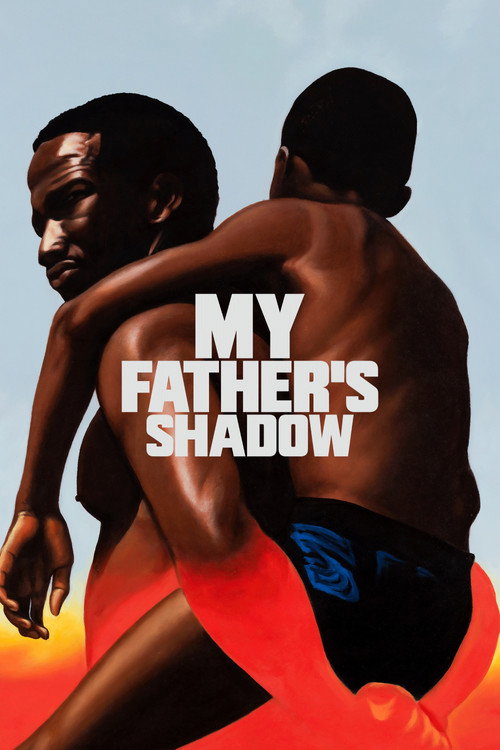
My Father's Shadow
2025 · Akinola Davies Jr.
When you want a film that makes history feel personal — that finds the political inside the domestic, the epic inside the ordinary. For a quiet evening when you want something genuinely moving.
What it's about
On June 12, 1993 — the day of Nigeria's presidential election — two young brothers, Akin and Remi, travel into Lagos with Folarin, the estranged father they barely know. His agenda is practical: collect unpaid wages, show the boys the city, get everyone home safely. But Lagos is crackling with political tension as results come in from a vote whose outcome will define the country. The film stays close to the children — their wonder at the city's scale, their confusion about the man they're following — as history moves around them.
The experience
Tender, quietly tense, and shot through with the specific texture of childhood memory — the way a single day can feel both very small (a father's hand, the noise of a market) and enormous (a country holding its breath). It earns its emotion without sentimentality.
Performances
The film rests on its young leads, who register wonder, confusion, and love for a father they barely know with an unguarded naturalism that can't be taught.
The craft
Shot on 16mm in Lagos, the image carries a warmth and grain that suits both the period and the film's memory-register. The city is a full character — its heat, sound, and density felt as immediately as any line of dialogue — and Davies Jr. never lets the political backdrop swallow the human foreground.
Why it matters
Selected for Un Certain Regard at Cannes 2025, it's a debut that placed British-Nigerian filmmaking on the international festival map, and the most intimate cinematic account yet made of the June 12 annulment that shaped modern Nigeria.
Snapshot
My Father's Shadow is the feature debut of British-Nigerian director Akinola Davies Jr., a chamber drama of large historical resonance that compresses a nation's rupture into a single father-son day. Across roughly 93 minutes, two young brothers — Akin and Remi — travel from the countryside into Lagos with Folarin, the estranged father they barely know, on June 12, 1993, the day of Nigeria's annulled presidential election. The film's central wager is one of scale: it asks the smallest of stories (a man trying to recover unpaid wages, take his sons to an amusement park, and get them home) to carry the weight of a democratic catastrophe whose shockwave still defines modern Nigeria. Shot on 16mm in Lagos and threaded with English, Nigerian Pidgin, and Yoruba, it premiered in the Un Certain Regard section of the 2025 Cannes Film Festival, where it was received as the first Nigerian film admitted to the festival's Official Selection and took a Special Mention for the Caméra d'Or. The film is openly elegiac — co-written by the director with his brother Wale Davies and drawn from the loss of their own father in childhood — and its quiet, deferred revelation of Folarin's death recasts the entire journey as an act of mourning and reconstruction. It became one of the most decorated debuts of its year, gathering a BAFTA, BIFA, and Gotham recognition, and standing as a landmark for Nigerian cinema's arrival on the European festival circuit.
Industry & production
My Father's Shadow is a UK–Nigeria co-production assembled from an unusually robust slate of British and Nigerian backers, a structure that signals both its art-house ambitions and the institutional support now flowing toward African auteur cinema. The lead producer is Element Pictures (the Dublin/London company behind Yorgos Lanthimos's The Favourite and Poor Things and Charlotte Wells's Aftersun), with producing partners including Riz Ahmed's Crybaby Films and Lagos-based Fatherland Productions (Funmbi Ogunbanwo). Financing and support came from BBC Film and the BFI (drawing on National Lottery funds), with MUBI handling distribution across the UK, Ireland, North America, and Turkey, FilmOne Entertainment releasing in Nigeria, and The Match Factory managing international sales. Reported budget figures put the production at roughly £2.5 million ($3.4 million) — modest by international standards but substantial for a Nigerian-set debut shot on film.
The project's defining production fact is its long gestation: the Davies brothers reportedly developed the idea over more than a decade, and the casting of Sọpẹ́ Dìrísù (the Gangs of London and His House lead) as Folarin in early 2025 anchored the film commercially. The two brothers are played by real-life siblings Godwin Chiemerie Egbo (Akin) and Chibuike Marvellous Egbo (Remi), with Ụzọamaka Power as Abike. Filming took place on location in Lagos. The combination — an Aftersun-adjacent producer, a Pan-British-Nigerian financing web, and a global streamer as distributor — is itself part of the story, illustrating the pathway by which a personal, regionally specific debut reached an international audience.
Technology
The film's most consequential technological choice is its capture medium: it was shot on 16mm film rather than digitally. In a contemporary landscape dominated by high-resolution digital acquisition, the decision to work on a comparatively small, grainy gauge is an aesthetic and historical statement. 16mm carries built-in associations with the early 1990s — the period the film depicts — and with documentary and home-movie textures, lending the imagery a tactile, memory-like quality appropriate to a story that is ultimately a work of reconstructed recollection. The format imposes practical constraints (limited takes, careful exposure, the cost and logistics of stock and processing) that tend to discipline a production toward economy and intention, and on a Lagos location shoot those constraints are non-trivial. Beyond the camera negative, the specifics of the post-production chain — scanning, grading, and finishing — are not extensively documented in the public record, and I won't speculate about the exact workflow. What is clear is that the choice of celluloid is integral to the film's sensory argument: the grain is not decoration but a way of placing the viewer inside a remembered, slightly degraded past.
Technique
Cinematography
Cinematographer Jermaine Edwards shot the film on 16mm, and the grain structure of the format is central to its look. The reported visual approach favors an intimate, observational register tuned to the children's eye level — a Lagos seen from below and within, registering the city's enormity (its traffic, markets, crowds, and heat) as something experienced rather than surveyed. The 16mm palette tends toward warmth and softness, and the format's shallow latitude and visible grain naturalize the bright exteriors and crowded interiors of a 1993 cityscape. Detailed shot-by-shot accounts of lensing and camera movement are limited in the current record; what critics consistently noted is a sensibility that holds on faces and gestures, privileging proximity to the father and sons over spectacle, so that the political upheaval arrives at the edges of the frame rather than at its center.
Editing
Omar Guzmán Castro edited the film. Its dramatic architecture depends on editing in a specific and demanding way: the narrative unfolds as a near-real-time day-in-the-life, then withholds and finally delivers the revelation of Folarin's death, reframing everything that preceded it. This requires an editorial structure that sustains the loose, wandering rhythm of a day spent with a half-known parent while quietly seeding the film's elegiac undertow — the nosebleeds, the talk of a drowned brother, the sense of borrowed time. The transition from intimate drift to the chaos of the election's annulment and the checkpoint confrontation marks the film's key tonal pivot, and the cut to aftermath and funeral is the gesture on which the whole design turns.
Mise-en-scène / staging
The staging is built around contrast of scale: small bodies in a vast city, a private reunion inside a public catastrophe. The production design (the film recreates a 1993 Lagos of minibuses, street food, an amusement park, and a café where the election results play on television) grounds the drama in lived period texture. The journey structure — countryside to city, minibus to hitchhiking after the fuel runs out — uses movement through space to dramatize both the father's daily precarity (six months unpaid) and the children's expanding sense of the world. Public space becomes increasingly charged as the election turns: the café, the streets, and finally the military checkpoint convert ordinary settings into sites of danger. The staging keeps the father physically central and emotionally elusive, so that the boys — and the audience — are always reading him.
Sound
Sound is one of the film's most celebrated dimensions; it won Best Sound Design at the Africa Magic Viewers' Choice Awards. The score is credited to Duval Timothy — the British–Sierra Leonean pianist and artist known for spare, sample-inflected compositions — and CJ Mirra, who also contributed to the film's sound work. The soundscape carries the dual burden of intimacy and history: the granular ambience of Lagos (traffic, crowds, radio and television broadcasts of the election) versus the hushed interior register of the father-son scenes. The use of broadcast media diegetically — the televised election coverage — is how the national event enters the family's day, making sound the principal channel through which history intrudes. The music's restraint suits a film that earns its emotion through accumulation rather than underscoring.
Performance
Sọpẹ́ Dìrísù's performance as Folarin was singled out across the film's awards run, winning Outstanding Lead Performance at the Gotham Awards. The role demands a difficult balance: Folarin must be charismatic enough to win his sons (and the audience) while remaining opaque, flawed, and burdened — a man of unpaid wages, an exposed affair, and a body quietly failing (the recurrent nosebleeds). Dìrísù plays him as warm but withholding, which is precisely what allows the late revelations to land. The two child performances, by non-professional real-life brothers Godwin Chiemerie Egbo and Chibuike Marvellous Egbo, supply the film's spontaneity and its point of view; the naturalism of children responding to a barely-known father is a load-bearing element of the film's authenticity, and reviewers widely credited the trio's chemistry as the engine of the drama.
Narrative & dramatic mode
The film operates in the mode of intimate, observational realism shadowed by retrospection — a memory-film disguised as a present-tense day. Its primary dramatic engine is the asymmetry of knowledge between the characters and the audience: we follow an ordinary outing whose ordinariness is gradually revealed to be precious and finite. Two structures run in counterpoint. The first is domestic and developmental — children learning who their father is, and learning about fraternal love, loss, and adult disappointment. The second is historical and tragic — a nation's democratic hope (the June 12 election) curdling into military annulment and unrest. The film's signature move is to let the second structure detonate the first: the annulment and the checkpoint confrontation turn a tender day into a threatened one, and the deferred disclosure of Folarin's death converts the whole film into elegy. This is autobiography sublimated into fiction — the Davies brothers reconstructing a father they lost young — which gives the realist surface an undertow of longing and reconstruction rather than mere reportage.
Genre & cycle
At base this is a family drama and a coming-of-age film, but it sits at the intersection of several cycles. It belongs to the lineage of the father-and-children road/day film, where a journey through a city becomes a vehicle for fraught intimacy, and it shares clear kinship with the contemporary cycle of memory-driven, formally restrained debuts about parents seen through a child's incomplete understanding — Charlotte Wells's Aftersun (also an Element production) being the most obvious comparison point in its blend of 1990s setting, grainy texture, and retrospective grief. It is also a political-historical drama, using a precisely dated crisis as both backdrop and engine. Within African and specifically Nigerian cinema, it represents an auteur, festival-oriented art film distinct from the high-volume Nollywood commercial model — part of a broader wave of internationally financed African dramas reaching the European circuit.
Authorship & method
Akinola Davies Jr. directs and co-writes; this is his feature debut after a career in short films, music videos, and installation work. He and his brother Wale Davies (co-writer) had previously collaborated on the acclaimed short Lizard (2020), which won the Short Film Grand Jury Prize at Sundance — establishing the sibling writing partnership and the director's facility with a child's perspective on Nigerian life. The method here is explicitly personal: the brothers drew on the early loss of their own father, developing the project over many years, and the film's structure (a day reconstructed in retrospect, named protagonists "Akin" and "Remi" mirroring the filmmakers) makes that autobiographical impulse formal rather than incidental.
The key collaborators reinforce the film's distinctive register. Cinematographer Jermaine Edwards delivers the 16mm imagery; editor Omar Guzmán Castro shapes the deferred-revelation structure; and composers Duval Timothy and CJ Mirra supply a restrained, atmospheric score that critics and award bodies singled out. Lead actor Sọpẹ́ Dìrísù functions as a creative anchor for the adult role. The producing axis — Element Pictures with Crybaby and Fatherland — pairs an art-house pedigree with Nigerian on-the-ground production capacity, a combination that the director has framed in interviews as essential to telling the story authentically in Lagos.
Movement / national cinema
The film's most cited significance is national: it was received as the first Nigerian film selected for the Cannes Official Selection, a milestone widely covered as a breakthrough for the country's cinema. That framing situates My Father's Shadow at the leading edge of a "New Nigerian Cinema" — auteur-driven, internationally co-financed work that exists alongside, but is formally distinct from, the prolific Nollywood industry. Where mainstream Nollywood is built on speed, volume, and a domestic-to-diaspora commercial market, this film belongs to a smaller current of films pursuing festival prestige and global art-house distribution. Its trilingual texture (English, Pidgin, Yoruba) and its insistence on shooting in Lagos rather than abroad mark it as authentically rooted, while its financing and festival pathway tie it to a transnational British-African production ecology. The recognition it received was thus read less as the achievement of one film than as a threshold moment for an entire national cinema's international visibility.
Era / period
The film is set on and around June 12, 1993 — the date of a presidential election widely regarded as the freest in Nigeria's history, presumed won by Moshood "M.K.O." Abiola, and then annulled by the military regime of General Ibrahim Babangida. The annulment triggered a national crisis that helped push Nigeria deeper into military rule under Sani Abacha and remains a foundational trauma and reference point in the country's democratic memory; June 12 is now observed as Democracy Day. The film embeds its private drama in this exact rupture: the family's day collapses as the results are voided and unrest erupts, so the period is not mere backdrop but the determining force of the plot's final act. The choice of 16mm and meticulous period staging are in service of recovering this specific historical moment as lived experience rather than archival fact.
Themes
The film's governing themes radiate from the figure of the absent/estranged father: paternal love and its failures, the inheritance children receive (and don't) from parents they barely know, and the reconstruction of memory after loss. Fraternity recurs at two scales — the two brothers learning to love each other, mirrored in Folarin's grief for his own brother who drowned in childhood — knitting personal mortality into the film's texture (the nosebleeds quietly foreshadow Folarin's death). Against these intimate concerns the film sets public ones: democratic hope and its betrayal, the violence of the state (the checkpoint), and economic precarity (Folarin's six months of unpaid wages), so that the private and political become reflections of one another. Underlying all of it is the theme of mourning as an act of imaginative recovery — the film itself is a son's attempt to know a lost father — and the related theme of place: Lagos as a vast, indifferent, vital city through which a small family briefly moves.
Reception, canon & influence
Critically, My Father's Shadow was received as one of the standout debuts of its year. It premiered at Cannes Un Certain Regard on 18 May 2025 and won a Special Mention for the Caméra d'Or (the festival's first-feature prize), and aggregators recorded near-unanimous praise — Rotten Tomatoes reporting 98% positive from 82 critics and Metacritic 85/100 ("universal acclaim"). Its awards run was substantial: a BAFTA for Outstanding Debut, the BIFA for Best Director (amid a dozen BIFA nominations), Gotham wins for Breakthrough Director (Davies Jr.) and Outstanding Lead Performance (Dìrísù), a Silver Peacock Special Jury Award at the International Film Festival of India, and multiple Africa Magic Viewers' Choice Awards. It was selected as the United Kingdom's submission for Best International Feature Film at the 98th Academy Awards, though it did not advance to the final nominations.
The influences flowing into the film are legible: the autobiographical-memory debut in the vein of Aftersun (an Element stablemate), the city-as-character realism of films built around a child's-eye journey, and the political-historical drama that renders national crisis through one family's day. Its lineage in the director's own work runs directly back to the Sundance-winning short Lizard. As for what it may shape: it is too recent for a settled legacy, and I won't overstate its downstream influence. What can be said with confidence is its historic standing as the first Nigerian film in Cannes' Official Selection — a fact that immediately positioned it as a reference point and door-opener for a new generation of internationally ambitious Nigerian and African auteurs, and as a high-water mark for the art-house, co-financed alternative to the Nollywood mainstream.
A Deleuzian reading
Open on the café.
The full Deleuzian reading of My Father's Shadow →
Reception
Premiered at Cannes 2025 as the first Nigerian film ever in the festival's Official Selection, left with a Caméra d'Or Special Mention and rapturous reviews — too new for a reappraisal arc, it arrived already crowned.
How My Father's Shadow was received, from release to now →
How to watch My Father's Shadow: what to notice on a first viewing
- Listen for the election results on radios and televisions behind the family. The broadcast recurs in cafes, on the street, and through car radios while Folarin and his sons keep talking about ordinary things. History arrives as background noise, never something the characters address directly. This is how the day carries a national crisis without characters ever discussing it directly.
- Watch how small Akin and Remi look against Lagos's crowds and traffic. Davies keeps the boys physically dwarfed by markets, minibuses, and city streets all day, while the camera stays close enough that you can still read their faces. This keeps you at the boys' scale, taking in a city too large for them to do anything about.
- Watch Folarin's face when his sons ask him something personal. Sọpẹ́ Dìrísù plays Folarin warm and quick to laugh, but he deflects or half answers the harder questions, so you end up reading him the same way the boys do. Keeping Folarin a little unreadable is the point: he is a father his sons are only starting to know.
- Track the family's route: minibus, then walking once the fuel runs out. The day moves from countryside to city, then from vehicle to foot, slowing down rather than building toward any single goal. The journey exists for the time it gives father and sons together, not for what it accomplishes.
The whole guide to watching My Father's Shadow, with the keys for a rewatch →
Influences: the films it descends from and the films it influenced
- Aftersun (2022) — The direct template (and Element stablemate): an autobiographical-debut memory film that reconstructs a lost father through a child's incomplete vision, withholding the adult interior and using grainy lo-fi texture as the membrane between past and recollection.
- The Spirit of the Beehive (1973) — Founds the device of rendering a national political crisis entirely through a child who cannot fully decode it — the asymmetry of knowledge between viewer and protagonist becomes the dramatic form.
- The 400 Blows (1959) — The autobiographical child-protagonist debut shot handheld in real locations, ending on a warm-withholding freeze that refuses emotional resolution rather than supplying it.
- Pather Panchali (1955) — Establishes non-professional children and a journey/everyday-observation structure as the engine of drama, where wandering and small incident carry the weight a plot normally would.
- Killer of Sheep (1978) — 16mm grain and child's-eye drift through a neighborhood-as-character, casting non-professionals so that texture and place, not incident, define the realism.
- Ratcatcher (1999) — Grainy child's-eye poetic realism that stages the contrast of scale — a small body against an indifferent adult environment — through composition and tactile surface rather than dialogue.
- Germany Year Zero (1948) — A child moving through a city in near-real-time political aftermath, the neorealist model of letting a national catastrophe register only as it brushes one small witness.
- Do the Right Thing (1989) — Compresses a community to a single day threaded by diegetic radio broadcast, the on-air voice acting as the off-screen barometer of a tension building toward political rupture.
- Lizard (2020) — The director's own Sundance-winning short that established the child's-eye view of Nigerian life and the Davies-brothers writing method this feature directly extends.
- Roma (2018) — A memory film in which domestic intimacy is punctured by an off-screen national crisis arriving through news and broadcast, holding a restrained, observational register against historical violence.
- Atlantics (2019) — Contemporary African auteur cinema that prioritizes 16mm-grain handheld lyricism and atmospheric restraint over genre mechanics, the Cannes-launched art-house alternative this film shares a register with.
- Mami Wata (2023) — The formally bold, festival-facing new-Nigerian arthouse break from Nollywood, foregrounding stylized cinematography and craft ambition as the signature of the same emergent movement.
- Tótem (2023) — A near-real-time single day in which a child intuits a father's looming death she is never plainly told about — the same asymmetry-of-knowledge structure compressed into domestic time.
- Petite Maman (2021) — A child-scaled memory film built on restrained score and near-real-time intimacy, dramatizing loss of a parent through a child's quiet, unspoken processing.
- The Florida Project (2017) — Non-professional children performing warm-withholding play staged against an adult world of crisis they barely perceive — the contrast of scale between a child's game and the precarity around it.
- Beasts of the Southern Wild (2012) — A non-professional child lead carried on handheld grain and voiceover that mythologizes memory, using contrast of scale to set one small figure against a vast threatening world.
Similar films
- The Spirit of the Beehive (1973) — influence & lineage · same viewing thread
- Germany, Year Zero (1948) — influence & lineage · same viewing thread
- The President's Cake (2026) — same viewing thread
- All That's Left of You (2025) — same viewing thread
- Farha (2021) — same viewing thread
- Pather Panchali (1955) — influence & lineage · often watched together
- Petite Maman (2021) — influence & lineage · often watched together
- Sirāt (2025) — shared sensibility
All the films related to My Father's Shadow →
Watch it with: curated runs of related films
- War Through a Child's Eyes — Watch these in a run for how each sets a small, watchful child in front of a history far too big to understand — occupation, civil war, dictatorship, genocide — so the child's innocence throws the adult brutality into unbearable relief.