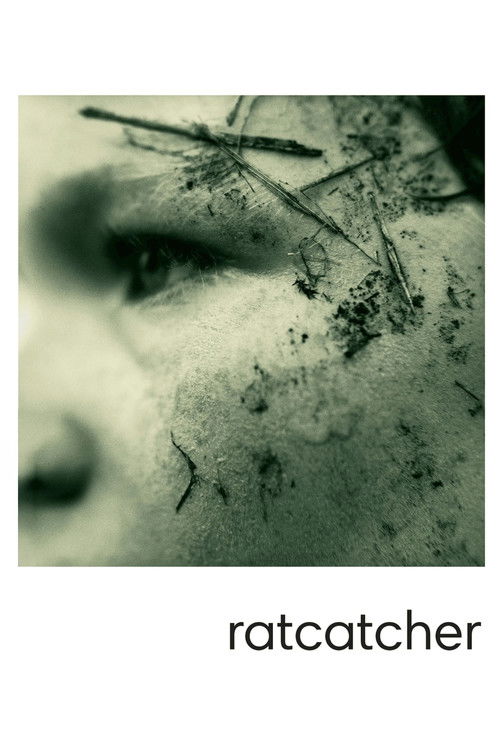
Ratcatcher
1999 · Lynne Ramsay
For when you want something slow, sad, and gorgeous — a film to sit inside rather than be entertained by. This is a challenge-and-reward pick, not a comfort watch, but the reward is real.
What it's about
Twelve-year-old James drifts through a Glasgow housing scheme during a garbage strike in the early 1970s, carrying a secret about a neighbor boy's drowning that he can't tell anyone. He orbits the canal where it happened, finds a tentative tenderness with an older girl the local boys mistreat, and daydreams about a half-built house at the edge of the city where the fields begin. It's a childhood summer with the weight of guilt pressing on it.
The experience
Quiet, tactile, and devastating in small doses — it works through images and textures rather than plot, so it feels less like being told a story than remembering one. Sad but never miserable; there are flashes of pure, unexpected beauty that hit harder for the grimness around them.
The craft
Lynne Ramsay came from photography and it shows: nearly every frame could hang on a wall, and she trusts an image of a boy wrapped in a net curtain or a mouse in a child's hands to carry what dialogue can't. The sound of the canal, the flies, the rustle of garbage bags — it builds a world you can practically smell. A patient watch on a good screen pays off.
Why it matters
One of the most acclaimed British debuts of the 1990s, it announced Ramsay as a major filmmaker and became a touchstone for poetic, image-first realism in British cinema.
Snapshot
Lynne Ramsay's debut feature is one of the finest British films of the 1990s and among the most assured first features in contemporary European cinema. Set in a Glasgow housing scheme during a refuse collectors' strike in the early 1970s, the film follows twelve-year-old James Gillespie through a summer shadowed by his silent complicity in a neighbor boy's drowning. Shot in close, tactile images by cinematographer Alwin Kuchler, Ratcatcher proceeds less by narrative logic than by the accumulation of sensory memory — the smell of rotting garbage, the cold drag of canal water, the brief, blinding light of a wheat field glimpsed from a new-build estate on the city's edge. It is a film about the poverty of aspiration as much as material poverty, and about the way guilt lodges in the body of a child before language can name it.
Industry & production
Ratcatcher was produced through a collaboration characteristic of late-1990s British art cinema: BBC Scotland and the Arts Council of England provided primary funding, with Canal+ and Pathé acquiring distribution rights for continental Europe and the UK respectively. The budget was modest — precise figures have not been widely published, and the film's producers have not foregrounded them — consistent with the scale of a first feature underwritten by public-service broadcasting and film council grants rather than commercial equity. Ramsay had developed significant industry credibility before the feature was greenlit: her short films Small Deaths (1996) and Gasman (1998) both won Jury Prizes in the Critics' Week at Cannes, an unusual double that attracted the attention of producers Gavin Emerson and others. The script, written by Ramsay herself, underwent development through BBC Scotland's drama department.
Casting followed a hybrid approach common in British social-realist production: professional actors filled several roles (Tommy Flanagan plays the drunken, defeated father with controlled understatement), while James's central performance came from William Eadie, a non-professional child actor found through local casting in Glasgow. The shoot took place on location in Maryhill and surrounding areas of Glasgow, with the unit working in actual housing schemes and alongside the Forth and Clyde Canal — the industrial waterway that functions throughout the film as both geographic fact and symbolic terrain.
Technology
Ratcatcher was shot on 35mm, with Kuchler selecting lenses and exposure strategies that favour shallow focus, intimate proximity to faces, and the textural rendition of surfaces — peeling paint, waterlogged stone, the grain of a child's skin. The image frequently sits just below comfortable exposure, pushing grain into visibility and lending the film a slightly faded, memory-like quality that suits its retrospective emotional register. No digital intermediate processing was standard practice in British production of this budget level in 1999, so the film's palette — desaturated without being entirely bleached, allowing patches of warm amber and gold to register as genuinely unusual against the gray surrounding fabric — was achieved through photochemical means in the grading suite. The production's relatively small format crew and location-driven approach allowed Kuchler and Ramsay a degree of spontaneity in framing that a larger unit would have inhibited.
Technique
Cinematography
Alwin Kuchler's work on Ratcatcher established his reputation and defined a visual approach he and Ramsay would develop further on Morvern Callar (2002). The camera is characteristically close: extreme close-ups of hands, mouths, eyes, and incidental objects — a dead mouse, a floating carrier bag, a biscuit tin — interrupt longer shots and carry the film's emotional freight as surely as dialogue. Kuchler uses a predominantly static or very slowly mobile camera that occasionally breaks into handheld agitation when James is under psychological stress, but the transitions between these registers are managed so organically that the formal shifts register subliminally rather than as technique. Natural and available light dominates; interiors are often severely underlit by commercial standards, preserving the authentic gloom of 1970s Glasgow tenement living. The famous sequence in which James visits the unoccupied new-build house on the peripheral estate — his family's hoped-for destination — and looks out through frameless windows at a vast field of golden wheat is lit with a rare, almost utopian warmth: grain, blur, light, the sensation of possibility. It is shot simply and holds the screen for an unusual duration, allowing a child's fantasy of escape to become the viewer's own.
Editing
Lucia Zucchetti's editing is elliptical and confident in its omissions. The film does not dramatize the moment of Ryan Quinn's drowning in a conventional sense; instead it constructs the event through fragmented, impressionistic cuts that situate guilt and causation in what is not shown. This structural strategy — the elision of the morally central event — organizes the film's entire dramatic rhythm. Scenes are frequently truncated before their social or emotional resolution, cutting away as adults begin to assert themselves or as consequences threaten to become explicit. This produces a rhythm of interruption and avoidance that enacts James's inner life more directly than dialogue could. Zucchetti worked closely with Ramsay on the assembly, and the film's editorial sensibility is inseparable from Ramsay's conception; the editing does not serve the screenplay so much as it is the screenplay's completion in time.
Mise-en-scène / staging
Ramsay's staging is anti-theatrical: actors are rarely positioned for legibility of expression or placed in conventional dialogue formations. The script's written exchanges are frequently subordinated to physical action, spatial proximity, and environmental detail. In the scene where James's mother scrubs the bathtub, the arrangement of bodies in a small room conveys the exhausted intimacy of family life more forcefully than the minimal dialogue. Objects are staged with the deliberateness of still photography — the film's origins in Ramsay's background as a photography student at the National Film and Television School are evident throughout — and recurring motifs (the canal, rats, water in multiple forms) are positioned with a consistency that borders on symbolic architecture without tipping into schematism. The refuse piling in Glasgow's streets during the strike is not only period detail but mise-en-scène: the environment is actively decomposing, and the film's human figures move through decay as their natural condition.
Sound
Sound design in Ratcatcher is as carefully constructed as the image. The film's acoustic world is one of ambient intrusion: the muffled percussion of domestic argument through thin walls, the specific liquid sound of the canal, street noise that presses against interior scenes without clarifying anything. The score, used sparingly, does not push emotional underscoring at conventionally loaded moments; rather, music tends to appear unexpectedly and withdraw before it can become manipulative. The precise composer credit and details of the sound team's approach have not been extensively documented in readily available published sources; what is clear from the film itself is that Ramsay and her sound collaborators made highly deliberate choices about silence and ambient texture, suppressing musical cue where a more conventional production would have deployed it.
Performance
William Eadie's performance as James is one of the great child performances in British cinema, remarkable for what it withholds. Eadie rarely performs distress or guilt overtly; the camera's sustained attention to his face and body allows the viewer to read a constant low-level internal pressure that never discharges. Tommy Flanagan brings an entirely unglamourised alcoholic defeat to the father without making him merely a type: there is genuine tenderness toward his wife and children that coexists with his incapacity to care for them adequately. Leanne Mullen as Margaret Anne brings an undefended quality to a role that could easily have become either victim or symbol — her scenes with James are among the film's most delicate, catching an adolescent sexuality that is clearly as confused and lonely as it is exploratory.
Narrative & dramatic mode
Ratcatcher operates in a lyrical-realist mode in which the objective storyline — James's guilt, his family's wait for rehousing, his friendships over one summer — is relatively thin, and the film's substance resides in moment-to-moment sensory and psychological experience. The narrative follows no strongly causal chain; events accrete rather than develop. This mode descends from a strand of European art cinema — Bresson's concentration on surfaces, Truffaut's elliptical childhood films, the Italian neorealists' attention to environment as social fact — while maintaining strong roots in British documentary tradition. The film rejects the narrative satisfactions of closure: its ending is deliberately suspended between James's possible death (the film's final image can be read as fantasy or as drowning) and the continuation of his family's ordinary life, leaving interpretation genuinely open rather than artificially ambiguous.
Kenny's subplot — the strange, sweet boy who sends his pet mouse to the moon on a balloon, and for whom this gesture is adequate explanation of himself — functions as the film's most purely lyrical passage. It is held free of the main psychological plot and offers a counterpoint of imaginative freedom to James's trapped guilt. The moon-mouse shot, in which the balloon ascends out of frame while a cut holds on the open sky, is the film's most celebrated image and one of the defining images of 1990s British cinema.
Genre & cycle
Ratcatcher inhabits the British kitchen-sink tradition while departing from it significantly. The social realist film in British cinema — from Room at the Top (1959) through the early work of Ken Loach and Mike Leigh — has generally privileged adult protagonists, naturalistic dialogue, and an observational approach to class dynamics. Ramsay's film is a child's film in the sense Truffaut meant: it refuses to adjudicate between James's felt world and the objective social world that surrounds and constrains him. It is closer to the lyrical tendency within social realism — the Terence Davies strand, the Bill Douglas trilogy — than to the more polemical mode of Loach. It is also, obliquely, a coming-of-age film, but one that refuses the genre's usual arc of growth and passage; James does not arrive anywhere secure.
Within Scottish cinema, the film participates in a 1990s cycle that includes Small Faces (Gillies MacKinnon, 1996) and Orphans (Peter Mullan, 1997), films that took Glasgow as a subject with a new seriousness and stylistic ambition, distinct from the London-centric perspective that had often shaped representations of Scotland in British cinema. It stands apart from the pop energy of Trainspotting (Danny Boyle, 1996), the decade's most commercially successful Scottish film, in its deliberate austerity and refusal of irony.
Authorship & method
Lynne Ramsay trained as a cinematographer and photographer at the National Film and Television School, and the visual intelligence of Ratcatcher is inseparable from this formation. She writes her own scripts, and her screenwriting approach is closer to the construction of images and acoustic environments than to conventional dramatic plotting: her scripts are characteristically spare in dialogue and dense in visual direction, functioning less as blueprints for performance than as scores for a specific kind of attention. Ramsay's method on set prioritizes space for the unexpected: the Kenny subplot's most celebrated moments reportedly emerged from improvisation with the young actor, and the production retained a flexibility that formal pre-planning would have foreclosed.
Alwin Kuchler's cinematography is a genuine collaboration rather than service work — his subsequent career (Morvern Callar, Sunshine, Kick-Ass) confirms a consistent aesthetic intelligence. Lucia Zucchetti's editing partnership with Ramsay continued on Morvern Callar, and the two films share an editorial grammar of strategic omission and sensory fragmentation. The film's small budget paradoxically amplified rather than constrained Ramsay's authorial control: with no commercial pressure to resolve ambiguities or sustain genre legibility, she and her collaborators built the film entirely according to their own formal priorities.
Movement / national cinema
Ratcatcher is a significant work within Scottish cinema and within British art cinema more broadly, though its relationship to both is slightly oblique. Scottish cinema in the 1990s was undergoing a self-conscious renaissance, partly catalyzed by devolution politics and the establishment of Scottish Screen as a funding body, and partly by the international success of Trainspotting. Ramsay's film belongs to this moment but resists its most characteristic modes: it does not recruit Scotland as spectacle (the heritage film), does not treat Glasgow through ironic urban energy (Trainspotting), and does not aestheticize poverty for outsider consumption. Its closest Scottish precedents are the Bill Douglas trilogy of autobiographical short films made in the 1970s — My Childhood (1972), My Ain Folk (1973), My Way Home (1978) — which share Ratcatcher's austerity, child-centred perspective, and working-class Scottish setting, and which similarly pursued an art-cinema aesthetic within a British production infrastructure more accustomed to naturalism.
Within British art cinema of the 1990s, the film belongs beside the work of Terence Davies — particularly Distant Voices, Still Lives (1988) and The Long Day Closes (1992) — in its commitment to memory, lyricism, and the formal encoding of subjective experience. Both filmmakers are indebted to a European tradition that British cinema often circles without fully embracing.
Era / period
Ratcatcher was made in 1999, within a particular configuration of British film production shaped by Channel 4's commitment to feature films since the 1980s, BBC Films' expansion into theatrical co-production, and the Arts Council's lottery funding for film that became available after 1995. These mechanisms produced a wave of formally ambitious, low-budget British films in the late 1990s that would not have been financed commercially. The film is also a period piece: it reconstructs Glasgow in the early 1970s, specifically during a refuse collectors' strike that left rubbish accumulating in residential streets and prompted public health responses including rodent control. This historical specificity grounds the film's symbolic infrastructure — rats, decay, filth — in documented social fact while allowing those facts to carry a broader metaphorical weight about the condition of the British working class in a period of industrial upheaval.
Themes
Guilt without absolution is the film's governing preoccupation: James witnessed Ryan's drowning and did not save him, possibly contributed to the circumstances that led to it, and carries this knowledge through the entire film without confession or punishment. The film is interested in the way guilt inhabits a child who lacks the emotional vocabulary to process it — it becomes a kind of static, a persistent interference in James's experience of everything else.
Aspiration and its costs run alongside guilt: the dream of the new housing estate on Glasgow's periphery — space, light, a field — functions as both genuine desire and potential escape from what James has done. The film refuses to resolve whether this dream is possible or illusory; its famous ending holds both open simultaneously.
Water recurs as the film's primary symbolic medium: the canal kills and fascinates; James's mother cleans furiously in a world that cannot be cleaned; the rats arrive through drainage and flooding. The body's relation to an environment that is simultaneously life-sustaining and toxic — class, geography, history pressing on the skin — is a consistent thematic undertow.
The film is also about masculinity and its failures across generations: the father who drinks because the world has offered him nothing adequate to his capacities; James who is moving, without guidance, into a version of manhood modeled on defeat. Margaret Anne's situation — using sex as a currency of affection in the absence of reliable care — mirrors James's own displaced need and completes a picture of adolescence in poverty as a series of improvised survivals.
Reception, canon & influence
Ratcatcher premiered in the Un Certain Regard section at the Cannes Film Festival in 1999 to strong critical attention, establishing Ramsay as a major new voice in European cinema. British critical reception was broadly enthusiastic, with reviewers identifying the film's lyrical intensity and its distance from the dominant modes of British social realism as defining qualities. The film was recognized in the BAFTA Scotland awards and developed a sustained critical reputation in the years following its release that has only grown: it now regularly appears in critical polls and retrospectives of British cinema, and Ramsay is consistently discussed as among the most important British directors of her generation.
Influences on the film run through several traditions simultaneously. The Bill Douglas trilogy is the most direct formal and biographical precedent within Scottish and British cinema. Terence Davies's Liverpool films provided a model for encoding working-class memory through non-linear, lyrical construction. From European art cinema, Truffaut's L'Enfant sauvage and Les Quatre Cents Coups — and more broadly the New Wave's investment in childhood as a mode of perception — inform the film's point of view. Italian neorealism (De Sica's Shoeshine in particular, with its doomed friendship between boys in a damaged city) underlies the film's ethical attention to children in poverty. Robert Bresson's concentration on physical surfaces and his systematic suppression of expressive performance shadow Ramsay's direction of Eadie throughout.
The film's forward influence is harder to trace in direct lineage — as with most formally distinctive work, its effect tends to be diffuse — but it is significant. Ramsay's own subsequent films (Morvern Callar, We Need to Talk About Kevin, You Were Never Really Here) develop the aesthetic approaches first worked out at feature scale in Ratcatcher: fragmented time, traumatic elision, the body as the primary register of psychological experience. The film contributed to a broader critical reassessment of what British social-realist cinema could be — that the tradition need not be limited to observational naturalism, that lyricism and political seriousness were not in conflict. Several subsequent British directors working with working-class subjects and non-linear formal strategies have cited Ramsay's example, though specific attributions are difficult to verify without caution. What can be said with confidence is that Ratcatcher opened a formal possibility in British cinema — the poetic social film made without irony or sentimentality, close to children, attentive to physical and environmental texture — that had existed before it only in fragments, and that it demonstrated this possibility at the level of sustained mastery.
A Deleuzian reading
A boy climbs through the empty new-build on the edge of the city, where his family hopes to be rehoused, and finds the windows have no glass yet — just frames opening onto a field of wheat.
The full Deleuzian reading of Ratcatcher →
Reception
Acclaimed out of Cannes in 1999 but seen by almost no one at the time, Ratcatcher spent two decades quietly climbing from 'promising British debut' to consensus pick for one of the greatest first features ever made.
How Ratcatcher was received, from release to now →
Influences: the films it descends from and the films it influenced
- My Childhood (1972) — Douglas's extreme close-up grammar of poverty — cramped hands, texturing faces — and his autobiographical ellipsis, structuring Scottish working-class childhood through strategic omission rather than narrative continuity, is the most direct formal precedent for Ratcatcher's visual language.
- Mouchette (1967) — Bresson directs a child protagonist through physical surfaces and gesture, systematically suppressing expressive performance to concentrate meaning in hands, feet, and textures rather than faces — the direct model for Ramsay's direction of William Eadie.
- Distant Voices, Still Lives (1988) — Davies substitutes lyrical sensory association for dramatic causality in encoding working-class memory — non-linear episodes linked by atmosphere rather than plot — providing the structural model Ramsay adopts for Ratcatcher's refusal of conventional kitchen-sink chronology.
- Sciuscià (1946) — De Sica casts non-professional boys in postwar urban poverty and refuses to aestheticize their suffering or resolve their plight through adult agency, establishing the neorealist ethical template for Ramsay's attention to children at the social margins.
- Les Quatre Cents Coups (1959) — Truffaut establishes childhood as a valid autonomous cinematic mode of perception rather than a device for adult irony, and his freeze-frame refusal of narrative closure is the structural precedent for Ratcatcher's open, unresolved ending.
- Kes (1969) — Loach's casting of David Bradley, a non-professional child in a British kitchen-sink milieu filmed with available light and improvisation-adjacent direction, establishes the social-realist grammar in which Ramsay situates herself before departing into lyrical non-linearity.
- Pather Panchali (1955) — Ray's poetic realism — ambient environmental sound, natural light, and physical-world textures as the primary emotional register alongside a child protagonist in poverty — is a formal precursor to Ramsay's atmospheric approach to social subject matter.
- The Loneliness of the Long Distance Runner (1962) — Ramsay imports Richardson's associative non-linear editing and ambient-over-score sound design to construct a working-class Scottish boy's subjective interiority, refusing narrative causality in favour of the same consciousness-centred fragmentary structure that organizes Smith's flashbacks.
- A Taste of Honey (1961) — Ramsay's mood-driven ellipsis — scenes cut before their emotional payoff, images that accumulate without explanation — extends Richardson's editing grammar directly, and the film's structural refusal of narrative resolution identifies it as a sustained Free Cinema heir.
- Naked (1993) — Extends post-Naked British realism into a harsher poetic register, retaining the on-location naturalism and bleak working-class milieu while individualizing the camera.
- Life Is Sweet (1991) — Extends British social realism into a heightened, sensory naturalism that finds poetic image-making within ordinary working-class environments.
- Meantime (1983) — Carries the observational-static camera and 16mm-textured attention to estate childhood into a more lyrical key, holding on ordinary deprivation with the same refusal of plot momentum.
- Morvern Callar (2002) — Ramsay develops Ratcatcher's formal language directly, retaining DP Alwin Kuchler and editor Lucia Zucchetti and deepening the editorial grammar of traumatic elision and fragmented time that Ratcatcher first worked out at feature scale.
- Fish Tank (2009) — Arnold fuses British kitchen-sink subject matter with handheld lyrical formal ambition, directing a non-professional young female protagonist on a working-class estate with available light — enacting the aesthetic space Ratcatcher opened for poetic social realism in British cinema.
- The Selfish Giant (2013) — Barnard's Bradford-set film of boys on the economic margins uses non-professional child leads, sparse ambient sound, and available light in a formally spare construction that directly inherits Ramsay's demonstration that British social subjects need not be rendered through observational naturalism.
- You Were Never Really Here (2017) — Ramsay radicalizes the traumatic elision first deployed in Ratcatcher — suppressing causal connective tissue, rendering violence through sound and aftermath rather than direct image — tracing the long-term formal trajectory that began in Ratcatcher's editorial experiments with strategic omission.
- My Father's Shadow (2025) — Grainy child's-eye poetic realism that stages the contrast of scale — a small body against an indifferent adult environment — through composition and tactile surface rather than dialogue.
- Blue Heron (2026) — Observational, sensory naturalism in which a child processes a death he half-caused through textures and natural light rather than plot — the restricted, elliptical child-POV realism closest to Romvari's register.
- Urchin (2025) — Poetic realism that lets oneiric escape-imagery bloom out of estate squalor through controlled, painterly framing rather than handheld vérité — the art-cinema-over-naturalism choice Urchin makes.
- This Is England (2007) — Ramsay establishes Super-16mm grain as poverty-and-period texture — making 1973 Glasgow materially present through the image's surface — and extracts performance from a non-professional child by immersing him in environment rather than directing him toward emotion, both techniques Meadows applies to his 1983 Midlands setting.
- We Need to Talk About Kevin (2011) — Ramsay's debut establishes the visual grammar Kevin inherits: an isolated, damaged child at the center, violence held at the frame's periphery, and working-class domestic space rendered through tactile sensory accumulation rather than psychological exposition.
- Aftersun (2022) — Naturalistic debut performance from a Scottish child lead (William Eadie) in a film that renders working-class interiority through lyrical textural scenes rather than dramatic incident; trauma-adjacent experience expressed through ambient detail rather than event.
- Moonlight (2016) — Sensory, water-haunted poetic realism of a poor boy's interior life, where ambient quiet, tactile close framing and recurring water imagery carry meaning the dialogue refuses to state.
- The Florida Project (2017) — Applies painterly lyricism and saturated beauty to a child's sensory perception of slum poverty, prefiguring the palette-plus-child-gap fusion.
- Orphans (1998) — Mullan's contemporaneous Glasgow-set film similarly ruptures linear dramatic structure into lyrical, image-driven episodes, treating social grief through formal fragmentation rather than observational realism within the same Scottish cinema context as Ratcatcher.
- Gummo (1997) — Korine's elliptical, non-narrative accumulation of fragments around impoverished children in a damaged American town — non-professional performances, ambient documentary texture, refusal of moral closure — develops an anti-dramatic logic of accumulation without climax structurally parallel to Ratcatcher's.
- La Ciénaga (2001) — Martel deploys off-screen ambient sound and truncation of scenes before their dramatic completion as primary storytelling devices, withholding adult explanation through a child's eye perspective — a parallel formal development to Ramsay's methods reached from a distinct but convergent tradition.
- Rosetta (1999) — The Dardennes' Bressonian handheld grammar — body-attached camera, non-professional performer, suppression of psychological expressivity, elliptical social world — arrives at nearly identical formal solutions to Ramsay's through their shared Bresson inheritance, independently and simultaneously.
- Sound of Falling (2025) — Tactile proximate camera and foregrounded concrete sound attached to non-professional child performers, sensation prioritized over plot.
- House of Hummingbird (2019) — Builds a child's-perspective drama out of sensory, elliptical fragments and a naturalistic young lead rather than causal narrative, mirroring Kim's accumulation structure.
- American Honey (2016) — Ramsay's British poetic-realist grammar — tactile macro close-ups of hands, water and vermin, and lyrical drift over plot — is the parallel Scots-lens sibling to Arnold's sensory naturalism.
- An Angel at My Table (1990) — Advances the feminist-auteur memory film — observational, sensory, unvain child performance and a refusal of catharsis — that Angel exemplified for the early-90s women's cinema.
- Violet Perfume: Nobody Hears You (2001) — Available-light naturalism and a child's-eye observation of poverty, staged through thresholds and enclosures, developed independently at the same moment as Sistach's own confined domestic framing.
- High Hopes (1989) — Ramsay renews British social realism with the same commitment to non-professional performance and environment-as-meaning, letting decor and derelict space carry the sociology that High Hopes reads through interiors.
- The Kid with a Bike (2011) — Parallel method rather than debt — non-professional child leads shot in a real deindustrialised housing landscape, with the film's decisive events elided and left to be reconstructed from what surrounds them.
Similar films
- Morvern Callar (2002) — influence & lineage
- Blue Heron (2026) — influence & lineage
- Fish Tank (2009) — influence & lineage
- Rosetta (1999) — influence & lineage
- Urchin (2025) — influence & lineage
- Sound of Falling (2025) — influence & lineage
- La Ciénaga (2001) — influence & lineage
- Mouchette (1967) — influence & lineage
All the films related to Ratcatcher →