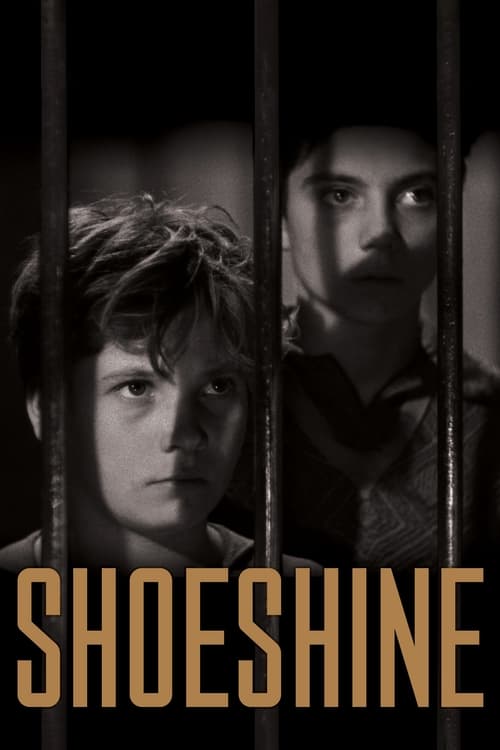
Shoeshine
1946 · Vittorio De Sica
For when you want to feel something true and are ready for a good cry — an honest heartbreaker, not a wallow. Emphatically not a light night; give it your full attention.
What it's about
Pasquale and Giuseppe shine shoes for American GIs in the rubble of postwar Rome, pooling every lira toward one shared dream: a white horse of their own. Duped into a black-market swindle, the two friends land in a juvenile prison, where the adult machinery of interrogation, isolation, and engineered betrayal goes to work on everything between them.
The experience
It starts warm — two kids, a horse, real joy — and then tightens into heartbreak with documentary plainness, no cushioning. The rawness of it stays with you; this is the kind of film that leaves the room quiet.
Performances
The two boys, Franco Interlenghi and Rinaldo Smordoni, were non-professionals, and that's exactly why it works — their friendship and its unraveling never once feel performed.
The craft
Shot cheaply on the real streets of a city still raw from war, with natural light and faces pulled from actual life, it turns poverty of means into moral force. The war-scarred Rome around the boys is as much the picture as they are.
Why it matters
It announced Italian neorealism to the world and won an honorary Academy Award — the recognition that paved the way for the foreign-language film Oscar itself.
Snapshot
Shoeshine (Sciuscià — the word is a phonetic Italianization of the American "shoeshine" the boys shout at GIs) is Vittorio De Sica's first fully realized work of Italian neorealism and, with Roberto Rossellini's Rome, Open City (1945), one of the films that announced the movement to the world. It follows Pasquale and Giuseppe, two boys who shine shoes for American soldiers in occupied Rome and pool their earnings to buy a white horse named Bersagliere. Drawn unwittingly into a black-market swindle, they are arrested and sent to a juvenile prison, where the institutional machinery — interrogation, isolation, betrayal engineered by adults — corrodes and finally destroys their friendship. The film ends in catastrophe. Made cheaply, on real streets and in a real city still raw from war, Shoeshine fused documentary surfaces with a tragic narrative arc and a moral seriousness that critics found almost unbearable. It earned an Honorary Academy Award before a competitive foreign-language category existed, and it became a touchstone for filmmakers and critics who saw in it proof that cinema could look directly at postwar suffering without flinching.
Industry & production
Shoeshine was made in the precarious conditions of the Italian film industry's immediate postwar collapse. The Cinecittà studios outside Rome — built under Fascism as the showpiece of a state-supported industry — had been damaged and partly repurposed (used at points as a refugee shelter), and the centralized financing and distribution structures of the regime had broken down. Production money was scarce, and neorealist filmmakers frequently worked on small, improvised budgets, assembling resources picture by picture. De Sica had difficulty financing the film; it was produced independently (with Paolo W. Tamburella among those credited on the production side), outside the comfortable studio system in which De Sica had earlier worked as a matinee-idol actor and as a director of lighter fare.
This independence was both a constraint and the source of the film's aesthetic. Without a studio backing a conventional star vehicle, De Sica and his screenwriter Cesare Zavattini could pursue a story about marginal children — a subject with no obvious commercial appeal — and shoot it on location with largely non-professional performers. The reformatory sequences and the Roman streets gave the film an authenticity that no constructed set could supply, and the modest scale freed the filmmakers from the obligations of glamour. The film's domestic reception in Italy was, by most accounts, muted: a war-weary public did not necessarily want to see its own deprivation reflected back, and neorealism's commercial position at home was always fragile. Its international acclaim — particularly in the United States and France — outran its box office, a pattern that would recur with Bicycle Thieves.
Technology
The film was shot on 35mm in black and white under conditions of genuine material scarcity. Postwar Italy suffered shortages of film stock, lighting equipment, and reliable studio facilities, and neorealist productions often worked with whatever was available, accepting a rougher, grainier image than prewar studio standards. Shooting was done substantially on location in Rome, which meant contending with available light, real interiors, and the acoustic and logistical messiness of actual places rather than controlled stages.
As was standard in Italian filmmaking of the period, dialogue was post-synchronized rather than recorded live: Italian cinema relied heavily on dubbing, and location sound was typically replaced with voices and effects added in post-production. This practice gave filmmakers flexibility on noisy real-world sets — and, in the neorealist case, the freedom to cast non-actors and untrained children whose voices could be managed or supplemented afterward. The technological "look" of Shoeshine — its slightly harsh contrast, its unprettified surfaces — is inseparable from these constraints, which neorealism converted into an aesthetic principle rather than treating as a deficiency.
Technique
Cinematography
The cinematography is credited to Anchise Brizzi, an experienced Italian director of photography. The visual approach favors clarity and observation over expressive flourish. In the early street scenes the camera takes in the geography of postwar Rome — crowds, military vehicles, the bustle of the black market — with a documentary attentiveness, while keeping the two boys legible within the crowd. The reformatory sequences shift register: the framing grows more confining, emphasizing bars, corridors, walls, and the partitioning of space that separates the boys from one another. The film's most discussed images turn on confinement and the geometry of institutions, and the climactic action on the prison stairs and at the river is staged for spatial legibility — the audience always understands exactly where each boy is, which is essential to the tragedy. The lighting tends toward an even, realist key rather than the high-contrast chiaroscuro of studio melodrama, though the prison interiors admit a heavier, more oppressive shadow.
Editing
The editing (credited to Niccolò Lazzari) serves the narrative's steady tightening from open-air freedom to enclosure and catastrophe. The film's structure is essentially a two-part movement: a relatively expansive first act among the streets and the dream of the horse, followed by the prison's grinding, episodic accumulation of humiliations and misunderstandings. The cutting in the interrogation sequence — where Pasquale is manipulated into believing Giuseppe is being beaten and "confesses" to protect him — is built to make the mechanics of betrayal painfully clear: the boys are separated by walls, and the editing exploits their inability to see one another, so that the audience grasps the manipulation the children cannot. The film withholds melodramatic acceleration; its rhythm is observational, letting consequences settle.
Mise-en-scène / staging
De Sica's staging draws its power from the friction between real environments and the children placed within them. The horse — gleaming, white, almost absurdly beautiful against the gray of the city — functions as the central object of mise-en-scène: a concentrated image of innocence and aspiration that the surrounding world cannot sustain. The reformatory is staged as a system: lines of boys, the bureaucratic processing of children, the casual cruelties of overcrowding. De Sica, himself a celebrated actor, was renowned for his handling of performers within the frame, and the staging repeatedly isolates the two protagonists from the adult world that acts upon them, so that the institution appears as an impersonal apparatus and the boys as its raw material.
Sound
Sound was assembled in post-production per Italian practice. Alessandro Cicognini's score — Cicognini was De Sica's regular composer through the major neorealist films — supplies emotional underlining, though neorealist orthodoxy as later theorized by Zavattini was suspicious of music that imposed feeling on documentary material. In Shoeshine the music tends to support the lyrical strain (the horse, the boys' camaraderie) while the prison passages rely more on ambient, institutional sound. The post-synchronized dialogue, with its non-professional young voices, contributes to the film's mixture of the rough and the affecting.
Performance
The performances of the two boys are the film's foundation. Franco Interlenghi (Pasquale) and Rinaldo Smordoni (Giuseppe) were non-professionals in the neorealist mold — children cast for their faces, presence, and naturalness rather than training. De Sica, drawing on his own depth as an actor, was famous for eliciting unaffected, emotionally exact performances from amateurs and children, and Shoeshine is an early demonstration of the gift he would extend in Bicycle Thieves (with Enzo Staiola and Lamberto Maggiorani) and Umberto D. The boys never read as performing; their friendship, jealousy, fear, and final rupture register as behavior rather than acting. Of the two, Interlenghi went on to a substantial professional film career, while the historical record on several of the child performers is comparatively thin.
Narrative & dramatic mode
The dramatic mode is tragic realism. The film opens in a register close to the picaresque — two resourceful street kids and their shared dream — and methodically darkens into tragedy. Crucially, the catastrophe is not the product of fate or villainy in the melodramatic sense but of a system: the casual exploitation of children by adults, the indifference of institutions, and a single act of psychological manipulation that turns the boys against each other. The narrative engine is the corrosion of friendship, and the film's structure is built so that the audience always understands more than the characters do, watching helplessly as misunderstanding hardens into betrayal. The ending is uncompromising and refuses consolation. This is neorealism's characteristic ethical stance: the camera observes, the consequences are social as much as personal, and the viewer is left with grief and implication rather than catharsis.
Genre & cycle
Shoeshine belongs to the founding cycle of Italian neorealism — the run of films, roughly 1945–1952, that includes Rossellini's Rome, Open City and Paisan, De Sica's own Bicycle Thieves and Umberto D., and Visconti's La terra trema. Within that cycle it is also a key early example of the postwar "child's-eye" film, using children's vulnerability to indict the adult social order — a lineage De Sica had already touched in The Children Are Watching Us (1944) and that resonates outward to later films about childhood and institutional cruelty. As social-problem drama it sits adjacent to the prison film and the juvenile-delinquency picture, but it bends those genres toward neorealism's documentary ethics rather than toward genre spectacle.
Authorship & method
Shoeshine is the product of the central authorial partnership of Italian neorealism: De Sica as director and Cesare Zavattini as screenwriter and theorist. Zavattini, who would become neorealism's most articulate ideologue, advocated a cinema of the everyday — stories drawn from ordinary life, ideally stripped of contrived plotting, attentive to the dignity and suffering of common people. Shoeshine's screenplay is credited to Zavattini together with Sergio Amidei (a major neorealist screenwriter, also central to Rome, Open City), Adolfo Franci, and Cesare Giulio Viola. The story grew out of observation of the real shoeshine boys of occupied Rome, in keeping with the movement's documentary impulse.
De Sica's method combined this documentary grounding with his own actor's sensitivity. Key collaborators include cinematographer Anchise Brizzi, composer Alessandro Cicognini (whose long association with De Sica spans the neorealist films), and editor Niccolò Lazzari. De Sica's signature — patient observation, location authenticity, and above all the coaxing of devastating performances from non-professionals and children — is fully present here, in what amounts to the rehearsal for the masterpieces that immediately followed.
Movement / national cinema
The film is a cornerstone of Italian neorealism, the movement that emerged from the ruins of Fascism and the Second World War and reoriented Italian cinema toward contemporary social reality. Neorealism's hallmarks — location shooting, non-professional actors, contemporary working-class and marginal subjects, an ethics of observation, and a refusal of studio gloss — are all on display. Shoeshine also belongs to the specific historical moment of Allied-occupied Rome, and the presence of American GIs and the black-market economy is not incidental color but the social ground of the story. As Italian national cinema, the film carries the period's project of moral and artistic reconstruction: a self-examination conducted in public, on the very streets where the events it depicts might have occurred.
Era / period
The film is set and made in the immediate aftermath of the war, in a Rome marked by occupation, poverty, displacement, and a thriving black market. The historical specificity is essential: the boys' livelihood depends on American soldiers; their dream and their ruin both pass through the informal wartime economy; and the overcrowded, under-resourced juvenile prison reflects an institutional system overwhelmed by postwar conditions. The film should be read against the larger European reckoning with the war's human costs and the particular Italian task of building a democratic culture out of the wreckage of Fascism.
Themes
The governing theme is the destruction of innocence by an indifferent and exploitative adult world. The friendship between Pasquale and Giuseppe is the film's emotional and moral center, and its betrayal — engineered by the manipulations of others and sealed by the boys' own fear and misunderstanding — dramatizes how social cruelty reproduces itself in the young. Related themes include the corrupting reach of institutions (the prison as a machine that grinds rather than reforms), the gap between dream and reality (the white horse as fragile aspiration), the economic desperation of the postwar moment, and the failure of adults — parents, guards, lawyers, swindlers — to protect or even see the children in their charge. Underlying all of it is neorealism's central conviction that personal tragedy is socially produced.
Reception, canon & influence
Critically, Shoeshine was received internationally as a major achievement and a moral event as much as an aesthetic one. Its most consequential institutional recognition came from the American Academy: at a time before a competitive foreign-language Oscar existed, the Academy granted Shoeshine an Honorary Award, citing the proof it offered that the creative spirit could triumph over the adversity of a war-scarred country — a gesture that effectively inaugurated the recognition of foreign-language film at the Oscars. The film was also recognized in the Academy's writing category. Among critics, Pauline Kael's account of Shoeshine became famous in its own right: she described the film as a shattering experience and, in a much-cited anecdote, recalled overhearing a couple dismiss it on the way out, using the moment to reflect on the gulf between art and casual consumption. Orson Welles is widely reported to have praised the film in extraordinary terms, marveling that De Sica achieved an effect of pure life in which the camera seemed to disappear — a tribute frequently quoted, though the exact wording varies across sources and should be cited with care.
The influences on the film run through the neorealist current already set in motion by Rossellini's Rome, Open City (1945) and Paisan (1946), and through De Sica and Zavattini's own earlier collaboration on The Children Are Watching Us. Looking forward, Shoeshine helped establish the template that De Sica and Zavattini would perfect in Bicycle Thieves (1948) and Umberto D. (1952), and neorealism as a whole became one of the most consequential influences in world cinema — shaping the French New Wave's location aesthetics and amateur casting, Indian cinema (Satyajit Ray repeatedly cited the neorealists and Bicycle Thieves in particular), the Iranian films of childhood, and countless later movements committed to social realism. The specific subgenre of the child confronting institutional cruelty — from Truffaut's The 400 Blows onward — carries Shoeshine's imprint. Within De Sica's own canon it is sometimes overshadowed by Bicycle Thieves, but it is properly regarded as the film in which his neorealist voice fully arrived.
A Deleuzian reading
Open on the horse.
The full Deleuzian reading of Shoeshine →
Reception
Italian audiences largely shunned it in 1946 — postwar Italy didn't want its poverty reflected back — but it was a sensation abroad, and in 1947 it received the first-ever honorary Oscar for a foreign-language film. Today it's secure in the neorealist canon, if perpetually in the shadow of De Sica's own Bicycle Thieves.
How Shoeshine was received, from release to now →
Influences: the films it descends from and the films it influenced
- Aniki-Bóbó (1942) — Casts non-professional street children in a moral drama of transgression and guilt shot in real urban locations, extending Aniki-Bóbó's method four years later at neorealism's center.
- The Kid (1921) — Transposes The Kid's institutional terror — the wagon, the authorities, the boys' home — into documentary-textured location shooting, using the child's uncomprehending gaze as the instrument of social indictment.
- Bicycle Thieves (1948) — The immediate perfection of Shoeshine's template—Zavattini's everyday-story doctrine, a non-actor father-son pair, and the symbolic object (bicycle/horse) whose loss drives social tragedy.
- Umberto D. (1952) — Pushes the De Sica–Zavattini program toward its purest 'cinema of the everyday,' sustaining Shoeshine's patient observational duration and devastating non-professional lead performance.
- Germany Year Zero (1948) — Sibling treatment of the destruction-of-innocence theme—a child navigating institutional and economic ruin toward self-destruction, shot amid real rubble with a non-professional boy.
- Los Olvidados (1950) — Transposes Shoeshine's social-determinism and street-children tragedy to Mexico City, retaining location shooting and the doomed-youth arc while injecting surrealist dream interludes.
- The 400 Blows (1959) — Directly inherits the child-confronting-institutional-cruelty subgenre, ending in a juvenile detention center, and applies neorealism's location aesthetics and amateur child casting to Paris.
- Pixote (1981) — The most literal descendant—non-professional street children inside a brutal reformatory, recasting Shoeshine's institutional-confinement and destruction-of-innocence in São Paulo.
- Where Is the Friend's House? (1987) — Anchors the Iranian films-of-childhood lineage credited to neorealism, using real village children and observational rhythm to dramatize a child's moral ordeal against indifferent adult institutions.
- Salaam Bombay! (1988) — Extends Shoeshine's street-children realism by casting actual Bombay slum kids shot on real locations, tracing social determinism toward an inexorable loss of innocence.
- Ratcatcher (1999) — De Sica casts non-professional boys in postwar urban poverty and refuses to aestheticize their suffering or resolve their plight through adult agency, establishing the neorealist ethical template for Ramsay's attention to children at the social margins.
- Capernaum (2018) — Casts non-professional children drawn from the depicted social stratum inside a carceral bureaucratic system incapable of serving them; the device of a child seeking justice from adult institutions that structurally exclude him is the template Labaki inherits for Zain's lawsuit against his parents.
- Nobody Knows (2004) — Italian-neorealist casting of untrained children as the emotional center, shooting their unpolished behavior observationally so poverty and abandonment read as documented fact, not staged pathos.
- The Little Girl Who Sold the Sun (1999) — De Sica's portrait of street children surviving the informal economy with their own moral code models the performance register Mambéty draws from his cast of Dakar child vendors.
- Rome, Open City (1945) — Established the neorealist grammar Shoeshine adopts wholesale—shooting in actual war-scarred Roman streets with scavenged film stock and blending professional and street-recruited faces for documentary immediacy.
- Paisà (1946) — Modeled the observational, loosely-plotted episodic rhythm and on-location vernacular authenticity that De Sica's editor and screenwriters carry into Shoeshine's drift through occupied Rome.
- The Children Are Watching Us (1944) — The De Sica–Zavattini prototype for the child's-eye witnessing of adult betrayal, rehearsing the technique of staging catastrophe through a uncomprehending young face that Shoeshine perfects.
- Ossessione (1943) — Pioneered the working-class location realism and earthy non-glamorized milieu—shooting real provincial environments rather than Cinecittà sets—that fed the neorealist current Shoeshine extends.
- Zero for Conduct (1933) — Originated the lyrical child-versus-institution structure and the use of real, unpolished children in revolt against custodial cruelty, an ancestor to Shoeshine's reformatory.
- Toni (1935) — Proto-neorealist precedent for shooting an entire feature on real locations with a largely non-professional, regionally-accented cast, a method Shoeshine institutionalizes.
- La Terra Trema (1948) — Sibling neorealist work taking the non-professional cast to its limit by using actual Sicilian fishermen speaking dialect on location, extending the documentary-realism impulse Shoeshine shares.
- Pather Panchali (1955) — Ray explicitly cited the neorealists; replicates Shoeshine's location shooting, non-professional cast, and child's-eye observation of poverty with Cicognini-style scoring transposed to Ravi Shankar.
- Kes (1969) — Carries the social-determinism and symbolic-object (the kestrel) tragedy of a working-class boy crushed by school and class, using a non-professional lead and observational location realism.
- Twenty-Four Eyes (1954) — Contemporaneous neorealist practice of location shooting and casting real, non-professional children for unforced pathos, paralleling Kinoshita's on-location Shodoshima work and child ensemble (including real siblings).
Similar films
- Bicycle Thieves (1948) — influence & lineage
- Paisan (1946) — influence & lineage
- Germany, Year Zero (1948) — influence & lineage
- Umberto D. (1952) — influence & lineage
- Rome, Open City (1945) — influence & lineage
- Obsession (1943) — influence & lineage
- Cinema Paradiso (1988) — shared sensibility
- Two Women (1960) — shared sensibility
All the films related to Shoeshine →