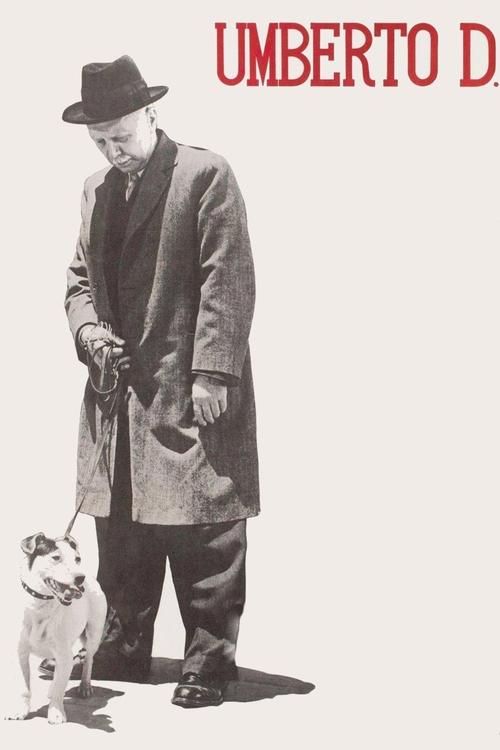
Umberto D.
1952 · Vittorio De Sica
For when you need a good cry and want it earned honestly — a film about loneliness and dignity that leaves you gentler with the world. It's emotionally heavy but never cruel; comfort and heartbreak in the same breath.
What it's about
An elderly retired civil servant in postwar Rome is running out of road: his pension won't cover the rent, his landlady wants him out by the end of the month, and almost nothing stands between him and the street. What he has left is a rented room, a friendly young housemaid with troubles of her own, and a small dog named Flike — the one creature whose loyalty is not for sale. The film simply follows him through a handful of days as he tries to hold onto the last pieces of a dignified life.
The experience
Quiet, patient, and devastating — it finds suspense in whether a proud old man can scrape together rent money, and it earns tears without ever begging for them. The tenderness between the man and his dog keeps it from being bleak; it's sorrowful but full of small warmth.
Performances
Carlo Battisti, a non-professional actor in the lead, gives Umberto a stiff-backed pride that makes every small humiliation land twice as hard — one of the great arguments for casting real faces over movie stars.
The craft
De Sica and screenwriter Cesare Zavattini strip away plot almost entirely and let ordinary routines — waking up, making coffee, walking a dog — carry the drama, shot in real Roman streets in stark black and white. A famous early-morning kitchen scene, where nothing 'happens' at all, is one of the most quietly moving stretches of filmmaking anywhere.
Why it matters
Widely regarded as the last great work of orthodox Italian neorealism and a film so unsparing about poverty that it drew official disapproval in its own country; its influence runs through every later film that finds drama in ordinary lives observed closely.
Snapshot
Umberto D. is the austere culmination of the collaboration between director Vittorio De Sica and screenwriter Cesare Zavattini, and it is often described as the last great work of orthodox Italian neorealism. It follows an elderly retired civil servant, Umberto Domenico Ferrari, across a handful of days as he tries — and fails — to hold together the two remaining anchors of his life: a rented room he can no longer afford and a small mongrel dog named Flike. There is almost no plot in the conventional sense. A pension too small to live on, a landlady determined to evict him, a friendly but powerless servant girl, a feigned illness, a contemplated suicide: these are the film's events. Its true subject is the texture of solitary survival and the quiet erosion of dignity in old age. More radical than the more famous Bicycle Thieves, Umberto D. pushes neorealism toward an aesthetic of pure duration, and it became, partly through André Bazin's championing of it, a touchstone for a cinema of the everyday.
Industry & production
The film was made within the Italian commercial industry of the early 1950s, but at the margins of its appetites. Neorealism by 1952 was already commercially exhausted at home; audiences were turning toward escapist comedy and the spectacle that would soon coalesce into the "white telephone" successors and the peplum boom. De Sica financed the project with considerable personal investment and difficulty — he is widely reported to have put his own money and reputation behind a subject no producer regarded as bankable — and the production carried a dedication to his father, Umberto De Sica, signaling how personal the material was. Producer Giuseppe Amato was attached, with distribution through the Rizzoli orbit, though the precise financial arrangements are not richly documented in English-language sources and should be treated with some caution.
Commercially the film struggled, and its reception became entangled with politics. The most consequential industrial fact about Umberto D. is the open hostility it drew from the governing Christian Democrats. Giulio Andreotti, then an undersecretary with oversight of cinema, publicly rebuked De Sica, arguing in print that exposing Italy's poverty and misery to the world did the nation a disservice — a stance frequently summarized as accusing neorealists of "washing dirty linen in public." Coming alongside the censorship leverage of the Andreotti Law's funding mechanisms, this signaled official displeasure with the movement and is conventionally cited as a marker of neorealism's institutional suffocation.
Technology
Umberto D. was shot on 35mm black-and-white film with the standard Academy ratio, using the conventional studio-and-location apparatus of early-1950s Italian production. There is no technological novelty to claim here; if anything, the film's importance is inversely related to its means. Like its neorealist predecessors it depended on relatively portable equipment and available light for its exteriors, mixing genuine Roman locations — streets, a tram, a hospital ward, a dog pound — with controlled interiors of the boarding house. The grain and tonal restraint of the cinematography are consonant with the postwar Italian stock and laboratory conditions. The film's technical achievement lies entirely in the discipline of its image-making rather than in any apparatus.
Technique
Cinematography
The cinematography is by G.R. Aldo (Aldo Graziati), one of the finest camera artists of the period, whose credits include Visconti's La Terra Trema and Orson Welles's Othello, and whose career was cut short by a fatal car accident during the shooting of Visconti's Senso in 1953. Aldo's work on Umberto D. is notable for its sober elegance: a controlled, slightly mournful greyscale, careful interior modeling of the cramped boarding-house rooms, and an unsentimental clarity in the street and institutional spaces. The camera is largely self-effacing, observing rather than dramatizing, but Aldo's compositions repeatedly isolate Umberto within doorways, windows, and the geometry of the apartment, giving visual form to his marginalization. The famous extended sequence of the maid's morning — discussed below — is also an achievement of patient, unobtrusive framing.
Editing
Eraldo Da Roma, the editor associated with several key neorealist films, cut the picture. The editing is defined by what it refuses: it resists the elision of "dead time." Where classical cutting would compress a character's waking, dressing, or waiting into a few efficient shots, Umberto D. lets such passages play at something nearer their real duration. The result is a rhythm of accumulation rather than acceleration, in which small gestures acquire weight through being allowed to unfold. This restraint is the editorial correlate of Zavattini's theory that cinema should follow life rather than impose dramatic shape upon it.
Mise-en-scène / staging
The staging is built on confinement and routine. The boarding house — with its theatrical-minded landlady, her transient lovers, and her subletting of Umberto's room by the hour — is rendered as a small, indifferent social world. De Sica stages Umberto's humiliations with precision: the half-concealed begging on the street, the instinctive turning of the palm downward when a passerby might see, the calculation of selling books and a watch. Objects carry enormous charge — a thermometer, a coffee grinder, coins, the dog itself — because the film's drama is materially specific. The hospital, the pound, and the public garden are each staged as institutional or open spaces that dwarf the solitary figure moving through them.
Sound
Alessandro Cicognini, De Sica's regular composer, provided the score, and his music is deployed with notable restraint, underscoring emotion without swamping the documentary surfaces. The film's most discussed use of sound, however, is diegetic and environmental: the ambient textures of the apartment and the street, the bustle that surrounds and ignores Umberto. Because the performances were built around a non-professional lead, the soundtrack — like much Italian cinema of the era — relies on the standard practice of post-synchronized dialogue, with the spoken track constructed in post-production rather than recorded clean on set.
Performance
The casting embodies neorealist doctrine. The title role is played by Carlo Battisti, a professor of linguistics with no acting career, whose weathered, undemonstrative presence supplies exactly the unperformed quality De Sica sought; he essentially never acted again. Maria Pia Casilio, a genuine newcomer, plays Maria the pregnant maid with an unaffected naturalness that grounds the film's tenderness. Lina Gennari gives the landlady a brittle social vanity. And Flike the dog is a performer in his own right, central to the film's emotional architecture and to its near-unbearable climax. De Sica, himself a celebrated actor and a master at directing non-professionals, drew performances of remarkable transparency — faces and bodies that seem caught rather than directed.
Narrative & dramatic mode
Umberto D. is the purest screen realization of Zavattini's program of "pedinamento" — following an ordinary person through unremarkable time. Its dramatic mode is anti-dramatic: it deliberately starves the viewer of plot mechanics, suspense, and resolution. The narrative proceeds episodically, organized less by causation than by the recurrence of need and the slow closing of options. The celebrated sequence in which the maid rises, grinds coffee, wets the floor to drown ants, and stares out the window dramatizes nothing in the usual sense; it presents the lived continuity of a morning. Bazin singled out this passage as the realization of a cinema that depicts not events but the duration in which events fail to occur. The film's late movement toward suicide — Umberto's calculation that he and the dog might step in front of a train — introduces, almost despite itself, an intense dramatic charge, only to refuse catharsis. The ending, in which the dog's animal vitality pulls Umberto back from death into an unresolved continuation, is one of cinema's great refusals of closure.
Genre & cycle
Nominally a drama, the film belongs to the neorealist cycle that De Sica and Zavattini had defined across Shoeshine (1946), Bicycle Thieves (1948), and Miracle in Milan (1951). Within that body of work, Umberto D. represents both an apotheosis and an endpoint. Where Bicycle Thieves still possessed a clear narrative engine — a stolen bicycle, a search — Umberto D. strips away even that armature, making it the cycle's most uncompromising entry. It can also be read against the emergent social-problem film, since its precipitating subject is the inadequacy of old-age pensions, dramatized in the opening pensioners' protest. But it resists the reformist legibility of a problem picture; its pessimism is too deep, its attention too dispersed across the ordinary.
Authorship & method
The film is the product of a genuinely dual authorship. Zavattini, neorealism's principal theorist, supplied not only the screenplay but the aesthetic ideology — the insistence that the most banal stretch of a life is worthy of cinema, that the camera should attend to the ninety minutes in which "nothing happens." De Sica supplied the humanist warmth, the gift with actors and non-actors, and the directorial tact that kept theory from curdling into mere demonstration. Around them, Aldo's cinematography, Da Roma's editing, and Cicognini's music form the technical signature of the late neorealist team. The dedication to De Sica's father suggests how far the project was, for the director, an act of filial and moral seriousness rather than careerism — a film made, by most accounts, against commercial sense and partly at his own expense.
Movement / national cinema
Umberto D. is canonical Italian neorealism, the movement born in the ruins of the war with Rossellini's Rome, Open City (1945) and committed to location shooting, non-professional actors, everyday subjects, and the social truth of ordinary Italian life. By 1952 the movement was under pressure from a recovering economy, a conservative government hostile to its portrait of national poverty, and audiences hungry for entertainment. The film thus stands at neorealism's twilight: it carries the movement's principles to their most rigorous conclusion at the very moment those principles were ceasing to be commercially or politically tenable. It is frequently treated as the symbolic terminus of the classical neorealist phase, after which the movement diffused into the more stylized and interiorized cinema of the later 1950s.
Era / period
The film is rooted in the specific conditions of early-1950s Italy: postwar reconstruction, the Marshall Plan, and the consolidation of Christian Democratic power under De Gasperi. Its inciting situation — elderly pensioners marching for an adequate stipend, only to be dispersed by police — locates it precisely in a society whose economic recovery was leaving its most vulnerable behind. The boarding-house economy, the pawning of small possessions, and the bureaucratic indifference of hospital and pound all belong to this moment of uneven prosperity. The political reaction the film provoked is itself a period document: the governing party's wish to suppress unflattering images of national hardship as Italy sought to project modern respectability.
Themes
The film's governing theme is the loneliness of old age within a society that has no place for the unproductive. Dignity is its great preoccupation — the effort to remain decent, even invisible, in the face of poverty, and the shame attached to needing help. The bond between Umberto and Flike dramatizes love stripped to its barest, most unconditional form, and the dog becomes the single tie that makes survival bearable; the film's refusal of suicide is finally an argument that even the most diminished life retains an obligation and an attachment. Adjacent themes include the failure of social solidarity, the isolation of the individual amid urban crowds, the indifference of institutions, and the quiet kinship between the old man and the equally precarious pregnant maid — two figures the social order has discarded. Beneath all of it runs Zavattini's conviction that ordinary suffering, attended to closely enough, is itself a moral subject.
Reception, canon & influence
Initial reception was muted and politically fraught. The film did not perform well commercially in Italy, and the Andreotti rebuke framed it within a hostile official narrative about neorealism's unpatriotic pessimism. Yet critically its stature grew, above all through André Bazin, whose essay celebrated Umberto D. — and particularly the maid's morning — as a landmark in the cinema of duration and the "fact-image," a film that approached the ideal of presenting life without dramatic distortion. Over time it entered the canon as one of De Sica's supreme achievements, frequently ranked with or even above Bicycle Thieves by admirers of its greater austerity, and it has recurred on serious critical polls of the cinema's finest works.
Looking backward, the film is the heir of Rossellini's and De Sica's own earlier neorealism, and of Zavattini's theoretical writing across the late 1940s; it distills tendencies the movement had been developing for half a decade. Looking forward, its influence is broad and durable. It helped legitimize a cinema of observation and dead time that runs through the modernist art film and into the work of directors committed to the dignity of ordinary lives — the socially attentive realism associated with figures such as Ken Loach and the Dardenne brothers, and the patient humanism of Iranian cinema in the Kiarostami era, are commonly traced in part to the neorealist example Umberto D. crystallized. Ingmar Bergman is among the major directors who professed deep admiration for it. Its fusion of an animal companion with a study of human loneliness, and its refusal of consolation, continue to mark it as one of the most quietly devastating films of its century. Where the record of its day-to-day production economics is thin, its critical afterlife is unusually well attested: this is a film whose reputation was largely made not at the box office but in the writing of those who recognized what its stillness had achieved.
A Deleuzian reading
The hand comes out first.
The full Deleuzian reading of Umberto D. →
Reception
A commercial flop in 1952 Italy, it was publicly attacked by government official Giulio Andreotti for 'washing Italy's dirty linen in public' — and is now canonized as neorealism's swan song and, by De Sica's own account, his favorite of all his films.
How Umberto D. was received, from release to now →
Influences: the films it descends from and the films it influenced
- Bicycle Thieves (1948) — The De Sica–Zavattini pedinamento — structuring a whole film around 'following' a single ordinary man (here the factory worker Lamberto Maggiorani) through real city streets — is the same architecture Umberto D. inherits and pares down to a pensioner's daily rounds.
- Shoeshine (1946) — Establishes the De Sica–Zavattini method of casting non-professionals as society's discarded and letting institutional indifference, not villainy, drive the tragedy — the template Umberto D. applies to the pensioner and the bureaucracy of the state.
- Rome, Open City (1945) — Codifies the neorealist technical signature Umberto D. uses — location shooting in real apartments and streets, post-synchronized dialogue, and a documentary 'fact-image' framing that refuses studio gloss.
- Paisà (1946) — Rossellini's episodic, observational construction — letting events unfold at their own undramatized rhythm toward Bazin's ideal of life 'without dramatic distortion' — is the duration aesthetic Zavattini theorized and Umberto D. perfects.
- La Terra Trema (1948) — Visconti's use of an entirely non-professional cast (real Sicilian fishermen) and long-take observation of ordinary labor in real time anticipates Umberto D.'s patient attention to gesture and the maid's morning chores.
- Toni (1935) — A proto-neorealist precedent — shot on location in Martigues with regional non-professionals and ambient reality rather than stars and sets — that the Italian movement, and thus Umberto D., later systematized.
- Ossessione (1943) — An early neorealist work whose attention to the textures and dead time of provincial working life prefigures the movement's commitment to the unremarkable stretches of existence that Umberto D. foregrounds.
- The 400 Blows (1959) — Extends the neorealist practice of observationally following a marginal protagonist (a non-professional boy) through real streets and institutions, ending on an unresolved, anti-dramatic image rather than narrative closure.
- Au Hasard Balthazar (1966) — Carries forward Umberto D.'s fusion of an animal's fate with human suffering and its reliance on material objects and restrained, near-affectless performance to generate emotion the script withholds.
- Jeanne Dielman, 23 quai du Commerce, 1080 Bruxelles (1975) — Akerman's real-time durational filming of domestic chores is the direct radicalization of the scene Bazin singled out — the maid's morning in Umberto D., where the camera attends to 'the ninety minutes in which nothing happens.'
- Kes (1969) — Loach's socially attentive realism — non-professional casting and a bond between a marginalized figure and an animal companion as the emotional core — is explicitly traced to the neorealist example Umberto D. crystallized.
- Rosetta (1999) — The Dardennes update the pedinamento into a handheld camera that physically dogs a precarious protagonist through her daily survival, preserving Umberto D.'s observational, dignity-of-ordinary-lives ethic.
- Where Is the Friend's House? (1987) — Kiarostami's patient humanism — non-professional cast, observational framing, and a slender 'errand' premise stretched to reveal a whole moral world — is commonly traced to the neorealist lineage Umberto D. anchors.
- Wendy and Lucy (2008) — Reichardt rebuilds Umberto D.'s central device — a destitute person whose dignity and loneliness are measured through devotion to a single dog — using dead time and economic precarity instead of dramatic incident.
- L'Avventura (1960) — Antonioni inherits the Bazinian 'temps mort' that Umberto D. pioneered — letting scenes run past their narrative function so duration itself becomes the subject — and pushes it into full modernist dedramatization.
- La Dolce Vita (1960) — De Sica's editorial principle — scenes run to their complete emotional exhaustion before a cut, with no tightening for narrative efficiency — is the direct precedent for Leo Cattozzo's duration-based rhythm in La Dolce Vita, where the accumulation of unresolved time within each episode is itself the argument about circularity and entropy.
- 4 Months, 3 Weeks and 2 Days (2007) — De Sica's extended real-time behavioral sequences — the famous morning-routine scene that refuses to compress or dramatize — establish the neorealist discipline of observational duration as a vehicle for social crisis without melodramatic punctuation, the discipline Romanian New Wave films, including 4 Months, descend from.
- Stroszek (1977) — Casting Carlo Battisti, a non-actor professor, as the protagonist establishes the Italian neorealist precedent for Herzog's method: a non-professional lead whose lack of technique produces an unguarded presence that extended-duration shots can exploit without the actor collapsing under the camera's scrutiny.
- L'Eclisse (1962) — De Sica's extended maid-waking sequence — pure non-event filmed at full duration without narrative justification — established the Italian neorealist permission to let quotidian time accrue meaning through accumulated detail rather than plot function, the structural foundation for L'Eclisse's dead-time editing philosophy.
- Tokyo Story (1953) — A contemporaneous study of dignity in old age that, like Umberto D., builds pathos from dead time, restrained framing, and the quiet refusal of melodramatic consolation rather than from plot.
- La Strada (1954) — De Sica's technique of unhurried, face-centred observation that forces the audience to inhabit the full duration of a vulnerable figure's experience — accumulating loneliness through the ordinary choreography of waiting and tending rather than through dramatic event — runs as a formal parallel to La Strada's episodic refusal of narrative economy in the long passages of Gelsomina's watching and enduring.
- Ikiru (1952) — An exact contemporary parallel: a retired state employee whose decades of institutional service have left him socially invisible and facing death, filmed with the same fixed-medium-shot discipline, minimal non-diegetic score, and unglamorous institutional framing — the Italian neorealist version of the same formal project Kurosawa pursues.
- Germany, Year Zero (1948) — De Sica's Bazinian commitment to scenes that run to their natural duration before cutting — refusing to abbreviate with expressive close-ups — extends the editorial logic of scene integrity Rossellini applied in Germany Year Zero's final act.
- Memories of Underdevelopment (1968) — Bequeaths the neorealist observation of a solitary man's dead time, whose passive everyday drift Alea inverts into Sergio's bourgeois idleness as an object of critique rather than pathos.
- Biutiful (2010) — Durational, unsentimental observation of a marginalized man's material decline that models Biutiful's patient continuity-editing over his failing body.
Similar films
- Bicycle Thieves (1948) — influence & lineage · same viewing thread
- Rome, Open City (1945) — influence & lineage · often watched together
- Au Hasard Balthazar (1966) — influence & lineage · often watched together
- Shoeshine (1946) — influence & lineage
- Tokyo Story (1953) — influence & lineage
- Obsession (1943) — influence & lineage · same viewing thread
- The Tree of Wooden Clogs (1978) — same viewing thread · often watched together
- Il Posto (1961) — same viewing thread
All the films related to Umberto D. →
Watch it with: curated runs of related films
- Neorealism and Its Shadows — Watch these together to see Italy from the ground up — the unemployed, the sharecropped, the compromised — from neorealism's birth to its stylish, sinister heirs.
Film essays and courses that include it
- Camera on the Street: Italian Neorealism and the World It Made
- Streets of Rubble, Faces of Truth: Italian Neorealism and Its Aftermath
- No Comfort: Cinema's Grammar of Despair
- The Long Reckoning: Cinema Faces Age and Death
- Nothing to Lose: A Century of Cinema at the Margins
- When the Camera Learned to Wait: From the Rubble of Rome to the Silence of Antonioni
- When Cinema Went Outside
- Alone in the Crowd