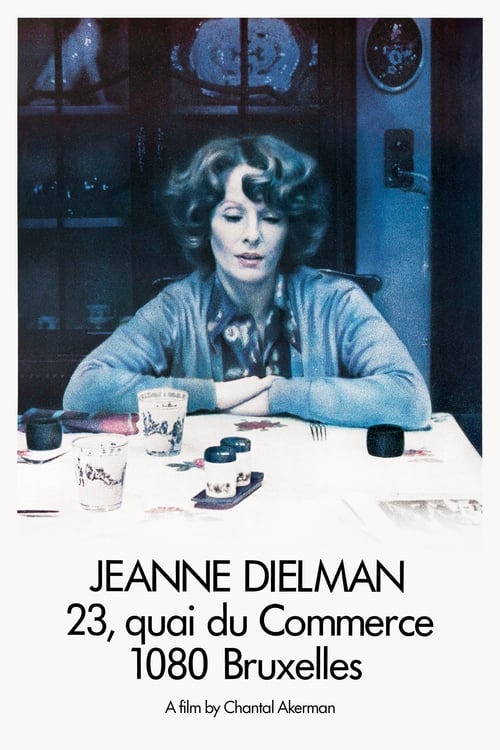
Jeanne Dielman, 23, quai du Commerce, 1080 Bruxelles
1976 · Chantal Akerman
For when you have a whole evening, your phone in another room, and an appetite for something monumental — a film you commit to like a pilgrimage and think about for weeks. Absolutely a challenge, and absolutely worth it.
What it's about
Three days in the life of a Brussels widow who runs her household like clockwork: cooking, cleaning, shopping, raising her teenage son, and receiving a paying male client each afternoon as just one more item in the routine. The camera watches her work — peeling potatoes, breading veal, making coffee — in full, unhurried takes. Then, in the smallest ways at first, the clockwork starts to slip.
The experience
Long, still, and mesmerizing in a way that has to be experienced to be believed — you settle into the rhythm of her chores until you know her routine by heart, which is exactly why the tiniest deviation (an unbuttoned coat, an overcooked dish) hits like a thunderclap. It builds a tension out of dishwashing that most thrillers can't manage with guns.
Performances
Delphine Seyrig is extraordinary — a glamorous star deglamorized into a housewife whose face barely moves, communicating an entire inner life through posture, pace, and the precision with which she handles a coffee pot. It's one of the great sustained pieces of screen acting.
The craft
Akerman, just twenty-five when she made it, fixes the camera low and frontal, never moving, never cutting away early, so household labor plays out in something close to real time. There's no score and no close-ups; the sound of running water, footsteps, and the elevator becomes the film's music. The control is total, and it turns an apartment into a pressure chamber.
Why it matters
Named the greatest film of all time in Sight and Sound's 2022 critics' poll, it's the cornerstone of feminist filmmaking and of cinema built from duration and routine — proof that a movie about housework could be as gripping as any epic.
Snapshot
Chantal Akerman's Jeanne Dielman is a three-hour-plus chronicle of roughly three days in the life of a Brussels widow who keeps a rigidly ordered household, raises a teenage son, and turns afternoon sex work into one more domestic chore. Shot when Akerman was twenty-five, the film fixes its camera at a low, frontal, unblinking remove and lets actions play out in near-real time: peeling potatoes, breading veal, making coffee, washing dishes, riding an elevator, sitting at a table. From this hyper-controlled stillness a quiet catastrophe emerges as the routine begins, almost imperceptibly, to slip. The film is now widely regarded as one of the central achievements of feminist cinema and of the postwar avant-garde, a status crystallized when Sight and Sound's 2022 critics' poll named it the greatest film of all time — the first directed by a woman to top that decennial survey. It is at once an austere durational experiment and a domestic drama of accumulating dread, and its reputation rests on the proposition that the texture of unremarked women's labor is itself worthy of epic running time.
Industry & production
Jeanne Dielman was produced through Akerman's own structures and the small, grant-supported margins of mid-1970s European art cinema rather than any commercial studio. It was made on a modest budget assembled in part from Belgian state and cultural funding, with Akerman drawing on the network she had built between Brussels, Paris, and a formative period in New York. The producer of record was Évelyne Paul, working with Akerman's company; the film was a Belgian–French co-production typical of the era's reliance on cross-border subsidy. Crucially, the production was woman-led to an unusual degree for its time — Akerman directing and writing, Babette Mangolte behind the camera, an editorial and production team in which women held decisive creative roles — a fact that is inseparable from the film's subject and method.
The shoot was famously disciplined and compressed relative to the film's length, a function of Akerman's exacting pre-planning: the framing, blocking, and duration of each shot were determined in advance, leaving comparatively little to improvisation on set. The film premiered in 1975 (it is frequently dated 1975 by its Cannes-adjacent festival screenings and 1976 by wider release) and reached audiences primarily through festivals, cinematheques, and the repertory/art circuit rather than commercial runs. It generated immediate controversy and debate in critical circles; reliable box-office figures are not part of the historical record, and the film's economy was never premised on theatrical returns. Its long afterlife has been sustained by institutional restoration and distribution — notably the Criterion Collection in North America — which moved it from a difficult-to-see touchstone to a widely available classic.
Technology
Technologically the film is conventional 35mm color filmmaking deployed for radically unconventional ends. It uses standard equipment of mid-1970s European production — a fixed camera on a tripod, no zooms, no Steadicam (which was only just emerging and is wholly alien to Akerman's aesthetic), and direct, location-based sound. There are no optical tricks, no process work, and no effects: the film's "technology" is essentially the discipline of leaving the apparatus alone. Akerman and Mangolte worked with available and practical light sources keyed to the apartment's domestic fixtures and windows, so that the look is determined by the real conditions of a Brussels flat rather than by an elaborate lighting rig. The most consequential technical decision is the simplest: the choice to let film run for the full duration of mundane actions, accepting the medium's capacity to record time literally rather than compress it. In that sense the film is an argument about what cinema's basic recording technology is for.
Technique
Cinematography
Babette Mangolte's cinematography is the film's signature. The camera sits low — roughly at the eye level of a seated person, often read as a child's or a domestic worker's vantage — and frames the rooms head-on, frontally, in fixed long takes. There is virtually no camera movement; compositions are stable, symmetrical, and architectural, treating doorways, corridors, and the kitchen as a proscenium. Akerman has described avoiding conventional coverage so as never to fragment Jeanne's body or cut in to "explain" her, and Mangolte's wide, deep framings keep the full figure and her actions legible within the room. Color is muted and domestic — blues, browns, the institutional teal of the kitchen — and light shifts with the time of day, so that the recurring tableaux register the passage from morning to night. The fixed frame also produces a peculiar suspense: because the camera will not move to find anything, the viewer scans the static image for the smallest deviation, and the cinematography converts watching into vigilance.
Editing
The editing, credited to Patricia Canino, is governed by duration rather than rhythm in the conventional sense. Shots are held far past the point at which mainstream cinema would cut, so that the "edit" is felt less as a join between images than as a decision about how long to endure each one. Cuts tend to fall on the completion of an action or on Jeanne's movement between rooms, frequently registered through her passage and the click of light switches. The structure is built on repetition and variation across the three days: nearly identical setups recur, and the editing invites the viewer to compare them, to notice that the second day's potatoes are overcooked, that a gesture lands a beat late. Meaning is generated by accumulation and by the small breaks in a pattern the cutting has carefully established. The film's notorious length is itself an editorial thesis: nothing is shortened to spare us, because the unspared time is the point.
Mise-en-scène / staging
Mise-en-scène is where Jeanne Dielman does most of its work. The apartment is a precisely organized stage in which every object has a fixed place and use, and Jeanne's choreography through it is meticulous and habitual. Akerman stages actions in their full, uninterrupted sequence — the complete making of a meal, the complete setting of a table — so that domestic labor acquires the weight usually reserved for plot. Continuity of behavior becomes the drama: a dropped spoon, an unbuttoned coat, a forgotten lid, a light left on, a button missed are catastrophic precisely because the staging has trained us in the exact order of things. The framing's frontality turns rooms into compartments and underlines Jeanne's confinement within a domestic grid. Even the unseen is staged through space and threshold — the bedroom door that closes on the clients, the hallway she traverses again and again — so that what the film withholds is as compositionally deliberate as what it shows.
Sound
The soundtrack is entirely diegetic; there is no musical score. The film's "music" is the ambient grain of the household and the street — running water, a kettle, cutlery, the scrape of a chair, the hum and gate-clang of the elevator, traffic from the quai, a doorbell, a radio. In the near-total absence of dialogue, these sounds carry enormous expressive and structural weight, marking rhythm and routine and, by their alteration or absence, signaling disturbance. Silence is itself a material: long passages without speech force attention onto breathing, footsteps, and the friction of objects. The decision to forgo non-diegetic music is of a piece with the whole project — refusing the conventional cues that would tell us how to feel, and insisting that the real sonic environment of unpaid and paid domestic labor is sufficient.
Performance
Delphine Seyrig's central performance is one of the most discussed in modern cinema. A stage- and screen-actor associated with elegance and with European art film (Resnais, Buñuel, Truffaut), Seyrig submits here to an anti-expressive discipline: she performs tasks with exacting, contained precision, her face composed and largely affectless, her emotion legible only through micro-fissures in control — a slowed gesture, a held pause, a flicker of disarray. The performance is built on the friction between Seyrig's cultivated bearing and the menial repetition she enacts, and on the audience's growing attunement to deviation. Because the camera never cuts in to underline feeling, the burden of interiority falls on the smallest physical inflections, making the role a study in restraint and duration. The young Jan Decorte, as the son Sylvain, provides a flat, watchful counterpoint, his stilted dinner-table exchanges among the film's rare verbal episodes.
Narrative & dramatic mode
Jeanne Dielman operates in a hyperrealist, durational mode that strips narrative to the rhythm of routine and then lets a fracture open within it. There is a story — across three days the widow's controlling order begins to fail, small mistakes multiply, and the third day ends in a sudden, violent act with one of her clients — but it is delivered almost entirely through behavior rather than exposition or dialogue. The dramatic engine is deviation from pattern: the film teaches its own grammar of normalcy so thoroughly that a dropped utensil or an overcooked dish becomes a plot point, and dread accrues without conventional suspense devices. The ending arrives as both shock and inevitability, and Akerman refuses to explain it psychologically; the final long-held shot of Jeanre seated in the dark after the act offers no catharsis or motive, leaving interpretation deliberately suspended. This is anti-melodrama built from the materials of melodrama — a housewife, a secret, a knife — emptied of music, montage, and reassurance.
Genre & cycle
The film sits athwart genre. Nominally a domestic drama, it has been productively read as a feminist counter-melodrama, as structural/avant-garde cinema, and even, in its slow dilation of menace and its eruption of violence, as a perverse relative of the thriller. It belongs to no commercial cycle; rather it stands among the key works of 1970s feminist and materialist filmmaking concerned with women's labor, the home, and the politics of looking. Its closest kin are found in the era's experimental and political art cinema — the durational structural film Akerman absorbed in New York, and the feminist project of revaluing the domestic — rather than in any genre tradition. If it inaugurated a "cycle," it is the loose lineage of slow, observational films about ordinary time that later critics would gather under the banner of "slow cinema."
Authorship & method
Jeanne Dielman is a definitive auteur work, but one whose authorship is explicitly collaborative and woman-centered. Akerman wrote and directed, and the film distills her method: rigorous pre-planning of frame and duration, a refusal to fragment the body, a commitment to real time, and an autobiographical undertow rooted in the domestic world of her mother and the Brussels Jewish milieu of her upbringing. Her formative exposure to the New York avant-garde — the structural films of Michael Snow and others — gave her the durational, fixed-frame vocabulary she turned toward feminist and domestic ends.
The key collaborators are essential, not incidental. Cinematographer Babette Mangolte, herself a significant experimental filmmaker, shaped the film's frontal, low, fixed-camera look and is central to its meaning. Actor Delphine Seyrig was a committed feminist and an active creative presence whose interpretive discipline realizes the role. Editor Patricia Canino executed the duration-driven cutting. There is, by design, no composer: the absence of a musical score is a defining authorial choice. The result is a film whose form and politics are continuous — the woman-led production embodying the argument the film makes about women's work and women's images.
Movement / national cinema
The film straddles Belgian and French cinema while belonging, in spirit, to a transnational feminist and avant-garde current. Akerman is the towering figure of modern Belgian cinema, and Jeanne Dielman is often invoked as its defining work, yet her practice was forged in Paris and New York as much as Brussels. The film converses with the legacies of European modernism — the durational and observational impulses that run from postwar art cinema through the structural film movement — and with 1970s feminist film theory, then crystallizing around questions of the gaze, spectatorship, and the representation of women. It is less a product of a national "wave" than a node connecting Belgian, French, and American experimental and feminist filmmaking, which is part of why it reads as foundational across several traditions rather than belonging tidily to one.
Era / period
Jeanne Dielman is a quintessential mid-1970s work, emerging at the confluence of second-wave feminism, the institutionalization of film theory, and a vibrant international avant-garde. Its preoccupations — domestic labor, the unwaged and waged work of women, the politics of the image — are those of its moment, and its form answers the era's theoretical interrogation of mainstream cinema's pleasures with a cinema of deliberate de-dramatization. It belongs to the post-1968 European art-film economy of grants, festivals, and cinematheques, and to a generational confidence that the most ordinary material could sustain the most ambitious treatment. Seen from its period, the film is both an intervention and a manifesto.
Themes
The film's governing theme is the visibility of women's labor — the unending, unremarked, unwaged work of cooking, cleaning, and caretaking, here given the running time of an epic. Adjacent to it is the continuity Akerman draws between domestic chores and sex work, both folded into the same regime of routine, so that the body's exploitation is rendered as one more item in a household schedule. Control and its breakdown structure the whole: order as defense, deviation as danger, repetition as both refuge and prison. The film meditates on time itself — its texture, its weight, its refusal to be compressed — and on confinement, with the apartment as a gendered enclosure. Solitude, widowhood, and the muted relation between mother and son thread through it. And, reflexively, it is a film about looking — about who and what cinema deems worthy of sustained attention, and about the ethics and politics of the female image, refusing the fragmenting, eroticizing gaze that feminist theory of the period was naming.
Reception, canon & influence
Reception was, from the first, polarized and consequential. The film's length and austerity divided early audiences and critics, but it was quickly recognized in cinephile and feminist circles as a landmark, and over the following decades its stature only grew. Its canonization reached an apex in the 2022 Sight and Sound decennial poll, where it was voted the greatest film of all time — the first woman-directed film to hold that position — a result widely discussed as both an endorsement of the film and a marker of shifting critical values. Restoration and distribution, including by the Criterion Collection, made it broadly available and cemented its teaching-canon status.
Influences on the film (backward): Akerman's vocabulary draws on the New York structural film movement — the durational, fixed-frame, anti-illusionist experiments she encountered in the late 1960s and early 1970s — and more broadly on European art-cinema modernism's appetite for dead time and observation. It draws equally on the feminist intellectual ferment of its moment, which supplied the urgency of its subject and the rigor of its refusals. Its autobiographical roots in Akerman's own family and the domestic world of her mother are an acknowledged source.
Legacy (forward): Jeanne Dielman became a foundational reference for feminist filmmaking and for what later criticism termed "slow cinema," its durational realism echoing in directors associated with patient, observational time. Its influence is routinely traced in the work of filmmakers who foreground duration, domestic space, and the dignity of the ordinary, and it has shaped academic film studies as a central case for discussions of the gaze, women's labor, and the politics of form. Beyond any single lineage, it altered the sense of what cinema could find worth filming, and how long it could justly look.
A Deleuzian reading
You remember the potatoes.
The full Deleuzian reading of Jeanne Dielman, 23, quai du Commerce, 1080 Bruxelles →
Reception
Hailed at its 1975 Cannes debut as 'the first masterpiece of the feminine in the history of cinema' but long confined to art-house and academic circles, it stunned everyone in 2022 by topping the Sight and Sound poll — dethroning Vertigo as the official Greatest Film of All Time.
How Jeanne Dielman, 23, quai du Commerce, 1080 Bruxelles was received, from release to now →
Influences: the films it descends from and the films it influenced
- Wavelength (1967) — Snow's structural-film insight that a camera's duration and procedure — here a 45-minute zoom across a loft — can organize a film without dramatic event gave Akerman the fixed-frame durational logic she turned toward domestic time.
- La Région Centrale (1971) — Its rigorously pre-programmed, anti-illusionist camera procedure modeled the kind of pre-planned frame-and-duration discipline Akerman imposed on Jeanne's apartment.
- Empire (1964) — Real-time fixed-camera observation of a single subject across extreme, uneventful duration established the durational-real-time principle Akerman adopts for household tasks.
- Umberto D. (1952) — The maid's morning sequence — grinding coffee, lighting the stove in uninflected real time — is the direct neorealist precedent for Jeanne's uncut kitchen choreography of mundane gestures.
- Tokyo Story (1953) — Ozu's low, frontal, locked-down framing of domestic interiors supplies the frontal-tableau grammar Mangolte and Akerman use to face Jeanne's rooms head-on.
- Au hasard Balthazar (1966) — Bresson's 'models' — performers drained of expressive acting — underwrite Seyrig's anti-expressive restraint and the film's refusal of psychological emoting.
- L'Eclisse (1962) — Antonioni's dedramatized 'dead time,' letting scenes run past narrative function, legitimized the patient durational observation Akerman pushes to its formal limit.
- Saute ma ville (1968) — Akerman's debut already confines a woman to a single kitchen performing frantic household tasks, the embryonic version of Jeanne's choreography of domestic labor and its breakdown.
- Hotel Monterey (1972) — This silent, Mangolte-shot, fixed-frame study of interior space is the direct rehearsal of the static-camera, available-light durational method later applied to the apartment.
- Stromboli (1950) — Akerman radicalizes Rossellini's editing ethics — the refusal to cut away from the full real-time duration of female domestic labor that American critics dismissed as slack — into an explicit feminist method: three days of unbroken domestic observation extend the patience Rossellini established into a political form.
- Cries and Whispers (1972) — Akerman radicalizes the duration-holding strategy Bergman employs — using real-time rhythm and a static, unblinking camera to excavate female interiority through domestic routine rather than crisis — pushing the ethical implications of Bergman's patient editing to their logical extreme.
- The Silence (1963) — Akerman's extended-duration scenes calibrated to real-time domestic labor, ambient diegetic sound without underscore, and the female body as the site of inexpressible inner life develop the temporal and sonic methods The Silence helped establish into a systematic feminist materialist film practice.
- The Seventh Continent (1989) — Builds dread from durational, fixed-frame repetition of a family's banal domestic routines — an explicit inheritance of Jeanne's accumulation of task-time and deviation from pattern.
- Safe (1995) — Distant, static framing of a housewife dwarfed by her domestic interiors plus anti-expressive performance channel Akerman's formal critique of women's domestic space.
- Sátántangó (1994) — A foundational slow-cinema work whose extended real-time long takes and patient observation extend Akerman's principle that the camera may justly look far longer than narrative requires.
- In Vanda's Room (2000) — Fixed-frame, available-light, durational observation of domestic interior labor and routine carries Akerman's static-camera domestic method into digital slow cinema.
- La Ciénaga (2001) — Diegetic-only, densely layered sound and fragmented domestic staging extend Akerman's sound-as-material and household-choreography toward a new register of off-screen bodily space.
- Wendy and Lucy (2008) — Durational, scoreless attention to a woman's small economic-survival tasks with observational restraint marks American slow cinema's debt to Akerman's dignity-of-the-ordinary form.
- Father Mother Sister Brother (2025) — Fixed frontal long takes that observe domestic ritual in something near real time, with silence and dead air treated as expressive material rather than gaps to be cut.
- The Currents (2025) — Durational, frontal staging of a woman inside domestic architecture, where placid surface routine masks interior rupture — the foundational text for surface-interior dissonance.
- Die My Love (2025) — Codifies the confined domestic interior as a pressure chamber of feminine labor and routine, where durational staging of household space becomes the engine of psychological rupture.
- Afternoons of Solitude (2025) — Makes duration-repetition a structural principle — behavior observed in real time until ritual reveals its fracture — the editorial logic behind the film's serial afternoons.
- Peter Hujar's Day (2025) — Real-time, anti-dramatic attention to a single ordinary day yields a total biography, the durational long-take logic that lets an undramatic transcript become a full portrait.
- Three Colors: Blue (1993) — Akerman's technique of applying sustained duration to domestic objects and routine tasks until they yield psychological weight — a potato peeling, a dish held in close-up past comfort — directly precedes Kieślowski's sugar cube and chandelier scenes as prop-as-psychology staging.
- Lives of Performers (1972) — Also shot by Babette Mangolte, it shares the cinematographer's frontal, anti-illusionist method and the project of building feminist form out of minimalist, structural duration.
- Wanda (1970) — A contemporaneous woman-directed, observational portrait of a passive woman that rejects melodramatic dramaturgy for unglamorous durational realism — the same feminist counter-melodrama impulse.
- News from Home (1977) — Made the year after, it extends the same fixed-frame durational long takes and refusal of dramatic event into New York streetscapes, prolonging the structural-domestic vocabulary.
- The Marriage of Maria Braun (1979) — Akerman's anti-cathartic editing strategy—sustained real-time duration that forces the viewer to endure domestic routine without release or commentary—establishes a formally cognate but independent parallel to Maria Braun's anti-catharsis rhythm; both films refuse conventional emotional relief to make ideological critique legible in the gap between event and expected feeling.
- Stalker (1979) — Akerman's fixed camera observing domestic ritual in extended real time, with an editing tempo calibrated to the actual duration of action rather than dramatic punctuation, develops the same formal commitment to ultra-slow cutting that defines Stalker's ascetic ~100-shot-per-163-minute rhythm, applied to domestic space.
- L'Argent (1983) — Shares the anti-theatrical real-time staging, the money-for-body economy, and the sudden elided act of violence delivered without psychological underlining.
- The Bitter Tears of Petra von Kant (1972) — Radical unity of place and durational long-take staging within a single apartment, letting fixed framing and real-time tempo do the dramatic work the way Petra's bedroom does.
- One Sings, the Other Doesn't (1977) — The same mid-1970s feminist project of making women's unshown labor and bodily life the entire subject, though Akerman's durational stasis is the formal inverse of Varda's mobile, song-punctuated lyricism.
- Personal Problems (1980) — Shares the commitment to real-time domestic duration and fixed observational framing that deliberately withholds dramatic climax.
- Perfect Days (2023) — Akerman films repeated domestic chores in near-real time so meaning accrues through tiny day-to-day variations — the repetition-as-revelation structure Wenders borrows for Hirayama's cycling days.
- An Autumn Afternoon (1962) — Frontal, waist-level static tableaux of domestic ritual performed in near-real-time duration — an independently arrived-at parallel to Ozu's geometric frontality and attention to household routine.
- First Cow (2020) — The slow-cinema attention to a domestic manual process shown in full — the loving real-time depiction of Cookie mixing, frying and selling the oily cakes is Akerman's durational treatment of labor as event.
Similar films
- Satantango (1994) — influence & lineage · often watched together
- News from Home (1977) — influence & lineage
- Wavelength (1967) — influence & lineage
- The Seventh Continent (1989) — influence & lineage
- The Currents (2025) — influence & lineage
- Wanda (1970) — influence & lineage · same viewing thread
- Rosetta (1999) — same viewing thread
- Tokyo Story (1953) — influence & lineage · often watched together
All the films related to Jeanne Dielman, 23, quai du Commerce, 1080 Bruxelles →
Watch it with: curated runs of related films
- The World Against Her — A run of women worn down or driven to extremity by a merciless community, marriage, or economy — watch them near each other and the sacrifice, the drift, and the violence start to rhyme.
Film essays and courses that include it
- The Constructed Self: A Century of Gender and Identity on Screen
- Duration and Doubt: The Art Film from Dreyer to Kiarostami
- Radical Attention: A Century of Art Cinema
- The Unbroken Take: From Camera Liberation to Single-Shot Cinema
- Four Walls, Infinite Pressure: The Chamber Cinema Canon
- The Unbroken Hour: Real Time as Form
- The Art of Duration: Slow Cinema from Dreyer to Tarr
- The Disappearing Self: A Cinema of Estrangement
- The Difficult Love: How Cinema Learned to See Inside the Family
- Premeditated: Cinema's Century of the Kill
- The Interior Eye: Cinema's Search for Lives Felt From Within
- What the Frame Cannot Hold: Cinema's Long Reckoning with Off-Screen Atrocity
- She Burns Everything Down: A Century of Feminine Fury
- The Glass Between Us