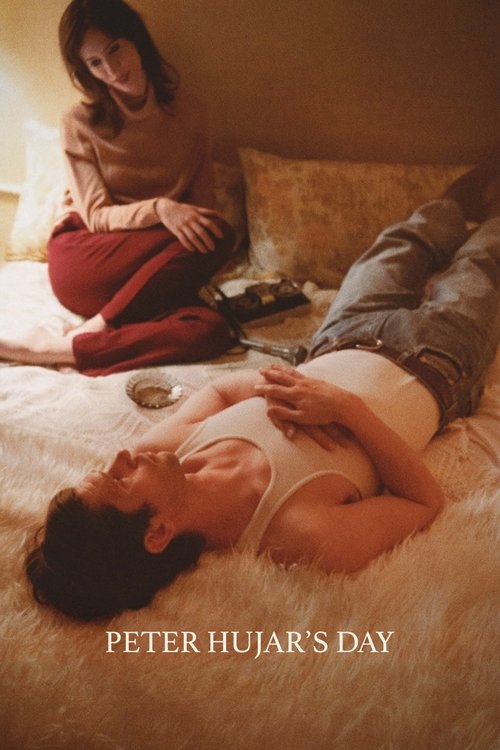
Peter Hujar's Day
2025 · Ira Sachs
For a slow evening when you want something that feels less like a movie and more like eavesdropping on a brilliant, funny, melancholy stranger. Especially for anyone drawn to the downtown New York art world of the 1970s.
What it's about
In 1974, writer Linda Rosenkrantz recorded a long conversation with photographer Peter Hujar in which she asked him to reconstruct everything he'd done across a single ordinary day in New York City. The tape was thought lost for decades. Ira Sachs stages that conversation in near real time — Ben Whishaw as Hujar, Rebecca Hall as Rosenkrantz, confined largely to a Manhattan apartment — building a portrait of an artist not through his celebrated work or his death, but through the texture of his hours.
The experience
Quiet, intimate, and unexpectedly absorbing — a film that rewards the patience to slow down and listen. At 76 minutes it barely overstays its welcome, but it carries the quality of attention of a much longer work.
Performances
Ben Whishaw is extraordinary — physically precise, verbally textured, finding the man behind the legend without ever performing greatness. Rebecca Hall matches him as Rosenkrantz, keeping her quiet and present rather than just a prompt-giver.
The craft
The formal constraint is the point: a single conversation, a single apartment, the grain and drift of remembered speech. Sachs works with minimal embellishment, trusting the material and his two actors completely. What the film does with time — making a reconstructed ordinary day feel monumental — is its central achievement.
Why it matters
A significant entry in the growing body of films recovering figures from the pre-AIDS New York queer art world, and a departure for Sachs that demonstrates how much his intimate formal approach can carry.
Snapshot
Peter Hujar's Day is a chamber two-hander adapted by Ira Sachs from a single 1974 audio recording: the writer Linda Rosenkrantz, then pursuing an oral-history project in which she asked friends to reconstruct one ordinary day in exhaustive detail, sat down with the photographer Peter Hujar and taped him recounting everything he had done across roughly twenty-four hours. The tape was long thought lost and was eventually rediscovered and published by Rosenkrantz as a slim book, Peter Hujar's Day, in 2021. Sachs's film stages that conversation more or less in real time, with Ben Whishaw as Hujar and Rebecca Hall as Rosenkrantz, confined largely to a Manhattan apartment. At roughly 76 minutes it is deliberately minor in scale and intimate in ambition — a portrait of an artist not through his work or his death but through the granular texture of a single unremarkable day. It premiered at the Sundance Film Festival in January 2025 and circulated on the 2025 festival circuit; the film is the work of one of American independent cinema's most consistent chroniclers of queer life and downtown New York.
Industry & production
The film belongs squarely to the low-budget, festival-funded sector of American art cinema in which Sachs has worked for two decades. It is a logical successor to his Passages (2023), and reunites him with Whishaw, who starred in that film — a continuity of collaborator that is itself characteristic of how Sachs builds projects around trusted actors. The production is small by design: essentially two performers, a single principal location, and a compressed shoot, the kind of economically lean package that can be financed outside the studio system and recouped through festivals, specialty distribution, and arthouse theatrical.
The source is unusual and worth stating precisely, because it shapes everything downstream. Rosenkrantz's project was a conceptual, almost Warholian experiment in the 1970s: to capture a life not in summary but in minute-by-minute recollection. Hujar's session survived where others did not, and its 2021 publication gave Sachs a ready-made, near-verbatim script. The film is therefore less an "adaptation" in the conventional sense than a staging of a found document — an approach that aligns it with a lineage of transcript-based and verbatim performance work.
On the business side I want to be careful not to overstate specifics. The film premiered at Sundance 2025 and played further festivals during the year; precise distribution deals, release dates, and any box-office figures are the kind of detail the public record reports unevenly for a film of this scale, and I will not invent them. What is safe to say is that this is not a commercial vehicle but a critical and cinephile object, positioned for the specialty market that has historically carried Sachs's work.
Technology
Peter Hujar's Day reportedly embraces analog photochemical capture rather than digital — a choice consistent with both its 1974 subject and the texture-forward aesthetics of much recent American independent film. The credited cinematographer is Alex Ashe; I am confident of the attribution but want to flag that some granular technical specifications (exact gauge, stock, lab) are the sort of thing I should not assert beyond what the record supports. The relevant point is conceptual: shooting on film, with its grain and its softer registration of skin and lamplight, is a way of letting the medium rhyme with the period and with Hujar's own practice as a black-and-white photographer who prized tonality and presence over slickness. The technological modesty is the point — no spectacle, no digital expansiveness, a deliberate smallness of means.
Technique
Cinematography
The visual scheme is dictated by the premise: two people talking in a room. Ashe's camera works within tight domestic space, attentive to faces, hands, the act of listening, and the small physical business of a long conversation — eating, smoking, shifting position, pouring a drink. The challenge of a film this static is to keep the frame alive across an essentially uninterrupted dialogue, and the cinematography accordingly leans on composition, the quality of natural and practical light, and the rhythm of when to hold and when to move rather than on coverage. The result is a portraiture-inflected style appropriate to a film about a portraitist: the apartment becomes a studio, the two actors its sitters.
Editing
Editing is paradoxically central to a film that appears to unfold continuously. The art lies in modulating a single long conversation — managing pace, deciding where to cut between speakers and where to let a take breathe, and shaping recollection into something with dramatic contour despite the near-absence of plot. I do not want to attribute the cut to a specific editor without certainty, so I will leave the credit unnamed here rather than guess; what can be said is that the film's effect depends on a restrained, rhythm-sensitive assembly that resists the temptation to "open up" the material.
Mise-en-scène / staging
The staging is the film's primary formal statement. By confining the action to interiors and to the ritual of the recorded interview, Sachs converts a logistical constraint into a thesis: that a life is legible in its smallest gestures. Period detail is handled through props, costume, and decor rather than through establishing spectacle of 1970s New York; the city enters chiefly through Hujar's spoken recollection — the phone calls, the errands, the lunches, the names — rather than through location work. This is a film about a day described, not a day depicted, and the mise-en-scène honors that by keeping us in the room where the describing happens.
Sound
Sound is unusually load-bearing here because the film is, at root, about a recording. The premise foregrounds the recorded voice as artifact, and the texture of speech — Hujar's cadence, hesitations, digressions — is the central sensory material. I am not in a position to confirm whether the film carries an original score or relies primarily on ambient and source sound, so I will not assert a composer credit. Functionally, the soundscape is dominated by dialogue and the quiet of domestic interiors, which suits a work that treats listening itself as a dramatic act.
Performance
Performance carries the film almost entirely. Whishaw's task is to inhabit a real photographer through nothing but talk, conjuring a personality, a milieu, and an economic and emotional reality through the recounting of trivia; the role asks for charm, melancholy, and the wandering associative quality of someone genuinely remembering. Hall, as Rosenkrantz, plays the harder-to-notice but essential part of the active listener — prompting, reacting, anchoring — whose attention gives the monologue its shape and stakes. The two-hander structure makes the chemistry between attention and disclosure the real subject of the acting.
Narrative & dramatic mode
The film's dramatic mode is anti-dramatic by conventional measure. There is no plot in the ordinary sense — no goal, obstacle, reversal, or climax — only the steady accretion of a recounted day. Its lineage is the verbatim or transcript-based work (theatrical "verbatim theater," the recorded-conversation film) and the conceptual portraiture of the 1970s downtown scene from which the source emerged. The tension is generated not by events but by the gap between the banality of what Hujar reports and the poignancy of what we, retrospectively, know: that this is a portrait of a vibrant queer artistic world shortly before the AIDS crisis would devastate it, and of an artist whose own life would be cut short. The mundane becomes elegiac through dramatic irony the film never has to underline.
Genre & cycle
Nominally tagged drama and history, the film sits in the cycle of artist-portrait and "based on a document" films, and more specifically in the small wave of recent works that reconstruct lost or archival recordings as cinema. It is also a chamber film — the single-location, dialogue-driven form — and a period piece that achieves period through performance and sound rather than production scale. Within Sachs's own output it extends his cycle of intimate New York character studies into a near-experimental register.
Authorship & method
Ira Sachs (b. 1965, Memphis) is among the most durable figures in American queer independent cinema, with a body of work — The Delta (1996), Keep the Lights On (2012), Love Is Strange (2014), Little Men (2016), Frankie (2019), Passages (2023) — marked by emotional precision, restraint, and a recurring interest in artists, couples, and the city as a moral environment. Peter Hujar's Day distills his method to its essence: trust in actors, attention to the texture of ordinary life, and a refusal of melodrama. His authorial signature here is the decision to do almost nothing — to let a found transcript and two performers carry the film — which is itself a strong directorial position.
Key collaborators: the credited cinematographer is Alex Ashe, whose work realizes the film's intimate, film-grain aesthetic. The two leads, Ben Whishaw and Rebecca Hall, function as creative collaborators as much as performers given how much the film rests on them; Whishaw's casting in particular continues his working relationship with Sachs from Passages. For the editor and any composer I will refrain from naming credits I cannot verify, rather than risk a false attribution — an honest gap is preferable to an invented fact. The originating author behind it all is Linda Rosenkrantz, whose 1974 recording and 2021 book are the film's true blueprint, and whose conceptual gambit — a day as a complete portrait — is the film's governing idea.
Movement / national cinema
The film is American independent cinema in its purest contemporary form: low-budget, auteur-driven, festival-launched, and aesthetically aligned with the photochemical, performance-centered wing of US art film. It also belongs to a transatlantic art-house sensibility — Sachs has worked extensively in Europe and casts internationally (Whishaw is British; Hall Anglo-American) — situating the film at the intersection of American indie and the European-festival ecosystem that sustains directors of his profile.
Era / period
There are two periods in play. The film is a 2025 work, but its subject is December 1974 and, more broadly, the downtown New York of the early-to-mid 1970s: a moment of intense, low-rent artistic ferment in photography, performance, and writing, the world of Hujar, Susan Sontag, Fran Lebowitz, and their circle, before commercial gentrification and before AIDS. Hujar (1934–1987) would publish his only book of the period, Portraits in Life and Death, in 1976 with an introduction by Sontag, and would die of AIDS-related illness in 1987. The recounted day thus sits on the cusp of a vanished era, and the film's contemporary vantage charges that ordinariness with retrospective grief.
Themes
The film's central theme is the ordinary day as biography — the claim that a life is most truthfully captured not in its milestones but in its trivia. Allied themes include: the archive and the recovered document (the film is itself an act of rescue, mirroring Rosenkrantz's rediscovery of the tape); the recorded voice as a form of survival; friendship and attention as creative acts; the precarious economics of an artist's life; and queer downtown culture on the eve of catastrophe. Above all it is a meditation on ephemerality — on how a single, unrepeatable day, spoken aloud and taped, becomes the closest thing to immortality an artist may be granted.
Reception, canon & influence
As a 2025 festival premiere, the film's critical reception was forming at the time of its release; the honest position is that its long-term canonical standing cannot yet be assessed, and I will not manufacture quotations, scores, or consensus it has not yet earned. What can be said responsibly is that it arrived with the credibility of a respected auteur and two acclaimed leads, and that its formal austerity makes it the kind of film likely to divide between viewers who find it hypnotic and those who find it slight — a familiar fate for chamber works of this radical minimalism.
Influences on the film run backward along two tracks. The first is documentary and conceptual: Rosenkrantz's 1970s oral-history experiment and the broader downtown culture of recorded talk (one thinks of Warhol's tape recorder, of a: A Novel, of the era's fascination with the unedited voice). The second is the tradition of the verbatim and single-location dialogue film, where dramatic interest is wrung from talk alone. Within Sachs's own filmography it draws on his long-standing intimacy of scale and his fascination with artists and with New York.
Its forward legacy is necessarily speculative this close to release. The most plausible contribution is as a model — a demonstration that a found audio transcript can be staged as cinema with rigor and feeling, and as a further entry in the ongoing rehabilitation of Peter Hujar's reputation, joining the exhibitions, reissues, and writing that have steadily restored him to the center of twentieth-century American photography. If the film endures, it will likely be as a refined example of the "recovered recording" film and as a tender, essayistic addition to the cinema of queer remembrance.
A Deleuzian reading
A man sits in a friend's apartment and tells her, more or less hour by hour, what he did yesterday.
The full Deleuzian reading of Peter Hujar's Day →
Reception
A modest sleeper at Sundance 2025 — a 76-minute film of two people talking in an apartment — it snowballed through word of mouth into one of the year's best-reviewed arthouse releases, widely called Ira Sachs' finest work.
How Peter Hujar's Day was received, from release to now →
How to watch Peter Hujar's Day: what to notice on a first viewing
- Notice the whole film stays inside one Manhattan apartment. Sachs confines nearly the entire film to a single room, two people and a tape recorder, with the city entering only through what Hujar describes rather than through any location filming. The tiny scale is the whole thesis: a life can be legible in one room and one day.
- Watch the camera hold on hands and small physical business. Ashe's camera stays attentive to eating, smoking, shifting in a chair, the small transactions of a long conversation, rather than cutting away to find a more dramatic image. Watching bodies do nothing much is exactly how the film asks you to pay attention.
- Watch Hall's face while Whishaw talks, not just his. Hall plays Rosenkrantz as the active listener, prompting, reacting, and anchoring the monologue with small shifts in attention that shape when Hujar wanders and when he's pulled back. Her listening is doing as much work as his talking, even though she says far less.
- Listen for hesitations and digressions in Hujar's recounting. The film treats the recorded voice itself as the central material, cadence, pauses, one errand reminding him of another, rather than as a delivery system for a scripted story. The texture of remembering, not the facts remembered, is what the film asks you to listen for.
The whole guide to watching Peter Hujar's Day, with the keys for a rewatch →
Influences: the films it descends from and the films it influenced
- Portrait of Jason (1967) — A single overnight recording session in one room turns one queer subject's continuous talk into a complete biographical portrait, with the prompting apparatus left audible as part of the artifact — the template for staging a recorded confession as cinema.
- Chelsea Girls (1966) — Durational, unedited recorded talk among Factory figures establishes the downtown aesthetic of letting the camera simply witness people speaking in real time, the Warhol tape-recorder ethos the film inherits.
- Outer and Inner Space (1965) — Edie Sedgwick performs beside her own pre-recorded video voice, literalizing recorded-voice-as-artifact — a person staged in dialogue with the captured trace of an earlier self.
- Jeanne Dielman, 23 quai du Commerce, 1080 Bruxelles (1975) — Real-time, anti-dramatic attention to a single ordinary day yields a total biography, the durational long-take logic that lets an undramatic transcript become a full portrait.
- News from Home (1977) — Recorded private correspondence read aloud over 1970s New York images treats voice as recovered archive of a vanished city — the same fusion of spoken document and downtown-NY texture.
- My Dinner with André (1981) — A single-location two-hander wrings all dramatic interest from talk alone, sustained by one rapt active listener — the chamber-dialogue grammar the seed adopts wholesale.
- The Mother and the Whore (1973) — Talk-saturated chamber realism where performance and listening carry the entire running time, modeling how unhurried monologue becomes the dramatic engine.
- The Arbor (2010) — Actors lip-sync verbatim to recovered audio testimony, making the recorded-recording method itself the film's form — the clearest contemporary kin to staging a found transcript.
- London Road (2015) — Builds its entire text from verbatim community recordings, extending the same verbatim-transcript-as-screenplay procedure into another register.
- Wojnarowicz: F**k You F*ggot F**ker (2020) — Constructed from David Wojnarowicz's own cassette journals, it uses recorded voice as primary artifact for queer elegy and archive-recovery within Hujar's exact downtown circle.
- The Velvet Underground (2021) — Assembles a portrait of 1960s–70s downtown New York from recorded talk and surviving documents, the same archive-and-recovery impulse applied to the Factory milieu.
- Carol (2015) — Ed Lachman's Super-16 photochemical grain is deployed as the very texture of queer period memory, the film-stock-as-elegy craft the seed shares.
- The Souvenir (2019) — Intimate film-grain portraiture and chambered two-hander scenes reconstruct an artist's life as recovered personal memory, matching the seed's archival, grain-textured intimacy.
- Before Sunset (2004) — Long-take real-time conversation sustains a feature on walk-and-talk alone, the long-take-modulation-of-talk technique that keeps a dialogue film alive.
- Love Is Strange (2014) — Sachs's own New York chamber study of a queer couple, built on restraint and intimacy of scale, the directorial method distilled in the seed.
- Passages (2023) — Immediately precedes the seed in Sachs's filmography and continues his Ben Whishaw collaboration, refining the actor-trusting, anti-melodramatic chamber approach the seed pushes to its limit.
Similar films
- Perfect Days (2023) — shared sensibility
- As I Was Moving Ahead Occasionally I Saw Brief Glimpses of Beauty (2000) — shared sensibility
- The Zone of Interest (2023) — shared sensibility
- Synecdoche, New York (2008) — shared sensibility
- Amour (2012) — shared sensibility
- Drive My Car (2021) — shared sensibility
- Moonage Daydream (2022) — shared sensibility
- It's Such a Beautiful Day (2012) — shared sensibility