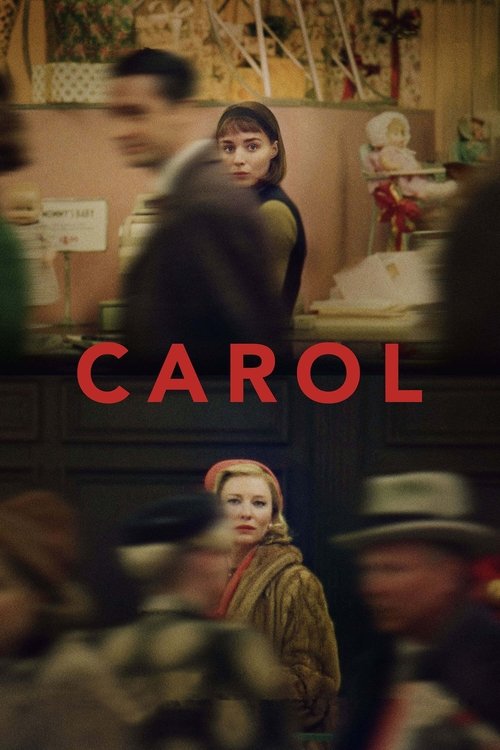
Carol
2015 · Todd Haynes
For a night when you want to fall in love slowly and feel every heartbeat of it — a grown-up romance to sink into, not a comfort watch exactly, but a deeply rewarding one. Reach for it when you want longing done right.
What it's about
In 1950s New York, a young department-store clerk with dreams of becoming a photographer catches the eye of an elegant older woman shopping for a Christmas gift. Carol is wealthy, married, and in the middle of a divorce; Therese is unformed, watchful, and unsure what she wants until this woman walks into her life. What begins with a glance across a counter grows into a romance that has to survive the suspicions and rules of its era, eventually taking the two of them out of the city and onto the road.
The experience
Hushed, slow-burning, and quietly devastating — the film runs on glances, pauses, and everything the characters can't say out loud. It's romantic in a way that aches rather than swoons, and the restraint makes the moments of real feeling land hard.
Performances
Cate Blanchett gives Carol a poised, armored glamour with fear moving underneath it, and Rooney Mara makes Therese's stillness magnetic — you watch her fall in love in real time, mostly with her eyes. The two performances work like a duet.
The craft
Shot on grainy Super 16mm, the film looks like a memory of the early fifties — muted greens and reds, faces glimpsed through rain-streaked windows and shop glass, so much of the story told in reflections. Carter Burwell's circling, melancholy score does heavy emotional lifting, and the period detail is immaculate without ever feeling like a museum. It rewards a screen big enough to read the smallest shifts in expression.
Why it matters
One of the most acclaimed films of the 2010s and a landmark queer romance, drawn from a novel that was itself groundbreaking for letting two women in love imagine a future. It confirmed Todd Haynes as a master of period melodrama with modern nerves.
Snapshot
Carol is Todd Haynes's adaptation of Patricia Highsmith's 1952 novel The Price of Salt (later reissued under the title Carol), a chamber romance between two women in early-1950s New York: Therese Belivet (Rooney Mara), a young department-store clerk with photographic ambitions, and Carol Aird (Cate Blanchett), an affluent, soon-to-be-divorced suburban wife. The film transposes Highsmith's pioneering source—notable in its era for refusing to punish its lesbian lovers with death, madness, or renunciation—into a meticulously controlled work of period filmmaking. Shot on Super 16mm by Edward Lachman, scored by Carter Burwell, and adapted by Phyllis Nagy, it premiered in competition at Cannes in 2015 and became one of the most acclaimed films of the decade. Its formal restraint, its photographic palette of glass, rain, and reflection, and its quietly affirmative ending mark it as both a culmination of Haynes's long engagement with melodrama and a touchstone for the wave of period queer romances that followed.
Industry & production
Carol was an independent, transatlantic co-production assembled by producers long central to American and British art-house cinema. The principal companies were Number 9 Films (Elizabeth Karlsen and Stephen Woolley) and Killer Films (Christine Vachon), with financing and distribution involvement from StudioCanal and Film4, among others; The Weinstein Company handled the U.S. release. The project had an unusually protracted development. Phyllis Nagy, a playwright and screenwriter who had known Highsmith personally, wrote her screenplay years before the film was made, and the property circulated through several configurations—at one point with other directors and stars attached—before Haynes joined and Blanchett and Mara were cast. This long gestation is well documented in the film's press history, though specific contractual details are not something to assert with precision.
The shoot took place largely in and around Cincinnati, Ohio, standing in for 1950s New York and the couple's road-trip route west, on a budget modest by studio standards (reported figures circulate but should be treated as approximate). The film premiered at the Cannes Film Festival in May 2015, where Rooney Mara shared the Best Actress prize. It went on to a strong awards season, earning six Academy Award nominations—including Best Actress (Blanchett), Best Supporting Actress (Mara), Adapted Screenplay, Cinematography, Costume Design, and Original Score—while being conspicuously passed over for Best Picture and Best Director, an omission widely discussed at the time as emblematic of the Academy's wariness toward queer subject matter.
Technology
The defining technological choice was the decision to shoot on Super 16mm film rather than digitally or on 35mm. By 2015 digital capture was the industry default, and even most period films that chose celluloid reached for the larger 35mm format. Haynes and Lachman deliberately selected the smaller gauge for its pronounced grain structure, which evokes the texture of mid-century photojournalism and color photography rather than the glossy sheen of contemporary cinema. The format's relatively shallow latitude and visible grain became expressive tools, lending the image a sense of period documentary truth. The film was finished through a digital intermediate, allowing the filmmakers to grade the desaturated, smoky palette—muted greens, browns, and reds—while preserving the organic qualities of the film stock. The choice situates Carol within a small group of 2010s prestige films using analog capture as an aesthetic statement against the digital norm.
Technique
Cinematography
Edward Lachman's photography, his most celebrated collaboration with Haynes after Far from Heaven (2002), is the film's signature achievement. The visual program is built around obstruction and mediation: the lovers are repeatedly framed through windows streaked with rain, through the glass of cars and storefronts, behind reflections and condensation, their faces partly obscured or doubled. This strategy makes the camera complicit in the period's enforced concealment—the women are watched, glimpsed, and surveilled before they are seen plainly. Lachman has cited a constellation of mid-century still photographers as touchstones, particularly Saul Leiter, whose color street work shot through rainy New York glass closely anticipates the film's compositions, alongside figures such as Ruth Orkin, Esther Bubley, and Vivian Maier. The handheld camera is restrained but present, lending intimacy without instability, and the framing favors off-center compositions and foreground occlusions that keep the viewer at a respectful, longing distance from the characters.
Editing
Affonso Gonçalves, another recurring Haynes collaborator, cut the film toward patience and suspension. The editing privileges held looks, glances exchanged across rooms, and the slow accumulation of charged small gestures over conventional dramatic acceleration. Crucially, the film is structured around a bracketing device: it opens on a scene—two women at a table in a hotel restaurant, interrupted by an acquaintance—whose full significance is withheld until the narrative circles back to replay it near the end, now saturated with everything the audience has learned. This circular architecture, which recasts an early "neutral" scene as a moment of quiet devastation, is the editorial-structural spine of the film.
Mise-en-scène / staging
Production designer Judy Becker and costume designer Sandy Powell construct a 1950s of precise social stratification. Carol's world of suburban affluence, furs, gloves, and tailored silhouettes is set against Therese's drabber, younger milieu of cramped apartments and the department-store shop floor. Powell's costuming does pointed character work: Carol's polished armor of color and texture versus Therese's more tentative, boyish, less assured wardrobe, the two palettes gradually drawing closer as the relationship deepens. Becker's interiors—the Aird home, the Frankenberg's toy department, motel rooms along the road—are dressed with restraint rather than nostalgia, avoiding the cluttered "period showcase" look in favor of lived-in plausibility. Staging frequently isolates the women within larger frames, emphasizing the social spaces—stores, parties, legal offices—that hem them in.
Sound
The soundscape is hushed and interiorized, attentive to the rustle of fabric, the click of a cigarette lighter, the ambient hum of public rooms that forces private feeling into whispered registers. Carter Burwell's score is among the film's most discussed elements: a small, repeating set of arpeggiated piano and string figures, minimalist and circling, that builds emotional pressure through reiteration rather than swelling melodrama. The cyclical music mirrors the film's structural return and its theme of inevitability, of feeling that recurs and will not be argued away. Period source music and songs punctuate the diegesis sparingly, anchoring scenes in their moment without overwhelming the original cues.
Performance
The acting is calibrated to suppression and indirection. Blanchett plays Carol as a woman fluent in performance herself—charm, poise, and worldliness deployed as both seduction and self-protection—while letting fear and exhaustion show in the seams. Mara's Therese is watchful, reactive, often nearly silent, her transformation registered in small increments of confidence and desire. Much of the relationship is carried not in dialogue but in the choreography of looks, the placement of a hand on a shoulder, the way each woman holds or withholds her gaze. The supporting performances—Kyle Chandler as Carol's wounded, controlling husband Harge, and Sarah Paulson as Abby, Carol's former lover and steadfast friend—supply the surrounding pressures of marriage, custody, and social consequence without tipping into villainy.
Narrative & dramatic mode
Carol operates in the register of intimate melodrama, but a melodrama deliberately drained of hysteria and pitched toward understatement. Its dramatic engine is external constraint pressing on private feeling: the obstacles are not the lovers' doubts so much as the legal and social machinery—Carol's divorce, the custody battle over her daughter, the threat of a "morality clause" that weaponizes her sexuality against her. The plot follows a familiar romance arc—meeting, courtship, a transformative road trip, a forced separation, and a final reckoning—but Nagy's adaptation refuses easy catharsis. The story is told largely from Therese's point of view, a coming-into-being narrative of a young woman learning her own desire and vocation, while Carol's interior life is held at a more guarded remove. The circular structure converts the ending from simple reunion into something more open and adult: a tentative, uncertain reaching-toward rather than a guaranteed happily-ever-after.
Genre & cycle
The film sits at the intersection of the woman's picture, the period romance, and queer cinema. It consciously invokes the 1950s Hollywood melodrama—the genre of Douglas Sirk and the "weepie"—while inverting that tradition's tendency to enforce social order in its final reel. As a lesbian romance, it belongs to a cycle of self-aware art films reclaiming and rewriting the mid-century closet. Within Haynes's own filmography it forms a loose triptych of 1950s-set studies of constrained desire alongside Far from Heaven and the HBO miniseries Mildred Pierce (2011). More broadly it can be read as part of a 2010s cycle of prestige queer cinema that treated same-sex love as a subject for major stars and serious craft rather than marginal or exploitative framing.
Authorship & method
Carol is a Todd Haynes film in the fullest authorial sense, but also the product of an unusually stable repertory company. Haynes, who emerged from the academic and avant-garde milieu of the late 1980s, has built a body of work obsessed with melodrama, identity, and the codes of mid-century American culture—Poison, Safe, Velvet Goldmine, Far from Heaven, I'm Not There. His method is scholarly and reference-laden, grounding each project in close study of period image-making; for Carol he and Lachman worked extensively from still photography, building the look from documented sources rather than generic nostalgia.
His key collaborators are central to the result. Cinematographer Edward Lachman translated the photographic research into the film's grammar of glass and grain. Composer Carter Burwell, best known for his long association with the Coen brothers, supplied the minimalist, circling score. Editor Affonso Gonçalves shaped the film's patient rhythm and its bracketing structure. Screenwriter Phyllis Nagy, a friend of Highsmith and the film's longest-serving creative presence, produced an adaptation that compresses and reframes the novel—most notably foregrounding Therese's ambition as a photographer—while preserving its refusal of tragedy. Costume designer Sandy Powell and production designer Judy Becker completed the authorial fabric. The cast, led by Blanchett and Mara, functioned as full collaborators in a performance style built on reduction.
Movement / national cinema
The film is American independent cinema with significant British financing and a transatlantic production base, situating it within the international art-film economy rather than the Hollywood studio system. Critically and historically it is most often placed in the lineage of New Queer Cinema, the loose movement named by critic B. Ruby Rich around 1992 to describe a wave of formally adventurous, politically defiant LGBTQ filmmaking. Haynes was one of that movement's founding figures (with Poison), and Carol can be read as its mature, mainstream-facing inheritance—New Queer Cinema's transgressive energies metabolized into the language of prestige period drama two decades on. Its visual debts also reach toward European art cinema's tradition of restraint and toward Asian cinema of suppressed longing, with critics frequently invoking Wong Kar-wai's In the Mood for Love.
Era / period
The film is set in roughly 1952–53, and its diegetic period is inseparable from its meaning. This is the America of the postwar Lavender Scare, of McCarthy-era conformity, of psychiatric pathologization of homosexuality and legal regimes in which a mother's lesbianism could be grounds to strip her of her child. The "morality clause" that threatens Carol is not melodramatic invention but a reflection of real period jeopardy. As a film made in 2015, Carol arrived at a hinge moment in LGBTQ history—the year of the U.S. Supreme Court's nationwide marriage-equality ruling—lending its recovery of a mid-century love story an implicit dialogue between past repression and present recognition, without ever underlining the contrast.
Themes
The film's central theme is desire under surveillance: the way love between women in its period must be coded, glimpsed, and conducted in the gaps of a watching society, a condition the cinematography literalizes through glass and reflection. Bound to this is the theme of the gaze and image-making—Therese is a photographer, and the film is partly about the act of looking, about learning to see and be seen, about the camera as an instrument of both desire and self-discovery. Class and power run throughout: the age, wealth, and worldliness that tilt the relationship and shape its risks. The narrative is also a Bildung, a young woman's coming-into-selfhood through love and vocation. Above all, the film foregrounds choice and cost—Carol's wrenching decision regarding her daughter, the price each woman pays for authenticity—while pointedly declining the era's mandate that such love must end in ruin. Its quiet refusal of tragedy is itself a thematic argument.
Reception, canon & influence
Carol was met with broad critical acclaim from its Cannes premiere onward, praised for its performances, Lachman's cinematography, Burwell's score, and the precision of its craft. It featured prominently on critics' year-end lists in 2015 and recurs near the top of decade- and century-spanning polls of the best films of the era; its strong placement in international critics' surveys has become part of its standing. Against this enthusiasm, its exclusion from the Best Picture and Best Director Oscar races—despite six other nominations—was widely read as a meaningful snub and folded into ongoing debates about the Academy's treatment of queer cinema.
Its influences flow backward from several directions. The foundational source is Highsmith's novel, historically significant for granting its lovers a future. Structurally, critics have drawn a direct line to David Lean's Brief Encounter (1945), whose framing device of a love affair revealed in flashback and a fraught café meeting interrupted by an intruder Carol clearly echoes. Aesthetically it descends from Douglas Sirk's 1950s melodramas (filtered through Haynes's own Far from Heaven) and from the mid-century still photographers, especially Saul Leiter, who shaped its visual surface. The mood of restrained, mediated longing aligns it with Wong Kar-wai's In the Mood for Love.
Looking forward, Carol is frequently credited as a catalyst and benchmark for the cycle of period lesbian romances that followed in the later 2010s and beyond—films such as Céline Sciamma's Portrait of a Lady on Fire (2019), Francis Lee's Ammonite (2020), and related works—against which it became a constant point of critical comparison. It consolidated a model in which queer love stories could command major stars, serious formal ambition, and prestige distribution, and it reaffirmed Haynes's standing as American cinema's foremost contemporary student of melodrama. Within a remarkably short span the film moved from acclaimed release to durable canonical status, regularly cited among the defining films of the twenty-first century's first quarter.
A Deleuzian reading
Start with the window.
The full Deleuzian reading of Carol →
Reception
Rapturously received at Cannes 2015, then infamously shut out of the Best Picture race despite six Oscar nominations — a snub that only fueled its rise; a decade on it's canonized as one of the 2010s' great films and an annual queer-Christmas rewatch ritual.
How Carol was received, from release to now →
Influences: the films it descends from and the films it influenced
- Brief Encounter (1945) — Supplies the circular bracketing structure—an affair revealed in flashback and a station/café tête-à-tête broken by an intruding acquaintance—that Carol reprises almost beat for beat in its opening-and-closing Ritz scene.
- All That Heaven Allows (1955) — Founds the grammar of externalizing forbidden feeling through reflective surfaces, window panes and decor that imprison the lovers, the Sirkian mise-en-scène Carol inherits via its glass-and-grain framing.
- Imitation of Life (1959) — Models the 'understated melodrama' mode—social prohibition felt through restraint and sacrifice rather than overt tragedy—that Nagy's adaptation preserves in its refusal of a punitive ending.
- Far from Heaven (2002) — Haynes and Lachman's earlier 1950s Sirk reconstruction is the direct dry run for Carol's method: period look built from documented image-making, with queer desire staged through chromatic and compositional repression.
- Safe (1995) — Establishes Haynes's interiorized soundscape and a performance style built on reduction and suppression, the affectless withholding Mara and Blanchett extend into held silences and indirection.
- In the Mood for Love (2000) — Pioneers longing mediated through doorframes, mirrors and slowed glances—the 'held-look suspension' of two people composed in cramped, obstructed frames—that Lachman's reflection-framing echoes.
- Vertigo (1958) — Provides the template of obsessive scopophilic pursuit—the beloved surveilled and idealized through glass and car windows—reworked in Therese's photographer's gaze trailing Carol through department-store panes.
- Letter from an Unknown Woman (1948) — Bequeaths the gliding melodrama of a woman narrating an unconsummated longing in retrospect, the elegant moving-camera-through-period-interiors that softens raw emotion into formal grace.
- All About My Mother (1999) — Haynes deploys the same editing grammar — unhurried cutting that holds on faces past narrative necessity, elliptical time jumps between encounters, extended close-ups respecting the Cassavetian principle of not cutting before an actor finishes thinking — directly inheriting Almodóvar's performance-centered rhythm and queer melodrama's anti-therapeutic ellipsis.
- The Remains of the Day (1993) — Repression under social constraint staged through barrier-blocking and glance — longing communicated by what propriety forbids being said aloud.
- Brokeback Mountain (2005) — Inherits the cool-light prestige melodrama of forbidden love conveyed through glances and restraint, post-Brokeback proof that queer romance could anchor awards-tier cinema.
- The Bitter Tears of Petra von Kant (1972) — Extends the foreground-obstruction grammar literally, shooting the lovers through rain-streaked glass, reflections and intervening objects, recasting the women's picture as queer melodrama.
- Portrait of a Lady on Fire (2019) — Builds an entire period lesbian romance around the held look as its central device and a painterly, desaturated surface, explicitly positioned by critics as Carol's successor in suppression-as-eroticism.
- Ammonite (2020) — A near-direct point of comparison to Carol: muted palette, period restraint and a slow-burn lesbian attraction conveyed through suppressed performance and physical reticence.
- The Souvenir (2019) — Shoots on Super-16 with a photographer protagonist and a still-photographic visual sensibility, building emotional withholding and period texture from documented images rather than nostalgia, as Haynes and Lachman did.
- Hamnet (2025) — Affonso Gonçalves's glance-based, withholding editorial restraint — cutting on suppressed feeling and deferred revelation — the art-house cutting sensibility he carries into Hamnet.
- Girls Like Girls (2026) — Models the language of desire-through-obstruction: longing conveyed via reflections, framing through glass and car windows, and the charged glance across social constraint instead of explicit declaration.
- Blue Jean (2023) — Films desire through obstructing, boxed and glass-fractured frames as a suppression study of surveilled longing — the compositional strategy Blue Jean reworks for the closet under Section 28.
- Wildlife (2018) — Ed Lachman's photochemical period palette and habit of shooting characters through glass, doorways, and partial obstructions — the framing vocabulary Wildlife adopts while stripping out the Sirkian saturation and camera movement.
- Call Me by Your Name (2017) — Extends Carol's model of prestige queer period romance carried by sensuous textured surfaces and performances built on what is left unsaid, desire registered in glances and withheld gestures.
- Phantom Thread (2017) — Shares the Super-16 grain, period-restraint costuming and suppression-indirection performance style, channeling a coded mid-century love affair through couture and the architecture of repression.
- Moonlight (2016) — Carries forward New Queer Cinema's interiorized longing and held-gaze close-ups, staging tenderness through reticence, charged silence and an arpeggiated minimalist score in the Burwell vein.
- The Handmaiden (2016) — A period lesbian romance organized around mirrors, glass and surveilling sightlines, deploying the obstructed-frame, reflection-mediated gaze as the visual logic of forbidden desire.
- Cold War (2018) — Pursues the same austere, desaturated (monochrome) treatment of a doomed mediated romance, compressing years into elliptical fragments and trusting held looks over dialogue.
- Peter Hujar's Day (2025) — Ed Lachman's Super-16 photochemical grain is deployed as the very texture of queer period memory, the film-stock-as-elegy craft the seed shares.
- 2046 (2004) — DP Ed Lachman, explicitly citing Wong Kar-Wai's telephoto shallow-focus grammar, shoots withheld desire through glass, rain-streaked windows, and mesh partitions in anamorphic widescreen; chromatic opposition between wintry exterior grays and warm interior amber performs the same emotional-key function as 2046's blue-silver train versus amber-rust hotel.
- The Double Life of Véronique (1991) — Edward Lachman shot on Super 16mm with warm Kodachrome-emulating color science and systematically composed through glass — rain-blurred car windows, restaurant panes — to achieve telephoto-style isolation of women observed from an emotionally loaded distance, a technique structurally identical to Idziak's amber optical filtration and long-lens approach, with observation-through-glass functioning as the same metaphor for impossible intimacy.
- Far from the Madding Crowd (2015) — Ed Lachman's Super 16 blown-up photography — selecting analog grain and muted color temperature to achieve period texture through the photochemical surface itself — is an analogous strategy to Bruus Christensen's Arri Alexa tuning for tonal richness over digital sharpness: both prioritize the sensory skin of the past over legibility.
- Dark Waters (2019) — The recurring Haynes unit (Lachman camera, Affonso Gonçalves editing) and its restrained, emotionally withheld, period-precise craft, repurposed here for the thriller.
- The Hours (2002) — Inherits the shallow-focus, glance-driven rendering of repressed queer desire in a period domestic setting, where longing is conveyed through framing and restraint rather than consummation or statement.
- The Virgin Suicides (2000) — Edward Lachman reprises his Virgin Suicides toolkit — grainy soft diffusion and longing compositions shot through rain-streaked car and shop windows as a memory-distancing device.
Similar films
- Far from Heaven (2002) — influence & lineage
- Hamnet (2025) — influence & lineage
- Phantom Thread (2017) — influence & lineage
- Portrait of a Lady on Fire (2019) — influence & lineage
- The Handmaiden (2016) — influence & lineage
- 45 Years (2015) — same viewing thread
- Brokeback Mountain (2005) — same viewing thread
- Little Women (2019) — shared sensibility
All the films related to Carol →
Watch it with: curated runs of related films
- The Weight of the Unspoken — A run of quietly shattering films where the largest feelings never get said aloud — love that outlasts reason, grief that gathers over a single family dinner, a long marriage cracked open by one old letter.