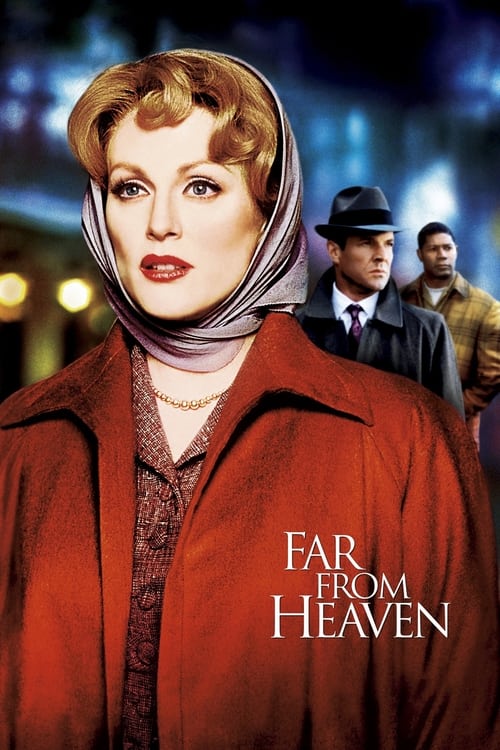
Far from Heaven
2002 · Todd Haynes
When you want a beautiful, grown-up tearjerker — melancholy in gorgeous packaging, ideal for a quiet, reflective evening when you'd rather feel something deeply than be distracted.
What it's about
Hartford, Connecticut, autumn 1957: Cathy Whitaker is the picture-perfect suburban housewife — beautiful home, executive husband, admiring neighbors — until she discovers her husband is hiding an attraction to men. As her marriage quietly fractures, her growing friendship with Raymond, her thoughtful Black gardener, sets the neighborhood gossips circling, and both bonds collide with everything her world will not permit.
The experience
Lush and immaculately composed on the surface, aching underneath — the sadness accumulates in glances, pauses, and things that can't be said out loud. It's a slow, elegant heartbreak that sneaks up on you.
Performances
Julianne Moore is devastating in her precision — a woman holding a smile together as her life dissolves — with Dennis Quaid painfully good against type as the anguished husband and Dennis Haysbert bringing warm, wounded dignity to Raymond.
The craft
Haynes recreates the look of 1950s Technicolor melodrama down to the lighting, costumes, and swelling strings — Elmer Bernstein's score and the saturated autumn cinematography are the real thing, not a wink. The gorgeousness is the point: the prettier the surface, the more it hurts. A film to see in the richest color you can.
Why it matters
Widely counted among the best American films of its decade, it earned Julianne Moore an Oscar nomination and cemented Todd Haynes as a major director — proof that an old Hollywood form could speak to what it once had to keep silent.
Snapshot
Far from Heaven is Todd Haynes's meticulous, openly avowed reanimation of the Hollywood "woman's picture" — specifically the Technicolor domestic melodramas Douglas Sirk made at Universal-International in the 1950s. Set in Hartford, Connecticut, over the autumn and winter of 1957, it follows Cathy Whitaker (Julianne Moore), an immaculate suburban housewife and "Mrs. Magnatech," whose ideal marriage fractures when she discovers her husband Frank (Dennis Quaid) is secretly attracted to men, and whose tentative emotional intimacy with her Black gardener Raymond Deagan (Dennis Haysbert) collides with the racial codes of her community. The film is at once a loving pastiche and a critique: it adopts the exact surfaces of Sirkian melodrama — saturated color, swelling strings, social-problem plotting — to voice subjects (homosexuality, interracial desire) that the originals could only gesture toward through subtext and censorship-bound displacement. The result is one of the most formally exact and emotionally generous American films of its decade, and a touchstone for what came to be called "the cinema of homage."
Industry & production
Far from Heaven was produced by Christine Vachon's Killer Films, Haynes's longtime production home, with John Sloss among the producing team; it was distributed by Focus Features, the specialty label then newly consolidated under Universal (the predecessor entity USA Films had been folded into Focus around this period). It was a modestly budgeted independent production rather than a studio prestige picture, and its costume-drama surfaces — period cars, full sets, a large supporting cast — were achieved on resources far slimmer than the look implies, a fact frequently noted by its makers though precise budget figures I won't assert here.
The film premiered in competition at the Venice Film Festival in 2002, where Julianne Moore won the Volpi Cup for Best Actress, and it traveled the autumn festival circuit (including Toronto) into a fall awards-season release. It became a significant critical success and awards contender, drawing four Academy Award nominations — Best Actress (Moore), Best Original Screenplay (Haynes), Best Cinematography (Edward Lachman), and Best Original Score (Elmer Bernstein) — though it won none. Moore was doubly visible that season, also nominated in the Supporting category for The Hours. The film swept a substantial share of US critics' group awards, where Haynes, Moore, and Lachman were repeatedly honored. Its strong critical standing and respectable specialty-market performance helped cement Focus Features' early identity as a home for auteur-driven work and confirmed Haynes's transition from the avant-garde margins (Poison, Safe) toward a wider, if still art-house, audience.
Technology
The film was shot photochemically on 35mm — Lachman composed in Super 35 — at a moment when digital intermediate finishing was emerging but film capture and largely traditional color work remained standard for this kind of production. The aesthetic project was deliberately anachronistic: rather than emulate the three-strip Technicolor dye-transfer process of the 1950s through period equipment (long defunct in the West), the filmmakers used contemporary stocks, lighting, and color control to evoke that older richness. The palette — pumpkin oranges, lilac purples, deep teals, autumnal reds — was engineered through gels, art direction, and grading rather than reproduced by vintage means. This is a film consciously about the look of an earlier technology, recreating its sumptuous artificiality with present-day tools, and that gap between the simulated and the original is part of its meaning.
Technique
Cinematography
Edward Lachman's photography is the film's most celebrated technical achievement and central to its argument. Working in close dialogue with Haynes's research into Sirk and into 1950s studio house styles, Lachman built a deliberately stylized, "unnatural" image: keyed colored light spilling across walls and faces, motivated and unmotivated alike; expressive use of windows, reflections, and panes of glass to frame and imprison characters; and a palette tied to the turning seasons, with autumn leaves and snow marking the emotional calendar. The lighting frequently abandons naturalism — purple shadows, an amber glow, a wash of blue — in the manner of studio-era glamour cinematography pushed toward the operatic. Camera movement is graceful and motivated, with elegant crane and dolly work that recalls the fluid sophistication of classical Hollywood rather than the handheld immediacy of contemporary indie film. The look is not nostalgia for its own sake: the heightened artifice makes visible the social artifice the story dissects.
Editing
James Lyons, Haynes's frequent collaborator, cut the film in a classical idiom that suppresses the calling-card flourishes of modern editing in favor of measured continuity, scene-building, and the dramatic dissolve. The pacing honors the melodramatic mode — letting reactions land, holding on faces, allowing Bernstein's score room to swell — while sustaining narrative clarity across the interlocking marital and interracial plots. The restraint is itself a choice: the editing refuses ironic distancing, asking the audience to be moved within the form rather than to watch it from outside.
Mise-en-scène / staging
Production designer Mark Friedberg and costume designer Sandy Powell render the Whitakers' world with an exactitude that doubles as critique. Interiors are color-coordinated to the point of theatricality; Cathy's wardrobe — chiffon scarves, structured coats, a recurring lilac — operates as both period accuracy and emotional semaphore. Staging emphasizes thresholds, doorframes, staircases, and the proscenium-like compositions of domestic space, so that the home becomes a stage set for performed respectability. The film's blocking repeatedly isolates Cathy within her own beautiful rooms, and choreographs the social geography of the town — the Magnatech office, the modern-art gallery, the Black neighborhood across an invisible line — as a map of permission and prohibition.
Sound
Beyond the score (discussed below), the soundscape favors the polished, studio-clean texture of classical Hollywood over contemporary realism. Dialogue carries a faint formality of diction matched to period manners; ambient design supports rather than competes with the music. The overall sonic surface, like the image, is buffed to an idealized smoothness that the narrative then troubles.
Performance
The acting is the film's riskiest and most disciplined element, because it asks contemporary actors to inhabit a registered, slightly heightened 1950s style without lapsing into camp. Julianne Moore's Cathy is a performance of luminous control — warmth and decorum maintained against rising private devastation, her composure cracking only in precisely calibrated moments. Dennis Quaid renders Frank's self-loathing and panic with a bruised opacity that resists easy sympathy or condemnation. Dennis Haysbert gives Raymond a grounded dignity and intelligence that the melodrama's logic ultimately, and pointedly, cannot protect. Patricia Clarkson, as Cathy's friend Eleanor, embodies the genial surveillance of the social world. The ensemble's shared achievement is tonal unanimity: everyone is performing the same delicate stylization at once.
Narrative & dramatic mode
The film operates squarely in the melodramatic mode — the "drama of the unspeakable," in which feelings that cannot be articulated within social constraint are displaced onto color, music, weather, and gesture. Its dual plot structure (the closeted husband; the forbidden interracial attachment) braids two forms of mid-century transgression, and its dramatic engine is the gap between surface decorum and suppressed truth. Crucially, Haynes withholds the melodrama's traditional consolations: where the genre often engineers a cathartic, if compromised, resolution, Far from Heaven arrives at a quieter, sadder dispensation in which the heroine's losses are not redeemed. The mode is sincere, not satirical — the pathos is meant to be felt — but it is inflected by a modern awareness that the original genre's happy endings were a kind of lie.
Genre & cycle
The film belongs to, and self-consciously revives, the 1950s Hollywood melodrama or "woman's picture," and within Haynes's career it forms part of a loose cycle of works investigating period genre and constructed identity. Its most direct generic model is the Sirkian social-problem melodrama, but it also draws on the broader cycle of Universal glossy domestic dramas. As a 2002 film consciously rebuilding a defunct studio genre, it sits within a turn-of-the-millennium current of art-cinema homage and pastiche, where directors reconstructed earlier styles not as parody but as serious formal inquiry.
Authorship & method
Far from Heaven is a thoroughgoing auteur work: Haynes both wrote and directed, and the film extends his career-long fascination with how identity is shaped and policed by social form, already evident in Safe (1995), where Moore played another imperiled suburban woman. His method here was archival and citational — an immersion in Sirk's films and in the visual grammar of the period, translated into an original screenplay that voices what the source genre repressed.
His key collaborators are essential to the result. Cinematographer Edward Lachman is effectively co-author of the film's visual argument and continued working with Haynes thereafter. Composer Elmer Bernstein — a giant of the studio era whose career reached back to the 1950s — supplied a lush, romantic orchestral score that is itself a form of historical authentication; this was among the last original scores of his life before his death in 2004, lending the film an additional layer of genuine period lineage rather than mere imitation. Editor James Lyons, a crucial recurring presence in Haynes's work, shaped the film's classical rhythm. Production designer Mark Friedberg and costume designer Sandy Powell built the saturated material world. Producer Christine Vachon and Killer Films provided the independent infrastructure that made an unconventional period piece possible.
Movement / national cinema
The film is a product of American independent cinema's specialty-distribution era, and of the New Queer Cinema lineage from which Haynes emerged in the early 1990s (Poison, 1991, is a founding text of that movement). Yet its deepest affiliations are transnational: it is explicitly modeled on the German-émigré Douglas Sirk's Hollywood films and on the German director Rainer Werner Fassbinder's own reworking of Sirk, Ali: Fear Eats the Soul (1974). Far from Heaven thus sits at a crossroads of American indie production, queer authorship, and a European art-cinema tradition of melodrama-as-critique.
Era / period
Two eras are in play. The film depicts 1957 suburban Connecticut — the affluent, conformist, Cold War-era America of corporate manhood, domestic femininity, segregation, and the closet — with documentary care for its manners and prohibitions. And it speaks from 2002, an era able to name homosexuality and interracial desire openly, looking back at the earlier period's silences. The film's power derives from holding both eras simultaneously: it never breaks frame to editorialize from the present, yet its very existence depends on a present-day vantage the 1950s could not occupy.
Themes
Its central themes are the violence of social conformity; the cost of the closet and the impossibility, within its world, of living an honest desire; the entanglement of racism and homophobia as twin enforcements of mid-century propriety; and the gulf between appearance and reality in suburban life. It dwells on female interiority and the limits placed on women's autonomy, on respectability as a cage, and on the way beauty — of homes, of seasons, of surfaces — can coexist with cruelty. Pointedly, it refuses to let its two transgressors share a redemptive escape: the structural sympathy the genre extends to the white heroine does not extend equally to the Black man whose presence in her life endangers him, and the film is alert to that asymmetry.
Reception, canon & influence
Critically, Far from Heaven was among the most acclaimed American films of 2002, widely praised for the precision of its homage and the sincerity of its feeling, with particular admiration for Moore's performance, Lachman's cinematography, and Bernstein's score; its festival and critics'-awards record and four Oscar nominations confirm its standing. Some critical debate attended the film's strategy — whether its immaculate pastiche kept emotion at an intellectual remove, or whether it achieved genuine pathos through the form — but the dominant verdict was strongly favorable, and its reputation has only grown.
Its influences flow backward to Douglas Sirk's All That Heaven Allows (1955), the clearest template, with its gardener-and-widow romance across a class line transposed here into race; to Imitation of Life (1959) and the broader Sirk corpus; and to Fassbinder's Ali: Fear Eats the Soul, which had already reworked All That Heaven Allows into an interracial, intergenerational story in 1970s Germany. Haynes's film is in effect the third term in that lineage, an American re-translation of a German émigré's American films by way of a German modernist's homage.
Forward, Far from Heaven became a landmark of contemporary melodramatic revival and the most cited modern example of cinematic homage done as serious art. It deepened the critical and popular re-evaluation of Sirk himself, and it consolidated an ongoing creative partnership and sensibility that Haynes carried into later period works — notably Carol (2015), again with Lachman and again concerned with constrained mid-century desire, which is frequently discussed as a companion piece. More broadly, it stands as a model for filmmakers seeking to use the resurrected forms of classical Hollywood not to mock them but to complete them — to say at last what those gorgeous, repressed pictures could only imply.
A Deleuzian reading
A branch of flowering quince, snapped off and held out across a fence.
The full Deleuzian reading of Far from Heaven →
Reception
A critical darling from day one — it topped 2002 year-end polls and earned four Oscar nominations — but it won nothing, and the sting of Julianne Moore's loss has only grown as the film settled into 'one of the great American films of the 2000s' status.
How Far from Heaven was received, from release to now →
Influences: the films it descends from and the films it influenced
- All That Heaven Allows (1955) — The direct structural template — gardener-and-widow romance across a social line — whose expressionist Technicolor, autumnal palette, and entrapping window/mirror framings Haynes and Lachman reproduce shot for emotional shot, transposing class transgression into race.
- Imitation of Life (1959) — Sirk's late melodrama supplies the racial subtext and the technique of using glossy surface perfection as ironic counterpoint to social cruelty, the very 'saying what the picture only implies' strategy Haynes adopts.
- Written on the Wind (1956) — Source of the saturated, anti-naturalist color coding — emotional states keyed to lurid blues, greens and ambers and to colored gel lighting through windows — that Lachman revives as the film's chromatic grammar.
- Ali: Fear Eats the Soul (1974) — Fassbinder's own remake of All That Heaven Allows demonstrated how to recast Sirk's class romance as an interracial story held at a Brechtian distance through doorway-framed, frozen tableaux of staring onlookers — the threshold compositions and policing gaze Haynes inherits.
- Magnificent Obsession (1954) — Established the Sirk–Ross Hunter–Universal house style of lush orchestral scoring and high-key glamour photography that Bernstein's romantic score and Friedberg's saturated production design authenticate.
- Leave Her to Heaven (1945) — A precursor three-strip Technicolor woman's picture whose lacquered, deep-focus domestic interiors and color-as-pathology model the heightened, immaculate surface Far from Heaven pastiches.
- Now, Voyager (1942) — The classical woman's-picture template of repressed feminine desire scored to swelling late-Romantic orchestration (Steiner), the studio-era grammar Bernstein consciously revives as a form of historical authentication.
- There's Always Tomorrow (1956) — Sirk's monochrome suburban melodrama of a trapped homemaker supplies the 'imperiled spouse in an airless modern house' staging, with bars-of-shadow and railing compositions caging the protagonist that Far from Heaven echoes.
- Safe (1995) — Haynes's earlier study of an imperiled suburban woman (also Julianne Moore) develops the cold, symmetrical wide framing that traps the body in domestic architecture, the directorial method he reapplies through Sirkian color here.
- Velvet Goldmine (1998) — Established Haynes's method of citational pastiche — building a film entirely out of a prior era's reconstructed visual and musical idioms — and his New Queer Cinema project of recovering suppressed desire from period forms.
- All About My Mother (1999) — Haynes explicitly inherits Almodóvar's method of refunctioning Sirkian melodrama through a queer lens — the saturated color palette, systematic color-coded mise-en-scène, and use of genre-coded décor to externalize the unspeakable are all derived from the Almodóvar style consolidated in this film, which Haynes has named as a direct model.
- The Marriage of Maria Braun (1979) — Haynes explicitly reconstructed Sirk through the lens of Fassbinder's methodology—using deep-focus entrapment compositions, the expressive color system in which palette encodes ideological seduction, and the women's picture as a vehicle for systemic social critique—making Far from Heaven a deliberate second-generation transmitter of the craft lineage that Maria Braun both absorbed and exemplified.
- Carol (2015) — The acknowledged companion piece: again with Lachman, it extends the constrained-mid-century-desire project, now shooting through rain-streaked glass and reflections to encode forbidden looking, deepening Far from Heaven's glass-and-reflection motif.
- Mildred Pierce (2011) — Haynes's miniseries continues his serious reanimation of the woman's picture, again pairing period-accurate craft (Friedberg's design, a lush score) with a revisionist interest in what the classical melodrama could not openly state.
- A Single Man (2009) — Inherits Far from Heaven's model of the meticulously art-directed, color-graded early-1960s closeted milieu, using expressive shifts in palette and immaculate period design to render gay desire that the era forbade speaking.
- The Master (2012) — Extends the contemporary movement to shoot period drama on photochemical large-format film with precise mid-century color and design as historical authentication, the same commitment to material-era craft Lachman's 35mm work modeled.
- Dark Waters (2019) — The Haynes–Lachman 'poisoned domestic everyday' — immaculate suburban surfaces photographed as sites of dread — whose controlled visual idiom carries into Dark Waters' restraint.
- Laurence Anyways (2012) — A studied Sirk revival that resurrects period-precise production design and pushes gay subtext into text, modeling how a contemporary director can inhabit vintage melodrama sincerely rather than ironically.
- In the Mood for Love (2000) — A contemporaneous melodrama of unconsummated desire that, like Far from Heaven, uses saturated period color, framing-through-thresholds and doorways, and a recurring romantic musical theme to externalize repression — parallel Sirkian revival in another idiom.
- Brokeback Mountain (2005) — Shares the project of completing classical genre forms (here the Western/romance) by voicing their repressed queer content through restraint, withheld resolution, and a yearning recurring score rather than explicit statement.
- Blue Velvet (1986) — Haynes explicitly revives the Sirkian formal system that Blue Velvet also draws from — saturated 1950s palette, bourgeois melodrama as ideological critique, suburban surface as concealment — making the two films siblings in a shared Sirkian inheritance applied to American suburban rot from opposite temporal directions.
- Letter from an Unknown Woman (1948) — Consciously revivalist woman's-picture melodrama that resurrects the classical genre's emotional grammar of repressed female desire that Letter exemplified and Haynes cites.
- Talk to Her (2002) — A contemporaneous, equally self-conscious resurrection of Sirkian melodrama — period-precise color and framing deployed as deliberate formal homage rather than pastiche.
- The Hours (2002) — Contemporary sibling in deglamorized domestic melodrama: a 1950s housewife's repression rendered through Sirkian color design and performance of held composure, the same year applying the same period-melodrama craft.
- Volver (2006) — A parallel Sirk-revival sibling — reconstructing 1950s saturated-color melodrama with modern candor about what the genre once repressed, extending the same transnational Sirk craft Almodóvar mines.
- But I'm a Cheerleader (2000) — A same-moment, explicitly Sirkian revival that likewise uses immaculate 1950s color melodrama to smuggle in queer content, running parallel to Babbit's Sirk debt in a different register.
- Invisible Life (2019) — The other great modern Sirk reconstruction — a scholarly rebuild of 1950s saturated palette and mannered staging — sharing Aïnouz's project of using period-accurate melodrama form to indict period repression.
- Mississippi Masala (1991) — Extends cinematographer Ed Lachman's color-as-meaning method — richly keyed, emotionally coded hues in a Sirkian melodrama of forbidden interracial attraction — the same expressive palette he brought to Nair's Mississippi frames.
- I Only Want You to Love Me (1976) — A conscious synthesis of Sirk and Fassbinder's Ali, reviving the artifice-as-critique melodrama and threshold framing to expose love constrained by social economy.
Similar films
- All That Heaven Allows (1955) — influence & lineage
- Carol (2015) — influence & lineage
- Safe (1995) — influence & lineage
- Leave Her to Heaven (1945) — influence & lineage
- Imitation of Life (1959) — influence & lineage
- In the Mood for Love (2000) — influence & lineage
- Written on the Wind (1956) — influence & lineage
- The Hours (2002) — shared sensibility
All the films related to Far from Heaven →