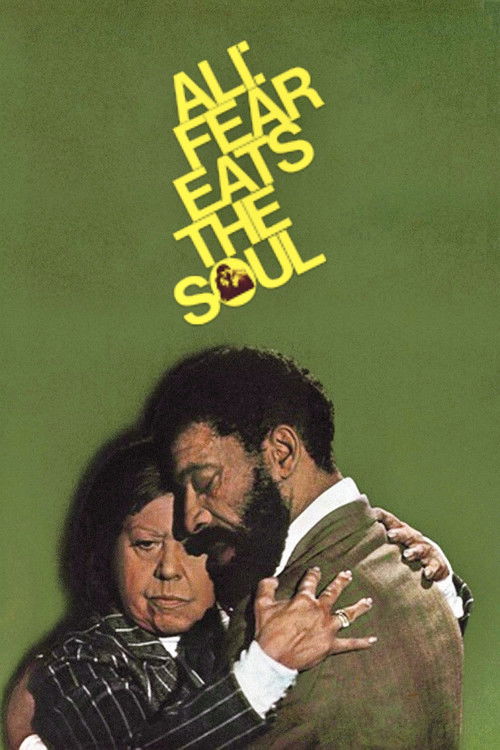
Ali: Fear Eats the Soul
1974 · Rainer Werner Fassbinder
When you want a love story that tells the truth — moving, sad, and humane rather than sweeping. One to watch alone and sit with afterward, not background viewing.
What it's about
Emmi, a widowed cleaning lady in her sixties, ducks into a Munich bar one rainy night and meets Ali, a Moroccan mechanic twenty years her junior. Their friendship becomes a marriage almost before they've thought it through — and everyone around them, from her grown children to the neighbors to the corner grocer, makes their disapproval brutally plain.
The experience
Quiet and devastating — the cruelty comes in small, everyday doses, and the tenderness between the two leads makes each snub land like a slap. It's a slow burn that leaves you tender toward strangers and furious at the people in the film.
Performances
Brigitte Mira, a former operetta performer handed the role of her life, plays Emmi with a dignity that makes every small humiliation hit hard; El Hedi ben Salem gives Ali a quiet, wounded stillness that says what the character can't.
The craft
Fassbinder shot it in fifteen days and made the framing do the talking: the lovers are seen through doorways and stairwells, hemmed in by the frozen stares of onlookers, so that prejudice literally becomes part of the architecture. Nothing is flashy; everything is deliberate.
Why it matters
A cornerstone of the New German Cinema and the tenderest film of Fassbinder's furious career, it reworked 1950s Hollywood melodrama into a mirror for immigrant-era Germany — and its influence on films about impossible love runs deep.
Fassbinder shot this in a fifteen-day gap between larger productions, and it became the tenderest film of his furious career: a Munich cleaning woman in her sixties and a Moroccan mechanic twenty years younger fall into a marriage that scandalizes everyone around them — her children, the neighbors, the grocer — before the cruelty curdles into something more insidious. Reworking Douglas Sirk's All That Heaven Allows for the Gastarbeiter Germany of the 1970s, Fassbinder frames his lovers through doorways and stairwells, pinned by the frozen, staring tableaux of onlookers, so that prejudice becomes architecture. Brigitte Mira, a former operetta performer given the role of her life, plays Emmi with a dignity that makes each small humiliation land like a blow; El Hedi ben Salem, the director's own lover, gives Ali a wounded stillness. A FIPRESCI winner at Cannes and a cornerstone of the New German Cinema, it later fathered Todd Haynes's Far from Heaven. Fassbinder's insight remains merciless: society's disapproval is survivable — it's what the lovers absorb from it that eats the soul.
A Deleuzian reading
Two people are eating at a table.
The full Deleuzian reading of Ali: Fear Eats the Soul →
Reception
It won the FIPRESCI prize at Cannes in 1974 and was warmly received from the start — but over the decades it's climbed from 'notable Fassbinder' to the consensus pick as his most beloved film, a Sight & Sound list regular and the standard entry point into his forty-film sprint of a career.
How Ali: Fear Eats the Soul was received, from release to now →
Influences: the films it descends from and the films it influenced
- All That Heaven Allows (1955) — Fassbinder lifts the exact plot armature — a lonely widow's love for a younger, lower-status man crushed by the frozen disapproval of respectable society — and transposes Sirk's class transgression onto age and race.
- Imitation of Life (1959) — Establishes the model Ali follows: a glossy 'women's picture' whose real subject is racial prejudice, using the melodramatic form itself as a Trojan horse to indict the audience's own bigotry.
- Written on the Wind (1956) — Source of Fassbinder's framing-as-entrapment — placing figures against and inside décor, doorways and mirrors so the mise-en-scène cages them; Ali strips the Technicolor but keeps the architectural imprisonment.
- Katzelmacher (1969) — Fassbinder's own prototype: xenophobia toward a Greek guest-worker rendered through static, friezelike group compositions of onlookers who stare and judge — the tableau-of-onlookers grammar he reuses wholesale in Ali.
- The Merchant of Four Seasons (1971) — His first fully Sirkian melodrama, fixing the template of the passive social victim destroyed by petit-bourgeois cruelty, shot in held, symmetrical compositions that Ali inherits directly.
- The Bitter Tears of Petra von Kant (1972) — Perfects the Brechtian tableau method — arranging performers in frozen, deliberately theatrical groupings and distancing the viewer from the emotion, which Ali deploys in its diner and staircase set-pieces.
- Magnificent Obsession (1954) — The Sirk melodrama that first showed Fassbinder how implausible plotting and emotional excess could be embraced rather than apologized for, licensing Ali's unabashed reliance on melodramatic coincidence and reversal.
- Far from Heaven (2002) — Haynes reconstructs Sirk explicitly through Fassbinder — an interracial forbidden love policed by the community's collective gaze — reviving the staged compositions and reading melodrama as social critique exactly as Ali does.
- Carol (2015) — Carries forward the Sirk-via-Fassbinder restraint: forbidden love framed through glass, car windows and doorways, letting suppressed emotion register in blocked, architecture-bound compositions rather than dialogue.
- Head-On (2004) — Directly inherits Fassbinder's Gastarbeiter melodrama — a mismatched Turkish-German couple ground down by prejudice and self-destruction — updating the New German Cinema social-melodrama of the migrant outsider.
- The Edge of Heaven (2007) — Weaves interlocking German-Turkish lives into a social melodrama of migration and grief, extending Fassbinder's concern with the foreigner inside German society and his use of coincidence to expose structural cruelty.
- Dogville (2003) — Radicalizes the tableau-of-onlookers and Brechtian distancing into a bare stage where a whole community's collective gaze turns on an outsider — Fassbinder's staring townsfolk taken to their theatrical extreme.
- Safe (1995) — Sirkian melodrama estranged through distanced doorway/window framings and recessive, flattened blocking — the Brechtian cooling of melodrama Haynes openly adopts.
- Talk to Her (2002) — Recasts Sirkian melodrama as serious post-war art cinema using framing and held distance as emotional instruments — the bridge by which Almodóvar inherits Sirk.
- Invisible Life (2019) — The key intermediary that proved Sirkian melodrama could be reclaimed as political cinema about outsiders, licensing Aïnouz to route class and gender critique through unironic 1950s-style romantic suffering.
- Joyland (2022) — Uses doorway, banister and mirror tableaux to physically box its taboo lovers inside the architecture of a judging society — the same framing-as-entrapment Sadiq applies to Haider and Biba.
- Fallen Leaves (2023) — Stages a Sirkian melodrama of social outcasts in composed, doorway-framed static tableaux that hold characters at a deliberate emotional distance — the frame-within-frame distancing Kaurismäki inherits.
- My Beautiful Laundrette (1985) — The formal device of framing an interracial couple through doorways, thresholds and glass while hostile onlookers hold the frame in static tableau — the compositional grammar behind Laundrette's shooting-through-glass staging of Omar and Johnny.
- The Other Side of Hope (2017) — Sirk rerouted through the guest-worker: the long, held, frontal tableau of a bar interior in which locals stare down a foreigner, an affair conducted in a second language, and racism registered as flat bureaucratic procedure rather than as outburst.
- Fox and His Friends (1975) — Companion social melodrama of exploitation across a status gap, using the same frames-within-frames through doorways and windows to stage how a naive outsider is consumed by those he trusts.
- The Marriage of Maria Braun (1979) — Extends Fassbinder's diagnosis of postwar German society through a single suffering protagonist, retaining the Sirkian glaze and architectural framing while widening the social-melodrama lens to the whole nation.
- In the Mood for Love (2000) — Shares the framing-through-architecture idiom — lovers glimpsed through doorframes, corridors and windows so that social constraint is expressed spatially, the same entrapment geometry Ali borrows from Sirk.
- In a Year with 13 Moons (1978) — The clearest working-out of Fassbinder's Sirk debt: characters framed and trapped through doorways, banisters and window frames, held in stillness while the camera watches from a distancing remove.
- Mother Küsters Goes to Heaven (1975) — Direct companion sharing the repertory method and the recurring Brigitte Mira 'Emma,' with the same Sirkian framing of figures through doorways and stairwells to stage social exclusion.
- I Only Want You to Love Me (1976) — The explicit Sirk remake made the same year, framing characters through doorways and stair-rails to fix them in place, is the sibling experiment in Sirkian-Brechtian threshold staging.
Similar films
- The Bitter Tears of Petra von Kant (1972) — influence & lineage · same viewing thread
- Head-On (2004) — influence & lineage · same viewing thread
- The Marriage of Maria Braun (1979) — influence & lineage
- Fox and His Friends (1975) — influence & lineage
- In the Mood for Love (2000) — influence & lineage · same viewing thread
- Mother Küsters Goes to Heaven (1975) — shared sensibility
- A Separation (2011) — shared sensibility
- In a Year with 13 Moons (1978) — shared sensibility
All the films related to Ali: Fear Eats the Soul →
Watch it with: curated runs of related films
- Love Against the Grain — A run of films where desire refuses the shape its world demands — opera stages, drought-struck Taipei, an honor-bound Lahore household, drenched Buenos Aires — and burns brighter, and more dangerously, for the refusal.