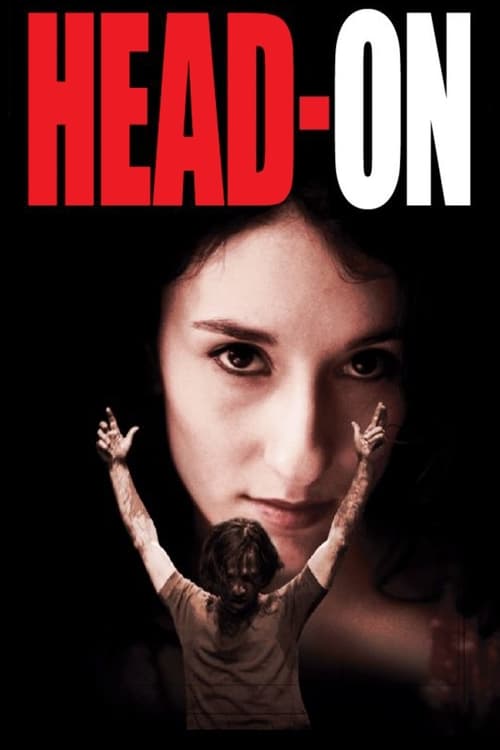
Head-On
2004 · Fatih Akin
When you want to feel something at full volume — a passionate, self-destructive romance with no safety net. Definitely challenge over comfort; save it for a night you can take a gut-punch and want to talk about it after.
What it's about
In Hamburg's Turkish community, a young woman desperate to escape her family's suffocating control proposes a sham marriage to a wrecked, hard-drinking man twice her age. The arrangement is supposed to mean nothing — separate lives under one roof — but what grows between them is real, jealous, and dangerous to them both.
The experience
Raw and combustible: it lurches between punk-club euphoria, black comedy, and sudden violence with an honesty that never softens its characters. It's a love story that hits like a fight, and it leaves a bruise.
Performances
Birol Ünel and Sibel Kekilli are ferocious together — his hollowed-out volatility against her reckless hunger for life — two performances that feel lived rather than acted.
The craft
Fatih Akin shoots with jagged, restless energy and cuts the story to a killer soundtrack that swings from punk to traditional Turkish music, with staged musical interludes on the Bosphorus punctuating the chapters like a Greek chorus. The filmmaking is as headlong as the people in it.
Why it matters
Winner of the Golden Bear at Berlin — the first German film to take it in nearly two decades — it announced Fatih Akin internationally and became the defining work of Turkish-German cinema, opening space for stories of life between two cultures.
Snapshot
Head-On (German: Gegen die Wand, literally "against the wall") is the breakthrough feature of Turkish-German director Fatih Akin and one of the defining works of Turkish-German cinema. It follows Cahit, a burnt-out, alcoholic man in his forties living in Hamburg, and Sibel, a young woman desperate to escape her conservative Turkish family, who proposes a sham marriage so she can win her freedom. What begins as a marriage of convenience curdles into genuine, ruinous passion. The film is structured around a violent turn — a jealous act, a death, a prison sentence — after which the story relocates to Istanbul and traces the pair's parallel self-destructions. Its combustible tone, punk energy, and unsentimental treatment of diaspora life made it a landmark. It won the Golden Bear at the 2004 Berlin International Film Festival, the first German production to take Berlin's top prize in nearly two decades, and went on to win the European Film Award for Best Film. Akin later framed it as the "Love" installment of a projected trilogy, Love, Death and the Devil.
Industry & production
Head-On was produced within the German independent sector, principally through Wüste Filmproduktion, the Hamburg company that had backed Akin's earlier features, in association with Akin's own production interests and with regional and national film-funding support of the kind that structures most German art cinema (film-fund subsidies from bodies such as the regional Filmförderung and public broadcaster co-financing are standard for productions of this scale, though I will not assign specific figures I cannot verify). The film was shot substantially in Hamburg — Akin's home city, and specifically its working-class and migrant-inflected districts such as Altona — with a significant second portion filmed in Istanbul. This bifurcated geography is not incidental: the production's movement from the German port city to the Turkish metropolis mirrors the narrative's own migration and gives the second half a documentary texture of real streets, hotels, and nightlife.
The film's most consequential production story lies in its casting. Sibel Kekilli was a non-professional discovered in an open casting process; her raw, ferocious performance was central to the film's impact. Shortly after the Berlinale triumph, the German tabloid Bild exposed that Kekilli had previously worked in pornographic films, provoking a media storm and, by her own account, estrangement from her family — a real-world echo of the film's themes of shame, honor, and a young woman's punishment for asserting sexual autonomy. Kekilli nonetheless won major German acting honors for the role and later achieved international recognition. Her co-lead, Birol Ünel, was by contrast an established, charismatic figure of German stage and screen whose own reputation for volatility fed into the role of Cahit. (Ünel died in 2020.)
Technology
Head-On is a product of early-2000s European filmmaking, made in the period when celluloid remained the prestige norm for theatrical features but lightweight, mobile shooting had become aesthetically fashionable. The film's handheld, run-and-gun immediacy — particularly in its Hamburg club scenes and its Istanbul street sequences — reflects a filmmaking culture increasingly comfortable with grabbed, available-light shooting. I will not overstate the technical specifics of format and stock beyond what the image plainly communicates: the look is grainy, saturated, and unpolished by design, prioritizing energy and presence over gloss. The film belongs to a moment when the tools of documentary and fiction were converging, and Akin exploits that convergence rather than any particular technological novelty.
Technique
Cinematography
The cinematography is by Rainer Klausmann, a key Akin collaborator whose work gives the film its restless, physical charge. Klausmann favors a mobile, handheld camera that stays close to bodies — in fights, in sex, in drunken collapse — producing an aesthetic of proximity and instability. Color runs hot: the reds of bars and blood, the sodium glow of night streets, the smoke-thickened interiors of Hamburg clubs. There is a deliberate contrast between the claustrophobic, grungy German interiors and the more open, sun- and neon-lit Istanbul exteriors, though Akin refuses to sentimentalize the Turkish city as any kind of redemptive homeland; Istanbul is filmed as its own site of danger and dislocation. The camera's willingness to lurch, to lose composure, is the visual correlative of the characters' emotional volatility.
Editing
The editing is by Andrew Bird, another recurring Akin collaborator. The cutting is propulsive in the film's musical and violent passages and patient in its scenes of intimacy and aftermath. Structurally, the most significant editorial-conceptual decision is the film's division into movements punctuated by the recurring musical interludes (see Sound), which function as chapter breaks and reset the emotional register. Bird's cutting sustains the film's characteristic tonal whiplash — the way a scene can pivot from tenderness to brutality within a beat — and manages the mid-film rupture, where the drama's center of gravity shifts from Cahit to Sibel and from Germany to Turkey.
Mise-en-scène / staging
Akin stages Head-On in lived-in, unglamorous spaces: cramped apartments, the family living room where marriage negotiations play out under the weight of tradition, the sweaty club, the barber's chair, the hospital, the prison visiting room. The domestic interiors of Sibel's family are dense with the objects and rituals of the Turkish-German middle class, and Akin uses that setting to make the pressures of honor and gendered expectation concrete rather than abstract. In counterpoint, Cahit's squalid flat externalizes his self-neglect. The staging repeatedly frames the couple in confined spaces that force intimacy and collision, reinforcing the film's title: these are people driving themselves against a wall.
Sound
Sound is arguably the film's signal formal achievement. The score is a compiled, eclectic soundtrack that yokes together Western punk, post-punk, rock, and soul with Turkish and Roma music — a sonic embodiment of the characters' split cultural belonging. The film is bracketed and interrupted by a recurring device: a Turkish ensemble led by clarinetist Selim Sesler, with a female vocalist (Idil Üner), performing classical Turkish songs while seated on the shore of the Golden Horn with the Istanbul skyline behind them. These tableaux function as a Brechtian chorus, standing outside the story to comment on it, marking the film's chapters and lending the melodrama an ironic, ceremonial frame. The contrast between this stately traditional music and the abrasive Western tracks that soundtrack Cahit's world is the film's central formal argument about identity made audible. (Wendy Rene's soul recording "After Laughter Comes Tears" is prominently associated with the film; I flag that the full needle-drop list is best verified against the film's credits rather than recalled track by track.)
Performance
The performances are extraordinary and largely responsible for the film's reputation. Birol Ünel plays Cahit as a man hollowed out by grief and drink, whose reawakening into love is as violent as his despair; the performance is physical, wounded, and unafraid of ugliness. Sibel Kekilli, in her debut, is a revelation — she plays Sibel's hunger for life, her recklessness, and her eventual devastation without vanity or restraint. The chemistry between the leads is combustible rather than romantic in any conventional sense, and both actors commit fully to the film's bodily extremity (self-harm, sex, brawling). Supporting turns, including family members whose love is entangled with control, ground the melodrama in recognizable social reality.
Narrative & dramatic mode
Head-On operates in the register of heightened melodrama disciplined by social realism. Its plot machinery — a marriage of convenience that becomes real love, a jealous killing, imprisonment, a fall into degradation, a reunion that cannot last — is frankly melodramatic, even operatic, and Akin embraces rather than disguises this. The chorus interludes announce the film's awareness of its own tragic architecture. Yet the emotions are earned through gritty specificity: the texture of migrant family life, the mundane cruelty of institutions, the physical reality of addiction. The narrative is cleanly divided into two movements, with the mid-film catastrophe functioning as a hinge that transfers the protagonism to Sibel and the setting to Istanbul. The ending withholds easy consolation; the lovers' trajectories diverge, and survival is figured as a choice with a cost rather than a happy resolution.
Genre & cycle
The film sits at the intersection of the doomed-love romance, the addiction drama, and the diaspora "identity" film. Within German cinema it belongs to, and helped redefine, the cycle of Turkish-German filmmaking. It consciously breaks from the earlier "cinema of the affected" (Kino der Betroffenheit) — the 1970s–80s guest-worker films that tended to depict migrants as passive victims of an oppressive host society or of patriarchal tradition. Akin's characters are agents of their own destruction and desire, not sociological case studies, and the film's punk sensibility marks a generational shift. It can also be read within the broader European tradition of transgressive, body-forward art cinema of the late 1990s and early 2000s.
Authorship & method
Fatih Akin, born in Hamburg in 1973 to Turkish immigrant parents, wrote and directed the film, and it consolidated the concerns that run through his body of work: the second- and third-generation experience of Turkish-Germans, the pull between Hamburg and Istanbul, music as identity, and love as a mortal risk. His method fuses autobiographical proximity to the milieu with a cinephile's appetite for genre and a musician's structural instincts. His key collaborators recur across his filmography: cinematographer Rainer Klausmann, whose mobile camera defines the look; editor Andrew Bird, who shapes the film's rhythm and chapter structure; and, on the production side, the Hamburg independent milieu (Wüste Film) that nurtured his early features. Rather than a single composer, the film's musical identity was built from curated recordings plus the specially staged Sesler-ensemble interludes — an approach that reflects Akin's treatment of the soundtrack as authorial statement, not accompaniment. Akin positioned Head-On as the first panel — "Love" — of an intended triptych, Love, Death and the Devil, continued by The Edge of Heaven (Auf der anderen Seite, 2007) as "Death"; the trilogy's completion is a matter Akin's later work complicates rather than tidily resolves, and I flag it as an announced authorial framework rather than a neatly finished one.
Movement / national cinema
Head-On is the emblematic work of Turkish-German cinema's coming of age and a key film of the so-called Berlin School's contemporary — though Akin's exuberant, genre-embracing style stands apart from the cooler, more minimalist Berlin School directors. More broadly it belongs to German national cinema's early-2000s international resurgence. Its Golden Bear was widely read as a symbolic recognition that films by and about Germany's largest immigrant community were central to, not marginal to, German cinema. The film also functions as transnational cinema in the fullest sense: German-financed, bilingual, split between two countries, and addressing audiences on both sides of a migratory divide.
Era / period
Made and set in the early 2000s, the film captures a specific moment in German society: a second and third generation of Turkish-Germans negotiating belonging in a country still debating multiculturalism and integration. The Hamburg it depicts — its clubs, bars, and migrant neighborhoods — is contemporary and unromanticized. The Istanbul sequences register a city at the turn of the millennium, globalizing and nocturnal. The film's frankness about sex, addiction, and intra-community patriarchy reflects a period in European art cinema when transgression and physical extremity were prized as markers of authenticity.
Themes
The film's central theme is the collision between freedom and belonging. Sibel's rebellion against the constraints imposed on Turkish-German women — her sexuality policed, her autonomy conditioned on marriage — drives the narrative, and the film is unsparing about how transgression is punished by both family and world. Love is figured not as salvation but as another form of the self-destruction both characters already practice: the title's "against the wall" names an impulse toward annihilation that predates the romance. Honor, shame, and the double standards of gender recur throughout, as does addiction in its many forms (alcohol, cocaine, love itself). Above all the film concerns hybrid identity — the impossibility, and the necessity, of living between two cultures, dramatized through language, music, and the two cities. The Istanbul interludes insist that "return" offers no clean homecoming.
Reception, canon & influence
Critically, Head-On was a major success and is widely regarded as one of the most important German films of the 2000s and the definitive Turkish-German feature. Its Golden Bear at the 2004 Berlinale was a landmark — the first German film to win Berlin's top award in a long span (roughly two decades, since the mid-1980s) — and it followed with the European Film Award for Best Film and multiple German Film Awards, including recognition for Sibel Kekilli's performance. Critics praised its ferocity, its performances, and its refusal of both social-problem piety and romantic cliché.
Looking backward, the film draws on several lineages: the melodramatic tradition (its operatic doom and its chorus-like framing recall a consciously theatrical, even Brechtian sensibility); the punk and post-punk culture that shaped Akin's generation; and the Turkish-German "guest-worker" cinema that preceded it — which Akin absorbs precisely in order to overturn its victim paradigm. The physical, transgressive art cinema of 1990s Europe is a clear stylistic kin.
Looking forward, Head-On reshaped its field. It legitimized Turkish-German cinema as a central strand of German national film and opened space for a subsequent wave of filmmakers working the same terrain of migration, identity, and diaspora. It cemented Akin as a major European auteur and set up his continued exploration of the Hamburg–Istanbul axis, notably in The Edge of Heaven. It launched Sibel Kekilli, who moved from the tabloid scandal surrounding her debut to a substantial acting career, including international television. Its fusion of curated music and narrative, and its model of the culturally split, self-destructive protagonist, have been influential reference points in later diaspora filmmaking. Where the historical record is thin — precise budget and box-office figures, or an exhaustive soundtrack accounting — this dossier declines to invent them; the film's significance rests securely on its awards, its critical standing, and its documented role in transforming Turkish-German cinema.
A Deleuzian reading
Six musicians on the shore of the Golden Horn.
The full Deleuzian reading of Head-On →
Reception
It stormed Berlin in 2004, taking the Golden Bear — the first German film to win it in 18 years — and was instantly hailed as the rebirth of German cinema. Two decades on it's only grown: a fixture of best-of-the-2000s lists and the film that made Fatih Akin an international name.
How Head-On was received, from release to now →
How to watch Head-On: what to notice on a first viewing
- Watch the musicians on the shore between chapters. A Turkish ensemble in formal dress performs classical songs by the Golden Horn at fixed intervals, standing outside the story to frame it rather than narrate it. Their stillness marks this as a tragedy with a shape older than these two people.
- Notice how close and unsteady the camera stays to bodies. Rainer Klausmann's handheld camera stays close through fights, sex, and drunken collapse, producing a constant sense of physical instability. The camera's own lack of composure mirrors the characters' volatility.
- Notice how hot and saturated the color runs in Hamburg. Reds of bars and blood, the sodium glow of night streets, smoke-thickened club interiors: the color palette stays warm and heavy throughout the German scenes. The color is doing emotional work the dialogue mostly refuses to do.
- Notice the cramped, ordinary rooms the couple keeps returning to. Apartments, a sweaty club, a barber's chair, a family living room: Akin stages the couple in confined spaces that force intimacy and collision. The rooms themselves keep pushing these two people together and apart.
The whole guide to watching Head-On, with the keys for a rewatch →
Influences: the films it descends from and the films it influenced
- Ali: Fear Eats the Soul (1974) — The template for Turkish-German love-as-doom staged as Brechtian melodrama — recurring tableau framings and rings of silent onlookers function as the disapproving chorus Akin revives with the Bosphorus ensemble.
- All That Heaven Allows (1955) — The saturated studio-melodrama grammar of transgressive love crushed by social convention, whose operatic color and framed-behind-glass compositions pass through Fassbinder into Head-On's melodrama-realism fusion.
- Mean Streets (1973) — Establishes the needle-drop compiled soundtrack married to a restless handheld camera inside a lived-in ethnic milieu, following a self-destructive protagonist who court his own ruin.
- 40 Square Meters of Germany (1986) — The archetypal guest-worker 'cinema of the affected' whose migrant-as-victim paradigm Akin deliberately absorbs and inverts — his anti-Betroffenheit stance is legible only against this precursor.
- Yol (1982) — Supplies the Turkish arabesk-melodrama register of honor, imprisonment and thwarted freedom, the social-realist doom that Akin channels into the Istanbul half of his two-movement structure.
- Breaking the Waves (1996) — Yokes intertitled chapter interludes and a raw handheld camera to operatic doomed-love melodrama, the exact device-plus-tone pairing Head-On uses to segment its narrative.
- The Edge of Heaven (2007) — The declared 'Death' panel of the same Love-Death-Devil trilogy, reuniting cinematographer Rainer Klausmann and editor Andrew Bird to extend the two-movement Hamburg–Istanbul hinge across interlocking fates.
- When We Leave (2010) — A Turkish-German honor-killing melodrama made directly in the space Head-On cleared, carrying forward the diaspora protagonist torn between freedom and belonging without reverting to victim piety.
- Fish Tank (2009) — Handheld, boxy-frame social realism in saturated council-estate light built around a non-professional debut lead, dramatizing the same freedom-versus-belonging rupture in a young woman's body.
- Mustang (2015) — A Turkish-diaspora auteur transposing the freedom-versus-belonging melodrama onto young women confined by tradition, pairing lyrical mobile camera with the doomed-transgression structure Akin legitimized.
- Yellow Letters (2026) — Codifies the Turkish-German return structure as a formal break: the film changes register when it crosses to Istanbul, shifting to location direct sound and street-level field recording so the city is heard as an acoustic environment rather than scored as exotic backdrop.
- Trainspotting (1996) — Pioneers the tonal whiplash between euphoria and horror driven by an eclectic compiled soundtrack, propelling non-glamorous addict bodies through unglamorous rooms with punk velocity.
- La Haine (1995) — Diaspora-underclass social realism rendered as kinetic handheld cinema with post-punk energy, the immigrant-margin milieu that Head-On extends into the German-Turkish frame.
- Kids (1995) — The 1990s transgressive art-cinema model of casting raw non-professional debut performers and filming bodies in genuinely lived-in, unglamorous spaces — the physical kin Sibel Kekilli's debut belongs to.
- Fallen Angels (1995) — Fuses wide-angle handheld mobility, saturated hot neon color and a curated pop-song score treated as authorial statement rather than accompaniment — Klausmann's palette and Akin's soundtrack method share this DNA.
- Requiem for a Dream (2000) — Segments a self-destructive spiral into seasonal chapters and swings violently between rapture and devastation, the chapter-interlude-plus-tonal-whiplash architecture Head-On deploys.
- A Prophet (2009) — Visceral handheld, genre-inflected social realism tracking a marginalized ethnic protagonist's violent self-transformation, extending the melodrama-realism hybrid into carceral register.
- Crossing (2024) — The Turkish-German diaspora film that bridges a Northern European city and Istanbul, using raw handheld intimacy and location shooting to render exile as lived bodily texture.
Similar films
- Ali: Fear Eats the Soul (1974) — influence & lineage · same viewing thread
- Mustang (2015) — influence & lineage
- Fallen Angels (1995) — influence & lineage · same viewing thread
- Cold War (2018) — same viewing thread
- Dreams (2024) — shared sensibility
- Crossing (2024) — shared sensibility
- Phoenix (2014) — shared sensibility
- The Marriage of Maria Braun (1979) — shared sensibility
All the films related to Head-On →
Watch it with: curated runs of related films
- Love Against the Grain — A run of films where desire refuses the shape its world demands — opera stages, drought-struck Taipei, an honor-bound Lahore household, drenched Buenos Aires — and burns brighter, and more dangerously, for the refusal.