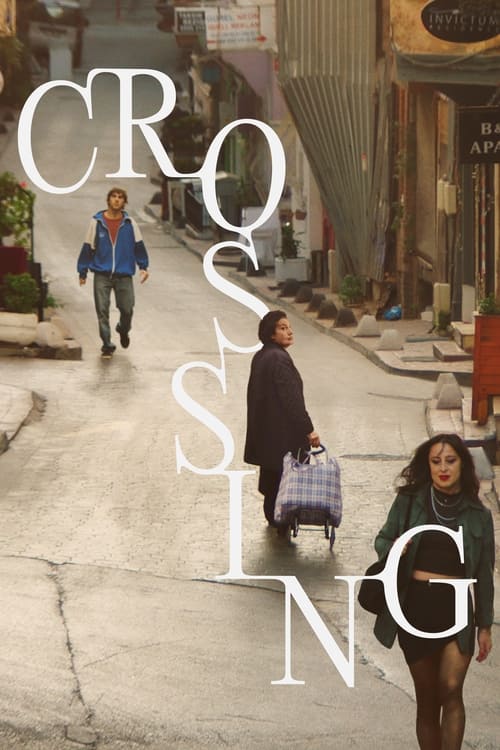
Crossing
2024 · Levan Akin
For when you want to travel without leaving the couch and end the night feeling better about people — bittersweet but ultimately comforting. Good for a reflective solo evening.
What it's about
Lia, a flinty retired teacher from Georgia, learns that the trans niece her family cast out years ago has crossed into Turkey. With an unpredictable young neighbor tagging along, she travels to Istanbul to find her — and the search opens out into the city itself: its ferries, stairwells, street cats, and the trans community living in its margins.
The experience
A warm, wandering road movie that keeps surprising you with kindness. It's melancholy at the edges but generous at heart, and the city feels so alive you can practically smell the sea air.
Performances
Mzia Arabuli is magnificently flinty as Lia, thawing by fractions of a degree, and Deniz Dumanlı is quietly revelatory as Evrim, a trans lawyer whose scenes give the film its warmest current.
The craft
Levan Akin cast from Istanbul's actual trans community and shot in the city's real ferries and crowded rooms with a loose, drifting camera that keeps wandering off after strangers — a habit that becomes the film's whole ethic: every passerby has a life worth following. The sense of place is extraordinary.
Why it matters
Following And Then We Danced — whose Tbilisi premiere provoked riots — the film confirmed Akin as a leading voice of queer cinema between Eastern Europe and Turkey, and won admirers for its portrait of chosen family.
Levan Akin followed And Then We Danced — the Georgian dance drama whose Tbilisi premiere provoked riots — with this warmer, wiser road movie across the Black Sea. Mzia Arabuli, magnificently flinty, plays Lia, a retired teacher who travels from Georgia to Istanbul with a feckless young neighbor in tow, searching for the trans niece her family cast out years before. Akin, Swedish-born to Georgian parents, cast from Istanbul's actual trans community and shot among the city's ferries, stairwells, and crowded rooms with a loose, drifting camera that keeps wandering off after strangers — a formal habit that becomes the film's whole ethic: every passerby glimpsed has a life worth following. Deniz Dumanlı is quietly revelatory as Evrim, a lawyer working trans-rights cases, and the film's vision of chosen family is generous without being naive. It opened the Berlinale's Panorama section in 2024 and took the Teddy jury award. The real third lead is Istanbul itself — a city, the film suggests, where people go both to disappear and to be found.
Reception
Premiered in Berlinale's Panorama section in 2024 to near-unanimous acclaim (97% on Rotten Tomatoes) and took the Teddy jury prize; since hitting MUBI it's grown from festival darling into a word-of-mouth favorite that cemented Levan Akin as more than a one-film (And Then We Danced) director.
How Crossing was received, from release to now →
Influences: the films it descends from and the films it influenced
- And Then We Danced (2019) — Akin's own prior film established his signature: a supple handheld camera that trails a body moving through a real Caucasus city, built around a barely-professional lead cast for physical authenticity rather than name recognition.
- Rosetta (1999) — The restless over-the-shoulder handheld that tails a protagonist's back through unglamorous urban space, refusing establishing shots so the viewer is locked to the character's forward momentum.
- Bicycle Thieves (1948) — The neorealist template of a search structured as a walk through the actual city, shot on location with nonprofessional actors whose untrained faces carry the film's documentary weight.
- Central Station (1998) — The road-quest that pairs a flinty older woman with a displaced youth, using the journey itself as the mechanism that thaws her, and casting a nonprofessional child against a seasoned lead.
- Cléo from 5 to 7 (1962) — The city-as-character drift, letting the camera wander real streets in near-continuous time so the urban fabric becomes the film's emotional weather rather than mere backdrop.
- Paris, Texas (1984) — The search-for-a-vanished-relative road movie in which landscape and cityscape are tuned to the seeker's interior state, and reunion is staged as a fragile, glass-separated encounter.
- The Searchers (1956) — The foundational quest-to-recover-a-lost-kin narrative engine, where the obsessive search reveals the searcher's own prejudices and need for redemption more than it recovers the missing.
- La Promesse (1996) — Handheld social-realist ethics built around an immigrant underclass, where a moral obligation to a stranger drives the protagonist's arc through unadorned urban locations.
- The Edge of Heaven (2007) — Istanbul-and-diaspora cross-border architecture: an older German woman searches the city for a marginalized young Turkish woman, using intersecting parallel journeys and Istanbul streets as the connective tissue.
- Head-On (2004) — The Turkish-German diaspora film that bridges a Northern European city and Istanbul, using raw handheld intimacy and location shooting to render exile as lived bodily texture.
- Tangerine (2015) — Trans sex-worker leads cast from the community itself, propelled through actual city streets in a walk-and-talk quest, treating the sidewalk as stage and nonprofessional performance as the film's realism engine.
- A Fantastic Woman (2017) — A trans protagonist embodied by a trans performer, staging the city and its institutions as a gauntlet the character must physically cross to claim dignity.
- Girl (2018) — Close, body-attentive handheld camerawork trained on a young trans protagonist, privileging physical, near-wordless observation of a marginalized figure over expository plotting.
- Happy Together (1997) — Queer characters stranded in a foreign city far from home, rendered through intimate handheld texture that makes the alien metropolis a character shaping their longing and estrangement.
- Distant (Uzak) (2002) — Istanbul rendered as a cold, character-shaping environment, where the city's indifferent spaces and long observational takes externalize the loneliness of people adrift in it.
- Pariah (2011) — Handheld queer coming-of-age observation of a marginalized youth negotiating identity across a city's public spaces, foregrounding chosen-family bonds over biological ones.
Similar films
- And Then We Danced (2019) — influence & lineage
- Head-On (2004) — influence & lineage
- All That's Left of You (2025) — same viewing thread
- Souleymane's Story (2024) — shared sensibility
- Touch (2024) — shared sensibility
- The Little Sister (2025) — shared sensibility
- Little French Fish (2020) — shared sensibility
- Past Lives (2023) — shared sensibility
All the films related to Crossing →
Watch it with: curated runs of related films
- The Countries We Carry — Watch these together when you want recent world cinema about heritage, exile, and family stretched across borders — each one a return to a homeland that no longer quite holds the people who left it.