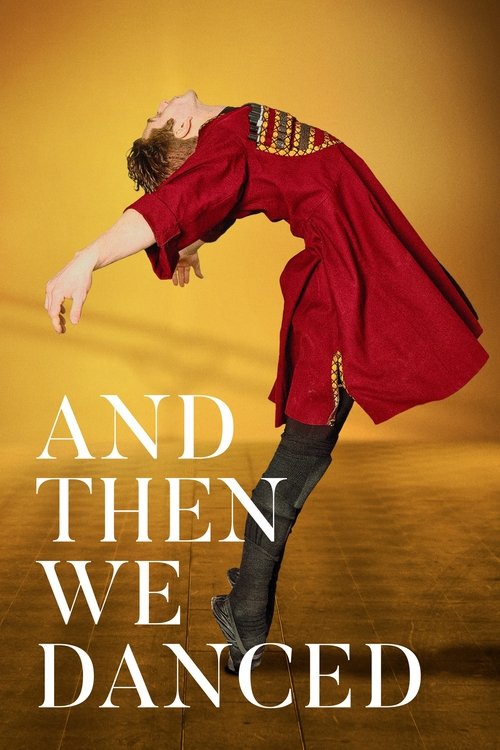
And Then We Danced
2019 · Levan Akin
For when you want to fall in love and root for someone at the same time — a film that makes your chest tight and then sets it loose. Emotional, yes, but ultimately a rush; save it for a night you want to feel everything.
What it's about
Merab has trained his whole life for a place in the National Georgian Ensemble, where traditional dance is guarded as the soul of the nation and male dancers are told there's no room for softness. Then Irakli arrives — his rival for the one open spot, and the person who awakens a desire that could cost Merab his future, his family, and everything he's built.
The experience
Tender and charged, with the pulse of both a sports movie and a first love — every rehearsal doubles as flirtation and threat. It builds to moments of pure physical release that hit like a shot of adrenaline, and it leaves you elated and a little heartbroken.
Performances
Levan Gelbakhiani, discovered on Instagram, gives one of the great physical performances of recent years — Merab's whole inner life is legible in his posture, and his solo dance set to a Robyn song is an instant-classic scene of rebellion as pure movement.
The craft
Levan Akin shoots dance the way it should be shot: full bodies, long takes, the camera close enough to feel breath and sweat. The film uses the strict vertical line of Georgian male dance as its central image — watching that rigidity bend into freedom is the story told through choreography, and it was made semi-clandestinely, with the crew concealing the subject in Tbilisi.
Why it matters
Its Georgian premiere sparked protests and made the film a landmark of queer cinema from a place where such a story could barely be filmed, turning it into an international cause as well as an arthouse hit.
Levan Akin, born in Sweden to a Georgian family, returned to Tbilisi to make a film that Georgian cinema itself could not yet safely produce: a love story set inside the National Georgian Ensemble, where traditional dance is guarded as the soul of the nation and male dancers are instructed that there is no room for softness. Merab, a striver from a family of dancers, meets his rival and undoing in the loose-limbed newcomer Irakli, and the film charts desire precisely through the body — posture, carriage, the rigid vertical line of the male dancer bending into something freer. Levan Gelbakhiani, discovered on Instagram, gives one of the era's great physical performances; his solo dance to Robyn's 'Honey' has become the film's emblem, rebellion staged as choreography. Shot semi-clandestinely with crew members concealing the script's subject, it premiered in Cannes' Directors' Fortnight and became Sweden's Oscar submission — but its truest reception came at home, where far-right mobs besieged the Tbilisi premiere and audiences crossed police lines to see it. Rarely has a film's own opening night proved its argument so completely.
Reception
A Cannes Directors' Fortnight favorite in 2019, it became something much bigger when far-right mobs tried to shut down its Georgian premiere — the Tbilisi screenings, held under police guard, turned the film into a landmark event for LGBTQ visibility in the Caucasus.
How And Then We Danced was received, from release to now →
Influences: the films it descends from and the films it influenced
- Beau Travail (1999) — Denis choreographs male bodies into military drill so that desire registers purely as movement, then closes on a solo eruption of dance to a pop track — the exact grammar Akin reuses for Merab's cathartic Robyn 'Honey' solo.
- Happy Together (1997) — Wong's handheld, close-quarters shooting of two men and the kitchen tango establish dance and cramped physical proximity as the language of queer longing.
- Billy Elliot (2000) — Stages dance as revolt against a coded-masculine, working-class tradition, the male body claiming a forbidden discipline against its milieu's expectations.
- Water Lilies (2007) — Sciamma films rigorously trained adolescent bodies (synchronized swimming) so that disciplined athletic performance becomes the carrier of suppressed queer desire.
- The Color of Pomegranates (1969) — Parajanov's Caucasian folk-tableau aesthetic — ritual, costume and national heritage rendered as static image — is the Georgian tradition Akin's dance ensemble both venerates and strains against.
- My Beautiful Laundrette (1985) — Frears embeds queer desire inside a tight ethnic-traditional community, the template for love that transgresses cultural and familial loyalty rather than mere prejudice.
- Dirty Dancing (1987) — Supplies the dance-film engine in which rehearsal partnership and enforced bodily proximity convert rivalry into erotic charge — the rivalry-to-desire arc between Merab and Irakli.
- Crossing (2024) — Akin's own prior film established his signature: a supple handheld camera that trails a body moving through a real Caucasus city, built around a barely-professional lead cast for physical authenticity rather than name recognition.
- Girlhood (2014) — Sciamma's uncut Rihanna 'Diamonds' number is the pop needle-drop group dance of momentary liberation that Akin directly echoes in the Robyn 'Honey' scene.
- Call Me by Your Name (2017) — Builds a queer awakening on sun-warmed tactile physicality and a physical, unstarry lead performance, letting bodies and touch rather than dialogue narrate desire.
- God's Own Country (2017) — Grounds queer desire in laboring bodies and a repressive rural-traditional milieu, terse and physical, desire expressed through work and gesture over speech.
- Weekend (2011) — Haigh's naturalistic handheld two-hander treats intimacy in near-real-time, unglamorized closeness — the same documentary-grained proximity Akin brings to Merab and Irakli.
- Rafiki (2018) — A queer romance shot and released against active state hostility and banned at home — the identical clandestine-production condition and queer-world-cinema festival circuit.
- The Way He Looks (2014) — Centers a tender adolescent queer coming-of-age on a physical-lead performance and the tactility of first desire, first-touch discovery over plot.
- Frances Ha (2012) — Baumbach's Bowie 'Modern Love' street-run is the joyful solo needle-drop of self-expression that rhymes formally with Merab's final unrestrained dance.
- Portrait of a Lady on Fire (2019) — Routes forbidden desire through disciplined looking and a communal a cappella chant scene, staging longing as an act of art and its reception.
- Heartbeats (2010) — Dolan's slow-motion, pop-scored rendering of yearning bodies typifies the queer-world-cinema needle-drop sensuality Akin deploys to externalize interior desire.
- Joyland (2022) — Ignites queer desire within a conservative dance-performance milieu and provokes real censorship backlash, twinning backstage-performance staging with social taboo.
- Fireworks (2023) — Extends the same craft of queer coming-of-age staged inside a tradition-bound, homophobic society where public space itself becomes a site of surveillance and risk.
Similar films
- Call Me by Your Name (2017) — influence & lineage
- The Way He Looks (2014) — influence & lineage
- Happy Together (1997) — influence & lineage
- Crossing (2024) — shared sensibility
- Blue Is the Warmest Color (2013) — shared sensibility
- Athena (2022) — shared sensibility
- Your Name Engraved Herein (2020) — shared sensibility
- A Moment of Innocence (1997) — shared sensibility