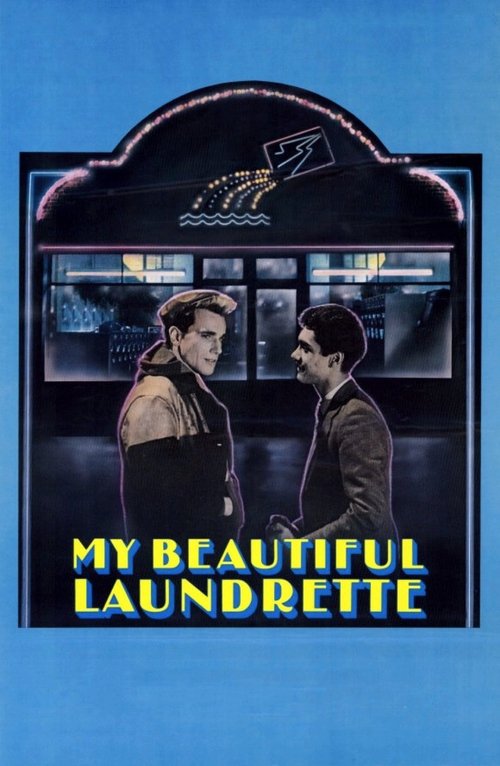
My Beautiful Laundrette
1985 · Stephen Frears
For when you want a love story with grit and politics in its veins — charming enough for a date night, sharp enough to leave you thinking about who gets to thrive in a hostile country.
What it's about
In Thatcher-era South London, Omar, a young Pakistani Briton, gets handed a rundown laundrette by his entrepreneurial uncle and sets out to turn it into something glamorous. He hires — and falls for — Johnny, an old school friend who's been running with a gang of racist skinheads. Around them swirl an ambitious immigrant family chasing money and respectability, and a city simmering with racial tension.
The experience
Scrappy, funny, and sexy, with a real undercurrent of menace — it bounces between family comedy, romance, and street-level danger without ever losing its warmth. It feels alive and a little dangerous, like the era it captures.
Performances
Daniel Day-Lewis, in an early breakout role, is magnetic as Johnny — tender, coiled, and completely convincing as a skinhead trying to become someone better. Gordon Warnecke matches him with an easy, ambitious charm as Omar.
The craft
Hanif Kureishi's screenplay — his first, and it earned an Oscar nomination — is the engine: fast, funny, and unafraid to make every character compromised. Shot on 16mm in six weeks for television, it has a rough immediacy that suits its world perfectly; Stephen Frears directs with unfussy energy that lets the writing and the romance breathe.
Why it matters
A TV movie that escaped to cinemas and became one of the defining British films of the 1980s, it broke ground by putting a gay interracial couple at the center of a mainstream hit and launched Kureishi, boosted Frears, and announced Daniel Day-Lewis.
Snapshot
My Beautiful Laundrette is a low-budget television film that escaped television. Shot on 16mm in six weeks for Channel 4's Film on Four strand, it was intended for broadcast; a festival screening at Edinburgh in 1985 and a subsequent run at the Toronto and New York festivals generated enough critical heat that the film was blown up to 35mm and given a theatrical release, where it became one of the defining British art-house successes of the decade. Hanif Kureishi's screenplay, his first for the screen, earned an Academy Award nomination — a remarkable outcome for a piece of subsidized television about a gay interracial couple running a launderette in South London.
The film's audacity was structural as much as thematic. It took the most familiar object of British social-realist cinema — the deindustrialised, racially fractious inner city under Thatcher — and refused to shoot it as misery. Omar (Gordon Warnecke), a young British Pakistani drifting through his father's flat in a tower block, is handed a failing launderette by his entrepreneur uncle Nasser (Saeed Jaffrey) and turns it, with the help of his old schoolfriend and former National Front associate Johnny (Daniel Day-Lewis), into a gaudy neon palace called Powders. The romance between the two men is presented without apology, explanation or tragedy. The drug money that finances the renovation is presented without moralism. The Pakistani businessmen are entrepreneurs, adulterers, landlords and wits rather than victims. Kureishi's script insisted that a British Asian community could be depicted as internally divided, ambitious, compromised and funny — a position that drew protest from some Pakistani organizations in Britain and America even as it made the film a landmark.
What holds it together is tone: a comedy of aspiration playing over a substrate of racial violence, delivered in a register that is neither realist documentary nor outright satire. Frears, then a veteran of British television with one notable feature behind him, directed it fast and unfussily, and the speed is legible in the finished film as a kind of nerve.
Industry & production
The film is inseparable from the institutional experiment that produced it. Channel 4 launched in November 1982 with a statutory remit to serve minority audiences and to commission rather than produce, and its film arm, Film on Four, under David Rose, became for roughly a decade the most important source of finance in British cinema. The model was cheap television films with theatrical ambitions: budgets in the hundreds of thousands, short schedules, television crews, and a broadcast slot as the guaranteed backstop. My Beautiful Laundrette was produced by Working Title — then a young company, this being among its earliest features — with Sarah Radclyffe and Tim Bevan producing.
The production was made on 16mm on a schedule of roughly six weeks, with a budget in the region of £600,000; precise figures vary between accounts and should be treated as approximate. The consequences of that economy run through the film. Locations are real South London streets and shopfronts, dressed rather than built. The cast mixes established Indian and Pakistani screen actors — Saeed Jaffrey, Roshan Seth — with unknowns and near-unknowns. Daniel Day-Lewis was a young stage actor whose screen work to that point was minor; his simultaneous appearance in 1985 as the punkish Johnny here and the fastidious Cecil Vyse in Merchant Ivory's A Room with a View became the calling card that made his reputation.
The decision to release theatrically was not the plan but the response to reception. Channel 4 had previously found that festival exposure could convert Film on Four commissions into cinema releases, and the strand's arrangements allowed a theatrical window before broadcast. The blow-up to 35mm carried visible grain, which reviewers at the time read variously as roughness or as authenticity. In the United States, Orion Classics handled the release, and the film performed strongly for a subtitled-free but thoroughly foreign-feeling British import, becoming a substantial art-house hit and running for months in major cities. It is worth stating plainly that reliable, verifiable gross figures for a 1985–86 specialty release of this kind are not consistently documented, and this dossier does not assert one.
The Oscar nomination for Best Original Screenplay in 1987 (for the 1986 US release year) confirmed the arrival of both Kureishi and the Channel 4 model. The immediate industrial consequence was a wave of imitation: for the rest of the decade, British features were routinely financed as television films and released as cinema, a practice that critics both credited with sustaining a national cinema and blamed for its small-screen aesthetic.
Technology
Technologically the film is a document of the mid-1980s television-film compromise. Shot on 16mm color negative with available and lightly supplemented light, it was designed to be finished for broadcast and only afterwards optically enlarged to 35mm for cinemas. That process — the blow-up — increases apparent grain and softens fine detail, and Laundrette wears the result openly. Its images have a granular, slightly smeared quality in low light that distinguishes them from contemporaneous 35mm British productions.
The film's most conspicuous technological subject, though, is inside the frame: the launderette itself. Powders is a machine-room, and its refurbishment is a small essay in mid-decade consumer technology — new machines, a sound system, video screens, and above all neon and backlit signage. The film treats these as the visible surface of Thatcherite enterprise: capital converted into light. There is a running joke in the staging that the launderette's most advanced feature is spectacle rather than function, a place people come to watch as much as to wash.
Practical lighting does considerable work throughout. Sodium street lamps, shop signs, the wash of fluorescent tubes in the launderette's interior and the glow of the neon frontage give the film a color palette that is unusual for the social-realist tradition it is often filed under: warm oranges and cold greens rather than gray. The technology available on a television budget in 1985 — fast stock, small units, real locations — shaped that look as much as any aesthetic decision.
Technique
Cinematography
Oliver Stapleton shot the film, beginning a long association with Frears that would continue through Prick Up Your Ears, Sammy and Rosie Get Laid, The Grifters and The Hi-Lo Country. His work here is fast and observational rather than composed: handheld and shoulder-mounted coverage in the street scenes, a preference for available light, and an unusual willingness to let color become expressive. The launderette, once transformed, is photographed as a stage — light spilling through glass, reflections doubling the actors, the frontage glowing against a dim street.
Two devices recur. The first is shooting through glass and reflective surfaces: windows, mirrors, the porthole doors of the machines. Characters are repeatedly seen refracted, overlaid, or watching from outside — a visual grammar for the film's interest in who is permitted inside which space. The most-discussed instance is the launderette's opening-night set piece, in which Omar and Johnny's private intimacy behind the back-room glass runs simultaneously with Nasser dancing with his white mistress Rachel in the main room, the two spaces held in the same optical field.
The second is the low-angle framing of the tower block and the elevated railway that recur as markers of place. Stapleton's exteriors keep South London legible and unromanticised without slipping into the gray-toned poverty-picturesque; the film's Britain is shabby but alive with signage and color.
Editing
Mick Audsley cut the film, another collaboration that would run for decades with Frears. The editing is brisk and slightly elliptical, moving between the film's several social worlds — Papa's flat, Nasser's suburban house, Salim's flat, the street, the launderette — with minimal connective tissue. Scenes tend to begin late and end early; a considerable amount of plot (the drug deal, the property dealings, the mechanics of the renovation) is implied in transitions rather than dramatized.
The film's signature editorial gesture is parallel construction. The climactic opening-night sequence cross-cuts the two rooms of the launderette so that a sexual encounter, a dance, and a business triumph read as a single event. Elsewhere Audsley and Frears cut against tonal expectation: comedy interrupted by violence, violence resolved into farce. The rhythm has something of television's economy about it, but the willingness to leave narrative gaps unfilled is closer to European art cinema than to British TV drama of the period.
Mise-en-scène / staging
The film's spatial logic is its argument. It organizes itself around a set of interiors that each encode a social position: the cramped flat where the alcoholic ex-journalist Papa (Roshan Seth) lies in bed with his bottle, radio and books, the Marxist intellectual reduced to a horizontal figure; Nasser's mock-Tudor suburban house with its garden and daughters; Salim's flat with its art and menace; and the launderette itself, which begins as a gray wreck and ends as a glittering hybrid — part nightclub, part shop, part shrine to enterprise.
The launderette is the film's central invention as a set. Its transformation is a visual joke about upward mobility (the name Powders, the neon, the piped music) and simultaneously a genuine object of desire. Frears stages the back room as a private zone concealed behind a two-way expanse of glass, so that intimacy and commerce occupy adjacent, mutually visible spaces — an image of the film's whole thesis about the entanglement of desire and money.
Costume and physical detail carry class and generational information efficiently: Johnny's cropped hair and battered jacket against Omar's progressively sharper suits, a wardrobe arc that tracks the film's reversal of who serves whom. Frears keeps the camera at conversational distance and lets performers move within the frame rather than cutting to them, a habit from his television years that gives the ensemble scenes their overlapping, unhurried quality.
Sound
Ludus Tonalis — the pseudonymous unit of Stanley Myers and Hans Zimmer — supplied the score, one of Zimmer's earliest film credits before his move to Hollywood. The music is synthesiser-based, spare, and deliberately non-naturalistic: repeating figures, bright electronic timbres, occasional South Asian melodic color. It works against the grain of the images, lending an almost fairy-tale lift to scenes of squalor and threat. That contrast is central to the film's tone; the score refuses to tell the audience that what they are watching is a social problem.
Diegetic sound does the counterweight: traffic, trains, the tumble and hiss of machines, the overlapping multilingual talk of Nasser's household. The soundscape of the launderette — mechanical, rhythmic, enveloping — becomes a kind of music itself in the later scenes.
Performance
The ensemble is one of the film's durable pleasures. Saeed Jaffrey's Nasser is expansive, charming and morally unbothered, a comic performance with real hardness underneath; Roshan Seth plays Papa as a wreck of principle, delivering the film's most bitter lines from a horizontal position. Derrick Branche's Salim and Shirley Anne Field's Rachel supply the middle registers — criminality with taste, and a mistress with more dignity than her situation allows. Rita Wolf's Tania is the film's restless conscience, a young woman who sees clearly what the men have arranged and leaves.
Gordon Warnecke plays Omar with a watchful passivity that curdles gradually into command; the performance has sometimes been read as recessive, but the arc requires it. Daniel Day-Lewis's Johnny is the breakout: a physical performance built on stillness and a slouching, coiled economy, with a South London accent and an unreadable tenderness. The famous moment in which he licks Omar's neck in full view of Nasser's car, or the scene in which he is confronted by his old skinhead comrades, are played without any of the signaling that a lesser actor would use to reassure the audience.
Narrative & dramatic mode
The film's mode is comic in structure and tragic in undertow. Its spine is a classic enterprise plot — acquire a failing business, refurbish it, open it — grafted onto a romance and set inside a family melodrama. Kureishi's script keeps three or four strands running: Omar and Johnny; Nasser and Rachel; Papa's decline and his demand that Omar be educated; and Tania's attempted escape. None resolves neatly. The launderette opens, the romance survives, the violence arrives, and the final image leaves the two men splashing each other with water in the back room, wounded and laughing — an ending that is deliberately provisional rather than triumphant.
Tonally, the film moves without transition between farce and menace. This is its most influential formal choice: British films about race and class had generally selected a register and stayed there. Laundrette treats the National Front thugs as both genuinely dangerous and slightly absurd; treats the drug trade as both criminal and a routine source of business capital; treats the gay romance as neither issue nor secret. The refusal to sort its material into problem and comedy is what gives the film its unsettled, still-modern feel.
Structurally it is loose, and some critics at the time and since have found it shapeless in its middle stretch — a consequence, arguably, of a television commission expanding into a feature and of a first-time screenwriter more interested in social observation than in mechanics.
Genre & cycle
The film belongs to at least three cycles simultaneously, which is part of its interest. It is a Film on Four production, and therefore part of the 1980s British television-film cycle alongside Angel, The Ploughman's Lunch, Wetherby, Letter to Brezhnev and later Wish You Were Here. It is part of the small, contentious cycle of anti-Thatcherite British features of the mid-1980s. And it is an early entry in what would become British Asian cinema, though in 1985 that category barely existed.
Against the dominant British export cinema of the moment — the heritage film, and specifically the Merchant Ivory and Chariots-of-Fire mode of exportable Englishness — Laundrette reads as a direct rebuttal. It is set in the present, in a Britain of tower blocks and squats and family businesses, and its England is one that the heritage film had no vocabulary for. Critics of the period, most influentially in debates in Sight & Sound and Screen, used precisely this opposition to argue about what British cinema should be.
Genre-wise it is best described as social comedy with romance, and it sits somewhere between the Ealing tradition of small-business eccentricity and the abrasive naturalism of the British new wave — while belonging fully to neither.
Authorship & method
Frears is the least auteurist of major British directors, and says so; his method is to serve the script and the actors, work fast, and avoid signature. He came to Laundrette from a long apprenticeship in British television — Play for Today, Alan Bennett's television films, Peter Prince's and others' single dramas — and one feature, Gumshoe (1971), plus the crime picture The Hit (1984). What he brings is speed, an ear for performance, and a refusal to editorialise. The film's most provocative material is staged without emphasis, which is why it lands.
Hanif Kureishi is the film's authorial center. A playwright of British Pakistani background, he wrote from inside the milieu — his father's family, the London Pakistani business world, the intellectual left of the previous generation — and against the expectation that a minority writer should produce positive images. His subsequent work with Frears (Sammy and Rosie Get Laid, 1987) and his novel The Buddha of Suburbia (1990) extended the same project. His screenplay's published edition, with an accompanying essay, became a widely taught text in film and cultural studies.
The key collaborators recur across Frears's career and constitute something like a repertory: Oliver Stapleton (cinematography), Mick Audsley (editing), and on the music side Stanley Myers, with whom Frears worked repeatedly and who mentored the young Hans Zimmer. Producers Sarah Radclyffe and Tim Bevan would build Working Title into Britain's most successful production company; Laundrette was a foundational credit.
Movement / national cinema
My Beautiful Laundrette is a central document of 1980s British cinema's argument with itself. The decade's British film culture was split between an internationally successful heritage mode and a domestically funded, politically engaged television-film culture; Laundrette is the most celebrated product of the latter and is routinely invoked in scholarship as the counter-example that proves the era was not only heritage.
It is also, more consequentially, a founding text of British Asian screen culture. Before it, British Asian characters on British screens were largely peripheral or defined by problem narratives. Laundrette placed a British Pakistani family at the center, gave them wealth, wit, self-interest and internal conflict, and declined the sociological frame. The line runs from here through Bhaji on the Beach (1993), East Is East (1999), Bend It Like Beckham (2002) and the television work of Gurinder Chadha and Ayub Khan Din, though none inherited Kureishi's willingness to be unflattering.
Its place in New Queer Cinema is retrospective rather than genealogical — the term arrived around 1992 — but Laundrette is consistently cited as a precursor. Its refusal to make homosexuality either the subject or the crisis of its plot, and its interracial pairing across a line of political violence, anticipate the movement's central moves by several years.
Era / period
The film is dated with unusual precision to its moment: the second Thatcher term, after the 1981 and 1985 urban disturbances and during the miners' strike's aftermath, in a Britain of high unemployment, aggressive privatization and rising organized racism. Its politics are not straightforward opposition. Kureishi gives the enterprise culture its due — Nasser's speech about squeezing the tits of the system, the pleasure the film takes in the launderette's success — while showing what it costs and who it abandons. Papa, the socialist intellectual, is the film's most defeated character; the entrepreneurs are the ones having fun.
The immigration politics of the period are equally specific. The film's Pakistani characters range from the barely legal to the propertied, and the question of who belongs in Britain is posed from inside the community rather than at its border. Johnny's skinhead past is treated as biography rather than aberration — he marched, Omar's family remembers it, and the film asks what it would mean to move past that without pretending it did not happen.
Reception, canon & influence
Critical reception in 1985–86 was strongly favourable and, in places, startled. British reviewers noted the film's tonal audacity and its break with the earnest realism expected of Channel 4; American critics, encountering it after festival acclaim, made it a New York art-house event. Vincent Canby in The New York Times and other major American critics championed it, and it appeared on numerous year-end lists; the New York Film Critics Circle honored Kureishi's screenplay. The Academy Award nomination for Best Original Screenplay followed. Not all response was positive: some Pakistani community organizations in Britain and among diaspora audiences in the US protested the depiction of Pakistani characters as drug dealers, slum landlords and adulterers, a controversy Kureishi has addressed directly in his published essays. That argument — about the burden of representation placed on minority artists — has itself become part of the film's scholarly afterlife.
Backward, the film's influences are eclectic. Kureishi's dramatic lineage runs through post-war British theater and its habit of using the family as a political stage. The Channel 4 context supplied the formal permissions and the television-realist substrate. Frears's own background in the socially engaged single play tradition shapes the observational method, while the film's comic register and its interest in small commerce carry a distant Ealing inheritance, ironised. Its treatment of desire across a political divide has been compared to Fassbinder's melodramas of the 1970s, particularly Ali: Fear Eats the Soul, though the resemblance is one of subject rather than demonstrable influence and should be read as critical analogy rather than established lineage.
Forward, its influence is broad and well documented. It made Daniel Day-Lewis a star and Hanif Kureishi a public figure. It confirmed the Film on Four model, which financed the majority of significant British features for the following decade and shaped Working Title's rise. It established the possibility of British Asian stories told from the inside, a line traceable through two decades of British film and television. And it is a standing reference point in queer cinema for the depiction of a gay relationship without disclosure, punishment or death — a template still cited when contemporary films are praised for the same refusal.
Institutionally, the film is thoroughly canonized: it appears in BFI polls of British cinema, is a fixture of university syllabi in British cinema, postcolonial studies and queer film studies, and has been reissued in restored editions. Its most durable legacy may be the simplest: it demonstrated that a film could be about race, class, sexuality and money at once, and be funny, and that none of those subjects required the others to be handled solemnly.
A Deleuzian reading
Opening night at Powders.
The full Deleuzian reading of My Beautiful Laundrette →
Reception
Shot on 16mm for Channel 4 television on a tiny budget, it became a surprise theatrical hit after festival acclaim and even landed Hanif Kureishi an Oscar nomination for the screenplay; today it's canonized as a defining film of both Thatcher-era Britain and queer cinema, complete with a Criterion release.
How My Beautiful Laundrette was received, from release to now →
How to watch My Beautiful Laundrette: what to notice on a first viewing
- Watch how often you see characters through glass or mirrors. Stapleton repeatedly shoots through windows, mirrors, and the porthole doors of the washing machines, characters refracted, overlaid, or watched from outside. The glass keeps splitting people into the person and their reflection, never quite letting you separate the two.
- Notice the warm orange and neon light against London's gray. Stapleton lights sodium lamps, shop signs, and the launderette's neon in warm oranges and cold greens rather than the gray palette British realism usually reaches for. The color itself argues against treating this world as simply bleak.
- Watch how the launderette changes from wreck to spectacle. Powders opens as a gray shell and becomes a glowing hybrid of shop, nightclub, and shrine, with a private back room concealed behind a wall of glass. The transformation is its own kind of magic trick, built entirely from light and paint.
- Notice how Omar's and Johnny's clothes change across the film. Johnny keeps his cropped hair and battered jacket while Omar moves into progressively sharper suits, a quiet wardrobe swap in who's really in charge. You can track who's gaining power just by what each man is wearing.
- Watch how little Johnny moves compared to everyone around him. Day-Lewis plays him with a slouching, coiled stillness, never rushing a gesture, in sharp contrast to the busier, louder people around him. The stillness reads as its own kind of danger and its own kind of tenderness.
The whole guide to watching My Beautiful Laundrette, with the keys for a rewatch →
Influences: the films it descends from and the films it influenced
- Saturday Night and Sunday Morning (1960) — Established the British template Frears works from and against: the working-class interior shot on location as a diagram of social position, with an amoral, upwardly-scheming protagonist the film declines to punish or moralize about.
- A Taste of Honey (1961) — Walter Lassally's handheld available-light location shooting plus the unremarked domestic cohabitation of a gay character — a homosexual presence staged without disclosure scene, diagnosis or death, the precise refusal Laundrette is credited with codifying.
- Ali: Fear Eats the Soul (1974) — The formal device of framing an interracial couple through doorways, thresholds and glass while hostile onlookers hold the frame in static tableau — the compositional grammar behind Laundrette's shooting-through-glass staging of Omar and Johnny.
- Nighthawks (1978) — Shot 16mm in available light across real London flats, clubs and workplaces, it proved a gay life could be filmed as texture and routine rather than as a coming-out crisis structure — the observational mode Frears inherits.
- Bloody Kids (1980) — Frears's own dry run: Chris Menges shooting nocturnal de-industrialised England on 16mm with sodium and neon practicals as the only light source, teenagers adrift in retail and car-park space — the lighting method Oliver Stapleton extends into the launderette.
- Moonlighting (1982) — Stanley Myers — half of Laundrette's Ludus Tonalis scoring team with Hans Zimmer — scored this migrant-labor picture built the same way: a single work site in London as the entire economic and political arena, shot fast on real streets.
- Walter (1982) — Channel 4's opening-night transmission and the founding instance of the Film on Four model Laundrette exploits — feature ambition on a television schedule and 16mm budget, with theatrical life treated as an afterthought rather than a premise.
- Sammy and Rosie Get Laid (1987) — The identical unit — Kureishi writing, Stapleton shooting, Mick Audsley cutting — pushing Laundrette's parallel cross-cutting further, into the triptych sex sequence and riot montage where simultaneous actions are intercut as a single political argument.
- Young Soul Rebels (1991) — Extends the Laundrette settlement to Black British queer material: an interracial gay relationship staged without punishment or coming-out apparatus, financed on the same Channel 4/BFI terms, with music used as period environment rather than underscore.
- Bhaji on the Beach (1993) — The first British Asian feature by a woman, made on the Film on Four terms Laundrette proved out, and inheriting its central formal wager — generational and communal conflict carried in a comic ensemble register instead of a sociological one.
- Beautiful Thing (1996) — Channel 4 again, and the Laundrette template made explicit: first love between two boys on a council estate, shot in available light in real flats and walkways, with pop music running as diegetic environment and no death, disclosure crisis or punishment in the structure.
- My Son the Fanatic (1997) — Kureishi's own continuation of his method — the generational political argument located inside a father-son economic relationship and a specific small business, so ideology is transacted as commerce rather than debated as dialogue.
- East Is East (1999) — Ayub Khan-Din writes from inside the milieu as Kureishi did, and rebuilds the launderette-as-set device around a Salford chip shop: a single family business premises doubling as the film's whole social and racial map.
- Dirty Pretty Things (2002) — Frears returns to the structure with Chris Menges shooting: London's undocumented immigrant economy observed through one night-shift workplace, staged without emphasis so the most extreme material lands unannounced.
- Weekend (2011) — The standing modern citation of Laundrette's queer settlement — a relationship shot handheld in available light in a tower-block flat, frequently framed through windows and balcony glass, with the drama sited in class and articulacy rather than in disclosure or threat.
- The Cider House Rules (1999) — Where cinematographer Oliver Stapleton developed his naturalist, available-light, character-led realism with Frears — the unfussy observational eye he later trains on the cider-house bunkroom and apple orchards.
- God's Own Country (2017) — British social realism that fuses gay romance with migrant labor and economics, and refuses tragedy as the queer default ending.
- And Then We Danced (2019) — Frears embeds queer desire inside a tight ethnic-traditional community, the template for love that transgresses cultural and familial loyalty rather than mere prejudice.
- Pride (2014) — Pioneers folding a gay romance directly into Thatcher-era class and coalition politics, refusing to bracket queer life off from the era's economic struggle — the intersection Pride builds its whole structure on.
- Letter to Brezhnev (1985) — The same year and the same economics — 16mm blown up to 35mm on a negligible budget, romance across a hard political divide played in a comic register, provincial night locations lit by whatever neon the street already had.
- Prick Up Your Ears (1987) — Stapleton and Audsley again, applying Laundrette's elliptical construction to a biography told out of order, and staging a gay domestic partnership in cramped interiors with the same flat refusal to signal that anything transgressive is occurring.
- Rita, Sue and Bob Too (1987) — The other film that broke Channel 4's earnest-realism contract by playing Thatcher-era estate life as vulgar comedy and withholding the editorial judgment the social-realist frame had always supplied.
Similar films
- Beautiful Thing (1996) — influence & lineage
- Phantom Thread (2017) — shared sensibility
- Darling (1965) — shared sensibility
- I, Daniel Blake (2016) — shared sensibility
- Pride (2014) — shared sensibility
- My Father's Shadow (2025) — shared sensibility
- Moonlight (2016) — shared sensibility
- God's Own Country (2017) — shared sensibility