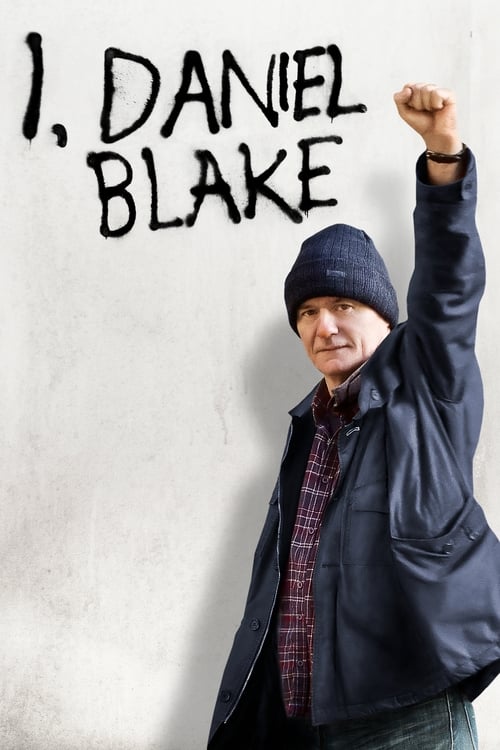
I, Daniel Blake
2016 · Ken Loach
For when you want a film that makes you feel — and makes you angry on someone's behalf. It will break your heart, but it's the kind of heartbreak that leaves you more human; keep tissues close.
What it's about
Daniel, a 59-year-old Newcastle carpenter recovering from a heart attack, is trapped in a cruel contradiction: his doctors say he can't work, but the benefits system rules that he can. As he battles the forms, phone queues, and online portals of a bureaucracy built to wear people down, he befriends Katie, a single mother newly relocated with her two kids to a city where she knows no one, and the two improvise a kind of family in the gaps of the system.
The experience
Warm, funny, and quietly devastating — the humor of ordinary people keeping their dignity, punctuated by moments of hardship that hit like a punch. It builds to an emotional force that sneaks up on you precisely because everything feels so plainly real.
Performances
Stand-up comedian Dave Johns brings unforced decency and dry wit to Daniel, and Hayley Squires is shattering as Katie — one scene of hers in particular is among the most talked-about pieces of acting in recent British film.
The craft
Ken Loach and screenwriter Paul Laverty strip away every ornament: unglamorous locations, naturalistic light, performances that never feel performed. The plainness is the point — the film's power comes from how documentary-real every waiting room and phone call feels.
Why it matters
Winner of the Palme d'Or at Cannes in 2016 — Loach's second — it became one of the most debated British films of its decade, cited in Parliament and in arguments about the welfare state itself.
Snapshot
I, Daniel Blake is Ken Loach's polemical social-realist drama about a Newcastle joiner who, recovering from a heart attack, is caught between the doctors who forbid him to work and a benefits bureaucracy that rules him fit to do so. Written by Loach's long-standing collaborator Paul Laverty, the film follows Daniel (Dave Johns) through the digital and procedural mazes of Employment and Support Allowance and Jobseeker's Allowance, and pairs his story with that of Katie (Hayley Squires), a single mother relocated from London to a city where she knows no one. The film premiered in competition at the 2016 Cannes Film Festival and won the Palme d'Or — Loach's second, a decade after The Wind That Shakes the Barley (2006). It became one of the most widely discussed British films of the decade, less as a formal object than as an intervention: a work explicitly designed to make an argument about austerity-era welfare policy and to move that argument into public and parliamentary debate. Its title, taken from the graffiti Daniel spray-paints on a Jobcentre wall, functions as the film's thesis — an assertion of citizenship and dignity against a system that reduces claimants to case numbers.
Industry & production
The film was produced by Rebecca O'Brien through Sixteen Films, the production company she runs with Loach and Laverty, and financed through the familiar European art-cinema architecture that has sustained Loach's work for years: a coalition of public-service broadcasters and film funds, principally the BBC and the BFI, with British, French and Belgian partners. This is a low-budget model by any commercial measure — Loach's films are made economically, with modest crews and short, disciplined shoots — and the Sixteen Films collective (Loach, Laverty, O'Brien) constitutes one of the most stable authorial units in contemporary European cinema, having worked together across numerous features since the 1990s.
The production is notable partly because it followed what had been reported as Loach's retirement. After Jimmy's Hall (2014), Loach, then in his late seventies, had suggested he was stepping back from feature filmmaking; I, Daniel Blake was the project that drew him back, reportedly because he and Laverty felt the human consequences of welfare reform demanded a film. Distribution in the UK was handled by eOne, and the film opened to unusually broad attention for a Loach picture, aided by the Cannes win and by a public conversation about food banks, sanctions and the Work Capability Assessment that the film both fed on and amplified.
Technology
Technologically, the film is defined less by innovation than by deliberate restraint, and by Loach's consistent resistance to the conveniences of contemporary production. Loach has long preferred to shoot on photochemical film rather than digital, valuing its texture and the discipline it imposes on a set, and I, Daniel Blake was made in that tradition with cinematographer Robbie Ryan. The camera is handheld or lightly supported, available and practical light is favoured, and the technical apparatus is kept small and unobtrusive so that performers are not overwhelmed by equipment. Loach's method also famously withholds technology's usual crutches from the actors: he shoots largely in chronological sequence and does not hand out the full script, so performers frequently do not know what is coming, receiving pages or information shortly before a scene. The film's most pointed engagement with technology is thematic rather than instrumental: the story turns on the state's insistence that citizens interact with it digitally — "we're digital by default," Daniel is told — and the long, agonizing scenes of a man of Daniel's generation failing to navigate an online application form dramatize digital exclusion as a mechanism of exclusion from welfare itself.
Technique
Cinematography
Robbie Ryan's photography is the visual embodiment of Loachian realism: observational, unshowy, and organized to keep the drama legible and human-scaled. The camera generally holds at eye level and at a respectful middle distance, favouring sustained framings over aggressive coverage, and cutting into closer views sparingly so that when the film does move in — on Katie in the food bank, on Daniel's face during his assessment — the proximity registers as emotional pressure rather than routine grammar. The palette is naturalistic and muted, keyed to the gray light of Newcastle and the fluorescent flatness of institutional interiors. Ryan avoids the picturesque; the compositions are functional, prioritizing the actor and the space over any pursuit of beauty for its own sake, which is precisely the point of a style meant to make artifice invisible.
Editing
Jonathan Morris, Loach's editor across much of his career, cuts the film to preserve the integrity of performance and the rhythm of lived time. The editing is patient, letting scenes run to their natural conclusion and resisting the compression that would sharpen them into conventional dramatic beats. This is a cinema built on continuity and duration rather than montage; the emotional force of set-pieces such as the food bank sequence depends on the refusal to cut away, on holding the moment past the point of comfort. The structure alternates Daniel's institutional ordeals with domestic scenes of his growing bond with Katie's family, and the cutting keeps the two strands in a steady, accumulating rhythm rather than building toward spectacle.
Mise-en-scène / staging
The staging is documentary in feel and rooted in real places: Jobcentres, a food bank, a cramped rehoused flat, the terraced streets of the North East. Loach's actors move through spaces dressed to look inhabited rather than designed, and blocking follows behavior rather than composition. The famous food bank scene is a study in staging as revelation — the geography of shelves, volunteers and a hungry woman is arranged so that a single small gesture becomes devastating. Throughout, the mise-en-scène insists on the material texture of poverty: the cold flat, the meager possessions, the objects that carry emotional weight (Daniel's woodwork, the fish mobiles he carves) precisely because there is so little else.
Sound
The soundtrack is dominated by direct, location-recorded sound — the murmur of waiting rooms, hold music, the bureaucratic voice on the telephone line — which grounds the film in an unglamorous acoustic reality. George Fenton's score is used with marked economy, entering quietly and withdrawing rather than underlining, in keeping with Loach's suspicion of music that tells an audience how to feel. The most eloquent sound is often silence or ambient noise: the maddening loop of a call-center queue becomes one of the film's cruellest instruments.
Performance
Performance is the heart of the film and the fullest expression of Loach's method. He cast Dave Johns, a stand-up comedian with little prior film experience, as Daniel, and Hayley Squires as Katie, favouring performers who could bring authenticity and, in Johns's case, a Geordie warmth and comic timing that make Daniel's decency tangible. Loach's techniques — chronological shooting, withheld script pages, improvisatory latitude, and staging surprises the actors do not anticipate — are all aimed at capturing spontaneous, unperformed reaction. The results are performances that feel discovered rather than delivered; Squires's work in the food bank, widely singled out, has the quality of something happening rather than being acted.
Narrative & dramatic mode
The film's dramatic mode is realist melodrama harnessed to political argument. Its narrative is deliberately linear and legible, structured as a mounting series of bureaucratic obstacles that function as the antagonist — a Kafkaesque machine of assessments, phone queues, sanctions and appeals that no individual official fully controls. Loach and Laverty personalize this system through two protagonists whose parallel struggles let the film generalize: Daniel's story indicts the treatment of the sick and older worker, Katie's the punishment of the young poor, and their surrogate-family bond supplies the warmth that keeps the polemic from curdling into misery. The mode is unabashedly sentimental in the classical sense — it seeks to arouse indignation and compassion — and it does not pretend to neutrality. Critics who fault the film do so largely on this ground, arguing that its people are drawn to prove a case; its defenders answer that the case is true and the drawing is humane.
Genre & cycle
Generically the film belongs to British social realism, the kitchen-sink lineage that runs from the late-1950s and 1960s New Wave through to Loach's own six-decade body of work. Within that tradition it sits in a specific contemporary cycle: the austerity film of 2010s Britain, works responding to public-spending cuts, precarity and the reshaping of the welfare state. It is a "state-of-the-nation" film in the most literal sense — an account of what the machinery of the state does to a citizen — and shares tonal DNA with the compassionate realism of the Dardenne brothers on the continent. Against the grain of a British industry often oriented toward heritage drama and genre entertainment, I, Daniel Blake is a self-conscious act of counter-programming.
Authorship & method
The film is the product of a durable collaborative authorship centered on Ken Loach as director, Paul Laverty as screenwriter, and Rebecca O'Brien as producer — a trio whose partnership defines late-period Loach. Laverty's screenplays are built on extensive research, and the film's texture of case-workers, forms and sanctions reflects that reporting-based method. Loach's directorial signature is by now codified: non- and first-time actors cast for authenticity, chronological shooting, scripts revealed piecemeal, an invisible camera style, and a refusal of the manipulative gloss of mainstream production. The key craft collaborators are among Loach's most trusted: cinematographer Robbie Ryan, editor Jonathan Morris, and composer George Fenton, each working in the restrained, performance-first register the director demands. The authorial vision is inseparable from a political one — Loach's long-standing socialism — and I, Daniel Blake is perhaps the most direct fusion of the two in his later career.
Movement / national cinema
As British national cinema, the film is a flag-bearer for a socially engaged tradition that Loach himself has done more than anyone alive to sustain. It descends from the Free Cinema and British New Wave impulses of the late 1950s, but its truest ancestor is Loach's own Cathy Come Home (1966), the television play about homelessness that famously helped catalyze public debate. The film is regional in emphasis — Newcastle and the North East, rather than a metropolitan London — and part of a broader body of English regional realism. Internationally it aligns with a European art-cinema of social conscience, and its Cannes triumph situated it within that continental prestige circuit as much as within British film culture.
Era / period
I, Daniel Blake is emphatically a film of its historical moment: post-2010 austerity Britain, in the years of coalition and Conservative welfare reform, food bank expansion, and the benefit sanctions regime. It arrived in 2016 — the year of the Brexit referendum — into a Britain preoccupied with questions of who the state serves and who has been left behind, and much of its cultural charge derived from that timing. The film reads now as a primary document of the mid-2010s: the digital-by-default state, the Work Capability Assessment administered by private contractors, and the lived reality of precarity are rendered with a specificity that will keep it valuable to historians of the period regardless of shifts in critical fashion.
Themes
Its central theme is dignity — the assertion, against a dehumanizing apparatus, that a person is a citizen and not a client, a number or a case. Around this cluster the film's other concerns: the cruelty of bureaucracy, and specifically bureaucracy as a diffuse, deniable form of institutional violence; poverty and hunger, given unforgettable form in the food bank; digital exclusion and the way "efficiency" can function as a barrier; solidarity and improvised kinship as the counterweight to institutional coldness; and the erosion of the postwar social contract. Work, and the identity that skilled manual labor confers, runs throughout — Daniel is a craftsman defined by making things, and the tragedy is partly of a man told his competence is worthless. Shame and pride, and the toll of being made to beg for what is owed, give the film its emotional undertow.
Reception, canon & influence
Critically, the film was widely acclaimed on release, with particular praise for its performances, its emotional directness and its moral urgency; the Palme d'Or crowned that reception, and the film later won the BAFTA for Outstanding British Film. A significant strand of criticism, however, pushed back — arguing that its characters are engineered to make a political point, its villains and victims too cleanly drawn, and its sentiment applied with too heavy a hand. That debate — between the film as necessary testimony and the film as agitprop — is itself part of its critical record and unusually explicit for a mainstream release.
Looking backward, its influences are the whole arc of Loach's own work, above all Cathy Come Home's model of drama-as-social-intervention, together with the broader British realist and Italian neorealist inheritance of ordinary people, real locations and the moral gravity of everyday hardship; the Dardenne brothers are a frequently cited contemporary kin. Looking forward, the film's most striking legacy is extra-cinematic: it became a reference point in public and political debate about welfare, food banks and sanctions, its title adopted as a rallying phrase and its arguments cited well beyond film culture. Loach and Laverty followed it with Sorry We Missed You (2019), a companion piece on gig-economy precarity that extends the same project. Within film history, I, Daniel Blake stands as the emphatic late-career statement of Britain's foremost political realist — a demonstration that the socially committed cinema of the 1960s remained, half a century on, capable of commanding the world's most prestigious festival and a genuine national conversation.
A Deleuzian reading
A carpenter's hands on a computer mouse.
The full Deleuzian reading of I, Daniel Blake →
Reception
It won Ken Loach a second Palme d'Or in 2016 and instantly became a political flashpoint in austerity-era Britain — praised as essential, dismissed by some right-leaning critics as unrealistic. A decade on it's settled in as the definitive film about the UK benefits system, still invoked whenever welfare policy makes headlines.
How I, Daniel Blake was received, from release to now →
Influences: the films it descends from and the films it influenced
- Cathy Come Home (1966) — Establishes Loach's drama-as-intervention template — a scripted narrative shot in documentary register (handheld, real locations, overlapping direct sound) engineered to enter public policy debate, the exact model I, Daniel Blake reactivates for the welfare crisis.
- Kes (1969) — Codifies Loach's casting method — locally recruited non-professionals (David Bradley) directed to inhabit rather than perform — and Chris Menges' unobtrusive observational framing that lets working-class faces carry the scene.
- Bicycle Thieves (1948) — The neorealist source code: non-professional leads, real streets, and a narrative built as a humiliating quest through an indifferent institutional maze — the structural spine of Daniel's odyssey through the benefits system.
- Rome, Open City (1945) — Founds the practice of shooting fiction in actual locations with available light and a moral gravity toward everyday hardship that Loach inherits wholesale as his ethical-aesthetic baseline.
- Saturday Night and Sunday Morning (1960) — The British kitchen-sink prototype — a regional working-class protagonist filmed in his own industrial milieu with location sound and unglamorized interiors, the New Wave lineage Loach radicalized toward politics.
- Riff-Raff (1991) — Refines the withheld-script method — actors given pages only as scenes arrive, shot chronologically on a real building site — producing the improvised, overlapping banter texture that surfaces again in the jobcentre and food-bank scenes.
- Raining Stones (1993) — Perfects Loach's tragicomic austerity mode: a decent working man ground down by debt and benefit shortfalls, mixing warmth and humor with mounting dread — the tonal blueprint for Daniel and Katie.
- Ladybird, Ladybird (1994) — Pioneers bureaucracy-as-antagonist as dramatic engine — social services rendered a faceless adversary against a non-professional lead (Crissy Rock), the same casework-as-conflict structure driving Daniel's appeals.
- Two Days, One Night (2014) — Builds its drama as a serial quest through an unforgiving economic system (each visit a bureaucratic negotiation), the same episodic humiliation architecture Laverty uses for Daniel's encounters.
- The Wind That Shakes the Barley (2006) — Extends the Laverty-Loach formula that won Wind its Palme — an economical script dense with argument, ordinary lives staged as political case — and took Loach's second Palme d'Or a decade later.
- The Selfish Giant (2013) — Carries the austerity-realist lineage forward with non-professional child actors in a real Bradford of scrap-metal poverty, applying Loach's observational-casting method to a new generation of British hardship film.
- Sorry We Missed You (2019) — The explicit companion piece — same Loach/Laverty/O'Brien trio, same withheld-script non-professional method — extending the bureaucracy-as-antagonist project from welfare sanctions to gig-economy zero-hours precarity.
- The Old Oak (2023) — Loach and Laverty's late-career coda reuses the identical toolkit — locally cast non-actors, chronological shooting, austerity-Britain setting — closing the arc that I, Daniel Blake reopened for post-industrial community collapse.
- A Place for Her (2026) — Makes welfare bureaucracy the antagonist, using naturalist ensemble and procedural humiliation to locate violence inside administration itself.
- Rosetta (1999) — The Dardennes' Palme-winning precarity study shares the handheld, following-camera observation of a non-professional fighting for the right to work and welfare — the frequently cited contemporary kin to Loach's method.
- Sweet Sixteen (2002) — A Laverty screenplay built on the same research-reported texture and a discovered non-professional lead (Martin Compston), demonstrating the Loach-Laverty authorship engine mid-run.
- Fish Tank (2009) — Robbie Ryan — Daniel Blake's cinematographer — shoots a first-time lead in handheld, natural-light social realism, the visual grammar he carries directly into Loach's film.
- Nil by Mouth (1997) — Extends British social realism through improvisation-derived dialogue and location-recorded direct sound in real council estates, the naturalist-performance register Loach shares.
- Shoplifters (2018) — Loach's accumulative social realist staging of bureaucratic exclusion through non-professional performances and location-bound diegetic sound represents the parallel British tradition to Kore-eda's observational restraint; both build institutional indictment from the density of mundane domestic and administrative detail rather than from dramatic confrontation.
- Vera Drake (2004) — Sustains the tragic-mode social realism that indicts the state's treatment of a fundamentally decent working person, refusing sentimental uplift.
- Souleymane's Story (2024) — Builds its drama around the bureaucratic assessment interview as narrative engine — the applicant across a desk from a functionary — the same climactic-interview device that structures the seed.
Similar films
- Fish Tank (2009) — influence & lineage
- Shoplifters (2018) — shared sensibility
- The Wind That Shakes the Barley (2006) — shared sensibility
- Children of Men (2006) — shared sensibility
- Kes (1970) — shared sensibility
- Biutiful (2010) — shared sensibility
- Secrets & Lies (1996) — shared sensibility
- Bleak Moments (1971) — shared sensibility