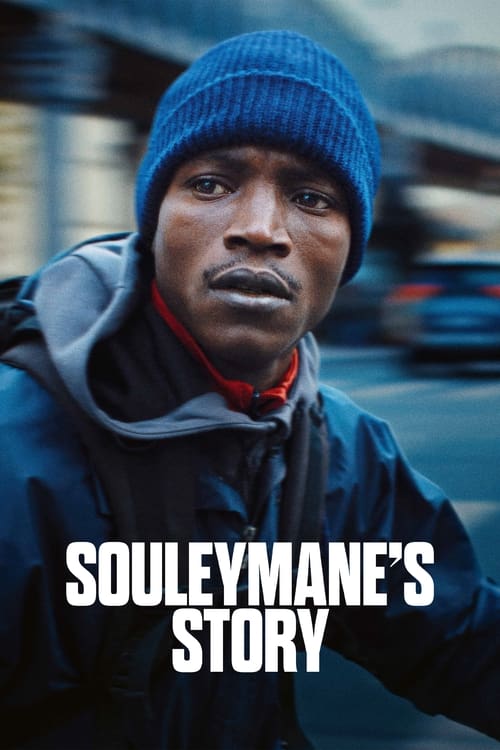
Souleymane's Story
2024 · Boris Lojkine
For when you want a film that grips like a chase movie but leaves you thinking about the real world — the delivery riders you pass every day. Challenging, urgent, and worth the discomfort.
What it's about
Souleymane, a young Guinean immigrant, pedals food deliveries through Paris traffic under someone else's courier account, sleeping wherever the city's emergency system has a bed. In two days he faces his asylum interview — the single conversation that will decide his future — and he spends every spare moment rehearsing the story he's supposed to tell, a story that keeps slipping away from the truth.
The experience
It plays like a thriller even though the stakes are a form and an interview — breathless, handheld, no wasted minute, with the constant low hum of an app dictating a man's life. Exhausting in the best sense, and deeply moving.
Performances
Abou Sangaré, a non-professional mechanic whose own residency status was unresolved during filming, is extraordinary — so unguarded and precise he won the Un Certain Regard acting prize at Cannes and the César for the role.
The craft
Boris Lojkine shoots in a propulsive vérité register — handheld camera weaving through actual Parisian streets, the gig economy's phone-app tyranny rendered with procedural exactness. The sound of traffic, notifications, and breath does as much work as any score; see it somewhere you can't check your phone.
Why it matters
A Jury Prize winner in Un Certain Regard at Cannes 2024, it became one of the defining recent films about Europe's asylum system and gig-economy underclass, told from inside rather than about.
Two days in the life of a Guinean bike courier in Paris, pedaling meals through traffic while rehearsing the story he must tell at his asylum interview — the single conversation that will decide everything. Boris Lojkine, a former philosophy lecturer who turned to filmmaking with documentaries shot in Vietnam and the fiction feature Hope, works here in a vérité register so propulsive the film plays like a thriller: handheld camera weaving through actual Parisian streets, the gig economy's phone-app tyranny rendered with procedural exactness. The Dardenne comparison is earned, but Lojkine's real coup is Abou Sangaré, a non-professional mechanic from Amiens whose own residency status was unresolved during production; he won the Un Certain Regard acting prize at Cannes 2024, where the film also took the Jury Prize, and the César for most promising actor. Everything funnels toward a climactic interview staged as a patient, devastating two-hander across a desk — one of the great extended dialogue scenes of recent European cinema, built almost entirely on a face deciding what the truth is worth.
Reception
Premiered in Un Certain Regard at Cannes 2024 and never had to be rediscovered — it took the Jury Prize, the acting prize and the FIPRESCI there, then converted eight César nominations into four wins (screenplay, editing, supporting actress, male revelation) at the 2025 ceremony. In under a year it went from small French social drama to the consensus 'best film about the gig economy yet made'.
How Souleymane's Story was received, from release to now →
Influences: the films it descends from and the films it influenced
- Bicycle Thieves (1948) — Sets the neorealist template the film runs on: a non-professional lead traversing a city over a compressed span, chasing the one thing his survival depends on, with the street itself as set and antagonist.
- Pickpocket (1959) — The Dardenne-line source for its performance grammar — a 'model' non-actor whose impassive face and working hands in tight closeup carry the drama, and a thriller built from small furtive gestures rather than dialogue.
- La Promesse (1996) — Direct parent: undocumented-migrant labor and moral debt shot in restless handheld vérité, the camera bound to a protagonist forced into complicity by economic precarity.
- Rosetta (1999) — The stylistic blueprint — handheld camera pinned to the back of a young protagonist's neck as she desperately hunts legitimate work, turning the pursuit of a job into breathless kinetic suspense.
- Two Days, One Night (2014) — The seed's compressed two-day ticking-clock structure lifts directly from this: a protagonist making a deadline-bound round of encounters, each a tense two-hander that must be 'won' before time runs out.
- 4 Months, 3 Weeks and 2 Days (2007) — Model for the single-crisis-day thriller: real-time dread built in long handheld takes as an ordinary person navigates a bureaucratic ordeal that could destroy them, climaxing in an unbearable negotiation across a table.
- The Class (2008) — Pioneers the method the seed uses — casting non-professionals close to their real lives and workshopping extended, overlapping vérité dialogue scenes, then framing the whole as a Cannes-honored two-hander institutional confrontation.
- Sorry We Missed You (2019) — The closest cousin on gig-economy craft: a delivery worker tethered to a handheld scanner/app whose algorithm dictates his day, dramatizing precarity-by-interface exactly as the seed does with its rider app.
- I, Daniel Blake (2016) — Builds its drama around the bureaucratic assessment interview as narrative engine — the applicant across a desk from a functionary — the same climactic-interview device that structures the seed.
- The Measure of a Man (2015) — Uses the job/appraisal interview as recurring formal device, shooting Vincent Lindon in unbroken vérité two-handers where the protagonist's dignity is litigated in real time across a table.
- Dheepan (2015) — Cannes-honored migration thriller whose asylum seeker survives by fabricating an identity and papers, tipping social-realism into genre suspense the same way the seed hangs a thriller on an asylum claim.
- Hope (2014) — Lojkine's own prior migration film establishing his method: immersive vérité fieldwork with non-professional leads playing versions of their journeys, the sub-Saharan-to-Europe route rendered as intimate handheld ordeal.
- Camille (2019) — Continues his authorship — docufiction hybrid shot on location with locals, blurring reportage and drama, the same immersion he brings to the Paris courier milieu of the seed.
- Io Capitano (2023) — Contemporary migration companion cast with real migrants and shot along the actual route, dramatizing the West-African-to-Europe passage as first-person survival thriller with a non-professional face at its center.
- Atlantics (2019) — Shares the non-professional lead and the migration-and-labor economy told from the departure end, using face-in-closeup and location vérité to register precarity rather than spectacle.
Similar films
- Dheepan (2015) — influence & lineage
- Two Days, One Night (2014) — influence & lineage
- La Promesse (1996) — influence & lineage
- La Haine (1995) — same viewing thread
- Capernaum (2018) — same viewing thread
- Crossing (2024) — shared sensibility
- It Was Just an Accident (2025) — shared sensibility
- Le Havre (2011) — shared sensibility
All the films related to Souleymane's Story →
Watch it with: curated runs of related films
- Cinema of the Dispossessed — A run of slum-and-favela dramas — Rio, Mexico City, Mumbai, the Paris banlieue — where children survive by their wits and the city itself is the antagonist.