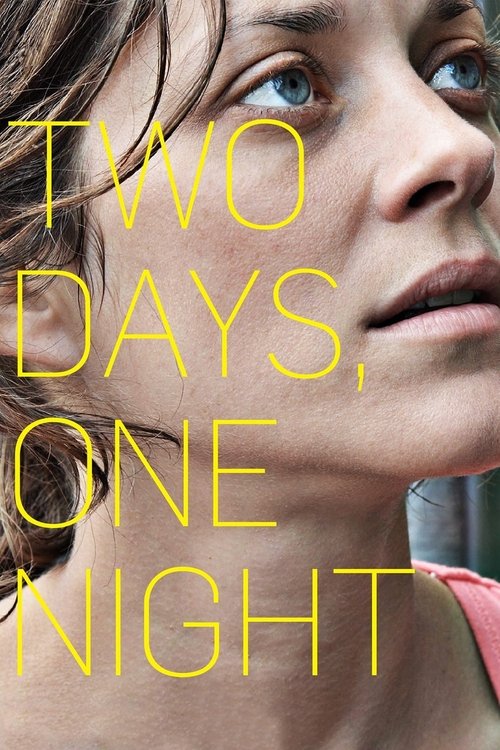
Two Days, One Night
2014 · Jean-Pierre Dardenne
For when you want a film to chew on for days — one that makes an ordinary situation as gripping as any thriller. This is challenge, not comfort, but it repays every minute and ends somewhere earned.
What it's about
Sandra, a factory worker in a Belgian steel town, comes back from medical leave for depression to learn her colleagues have been given a vote: a €1,000 bonus each, or her job. She has one weekend — two days and one night — to knock on sixteen doors and ask people who need the money as badly as she does to give it up for her. Her husband keeps her moving; her own fragility keeps threatening to stop her.
The experience
It's a suspense film built entirely out of doorstep conversations — each knock tightens your chest, because every colleague is a decent person with a real reason to say no. Spare, unsentimental, and quietly devastating, it leaves you arguing with yourself about what you'd do on either side of the door.
Performances
Marion Cotillard, stripped of all movie-star armor, plays Sandra's exhaustion, shame, and flickering resolve with almost documentary transparency — an Oscar-nominated performance where the drama lives in how she gathers herself before each doorbell.
The craft
The Dardenne brothers shoot in long handheld takes that stay at Sandra's shoulder, with no score and no rhetorical push — the tension comes purely from structure, a ticking clock and a running tally. The repetition of the ask, door after door, becomes its own kind of suspense engineering.
Why it matters
A high point of European social realism and the film that proved a global star could disappear into the Dardennes' working-class world, it became a touchstone for how cinema can dramatize economic precarity without a villain in sight.
Snapshot
Two Days, One Night (Deux jours, une nuit) is the eighth narrative feature by the Belgian brothers Jean-Pierre and Luc Dardenne, and the film in which their long-running project — a cinema of the working poor rendered as moral suspense — met a movie star. Marion Cotillard, an Oscar winner and one of the most recognizable French actors of her generation, plays Sandra, a worker at a small solar-panel factory in Seraing returning from a leave for depression. In her absence, management has discovered the plant runs fine without her, and has put the choice to her sixteen colleagues in the form of a vote: a €1,000 bonus each, or Sandra's job. She has a weekend — the two days and one night of the title — to visit them one by one and ask them to vote away their own money.
The premise is a machine of almost mathematical purity, and the film runs it to completion. Each visit is a scene; each scene is a variation; each variation adds a new configuration of shame, solidarity, hostility, or need. The structure is closer to a series of encounters in the manner of a medieval quest or a Bressonian station-drama than to conventional three-act construction, and the Dardennes let the repetition do its cumulative work rather than escalating it artificially. What emerges is not a portrait of villainy but of a system that has been engineered so that workers police each other, and of a woman who must overcome her own conviction that she is worth nothing in order to argue that she is worth something.
The film premiered in Competition at the Cannes Film Festival in 2014, where the Dardennes had already twice won the Palme d'Or (Rosetta, 1999; L'Enfant, 2005). It did not win, but it carried Cotillard to an Academy Award nomination for Best Actress — a rare crossover for a small European art film, and the first Oscar acting nomination for a performance in a Dardenne film. It stands as the Dardennes' most widely seen work and the clearest statement of their political method: no speeches, no villains, no montage of statistics, only a person knocking on a door.
Industry & production
The Dardennes have operated for decades through their own Liège-based company, Les Films du Fleuve, founded in the mid-1990s, in a coproduction structure typical of small-nation European art cinema: Belgian funding braided with French and Italian partners, national film-fund support, television pre-sales, and the Eurimages/regional-incentive apparatus that makes such films financeable at all. The company gives them something most directors of their scale lack — control over budget, schedule, and above all rehearsal time — and it is that control, rather than any technological advantage, that produces the distinctive Dardenne texture.
The single most consequential production decision here was the casting of Cotillard. The brothers had worked almost exclusively with a repertory of Belgian actors — Olivier Gourmet, Jérémie Renier, Fabrizio Rongione — supplemented by nonprofessionals and by unknowns discovered through extensive searching, as with Émilie Dequenne in Rosetta. They had begun edging toward name performers with Cécile de France in The Kid with a Bike (2011), whose casting drew similar advance skepticism and was widely judged to have worked. Cotillard was a larger step: an international star with a heavily mediated public image, dropped into a mode of filmmaking built on the erasure of performance-as-display.
The Dardennes' response was procedural. Their long-established method — weeks of rehearsal on the actual locations, blocking worked out physically with the camera present, the crew rehearsing alongside the cast — was applied to Cotillard as it would be to anyone. She worked in a wardrobe of a single tank top and jeans, without makeup that reads as makeup, and, by the brothers' account in interviews around the film's release, spent the rehearsal period learning to move through the real streets and stairwells of Seraing until the walking itself became unselfconscious. Fabrizio Rongione, a Dardenne regular since Rosetta, plays Manu, Sandra's husband, and the supporting ensemble mixes company veterans with lesser-known and first-time performers, which flattens the star differential inside the frame.
Production took place, as always, in and around Seraing and the Meuse valley industrial belt outside Liège — a region of shuttered steelworks and social housing that has functioned for the Dardennes as Yoknapatawpha functions for Faulkner. The solar-panel plant is a pointed choice: not a dying smokestack industry but a green-economy employer, the kind of firm that is supposed to represent the future, running on the same logic of squeezed headcount and bonus-for-attrition.
Distribution followed the arthouse pattern: Cannes premiere, festival circuit through the autumn, staggered European release, and a U.S. release through IFC's Sundance Selects arm at the end of 2014, timed to awards eligibility. The Cotillard nomination, which surprised most forecasters, materially expanded the film's American footprint. Precise grosses vary by source and are not worth asserting here; what is safe to say is that it performed strongly for a subtitled two-hander-in-multiples and remains among the Dardennes' most commercially visible titles.
Technology
Technologically the film is deliberately unremarkable, and that is a position rather than an oversight. It was shot on 35mm — the Dardennes remained committed to photochemical origination well into the period when most of their European peers had converted to digital capture, and Two Days, One Night belongs to that late-film cohort. The choice is consistent with their aesthetics: film's response to available and mixed light in interiors, its grain in shadow, its unforgiving relationship to underexposure, all reinforce a look that refuses gloss without stylizing grit.
The camera is handheld throughout, often on the shoulder, with the operator's body absorbing the movement rather than a stabilizer smoothing it. There is no Steadicam glide, no drone, no crane; the mobility is human-scaled because a human is carrying it. Lighting is minimal and motivated — daylight through windows, practical fixtures, the flat institutional wash of a factory floor or a supermarket — with the grade holding to a desaturated naturalism.
What technology the film does foreground is diegetic and thematically loaded. The mobile phone is the film's key instrument: Sandra's campaign runs on calls, texts, addresses relayed by her ally Juliette, and the constant low-grade dread of the device ringing with another refusal. The bonus vote itself is a small technology of management — a procedure, a form, a show of hands that converts a corporate decision into a peer verdict. And the plant's product, solar panels, quietly indexes the twenty-first-century economy's habit of dressing precarity in progressive clothing.
Technique
Cinematography
Alain Marcoen has photographed nearly every Dardenne feature since La Promesse (1996), and the collaboration constitutes one of the most consistent director-cinematographer partnerships in contemporary European cinema. His work here is a refinement rather than a departure. The camera stays close to Sandra — a following shot at shoulder height, a half-step behind or beside, framing that crops the world to what she can see and cutting off the reverse-angle comforts of conventional coverage. Where the earlier films (Rosetta especially) used a jittery, aggressive proximity that pinned the viewer to the protagonist's back, the later work including this one is calmer: still handheld, still close, but with longer takes and fewer whip-pans.
Marcoen and the Dardennes largely refuse the shot/reverse-shot grammar of dialogue. A conversation between Sandra and a colleague is more often held in a single mobile two-shot, the camera adjusting to keep both bodies in frame, so that the negotiation happens in continuous space and real time. This has an ethical consequence: you cannot cut away from a person's discomfort, and neither can Sandra. The reaction is not delivered as a separate shot to be edited for effect; it happens in front of you, adjacent to the request that caused it.
There are no establishing shots in the classical sense, no aerial context, almost no wide framing that would let the viewer survey the situation from above. Depth is shallow-ish and the backgrounds are the actual textures of the region. Compositions frequently place Sandra slightly off-center with dead space ahead of her, so the frame is always about to be entered by whatever comes next.
Editing
Marie-Hélène Dozo, the Dardennes' editor across their major features, cuts against the grain of contemporary pacing. Scenes begin fractionally before the dramatic event and end fractionally after — Sandra walking up to the door, the pause on the threshold, the walk away — so that the transitional labor of the quest is preserved rather than elided. Average shot length is long by mainstream standards; within scenes, cuts are functional and unemphatic, motivated by the need to see something rather than by rhythm for its own sake.
The macro-structure is the film's boldest editorial gesture: sixteen colleagues, a serial rhythm of approach-request-response-departure, repeated across a weekend. Conventional wisdom says this cannot sustain a feature. Dozo and the brothers sustain it by varying the internal shape of each unit — one encounter erupts into violence, another dissolves into weeping, another is settled in three words, another is interrupted by a wife or a child or a job — and by threading Sandra's own physical and psychological deterioration through the sequence so the repetition registers as accumulation rather than reiteration. The film's few genuine ellipses (the night that separates the two days, the passage to Monday morning) carry disproportionate weight precisely because so little else is cut around.
Mise-en-scène / staging
Staging is the Dardennes' true medium, and here it is essentially architectural. Nearly every encounter is organized around a threshold: a front door, a garden gate, a car window, the counter of a shop, the edge of a football pitch. Sandra is almost always on the outside asking to be let in — sometimes literally, always structurally. The film's spatial logic makes the class question physical: these are people with homes to defend and a bonus that would fix a leaking roof or pay for a child's schooling, and Sandra's request arrives at the border of their domestic security.
The Dardennes rehearse blocking exhaustively on location before shooting, and the result is choreography that reads as accident. Bodies turn away, step back, resume tasks, keep working while talking. There is almost no dressing of location for expressive effect — the houses are houses, the plant is a plant — and no symbolic props beyond the ones the story requires. Costume is functional and repetitive; Sandra wears essentially the same clothes throughout, which serves both the compressed timeframe and the erasure of the star.
The recurring motif of the car — Manu driving Sandra from address to address, the two of them talking in the front seats, the radio — provides the film's only enclosed, semi-private space, and it is where the film's few moments of tenderness and its worst crises both occur.
Sound
The Dardennes' sound design is famously subtractive: no non-diegetic score, ambient sound recorded on location, and a mix that preserves the acoustic character of each space rather than smoothing it. Traffic, birdsong, a washing machine, the hum of a factory floor, doors, footsteps on stairs. Silence is used structurally — the pause after a refusal, the dead air in a car.
The exception, and it is one of the film's most discussed choices, is the use of pop music heard within the story on car radios: songs that arrive as a small, almost unbearable lift inside an otherwise unscored film. Because the Dardennes have trained the viewer for six features to expect no music at all, a song on a radio detonates. It functions as Sandra's fragile access to feeling — she is medicated, exhausted, flattened — and as a rare permission for the audience to feel something the film has otherwise withheld.
Dialogue is recorded close and played without theatrical projection. Sandra's voice is thin and often at the edge of breaking; the sound of her repeating the same request sixteen times, in slightly different words, is arguably the film's central formal device.
Performance
Cotillard's Sandra is a study in subtraction. The star's arsenal — the expressive face, the vocal control, the capacity for grand emotion that won her the Piaf role — is systematically withheld. She plays depression not as visible grief but as effort: the labor of getting out of a car, of steadying a hand before knocking, of forming a sentence. The performance's engine is the pill, the bathroom, the bed, the recurring collapse; its arc is not from sadness to happiness but from someone who cannot say "I want to keep my job" to someone who can say it and mean it.
Crucially, she is not the film's only performance of note. The sixteen colleagues are played across a spectrum of professional experience, and the Dardennes' method flattens the difference: everyone speaks at the same volume, everyone is given the same right to be understood. Fabrizio Rongione's Manu is a quietly radical piece of writing and playing — a husband whose belief in his wife never wavers and never becomes saintly, whose insistence is sometimes itself a pressure. The colleagues who refuse are given reasons the film respects; the ones who agree are not made heroic. That even-handedness is a performance-directing achievement as much as a script one.
Narrative & dramatic mode
The film's dramatic mode is the moral thriller conducted at the scale of ordinary life. It has a hard deadline (Monday morning), a countable objective (nine of sixteen votes), and a ticking structure — which is to say it borrows the architecture of suspense cinema and fills it with wage arithmetic. The Dardennes have used this shape before: the buried moral debt of La Promesse, the job hunt of Rosetta, the retrieval quest of L'Enfant. Here the mechanism is at its most explicit and most legible, which is part of why the film traveled.
Within that frame the mode is episodic and cumulative rather than escalating. There is no antagonist; the foreman Jean-Marc is a pressure point rather than a villain, and the boss is largely absent, appearing as a policy rather than a person. Conflict is distributed across sixteen faces, and each face carries a legitimate counter-argument. The film is thus organized less as protagonist-versus-obstacle than as a sequence of ethical propositions, each one asking the viewer: what would you vote?
The ending — which the film has been quietly building toward and which turns not on the tally but on Sandra's own decision — is the Dardennes' characteristic move: the resolution of the plot problem matters less than the resolution of the moral one. Grace, in their cinema, arrives as an action, not a feeling, and usually in the last minute. Without spoiling its content: the final scene relocates the film's victory from the vote to Sandra's recovered capacity to refuse on someone else's behalf, and her walk away from the plant is the closest thing the brothers have made to a triumphant ending.
Genre & cycle
The film sits at the confluence of two traditions. The first is social realism in its European strain — the Italian neorealists, the British kitchen-sink and its Loachian descendants, the French naturalist tradition — with its commitment to nonprofessional or de-glamorized performance, real locations, contemporary economic subject matter, and the refusal of consolation. The second is what might be called the moral-crisis film, the Bressonian and Rossellinian lineage in which an ordinary person is placed under a spiritual test and the camera watches whether they pass.
Within the Dardennes' own filmography it belongs to their late cycle. After the hard, near-abrasive early work (La Promesse, Rosetta, Le Fils, L'Enfant), The Kid with a Bike marked a softening — brighter palette, professional lead, a fairy-tale substructure, and the first flickers of non-diegetic music. Two Days, One Night continues that opening-out: star lead, clearer premise, more accessible emotional register, and an ending less withholding than any that preceded it. Critics divided on whether this represented maturity or dilution, a debate that has followed the brothers through The Unknown Girl (2016), Young Ahmed (2019), and Tori and Lokita (2022).
As a cycle marker in the broader culture, it belongs unmistakably to post-2008 crisis cinema: the wave of European films about austerity, precarity, and the gig-and-bonus economy that runs alongside Laurent Cantet's workplace films, Stéphane Brizé's The Measure of a Man (2015) and At War (2018), and Ken Loach's late-career I, Daniel Blake (2016) and Sorry We Missed You (2019). Two Days, One Night is arguably the crispest formal solution any of them found to the problem of dramatizing an economic structure.
Authorship & method
Jean-Pierre and Luc Dardenne write and direct jointly, and their method is unusually stable and unusually documented — Luc has published production diaries that describe the working process in detail. They begin from a situation rather than a plot, work the screenplay through many drafts, and then rehearse extensively on the actual locations, blocking every movement with the camera present so that the shot and the performance are developed together rather than sequentially. Shooting is done with high take counts; the goal is not spontaneity in the improvisational sense but a physical exactness so thoroughly internalized that it stops looking like acting.
Their key collaborators have been with them for decades. Alain Marcoen (cinematography) and Marie-Hélène Dozo (editing) have shaped the visible surface of the films since the mid-1990s; Igor Gabriel has served as production designer across the body of work. Les Films du Fleuve, their own company, provides the production continuity. Notably, there is no composer credit in the conventional sense on their major features, because there is no score — a structural authorship decision as significant as any positive one. The brothers came to fiction from documentary, having spent the 1970s and 80s making video documentaries about working-class and resistance history in the Liège region, and that formation is legible in every subsequent frame: the interest in labor, the suspicion of rhetoric, the sense that a camera's job is to be present rather than to comment.
The intellectual frame is explicitly ethical. Luc Dardenne has written at length about the influence of the philosopher Emmanuel Levinas, whose account of the face of the other as the ground of moral obligation maps almost directly onto the brothers' formal practice — the insistence on holding a person in frame, the refusal of the god's-eye view, the drama that turns on whether a character can see another person as a person. Two Days, One Night is the most literal expression of this in their work: a film in which the entire plot consists of one woman presenting her face to sixteen others and asking what they owe her.
Movement / national cinema
Belgium's francophone cinema is small, and the Dardennes are its dominant international presence. Working out of Wallonia — a region defined by the collapse of coal and steel and by the political and linguistic tensions of the Belgian federal settlement — they have made a national cinema out of a post-industrial locality, in the way that certain Iranian, Romanian, or Taiwanese filmmakers built international reputations from intensely specific ground.
The Wallonian setting is not incidental. Seraing's mills closed across the late twentieth century, and the region's unemployment and social-housing landscape supplies the films' entire material vocabulary. The Dardennes have also consistently attended to migration — undocumented workers in La Promesse, African migrants in Tori and Lokita — and Two Days, One Night quietly registers the same texture in its ensemble, where the colleagues include workers on precarious contracts and of varied origin, all subject to the same bonus mathematics.
Internationally they are usually grouped with the strand of 1990s–2000s festival realism that also includes the Romanian New Wave, certain Iranian filmmakers, and the Anglo-Irish social realists — a loose formation defined less by manifesto than by shared method: long takes, handheld camera, no score, nonprofessional or de-starred performance, contemporary subject matter, moral rather than psychological drama. Cannes has been the institution that sustained and canonized this formation, and the Dardennes are among its most decorated figures, being two-time Palme laureates and near-permanent fixtures of Competition.
Era / period
The film is precisely of its moment: 2014, six years into the aftermath of the global financial crisis, in a Europe where austerity had become the governing common sense and where the vocabulary of flexibility, restructuring, and productivity had thoroughly colonized workplace life. The specific device — asking workers to vote on whether a colleague's job is worth their bonus — is a fictional construction, but it dramatizes a real and well-documented management logic in which cost pressure is displaced downward and workers are made complicit in decisions that were never theirs to make.
The green-energy setting sharpens the period signature. A solar-panel plant in 2014 is an emblem of the future economy; its labor practices are indistinguishable from those of the industry it replaced. The film also sits at a moment when depression and mental health had become newly visible as workplace issues without becoming newly protected — Sandra's illness is simultaneously the reason for her leave, the pretext for her expendability, and the obstacle to her fighting back.
Formally, 2014 is late in the life of celluloid production and late in the Dardennes' hard-realist phase; the film registers both as a summation and as a hinge toward the more openly humane late works.
Reception, canon & influence
Critical reception was strongly positive, and the near-universal talking point was Cotillard — specifically, whether a star could survive the Dardennes' method, and the widespread conclusion that she had, by disappearing into it. The film appeared on many international year-end lists for 2014 and 2015 (its U.S. release straddled the boundary) and drew particular praise for the audacity of its structure. The dissenting line, present in a minority of reviews, held that the premise was schematic and that the star casting softened the brothers' astringency — the same argument that had greeted The Kid with a Bike.
Its most consequential institutional recognition was Cotillard's Academy Award nomination for Best Actress, a genuinely unusual outcome for a French-language art film without a major awards campaign behind it, and a mark of how completely the performance registered even for viewers outside the Dardennes' usual audience. At Cannes the film competed for the Palme d'Or without winning; the brothers' two prior Palmes remain their headline festival honors.
Backward — what shaped it. The lineage is legible and the Dardennes have never hidden it. Robert Bresson is the deepest source: the fragmentation of the body into hands and doors and objects, the flat non-performance, the moral test resolved by an act of grace, and above all Mouchette and L'Argent as models for tracing a social mechanism through a single vulnerable body. Italian neorealism, especially Bicycle Thieves, supplies the shape of the quest through a city for an economic object. Ken Loach and the British social-realist tradition supply the political register, though the Dardennes are notably less interested than Loach in explicit argument. Rossellini's postwar films underwrite the belief that a camera pointed at the real can carry a moral charge. And their own documentary apprenticeship in the Liège industrial belt supplies the ground truth. Levinasian ethics, as noted, provides the conceptual spine.
Forward — what it shaped. The film's most durable contribution is a formal solution rather than a style: the demonstration that a rigorous, essentially procedural structure — one request, repeated N times, against a deadline — can hold a feature and produce something closer to suspense than to sociology. That template has been visible in subsequent European social cinema, and the broader post-crisis workplace cycle around Brizé, Loach's late films, and a range of festival titles about precarity shares its terrain if not always its discipline.
Its second legacy is a casting argument. Two Days, One Night is now the standard citation for the proposition that a major star can be absorbed into a realist method without breaking it, provided the method rather than the star sets the terms. That argument has been made by other films since — stars submitting to observational, de-glamorized, long-take work — and the Dardennes' example is regularly invoked in the discussion.
Within the brothers' own career, the film marks the point at which their late manner consolidated: professional leads, cleaner premises, and endings that permit something like hope. It is also, for many viewers, the entry point to the filmography — the Dardenne film most likely to be assigned in a course on labor and cinema, most likely to be screened in a political context, and most likely to be the first one someone sees. Whether it will hold the canonical position of Rosetta — which is credited with prompting Belgian youth-employment legislation informally known by the film's name, and which remains their most historically consequential work — is unsettled. What is not in doubt is that it is their most perfectly engineered one: a film whose entire argument is contained in the act of a tired woman knocking on a door and saying, again, I know this is difficult, but I need to ask you something.
A Deleuzian reading
A woman stands at a garden gate and doesn't knock yet.
The full Deleuzian reading of Two Days, One Night →
Reception
A Cannes 2014 critical darling that shockingly left the festival empty-handed, it's since climbed steadily — now routinely named among the best films of the 2010s and the crown jewel of the Dardennes' late period.
How Two Days, One Night was received, from release to now →
How to watch Two Days, One Night: what to notice on a first viewing
- Notice you never get a wide shot to get your bearings. Marcoen's camera stays at Sandra's shoulder throughout the film; there are no establishing or aerial shots that would let you survey a scene from above. The film only shows you what she can see, so her isolation becomes yours too.
- Notice conversations are held in one continuous shot. Marcoen and the Dardennes shoot dialogue as a single mobile two-shot instead of cutting between faces, so nobody's reaction is ever edited away. You cannot cut away from someone's discomfort, and neither can Sandra.
- Watch for a doorway, gate, or car window at each visit. Nearly every encounter is staged at a threshold, with Sandra outside asking to be let in, structurally as much as literally. The class question becomes physical: these are people with homes to defend, and she is on the wrong side of the door.
- Listen for whether any music plays outside a car radio. There is no score at all; the only music comes from car radios, so when a song plays it lands as an event, not as backing. The absence of score all film makes the one pop song that plays feel like a small, unbearable lift.
- Watch the effort in small actions, like getting out of a car. Cotillard plays exhaustion and depression as labor rather than visible grief: steadying a hand, forming a sentence, standing up. Feeling here is carried in effort and posture, not in an expressive face.
The whole guide to watching Two Days, One Night, with the keys for a rewatch →
Influences: the films it descends from and the films it influenced
- Mouchette (1967) — Bresson's fragmentation of a girl's ordeal into hands, doors and objects, with affect drained from the face, is the direct model for staging Sandra's appeals as a series of thresholds and gestures rather than reaction shots.
- L'Argent (1983) — Its chain-of-consequence construction — a single economic token passed hand to hand, each transfer a self-contained moral unit — supplies the modular episode architecture the Dardennes convert into a countable series of visits.
- Bicycle Thieves (1948) — The neorealist quest-through-the-city-for-an-economic-object, shot on real streets with the walking between destinations left in, is the itinerary structure rerun with a wage in place of a bicycle.
- Umberto D. (1952) — De Sica's preservation of unproductive transitional time — the waiting, the loss of nerve before asking someone for money — licenses the refusal to cut between doorsteps and the retention of every approach and departure.
- Cléo from 5 to 7 (1962) — A near-real-time countdown imposed on a woman crossing a city, every encounter measured against a verdict she cannot influence, is the structural precedent for the weekend-deadline armature.
- Jeanne Dielman, 23 Quai du Commerce, 1080 Bruxelles (1975) — Akerman's Belgian wager that exact serial repetition can carry a feature — training the viewer in a pattern so that deviation registers as event — is the formal engine retooled here into suspense.
- Raining Stones (1993) — Loach's episodic chain of humiliating money-raising attempts against a fixed date supplies both the serial-attempt shape and the political register, which the Dardennes keep while stripping out his explicit argument.
- Rosetta (1999) — Alain Marcoen's shoulder-mounted camera trailing the protagonist's nape at fixed distance, with no establishing shots and no score, is invented here and applied to Sandra essentially unchanged.
- Le Fils (The Son) (2002) — Its systematic refusal of shot-reverse-shot — holding both parties in one cramped frame so a moral confrontation cannot be edited into comfort — is the grammar that governs every doorstep exchange.
- The Kid with a Bike (2011) — The immediate rehearsal for star-subtraction: a professional lead (Cécile de France) de-glamorized through on-location rehearsal until performance flattens, paired with the cleaner premise and permitted-hope ending of the late manner.
- They Don't Wear Black Tie (1981) — Reduces solidarity-vs-survival to a chamber structure of coworkers voting whether to sacrifice a bonus to save a colleague's job — the picket-line betrayal dialectic distilled through observational, near-real-time naturalism.
- The Working Class Goes to Heaven (1971) — Carries forward the representation of industrial labor without sentimentality via restless handheld camerawork and a worker set against colleagues by managerial pressure.
- La loi du marché (The Measure of a Man) (2015) — Brizé embeds a single professional actor among nonprofessionals playing their actual jobs and shoots the friction in long observational takes — the casting proposition Cotillard's performance had just validated.
- I, Daniel Blake (2016) — Loach's late turn to one claimant repeating a single request across a bureaucracy, each rebuff its own scene, adopts the request-repeated-N-times structure rather than his earlier ensemble form.
- American Honey (2016) — A door-to-door sales structure in which a young woman delivers the same pitch to strangers on thresholds, shot handheld from the shoulder with nonprofessional players and pop sourced diegetically from the van stereo.
- Never Rarely Sometimes Always (2020) — A compressed deadline quest for a medical procedure, followed handheld and scoreless, whose moral test is staged as a single unbroken take of a questionnaire rather than as dramatized crisis.
- Nomadland (2020) — Frances McDormand is absorbed into an ensemble of nonprofessionals playing themselves and pitched down to their register — the star-submits-to-method argument that Two Days, One Night is the standard citation for.
- Tori and Lokita (2022) — The brothers' own re-run of the engineered procedural quest — a hard clock, a series of threshold-blocked transactions, no score — now split across two bodies instead of concentrated in one.
- Emily the Criminal (2022) — The Dardennes' use of Marion Cotillard performing exhausting economic labor across a single-goal mission — shot handheld with physical closeness that makes her exertion palpable — established the performance-as-physical-endurance model that Plaza extends in Emily's escalating criminal commitments.
- Happening (2021) — Builds an escalating deadline structure — a woman driven through a gauntlet against a hard clock — the ticking-clock architecture Happening chapters by weeks.
- All Your Faces (2023) — Structures the whole film as a series of repeated one-on-one moral appeals, each a variation on the same conversation, mirroring Herry's parallel-strand accumulation of mediation encounters.
- Souleymane's Story (2024) — The seed's compressed two-day ticking-clock structure lifts directly from this: a protagonist making a deadline-bound round of encounters, each a tense two-hander that must be 'won' before time runs out.
- A Place for Her (2026) — Builds drama as a repeated series of one-on-one workplace confrontations, each colleague encounter a discrete procedural beat that accumulates into a portrait of a labor collective under pressure.
- Yellow Letters (2026) — The airtight-premise architecture Duncker's screenwriting shares: one irreversible administrative condition stated in the first minutes, then a serial structure of doorstep encounters in which every scene is forced by the premise and no scene requires a villain.
- 4 Months, 3 Weeks and 2 Days (2007) — Extracts thriller-grade tension from an unglamorous procedural errand under a hard clock using long unbroken takes, available light and no score — the same conversion of obstruction and negotiation into suspense.
- The Death of Mr. Lazarescu (2005) — Builds its whole runtime from one request repeated at successive institutional thresholds, each refusal a discrete scene with preserved transit between them, arriving independently at the same repeat-the-ask architecture.
- Oslo, August 31st (2011) — The Dardennes' one-weekend social-round structure — a protagonist making serial visits that accumulate into a portrait of social impossibility — is the closest formal parallel to Oslo's day-of-visits architecture, both films using repetition-with-variation across encounters as their central dramatic engine.
- Young Mothers (2025) — Structures an entire film as repeated face-to-face moral appeals shot handheld in natural light without score, the door-to-door ethics that Young Mothers extends into its ensemble of women.
- Love Letters (2025) — Supplies the ticking-procedural engine — a protagonist working through a finite sequence of documentary/administrative steps — and the handheld, present-tense realism that turns paperwork into suspense.
- A Hero (2021) — Sibling built on the same door-to-door negotiation structure, where a person must plead their case repeatedly and each encounter re-weights the moral ledger, shot in restrained handheld realism.
Similar films
- Rosetta (1999) — influence & lineage
- The Kid with a Bike (2011) — influence & lineage
- 4 Months, 3 Weeks and 2 Days (2007) — influence & lineage
- L'Argent (1983) — influence & lineage
- Young Mothers (2025) — shared sensibility
- The Child (2005) — shared sensibility
- Souleymane's Story (2024) — shared sensibility
- Jeanne Dielman, 23, quai du Commerce, 1080 Bruxelles (1976) — shared sensibility