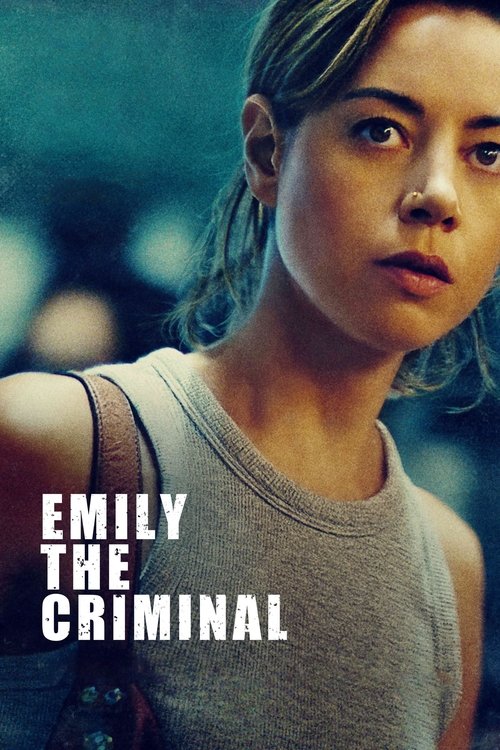
Emily the Criminal
2022 · John Patton Ford
When you want a gripping, no-fat crime story you can finish in one sitting and still have something to argue about — the anger under it is the point. Tense but very watchable; a great pick when prestige-length dramas feel like homework.
What it's about
Emily is buried in student debt, locked out of decent jobs by an old felony record, and delivering food to stay afloat in Los Angeles. A tip leads her to a 'dummy shopper' gig — walking out of stores with goods bought on stolen credit cards — run by a charismatic middleman named Youcef. The money is fast, the danger is real, and the two of them start thinking bigger.
The experience
Lean, tense, and propulsive — every job Emily pulls tightens your stomach, because the film makes you feel how thin the margin is between getting paid and getting hurt. It moves like a thriller but stings like a bill you can't pay.
Performances
Aubrey Plaza strips away her deadpan comic persona for something harder and hungrier — you watch desperation calcify into nerve in real time — and Theo Rossi gives Youcef a warmth that keeps the film's one tender thread alive.
The craft
John Patton Ford shoots LA at street level — parking structures, warehouses, strip malls — with a handheld naturalism that makes every transaction feel like it could go wrong. The script is ruthlessly economical: no wasted scene, and the tension comes from logistics, not contrivance.
Why it matters
A festival breakout that announced Ford as a director to watch and reframed Plaza as a serious dramatic lead, it hit a nerve with anyone who's done the math on debt and dead-end wages.
Snapshot
A tightly coiled Los Angeles crime film built around economic desperation rather than glamour, Emily the Criminal announced John Patton Ford as a serious directorial voice and delivered Aubrey Plaza's most sustained dramatic performance to date. Emily Benetto, burdened by student-loan debt and locked out of legitimate employment by a prior felony conviction, is recruited into a credit-card fraud ring run by a Lebanese-American middleman named Youcef. What begins as transactional escalates — romantically, financially, violently — until Emily embraces criminality not merely as survival but as identity. Shot with a leaned-in naturalism on the streets and parking structures of Los Angeles, the film belongs to a durable lineage of American crime dramas that treat illegality as a diagnostic lens on economic structure rather than a source of moral condemnation.
Industry & production
Emily the Criminal was produced as an independent feature and marks the feature debut of writer-director John Patton Ford, who had worked previously in short-form fiction. Aubrey Plaza was attached early as both lead and producer, operating through her production company Evil Hussy Productions — an arrangement that gave Plaza unusual creative leverage and helped the project maintain its lean, uncommercial shape. The film premiered at the Sundance Film Festival in January 2022, where it generated significant acquisitions interest; Roadside Attractions took domestic theatrical rights, with Netflix acquiring streaming rights for the United States following its theatrical run. The production was shot entirely on location in Los Angeles, with a modest budget that Ford and his collaborators have discussed publicly in general terms as necessitating efficiency and practical resourcefulness, though specific figures should not be stated here without reliable sourcing. The credit-card fraud scheme depicted — known in criminal parlance as "carding" or "dummy shopping," in which buyers use stolen card data to purchase goods that are then fenced — was researched for accuracy and lends the film an unusual procedural authenticity for an independent thriller.
Technology
The film was captured digitally, consistent with the standard practice of independent American production in this period. The digital format suits the aesthetic ambition: a clean, available-light-adjacent image that neither glamorizes its environments nor aestheticizes poverty. The color grade sits in warm Los Angeles midtones — ochre concrete, bleached asphalt, the amber of fluorescent-lit interiors — without sliding into the teal-and-orange conventions of commercial genre filmmaking. Post-production was managed at an independent scale, and the finished film's technical polish given its budget constraints received notice from reviewers attuned to craft. The film does not use visual effects in any significant way; its thriller elements are achieved through staging, editing tempo, and sound design rather than digital augmentation.
Technique
Cinematography
Cinematographer Jeff Bierman, working closely with Ford, established a mobile, close-quarters visual grammar that places the camera in uncomfortable proximity to Plaza's face throughout. The lens stays near Emily — rarely granting the distancing medium shots that would allow the audience to evaluate her from outside. The effect is less identification in the conventional sense than entrapment: we share her narrow bandwidth of attention, her tunnel vision as she reads a room for danger or opportunity. Handheld work dominates the film's active sequences, particularly the tense buying runs in retail parking lots, but the handheld is disciplined rather than agitated — it communicates embodied alertness rather than chaos. Wider, more static compositions appear when Emily is in institutional or formally hierarchical spaces (the staffing agency, the office where she is humiliated), reinforcing her spatial subordination. Natural light is used wherever possible, and Bierman's exposure choices lean toward letting the image breathe warmly rather than pressing for clinical precision.
Editing
The editing rhythms are notably controlled for a thriller, resisting the temptation to use fast cutting as a substitute for tension. Ford, who wrote and directed, clearly understood that dread accumulates best when scenes are allowed to play out in duration — a buying run is frightening because we watch it unfold in something approaching real time, not because it is broken into frenetic fragments. The first major transaction scene in a car dealership, which puts Emily in contact with a volatile and threatening buyer (Bernardo), is edited so that no cut relieves the pressure; the camera stays on faces and the scene threatens to tip into violence long past comfortable. The film's overall architecture is clean: scenes run to their natural length and end without coda. The record on the specific editor or editing room dynamics is not detailed in publicly available production accounts, and specific claims should not be made here.
Mise-en-scène / staging
Ford's staging choices throughout reflect a social-realist discipline: nothing is decorated, nothing is art-directed for atmosphere beyond what the real locations already offer. The Los Angeles of Emily the Criminal is the city of logistics and hustle — parking structures, storage units, the backs of restaurants, freeway-adjacent commercial strips. Youcef's apartment, where Emily begins to spend time, registers as lived-in and modest, its warmth belonging to the people rather than to any production design statement. The "dummy shopping" transactions are staged for maximum procedural legibility; Ford wants the audience to understand exactly how the scheme works, and his staging is instructive in the manner of the best heist subgenre filmmaking, without ever pausing to explain itself. The film's violence, when it arrives, is staged practically and without choreographic elaboration — it is fast, ugly, and consequential.
Sound
The sound design carries much of the film's tension. Urban ambience — traffic, air conditioning, the hum of commercial spaces — is used not as texture but as psychological pressure. The film understands that silence in a tense environment is not neutral; it is the interval between stimulus and catastrophe. The score (the specifics of whose compositional credit the public record should be consulted for independently) is restrained, appearing more as atmosphere than melodic commentary, in keeping with the film's overall resistance to underlining emotion. Dialogue recording is clean and intimate, placing voices close in the mix and reinforcing the film's close-quarters visual aesthetic.
Performance
The central performance by Aubrey Plaza is the film's principal achievement and the element that anchors every other craft decision. Plaza built her public persona through deadpan comic work on Parks and Recreation and in films by directors like Miguel Arteta and Jim Strouse, work that often deployed her ironic detachment as a form of audience self-consciousness. In Emily the Criminal, Ford and Plaza route that quality elsewhere: Emily's flatness is not postmodern wit but emotional scar tissue — the affectless surface of someone who has been let down too many times to perform optimism. Plaza locates Emily's intelligence and resourcefulness as the same faculty as her rage, and makes the transition from victim of the system to agent of her own criminality feel continuous rather than transformative. Theo Rossi as Youcef contributes a performance of considerable warmth and complexity; his character is neither straightforwardly corrupt nor romanticized, and Rossi's work gives the film's central relationship enough texture that its erotic dimension earns rather than merely asserts itself. Gina Gershon appears in a brief but pointed scene as a creative-industry employer who offers Emily unpaid labor in exchange for access — the scene is a crystalline summary of the film's argument and Gershon plays it with knowing precision.
Narrative & dramatic mode
The film uses a classical dramatic structure — problem, escalation, crisis, resolution — but deploys it against the expectations of the crime genre by keeping motivation rigorously economic throughout. Emily does not become a criminal because she is seduced by the lifestyle or because of a character flaw; she becomes a criminal because the legitimate economy has nothing to offer her that does not involve exploitation. Ford is scrupulous about this: the film traces Emily's student-loan debt, her criminal record (a DUI), and her exclusion from the creative-professional world not as backstory but as continuous present. The narrative mode is closer to the social-problem film than to the thriller, even as Ford uses thriller mechanics — mounting stakes, ticking-clock set pieces, the threat of violence — with considerable craft. The ending, which declines to punish Emily, is the film's most pointed dramatic choice: she succeeds, by the terms the film has established, and the moral weight rests not on her but on the conditions that created her.
Genre & cycle
Emily the Criminal participates in a cycle of American independent films from the late 2010s and early 2020s that approached economic precarity through genre frameworks — a tendency visible in films like Uncut Gems (the Safdie Brothers, 2019), Nomadland (Chloé Zhao, 2020), and Ramen Shop (Eric Khoo, 2018) in adjacent national traditions, as well as in the social-realist crime work of the Dardenne Brothers in Belgium. Ford's film sits closer to the Lumet tradition — Dog Day Afternoon (1975), Before the Devil Knows You're Dead (2007) — than to the hyperkinetic neo-noir of the Safdies, though it shares their commitment to systemic critique. The credit-card fraud subgenre is relatively thin in American cinema; the film's procedural specificity is largely original rather than generic. Ford also draws on the tradition of the female-centered crime film, a cycle that includes Fish Tank (Andrea Arnold, 2009), Winter's Bone (Debra Granik, 2010), and Beasts of the Southern Wild (Benh Zeitlin, 2012), films in which the criminal or survival narrative is inseparable from a critique of how institutional America fails young women.
Authorship & method
John Patton Ford wrote the script before securing financing and direction, which is significant: the film reflects a writer-director's integrated vision rather than an adaptation or assignment. Ford trained at UCLA's film school, and Emily the Criminal exhibits the methodological traces of that formation — the social-realist influences, the comfort with location work, the interest in systemic rather than individual causation. His method on set, as described in interviews, emphasized practical preparation that would allow for flexibility and discovery during shooting rather than rigid adherence to shot lists. The collaboration with Aubrey Plaza appears to have been foundational: the two developed the script together in key respects, though Ford retains the writing credit, and Plaza's production-company involvement meant she was a creative interlocutor across the full development process. Jeff Bierman as cinematographer brought a visual approach compatible with the film's social-realist ambitions and prior experience with low-budget independent production that made him a pragmatic as well as aesthetic choice.
Movement / national cinema
The film belongs to American independent cinema in its post-Sundance form — a tradition with clear institutional parameters (the festival premiere, the dual theatrical-streaming release, the independent financing model) but significant aesthetic diversity within those parameters. More specifically, it participates in the Los Angeles-set social-realist strand that has periodically surfaced throughout American independent film history, from Charles Burnett's Killer of Sheep (1978) to Sean Baker's work (Tangerine, 2015; The Florida Project, 2017). That Los Angeles functions here not as the mythologized city of the industry but as a sprawling labor market of opportunity withheld is a recurring refrain in this strand. Ford does not position the film explicitly in relation to a national-cinema argument, but its sympathy with immigrant-adjacent characters — Youcef and his cousin operate the fraud scheme as a form of parallel economy — connects it to a broader conversation about who the American economy serves.
Era / period
The film captures a specific moment in American economic experience: the post-2008, post-pandemic landscape in which credential inflation has eroded the value of degrees whose debt burdens were incurred on the promise of professional access. Emily's situation — art-school graduate, student-loan debtor, locked out of the creative economy by a minor criminal record — is not unusual, and Ford's portrait of it is sociologically current in a way that will likely date the film historically as a document of this specific conjuncture. The gig economy is present throughout: the app-based food delivery work Emily does, the staffing agency with its extractive commission structure, the unpaid internship the Gina Gershon character proposes — these are the texture of American working life in the 2020s rendered with documentary accuracy.
Themes
Economic precarity and structural exclusion are the film's organizing concerns. Emily's criminality is presented as a rational response to an irrational system, and the film does not permit the audience an exemption from that logic: the same people who would condemn her choices are, in many cases, the architects of the conditions that produced them. The film is also a study in agency: Emily's arc moves from passivity and victimhood toward increasingly active self-determination, even as the means of that determination are illegal. Ford is interested in the relationship between debt and freedom — debt as a structure of control, and illegality as one of the few available exits from that structure. The romantic subplot with Youcef is handled with enough realism to avoid sentimentality: attraction here is partly ideological, a recognition of shared position outside legitimate economic participation. The film treats the immigrant-American experience with care through Youcef and his family, though this is a supporting strand rather than the film's primary concern.
Reception, canon & influence
Critical reception on Emily the Criminal's Sundance premiere and subsequent release was strongly positive, with particular attention directed at Plaza's performance, which was described by several major critics as revelatory. The film accumulated strong scores on aggregator platforms and generated serious awards-season conversation, including recognition from critics' circles and independent film bodies, though it did not penetrate the major guild awards in the way that some observers anticipated. The film's commercial performance was modest in theatrical release — consistent with its independent scale and the challenging post-pandemic exhibition environment — but its streaming afterlife on Netflix gave it a significantly larger audience over time.
Looking backward, the film's most evident influences are the crime-social-realism of Sidney Lumet, the economic-desperation mode of the Dardenne Brothers, and the female-centered survival narratives of Andrea Arnold and Debra Granik. There are also structural echoes of Michael Mann's interest in professionalism as identity — the way Emily commits to criminality with increasing craft and self-possession has a Mannian quality, though Ford's aesthetic is cooler and more restrained than Mann's. The procedural clarity of the fraud sequences suggests familiarity with the best of the heist tradition.
Looking forward, the film's influence is as yet limited by its recency and the typical lag between film release and demonstrable influence on subsequent work. It has, however, contributed to the rehabilitation of Aubrey Plaza as a dramatic lead of considerable range, which has downstream effects on casting and development. The film also represents a credible model for socially engaged, low-budget independent genre cinema that does not require the maximalism of the Safdies to achieve intensity — a quiet proof of concept for a more spare mode of American crime filmmaking. Ford's subsequent career will determine how the film is positioned historically; as of this writing, it remains his only completed feature and functions as a debut of real promise whose long-term canonical weight remains to be established.
A Deleuzian reading
A woman walks goods she didn't pay for out of a store, on a card that isn't hers, and the camera will not give us the reassuring wide shot that would let us judge her from across the lot.
The full Deleuzian reading of Emily the Criminal →
Reception
A buzzy Sundance 2022 debut that got glowing reviews but a quiet theatrical run — then blew up when it hit Netflix that December, topping the charts and getting rediscovered as one of the year's best sleepers, right in the middle of Aubrey Plaza's White Lotus-fuelled career surge.
How Emily the Criminal was received, from release to now →
Influences: the films it descends from and the films it influenced
- Dog Day Afternoon (1975) — Lumet's handheld, location-shot New York methodology — available light, ambient street sound as pressure environment, and an amateur's escalating criminal commitment rendered through close observational coverage — establishes the economic-desperation-as-crime template Ford explicitly works within.
- Thief (1981) — Mann's decision to film James Caan's safecracking with procedural precision — lingering on the tactile details of criminal craft as a form of professional expertise — provides the template for Ford's fraud-training sequences, where Emily's growing technical skill is treated with the same seriousness Mann extended to career criminals.
- Rosetta (1999) — The Dardennes established the exact grammatical package Ford deploys: handheld camera locked at shoulder height behind a young working-class woman's body across a single-minded economic quest, available light, location-only shooting, and the complete suppression of non-diegetic score.
- The Son (2002) — The Dardennes' use of sustained long-take observation to build tension through procedural task-performance — the camera following a body through skilled work without explanatory cutting — directly informs Ford's staging of Emily's fraud-training sequences as scenes of craft acquisition under pressure.
- Frozen River (2008) — Hunt's spare Sundance debut — a single mother who crosses into criminality out of economic necessity, shot in available light with social-realist locations and near-total score suppression — provides the closest structural and formal American precedent: female protagonist, rational criminality, debut austerity.
- Wendy and Lucy (2008) — Reichardt's micro-budget aesthetic — female protagonist in economic freefall, available light, score almost entirely suppressed, the environment as an indifferent economic system — established the austere formal mode within American independent cinema that Ford adapts for the Los Angeles social-realist context.
- Fish Tank (2009) — Arnold's close-quarters handheld technique, tracking a young woman's body through marginalized urban space in available light with ambient sound replacing score, provided a key technical model for the cinematographic approach Jeff Bierman applies to Emily's navigation of the city.
- Winter's Bone (2010) — Granik's female-protagonist survival narrative — Jennifer Lawrence's physically committed, economically motivated performance driving a procedural quest through criminal-adjacent territory — established both a performance model and a genre framework for the female-centered American independent crime film that Emily inherits.
- Two Days One Night (2014) — The Dardennes' use of Marion Cotillard performing exhausting economic labor across a single-goal mission — shot handheld with physical closeness that makes her exertion palpable — established the performance-as-physical-endurance model that Plaza extends in Emily's escalating criminal commitments.
- American Honey (2016) — Arnold's sustained handheld available-light shooting across American working-class landscapes, following a young woman's economic self-determination through marginal channels with a 4:3 aspect ratio that intensifies bodily intimacy, established the visual grammar Ford adapts for Los Angeles.
- A Thousand and One (2023) — Rockwell's Sundance Grand Jury Prize debut extends the female-centered American social-realist mode — handheld intimacy, economic desperation, urban locations as systemic pressure environment, a Black female protagonist whose crimes are rendered rational by circumstance — demonstrating the durability of the formal template Emily consolidated.
- Heaven Knows What (2014) — The Safdies' early feature deployed the same core technical package — handheld available light, urban ambient sound as psychological pressure, female protagonist in economic extremity — establishing this cluster as a defining approach of American independent crime film, which Ford works within at a more controlled register.
- Tangerine (2015) — Baker's Los Angeles-set, available-light handheld film about economically precarious women navigating criminally adjacent survival — shot entirely in practical spaces using ambient sound design — shares Ford's procedural intimacy and commitment to the city as an indifferent economic environment.
- Good Time (2017) — The Safdies established the high-intensity pole of the post-Dardenne American independent crime tradition against which Ford's film defines itself; Emily the Criminal is the dossier's own 'spare alternative' to Safdie maximalism, and the two films together mark the range of the mode.
- Uncut Gems (2019) — The Safdies' sound-design methodology — overlapping dialogue, street noise, and electronic score fragments used as sustained psychological pressure rather than emotional signposting — mirrors Ford's deployment of Los Angeles urban ambience as the film's primary tension mechanism.
- Shoplifters (2018) — Kore-eda's staging of family theft as economically rational survival behavior — procedurally legible criminal activity rendered with a non-judgmental observational camera and no scoring — shares Emily's central dramaturgical argument that criminality is a coherent response to systemic economic exclusion.
Similar films
- Shoplifters (2018) — influence & lineage
- Crime 101 (2026) — same viewing thread
- Ambulance (2022) — same viewing thread
- The Order (2024) — shared sensibility
- Rebel Ridge (2024) — shared sensibility
- Souleymane's Story (2024) — shared sensibility
- Crisis (2021) — shared sensibility
- One False Move (1992) — shared sensibility
All the films related to Emily the Criminal →
Watch it with: curated runs of related films
- The Walls Close In — A run of lean 2020s crime thrillers where an ordinary person gets pulled past the point of no return and the pressure keeps ratcheting.