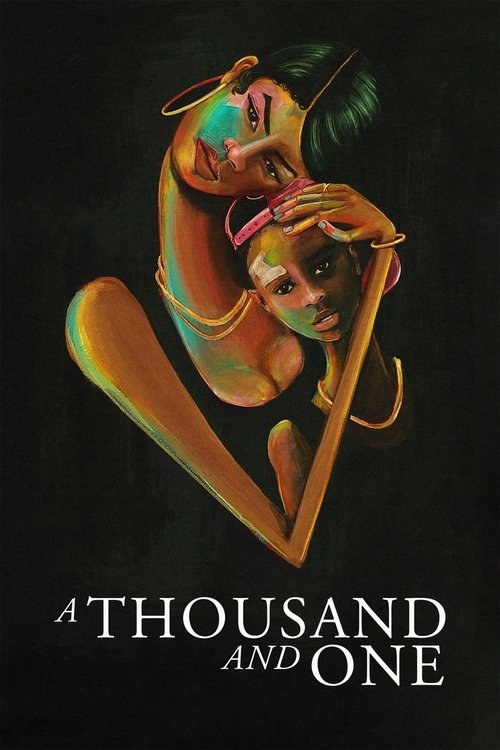
A Thousand and One
2023 · A.V. Rockwell
When you want a film to sit with — a serious, absorbing drama for a night you're ready to feel something and think about mothers, cities, and what people sacrifice to keep a family together. More challenge than comfort, but deeply rewarding.
What it's about
Fresh out of Rikers in 1994, a hairdresser named Inez does the one thing she can't undo: she takes her six-year-old son Terry out of foster care without permission and raises him in Harlem under an assumed life. The film follows them across more than a decade of ordinary days — school, work, a growing family — while the secret ticks underneath and the neighborhood gentrifies around them, block by block.
The experience
Patient, tender, and quietly suspenseful — it moves like a novel, letting years pass while a low hum of dread builds under the love. It earns its emotions the slow way, and the last stretch hits hard.
Performances
Teyana Taylor is ferocious and wounded as Inez — a performance that swept critics' awards — and three different actors carry Terry from boyhood to the edge of manhood without a seam showing.
The craft
Eric K. Yue's grainy, sun-warmed cinematography makes 90s Harlem feel remembered rather than recreated, and A.V. Rockwell's script threads a city's transformation — stop-and-frisk into gentrification, landlords circling — through one apartment's story without ever turning into a lecture. The time jumps are handled with a novelist's confidence.
Why it matters
It won the Grand Jury Prize at Sundance and announced A.V. Rockwell as a major new American filmmaker; it's already a touchstone for portraits of Black motherhood and a Harlem being priced out of existence.
A.V. Rockwell's debut won the Grand Jury Prize at Sundance and announced a filmmaker with a novelist's patience: the story of Inez, a hairdresser fresh out of Rikers in 1994, who takes her six-year-old son out of foster care without permission and raises him in Harlem under an assumed life. The secret ticks quietly beneath a decade and a half of ordinary days while the city transforms around them — Giuliani's stop-and-frisk years shading into Bloomberg-era gentrification, landlords circling, the neighborhood's complexion changing scaffold by scaffold — so that the film becomes a double portrait, of a mother and of a Harlem being priced out of existence. Teyana Taylor, in a ferocious, wounded performance that swept critics' awards, holds the center while three actors carry Terry from boyhood to the edge of manhood. Eric K. Yue's grainy, sun-struck 35mm-styled images and Gary Gunn's orchestral score give a small story the scale of an epic. Rockwell has said she made it as a love letter to the women New York failed to love back.
Reception
It stormed out of Sundance 2023 with the Grand Jury Prize and rave reviews, then got largely bypassed by the big awards bodies — and has since settled into 'one of 2023's most criminally underseen films' status among film fans.
How A Thousand and One was received, from release to now →
Influences: the films it descends from and the films it influenced
- Moonlight (2016) — Pioneers the chaptered life-stage structure that casts three different actors to embody one person across time — the exact multi-actor-aging device A Thousand and One uses to track Terry from child to teen.
- Killer of Sheep (1978) — Establishes the grainy, available-light neorealist portrait of Black working-class urban survival where the neighborhood itself, not plot, carries the film.
- Crooklyn (1994) — Model for period-specific reconstruction of a Black NYC block, rendering the family apartment and street as a living character anchored to an exact era.
- Pariah (2011) — Bradford Young's underexposed, richly saturated grain lighting Black skin in low-light NYC interiors — the tactile cinematographic grammar Rockwell inherits.
- Middle of Nowhere (2012) — Builds its drama on a Black woman tethered to an incarcerated partner, making the incarceration-and-reentry cycle the story's emotional engine under soft natural light.
- Boyhood (2014) — Sets the template for the longitudinal time-spanning epic tracing a child into adulthood; Rockwell adapts the ambition through recast actors rather than real-time shooting.
- George Washington (2000) — Applies 35mm anamorphic lyricism and natural light to poor children moving through a decaying American landscape, elevating the everyday into myth.
- Fish Tank (2009) — Handheld, available-light naturalism inside a volatile single-mother household, using nonprofessional texture to make domestic instability feel unmediated.
- Ratcatcher (1999) — Grainy, tactile poetic realism of tenement childhood, finding lyric close-ups within social-realist squalor.
- Do the Right Thing (1989) — Stages a single stretch of one Black neighborhood as the film's actual protagonist, the city-as-character logic Rockwell brings to 1990s Harlem.
- Just Another Girl on the I.R.T. (1992) — A Black-woman-authored debut portrait of a young Black woman navigating 1990s NYC on the subway and street, the same authorship-and-place lineage as Rockwell's first feature.
- Emily the Criminal (2022) — Rockwell's Sundance Grand Jury Prize debut extends the female-centered American social-realist mode — handheld intimacy, economic desperation, urban locations as systemic pressure environment, a Black female protagonist whose crimes are rendered rational by circumstance — demonstrating the durability of the formal template Emily consolidated.
- Nickel Boys (2024) — Extends the grainy, sensory Black-life realism and a withheld-truth narrative structure whose reveal recontextualizes everything before it.
- If Beale Street Could Talk (2018) — Period NYC romance ruptured by wrongful incarceration, carried on a warm film-stock palette and a swelling orchestral score that ennobles Black interior life.
- The Last Black Man in San Francisco (2019) — Frames gentrification-as-dispossession and scores it with Emile Mosseri's sweeping orchestral theme, treating the changing city as the true antagonist-character.
- Mudbound (2017) — A time-spanning, multi-strand epic shot by Rachel Morrison on grainy naturalist stock that treats interwoven Black and white American lives across years.
- Fruitvale Station (2013) — Intimate handheld naturalism on grainy 16mm rooted in one specific city geography, compressing Black urban life into charged everyday texture.
Similar films
- Boyhood (2014) — influence & lineage
- Pariah (2011) — influence & lineage
- Moonlight (2016) — influence & lineage
- Nickel Boys (2024) — influence & lineage
- Origin (2023) — shared sensibility
- Minari (2021) — shared sensibility
- Riceboy Sleeps (2023) — shared sensibility
- Waves (2019) — shared sensibility