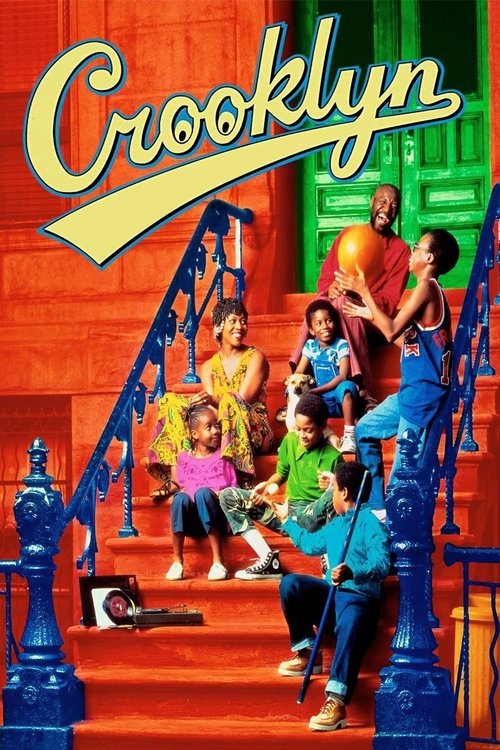
Crooklyn
1994 · Spike Lee
For when you want to be wrapped in family — the yelling, the music, the love underneath — comfort viewing with a real ache in it. Reach for it when you're missing home or want a film that feels like a photo album come alive.
What it's about
A schoolteacher, her jazz-musician husband, and their five kids share a Brooklyn brownstone in the early 1970s. Mom holds the household together on grit and love while Dad clings to playing music too pure to pay the bills, and the story unfolds through the eyes of the only daughter, nine-year-old Troy, navigating brothers, neighbors, and one strange summer away from home. It's Spike Lee's own childhood, written with his siblings and steeped in stoop games, Soul Train, and sibling warfare.
The experience
Warm, loose, and noisy in the best way — it moves like memory, drifting from joke to argument to song, then lands a quiet gut-punch you didn't see coming. You leave a little homesick for a block you never lived on.
Performances
Alfre Woodard is magnificent as the mother — fierce, funny, and exhausted all at once — and Delroy Lindo matches her as the proud, stubborn father; together they make a whole marriage visible in glances and kitchen arguments.
The craft
Lee builds the film from texture instead of plot, with a wall-to-wall soul soundtrack — Stevie Wonder, the Stylistics — that works like a second script. His boldest swing is a long stretch shot with a deliberately distorted, stretched frame so an unfamiliar place literally feels wrong. It's a film to hear as much as see; good speakers make it sing.
Why it matters
Coming right after Malcolm X, it revealed the tender, autobiographical side of Spike Lee and has grown into one of the most beloved portraits of Black family life in 1970s Brooklyn — a touchstone for memory films about childhood.
After the monumental effort of Malcolm X, Spike Lee turned homeward and made his tenderest film — a memory piece written with his siblings Joie and Cinqué, drawn from their own 1970s childhood in Bedford-Stuyvesant and dedicated to the mother they lost young. Alfre Woodard is magnificent as the schoolteacher holding a brownstone household together; Delroy Lindo matches her as the jazz-purist husband too principled to play music people will pay for. The film runs on texture rather than plot: stoop games, Soul Train on the television, sibling warfare, a wall-to-wall soundtrack of Stevie Wonder and the Stylistics that functions as autobiography in itself. Its boldest gamble remains startling — an extended sojourn down South shot with an anamorphic lens deliberately left unsqueezed, so the frame stretches queasily and the world feels wrong, exactly as it does to a child far from home. Projectionists posted disclaimers; Lee refused to fix it. Seen through ten-year-old Troy — a superb Zelda Harris — it's the most openhearted thing he has ever made.
A Deleuzian reading
For a few minutes in the middle of *Crooklyn*, the picture goes wrong.
The full Deleuzian reading of Crooklyn →
Reception
Met with mixed reviews and modest box office in 1994 — critics coming off Malcolm X found it meandering — Crooklyn has since been warmly reappraised as one of Spike Lee's most personal films and a fixture of every 'most underrated Spike Lee joint' conversation.
How Crooklyn was received, from release to now →
Influences: the films it descends from and the films it influenced
- Amarcord (1973) — Establishes the plotless, seasonally-episodic memory-town structure — a childhood community rendered as a string of vignettes rather than a plot — that Crooklyn adopts for its Brooklyn block.
- Cooley High (1975) — Pioneers scoring a Black coming-of-age wall-to-wall with period Motown/soul as an emotional-memory track, then rupturing the nostalgia with sudden loss — Crooklyn's exact soundtrack-and-grief method.
- American Graffiti (1973) — Model for using near-continuous diegetic period pop (radio/record) as the film's de facto score and primary time-machine device rather than an orchestral cue.
- Killer of Sheep (1978) — Poetic-neorealist, near-plotless observation of Black working-class domestic life and children's play, prioritizing texture and rhythm of a neighborhood over narrative — the template Crooklyn Black-family-fies.
- Meet Me in St. Louis (1944) — Warm, plot-light chronicle of a bustling multi-kid household anchored by songs of its era, where the drama is the family unit's daily friction rather than an external conflict.
- The 400 Blows (1959) — Founds the autobiographical child's-eye subjectivity — camera pinned to a young protagonist's perception of adult chaos — that Crooklyn routes through Troy.
- Do the Right Thing (1989) — Lee's own prior template: a single Brooklyn block treated as a saturated-palette ensemble ecosystem, direct-address heat, and stylized theatrical staging carried into Crooklyn's cul-de-sac.
- Jo Jo Dancer, Your Life Is Calling (1986) — Adopts the premise that a Black childhood household is the subject and not the backstory, and makes memory a photographic condition — an overtly distorted, warmer lens regime marks the remembered stretch off from the present, the same optical bracketing Alonzo does with palette.
- Eve's Bayou (1997) — Extends Crooklyn's device of filtering a Black family's fractures through a young girl's subjective, unreliable memory, with the child as the film's perceptual center.
- Ratcatcher (1999) — Carries forward the plotless, poetic child's-eye texture of a working-class neighborhood, built from sensory fragments rather than causal plot.
- The Tree of Life (2011) — Radicalizes the impressionistic, plotless memory-piece of a period childhood household, structured by association and mood in place of scene-to-scene causality.
- Beasts of the Southern Wild (2012) — Inherits the deliberate optical distortion of a child's POV — Crooklyn's anamorphic-unsqueezed Southern sequence answered by handheld, warped subjectivity to render a young girl's dislocation.
- 20th Century Women (2016) — Extends the autobiographical, plotless family-texture memory-piece scored by curated period needle-drops and narrated recollection of a specific household era.
- Moonlight (2016) — Advances the expressive, subjective cinematography of a Black childhood — color and camera keyed to inner emotional state — from the Lee/Jafa lineage.
- The Florida Project (2017) — Continues the episodic, plot-light child's-eye chronicle of a marginalized community, where kids' play and small incidents supply the structure.
- Roma (2018) — Directly extends the autobiographical, plotless domestic-texture memory film organized around a household's maternal/caregiving figure and the small rituals of a bygone period.
- A Thousand and One (2023) — Model for period-specific reconstruction of a Black NYC block, rendering the family apartment and street as a living character anchored to an exact era.
- Daughters of the Dust (1991) — Shares cinematographer Arthur Jafa, whose lyrical, unhurried lensing of Black family and Black skin tones defines both films' visual grammar of interiority.
Similar films
- Do the Right Thing (1989) — influence & lineage
- Eve's Bayou (1997) — influence & lineage
- Roma (2018) — influence & lineage
- Moonlight (2016) — influence & lineage
- Clockers (1995) — shared sensibility
- David Byrne's American Utopia (2020) — shared sensibility
- She's Gotta Have It (1986) — shared sensibility
- The Wiz (1978) — shared sensibility