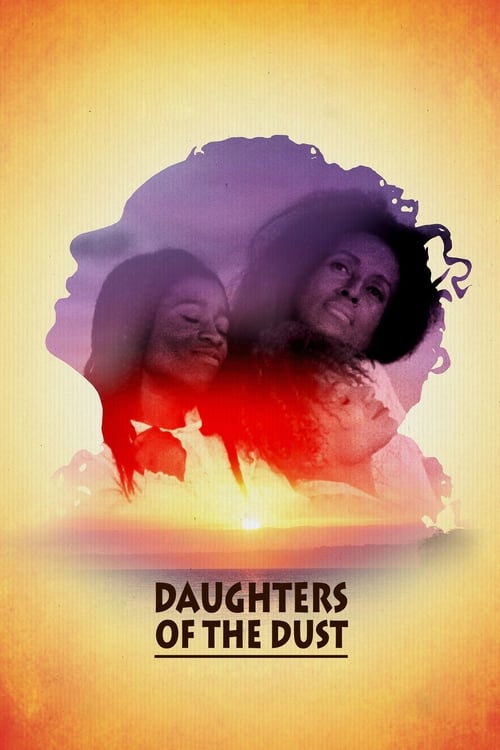
Daughters of the Dust
1991 · Julie Dash
For a contemplative evening when you want beauty and ancestry rather than momentum — a film to sink into like a long poem, best approached unhurried and undistracted.
What it's about
On a single day in 1902, the Peazant family — Gullah descendants of enslaved Africans living on the Sea Islands off the South Carolina coast — gather for a farewell picnic on the beach. Some are leaving for the mainland North and its promises; others, led by the family's ancient matriarch, refuse to abandon the island ways. The film moves among grandmothers, daughters, and an unborn child's voice as the family weighs what migration will cost them.
The experience
Less a plot than a slow, gorgeous immersion — voices, rituals, and wind-blown white dresses on sand, woven together like memory itself. It asks you to drift rather than follow, and if you surrender to its rhythm it becomes genuinely transporting.
Performances
Cora Lee Day anchors the film as Nana Peazant, the matriarch holding the old ways, and the largely female ensemble plays like a chorus — individual faces surfacing from a collective voice.
The craft
Arthur Jafa's cinematography is the stuff of legend: sun-bleached beaches, indigo-stained hands, tableaux composed like paintings, all moving to Gullah speech and layered narration. Dash structures it as a tapestry rather than a story, and on a big screen its images have real physical force.
Why it matters
The first feature by an African American woman to get a general U.S. theatrical release, it became a foundational work of Black independent cinema whose imagery still ripples through music videos, fashion, and filmmaking decades on.
Snapshot
Daughters of the Dust is a lyric, non-linear meditation on memory, migration, and cultural survival, set on a single day in 1902 as the Peazant family—Gullah descendants of enslaved Africans on the Sea Islands off the Georgia–South Carolina coast—gather for a farewell picnic before some of them depart for the mainland North. Directed, written, and produced by Julie Dash, it is widely recognized as the first feature film directed by an African American woman to secure a general theatrical release in the United States, following its premiere at the 1991 Sundance Film Festival and theatrical distribution the following year. Rather than a plot-driven drama, the film is organized as a woven tapestry of voices, tableaux, and ancestral invocations, narrated in part by an "Unborn Child" who speaks from a future not yet arrived. Its combination of ethnographic specificity—Gullah dialect, indigo, Ibo Landing lore—and formally radical, painterly image-making made it a landmark of independent Black cinema and, decades later, an acknowledged touchstone for a generation of visual artists.
Industry & production
The film's production history is inseparable from its meaning: it took Dash the better part of the 1980s to finance. She had conceived the project as one part of a planned cycle of films about Black women's history, and struggled through years of rejections from an industry that saw no commercial template for a Gullah period piece narrated by women. The decisive support came from public-television money—American Playhouse, the PBS-affiliated production strand that backed a number of important independent features of the era—which allowed principal photography to proceed. The film was shot on location on the Sea Islands (St. Helena and surrounding areas are associated with the production), a choice that embedded the landscape itself into the picture's texture.
It was made on a modest budget by feature standards, and the record consistently frames it as a labor of persistence rather than industrial machinery. After its Sundance premiere, it was released theatrically—Kino International is the distributor associated with its original American run—and it performed strongly for a specialized release, sustaining long engagements in select cities on the strength of word of mouth and unusually devoted audiences, particularly among Black women. I want to be careful here: precise budget and box-office figures circulate in secondary sources with some variation, and I will not assert a specific number I cannot verify. What is firmly established is the film's status as a commercial anomaly that proved an audience existed where the industry had assumed none.
Dash also documented the making of the film in her own 1992 book, Daughters of the Dust: The Making of an African American Woman's Film, which combines the screenplay, dialogue with critic and scholar interlocutors, and production reflection—an unusually rich primary source for a film of its scale.
Technology
Daughters of the Dust was shot on 35mm film, and its images were engineered for a specific, non-naturalistic look. Cinematographer Arthur Jafa and Dash pursued a palette of soft pastels, sun-bleached whites, and rich blacks that resists the conventions of both Hollywood glamour lighting and documentary realism. The technology of the period—film stock, filtration, and the manipulation of natural coastal light—was bent toward a painterly rather than transparent register. The film also makes expressive use of variable frame rates: passages of slow motion and altered speed give bodies and gestures a suspended, ceremonial quality, and this manipulation of the camera's temporal mechanics is one of the picture's signatures rather than an occasional flourish. In an era before digital intermediate grading was standard, the film's distinctive tonality was achieved photochemically and through on-set craft, which is part of why its look reads as handmade and specific.
Technique
Cinematography
Arthur Jafa's cinematography is the film's most celebrated technical achievement; he was recognized with the cinematography award at Sundance in 1991. Jafa treats the frame as a canvas: figures in white cotton and lace are arranged against sand, water, and marsh grass in compositions that recall photography and painting more than narrative cinema. He uses long lenses, shallow focus, and, crucially, slow and altered motion to dislodge the images from ordinary time—an aesthetic Jafa would later theorize in his own art practice around the idea of "Black visual intonation," the attempt to give the moving image the tonal and rhythmic qualities of Black music. The camera lingers, drifts, and repeats; it privileges texture, gesture, and light over spatial coverage.
Editing
The editing rejects continuity logic in favor of associative, poetic assembly. Scenes are not linked by cause and effect but by rhyme, echo, and thematic resonance, so that time folds—past, present, and the voice of the unborn future coexist. The result is closer to lyric poetry or a memory-structure than to classical scene construction, and it demands that the viewer surrender the expectation of forward plot momentum. The film's editors are credited in the production, though I will not over-specify their individual contributions beyond noting that the cutting is integral to the film's non-linear design and was clearly conceived in concert with Dash's script and Jafa's imagery.
Mise-en-scène / staging
Mise-en-scène is where the film's ethnographic care and its aesthetic ambition meet. Costume—period whites, lace, indigo-dyed cloth—carries historical meaning: indigo recalls the dye plantations and the literal stain of that labor on Gullah hands, a motif the film foregrounds. Props and set dressing evoke a syncretic spiritual world in which West African retentions, Islam, Christianity, and Indigenous influence coexist. Dash stages the family in friezes and processions along the shore, choreographing groups into painterly arrangements. The Sea Island landscape itself—Ibo Landing, the water, the moss and marsh—functions as a character and as an argument about rootedness versus departure.
Sound
The soundscape braids Gullah speech, layered voice-over, and an original score by composer John Barnes that blends orchestral, African, and diasporic musical idioms. Dash made the deliberate choice to have characters speak in authentic Gullah dialect, a decision that centers the culture on its own terms rather than translating it for outside ease; the density of overlapping voices contributes to the film's immersive, oral-tradition texture. The narration of the Unborn Child and the elder Nana Peazant's incantations give the sound design a scriptural, storytelling cadence.
Performance
Performances favor stillness, ritual bearing, and choral presence over psychological realism. Cora Lee Day anchors the film as Nana Peazant, the matriarch who embodies ancestral memory and resists the family's northward pull. Barbara-O plays Yellow Mary, the worldly returning relative marked by rumor; Alva Rogers plays Eula, the pregnant young woman; Adisa Anderson plays Eli, her husband; Kaycee Moore plays Haagar, the forceful advocate for migration and assimilation; and Cheryl Lynn Bruce and others fill out the family's spectrum of belief. The ensemble is directed less toward individual arcs than toward embodying competing relationships to heritage.
Narrative & dramatic mode
The dramatic mode is meditative, choral, and non-linear. There is a nominal dramatic question—will the family leave, and at what cost to their identity?—but the film refuses to resolve it as suspense. Instead it circles a single day, distributing consciousness across many women and across time, and letting the Unborn Child narrate from beyond the story's present. This is closer to the modes of Toni Morrison or lyric poetry than to classical three-act drama: exposition arrives as invocation, conflict registers as differing spiritual and generational orientations rather than plot collision, and the "resolution" is a matter of tone and continuity rather than event. The film's dramatic power lies in accretion—of image, voice, and memory—rather than in the machinery of causation.
Genre & cycle
Nominally a period drama with elements of romance, Daughters of the Dust is more accurately understood as a work of poetic historical cinema and of diasporic memory-work. It participates in the broad category of the American independent art film of the late 1980s and early 1990s, but its closest kinships are with a Black diasporic and third-cinema lineage that fuses ethnography, folklore, and formal experiment. It stands somewhat apart from the commercially prominent cycle of early-1990s Black American cinema (the urban dramas that dominated the period's coverage), reaching instead toward historical recovery and avant-garde form.
Authorship & method
The film is a total authorial statement by Julie Dash, who wrote, directed, and produced it and who spent years researching Gullah history and culture to ground its every detail. Her method is scholarly and archival as much as cinematic—she treated the film as an act of cultural preservation and correction, restoring to the screen a community and history that mainstream cinema had erased or caricatured.
Her key collaborators shaped the work decisively. Cinematographer Arthur Jafa provided the film's revolutionary visual language and shared its conceptual ambitions about a distinctly Black cinematic image. Composer John Barnes supplied a score that fused diasporic musical traditions with orchestration, reinforcing the film's syncretic spiritual world. The editing realized Dash's non-linear conception on the cutting table. Together, this circle produced not a director's solo work imposed on technicians but a genuinely collaborative aesthetic experiment, several of whose members were connected to the same UCLA-centered milieu that formed Dash.
Movement / national cinema
Dash is a central figure of the L.A. Rebellion—the loose movement of Black filmmakers who studied at UCLA's film school from roughly the late 1960s through the 1980s, a group that includes Charles Burnett, Haile Gerima, Larry Clark, Billy Woodberry, Ben Caldwell, and Barbara McCullough, among others. Formed in dialogue with Third Cinema, African and diasporic cultural politics, and a rejection of Hollywood conventions, the movement sought a Black cinema grounded in community, history, and formal independence. Daughters of the Dust is arguably the movement's most visible feature-length achievement to reach a national audience, and Jafa's involvement ties it directly to that UCLA lineage. Within American national cinema, it belongs to the independent sector's most ambitious wing, and it can also be read as a diasporic film that looks across the Atlantic to African retentions rather than solely toward the American mainland.
Era / period
The film is doubly situated in time. As an artifact, it arrives at the turn of the 1990s, at a high-water mark for American independent cinema and for the arrival of Black filmmakers in the theatrical marketplace—though Dash's film pointedly diverges from the dominant idiom of that moment. As a story, it is set precisely in 1902, at the threshold of the Great Migration, when the movement of Black Americans from the rural South to Northern cities was beginning to accelerate. The film uses that historical hinge to dramatize a civilizational choice: what is gained and what is irretrievably lost when a rooted, semi-isolated culture disperses into modernity.
Themes
Its central theme is cultural memory and the cost of migration—the tension between preservation and progress, between the ancestral ground of the Sea Islands and the promise and peril of the North. Interlocking motifs sustain this: the transmission of memory through women and across generations; the Ibo Landing myth of Africans who, rather than accept enslavement, turned back toward Africa across the water, an emblem of resistance and return; indigo and its literal staining of the body as a mark of slavery's labor carried into freedom; syncretic spirituality braiding African, Islamic, Christian, and Indigenous strands; and the presence of the ancestors and the not-yet-born within the living present. Above all, the film insists on Black women as the bearers and interpreters of history—the point from which the entire narrative consciousness radiates.
Reception, canon & influence
Critical reception at the time was strong among those attuned to its ambitions and divided among viewers expecting conventional narrative; the film's demanding, non-linear form and dense Gullah dialect challenged mainstream critics even as it won passionate advocacy. It became a genuine cause among Black women audiences in particular, sustaining an unusually devoted following. Its historical importance was formally recognized when it was selected for preservation in the National Film Registry by the Library of Congress in 2004, on grounds of cultural, historical, and aesthetic significance.
Influences on the film (backward): Dash drew on the L.A. Rebellion's aesthetic and political program and its engagement with Third Cinema; on the literary example of Black women writers—Toni Morrison's memory-structured, non-linear historical fiction is a frequent and apt point of comparison; on the oral traditions and folklore of the Gullah themselves, extensively researched; and on a painterly and photographic visual tradition that Jafa translated into moving images.
Legacy (forward): The film's influence grew markedly over the following decades. Arthur Jafa's cinematography here became foundational to his own later career as one of the most significant contemporary visual artists working with the moving image. The most conspicuous act of homage arrived with Beyoncé's 2016 visual album Lemonade, whose imagery of Black women in period dress amid Southern landscapes drew widely noted inspiration from Dash's film; the renewed attention helped occasion a restoration and theatrical re-release of Daughters of the Dust in 2016, introducing it to a new generation. More broadly, the film became a lodestar for later Black filmmakers and artists pursuing non-linear, poetic, and diasporic modes of storytelling, and it is now firmly canonized in film-studies curricula as a landmark of both Black cinema and American independent film. Its reputation, thin in the commercial coverage of its own moment, has only deepened with time.
A Deleuzian reading
Nana Peazant's hands are stained blue.
The full Deleuzian reading of Daughters of the Dust →
Reception
In 1991 it was an arthouse event — the first feature by a Black American woman to get a wide US theatrical release — but it never got a real follow-up, and Julie Dash was effectively shut out of features. The 2016 restoration, riding the wave of Beyoncé's Lemonade visually quoting it, turned it from a scholars' touchstone into a genuine canon fixture.
How Daughters of the Dust was received, from release to now →
How to watch Daughters of the Dust: what to notice on a first viewing
- Listen for a narrator's voice that doesn't belong to anyone on screen. An Unborn Child narrates part of the film, a voice speaking from a future that hasn't happened yet, braided in with Gullah speech and Nana's incantations. The film is being told to you from outside ordinary time before you've even settled into it.
- Notice the blue staining on some of the family's hands. Indigo dye has sunk permanently into the skin of the older generation, a mark left by the labor of the plantations that made others rich. A single visible detail carries an entire economic history on the body.
- Watch how slowly and deliberately the camera moves through each scene. Jafa uses long lenses and altered motion to slow figures down, arranging white cotton and lace against sand and marsh grass like a painting. The images ask you to look the way you'd look at a photograph, not follow a plot.
- Notice that the film doesn't move forward in a straight line. Scenes are linked by rhyme and echo rather than cause and effect, so past, present, and the unborn future feel present at once. The film doesn't explain this structure; it just lets you feel time as layered rather than linear.
- Notice how the family is arranged and posed along the shore. Dash stages the family in friezes and processions, choreographing groups into deliberate, almost painted arrangements rather than naturalistic movement. Meaning here comes from how bodies are grouped and held, not from what anyone says.
The whole guide to watching Daughters of the Dust, with the keys for a rewatch →
Influences: the films it descends from and the films it influenced
- Killer of Sheep (1978) — Founding L.A. Rebellion work whose episodic, plotless tableaux of Black communal life — children at play, adults in repose — model the frieze-like, meditative observation over dramatic incident that structures Dash's film.
- Bush Mama (1979) — L.A. Rebellion / Third Cinema fusion of documentary-inflected realism with disruptive associative montage and voiceover, establishing the politicized non-linear form Dash inherits from the same UCLA milieu.
- Bless Their Little Hearts (1984) — Shot by Charles Burnett, its patient long-take compositions treating Black domestic space as painterly still life directly precede Jafa's tableau-based framing of the Peazant family.
- Touki Bouki (1973) — African elliptical montage that abandons linear causality for dreamlike, associative cutting and myth — a direct precedent for Dash's non-linear, memory-structured editing.
- Black Girl (1966) — Foundational Third Cinema text using interior monologue voiceover to restore subjectivity to a diasporic Black woman, a narrational strategy Dash extends into her choral, unborn-child narration.
- Days of Heaven (1978) — Magic-hour, painterly natural-light cinematography paired with a child's associative voiceover narration — the exact combination of luminous landscape imagery and unschooled poetic narration Dash and Jafa reprise.
- Mirror (1975) — Non-linear, memory-and-dream associative structure with drifting slow-motion and voiced poetry, the template for treating personal and cultural history as image-association rather than plot.
- Ganja & Hess (1973) — Black avant-garde feature that fuses African diasporic ritual, spirituality, and experimental rhythm into narrative, prefiguring Dash's syncretic ceremonial staging and refusal of genre convention.
- Meshes of the Afternoon (1943) — Avant-garde use of ritual repetition, choreographed slow-motion movement, and processional female figures — the vocabulary of ritual stillness and slowed gesture Dash deploys on the beach.
- Leila and the Wolves (1986) — Non-linear women's oral-history structure narrated through ancestral memory, painterly tableaux and saturated color — Srour's mosaic of intergenerational women's voices given a fuller diasporic form.
- West Indies: The Fugitive Slaves of Liberty (1979) — Renders diasporic memory as non-linear, frieze-like choreographed tableaux where past and present coexist in one staged space, inheriting Hondo's collapse of chronology onto a single frame.
- Losing Ground (1982) — Dash's painterly, sun-drenched centering of Black women's consciousness extends Collins's project and stands as the next Black-woman-directed US theatrical feature to carry that baton.
- Lemonade (2016) — The most explicit homage: Black women in period antebellum dress arrayed across Southern landscapes and porches, restaging Dash's indigo-and-white processional tableaux almost shot-for-shot.
- If Beale Street Could Talk (2018) — Held direct-address close-ups and saturated, tender lighting of Black skin as a deliberate aesthetic act, extending Jafa's 'Black visual intonation' into contemporary portraiture.
- Mudbound (2017) — Layers multiple first-person voiceover narrators over a Southern agrarian landscape, extending Dash's choral, many-voiced narration and land-as-memory into an ensemble structure.
- Hale County This Morning, This Evening (2018) — Non-narrative, associative editing of luminous Black Southern life explicitly pursuing a 'Black visual intonation,' the direct heir to Jafa's image-theory and Dash's meditative rhythm.
- Pariah (2011) — Cinematographer Bradford Young inherits Jafa's method of lighting deep Black skin with color and expressive underexposure, carrying the film's photographic ethics into a new generation.
- Selma (2014) — Composes marches as slowed, frieze-like processions of Black bodies moving through landscape — Bradford Young's cinematography reprising Dash's staging of collective movement as tableau.
- Sinners (2025) — Dash's non-chronological polyphony — ancestors, living, and unborn occupying the same frame simultaneously — establishes the palimpsest logic of Black temporal experience as a cinematic formal device, the structure Coogler's vision sequence extends into the acoustic register, using blues performance to collapse past and present into a single durational image.
- The Watermelon Woman (1997) — Established a Black-woman-authored independent cinema of memory and ancestral image-making, the tradition of self-made history Dunye extends into a fabricated lesbian genealogy.
- Eve's Bayou (1997) — The immediate progenitor — a Black-woman-authored, painterly, non-linear memory poem of Gullah/Creole folk spirituality and ancestral inheritance that made Eve's Bayou's lush interior Black Southern world commercially thinkable.
- Drylongso (1999) — A Black-woman-authored L.A. Rebellion feature built on painterly, sun-saturated color and the image-as-heirloom — a griot/photographer preserving a people on the verge of vanishing, which Drylongso literalizes in Pica's Polaroids.
- Nickel Boys (2024) — Non-linear ancestral memory rendered through tableau composition and voice-over that speaks across generations — a template for treating Black Southern history as remembered image rather than plot.
- Love Is the Message, The Message Is Death (2016) — Jafa's own signature video-art work that theorizes and realizes the distinctly Black cinematic image he first forged as Dash's cinematographer, making the two works branches of one project.
- Atlantics (2019) — By Mambéty's niece, it extends the elliptical Senegalese diasporic mode with ghostly returning spirits, choral female voices, and the sea as site of loss and cultural memory.
- The Piano (1993) — Arthur Jafa's photography charges the South Carolina Gullah landscape with Black female interiority, using ritualistic non-verbal performance as primary register and refusing Hollywood psychological grammar — a simultaneous feminist art-film working in the same transnational arthouse mode as Campion, with landscape carrying the same subjective weight.
- The Color Purple (1985) — It reclaims the Black women's Southern lyric in golden light from inside the Black female gaze, answering Color Purple's authorship problem while extending its pastoral interiority and theme of female self-creation.
- Crooklyn (1994) — Shares cinematographer Arthur Jafa, whose lyrical, unhurried lensing of Black family and Black skin tones defines both films' visual grammar of interiority.
- To Sleep with Anger (1990) — The closest LA Rebellion sibling: folklore-mode storytelling where ancestral memory and Gullah superstition are dramaturgical forces, sound built from spirituals, and Great-Migration displacement (island-to-North vs. South-to-California) is the underlying wound.
- Compensation (1999) — Fellow L.A. Rebellion film using painterly tableau composition, a photographic period palette, and Black women's historical memory — the closest formal sibling to Davis's archival-photograph, dual-era design.
- Sugar Cane Alley (1983) — Builds the same two devices on the Gullah islands: a creolized language spoken untranslated as the film's default register, and an elder as the sole conduit of pre-slavery memory delivered in a fire-lit oral-history set piece — Nana Peazant's function is Médouze's, transposed to the Sea Islands.
- Sankofa (1993) — Drawn from the same Georgia Sea Islands folklore corpus (the WPA-collected material behind the flying-Africans motif), Dash likewise dissolves chronology into circular ancestral time and narrates from an unborn/ancestral position, with tableau composition replacing the establishing shot.
Similar films
- Mudbound (2017) — influence & lineage
- Black Girl (1966) — influence & lineage
- Sankofa (1993) — shared sensibility
- Eve's Bayou (1997) — shared sensibility
- The Birth of a Nation (1915) — shared sensibility
- Origin (2023) — shared sensibility
- The Help (2011) — shared sensibility
- Sambizanga (1973) — shared sensibility