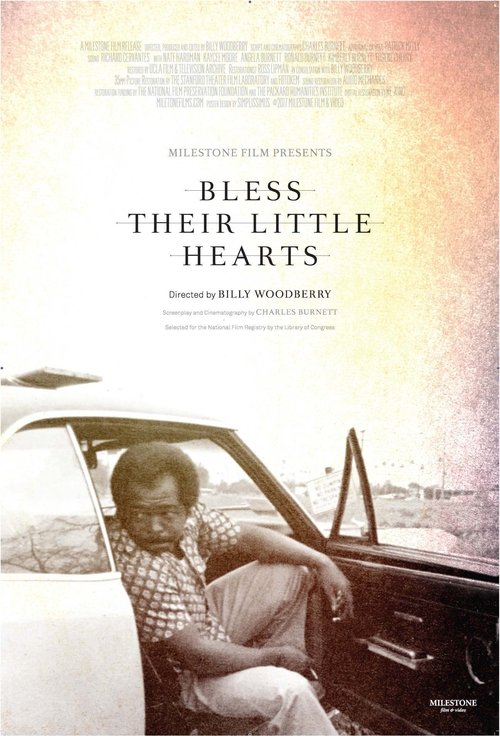
Bless Their Little Hearts
1984 · Billy Woodberry
For when you want something true rather than easy — a film that honors ordinary struggle without sentimentality. This is a challenge that pays you back, not comfort viewing.
What it's about
In Watts, Los Angeles, Charlie Banks is a family man who can't find steady work — just day labor, odd jobs, and long stretches of nothing. The film follows him, his wife, and their kids as chronic unemployment eats away at the household from the inside, straining a marriage that has to survive on patience and too little money.
The experience
Quiet, patient, and piercingly honest — it moves at the rhythm of real days and lets small moments carry enormous weight. It doesn't lecture; it just watches, and by the end you feel the full weight of what this family carries.
Performances
Nate Hardman and Kaycee Moore play the marriage at the film's core with startling rawness — their kitchen argument, a largely improvised single take running close to ten minutes, is one of the most searing depictions of a couple in crisis ever filmed.
The craft
Charles Burnett wrote the screenplay and shot the film, and his luminous black-and-white 16mm photography turns Watts into something both documentary-real and quietly beautiful. Nonprofessional actors and an unhurried, neorealist approach let poverty register as lived texture rather than message.
Why it matters
A cornerstone of the L.A. Rebellion, the movement of Black filmmakers out of UCLA who set out to picture Black life beyond Hollywood's frames — and a key document of American independent cinema at its most uncompromising.
A cornerstone of the L.A. Rebellion — the movement of Black filmmakers who emerged from UCLA in the 1970s and '80s determined to picture Black life outside Hollywood's frames — Billy Woodberry's first feature follows Charlie Banks, a Watts family man ground down by chronic unemployment, as he scrapes for day labor and for some remnant of self-respect. Charles Burnett, fresh from Killer of Sheep, wrote the screenplay and shot the film, and the kinship shows: luminous black-and-white 16mm, nonprofessional and semi-professional actors, a neorealist patience that lets poverty register as texture rather than thesis. Nate Hardman and Kaycee Moore (Burnett's own leading woman) play the marriage at the film's center, and their kitchen confrontation — a single take running nearly ten minutes, largely improvised — remains one of the most harrowing domestic scenes in American cinema. Long scarce, the film was restored and returned to circulation, and in 2013 the Library of Congress added it to the National Film Registry, formal recognition of what cinephiles already knew: this is one of the essential American films about work, and its absence.
Reception
Barely seen outside festivals in 1984 — it premiered in the Berlinale's Forum section and then all but vanished — the film was rescued by UCLA's L.A. Rebellion retrospective and a Milestone restoration, and is now routinely called one of the great American independent films of its decade.
How Bless Their Little Hearts was received, from release to now →
Influences: the films it descends from and the films it influenced
- Killer of Sheep (1977) — Burnett wrote, shot, and produced Bless Their Little Hearts, transplanting his own Killer of Sheep grammar—16mm reversal stock, static observational framing, and episodic vignettes of Watts labor—directly onto Woodberry's film.
- Bicycle Thieves (1948) — Supplies the neorealist template of unemployment as narrative engine: a proud man's fruitless job search shot on real streets with a nonprofessional lead, dignity eroded by economics rather than plot.
- Umberto D. (1952) — Models the neorealist patience with 'dead time'—holding on mundane domestic duration (chores, waiting, small humiliations) so poverty registers as lived tempo, which Woodberry stretches into his kitchen and household scenes.
- La Terra Trema (1948) — Establishes casting a real working-class community as itself, letting nonprofessional faces and regional speech carry sociological truth—the method Woodberry uses with his Watts family.
- Nothing But a Man (1964) — Pioneers the understated Black working-class marriage drama, using restrained performance and undramatized routine to show economic pressure fracturing domestic life—a direct precedent for the Hardman/Moore household.
- Faces (1968) — Bequeaths the improvised, real-time domestic confrontation—handheld intimacy and actors allowed to talk past each other—echoed in the film's celebrated unbroken kitchen argument.
- The Exiles (1961) — An earlier Los Angeles docu-fiction using nonprofessional marginalized subjects playing near-versions of themselves in real neighborhoods, prefiguring the LA Rebellion's ethnographic realism.
- Daughters of the Dust (1991) — Extends the LA Rebellion lineage and reuses actress Kaycee Moore (the wife here), carrying forward the movement's insistence on Black interiority rendered through unhurried, painterly composition.
- To Sleep with Anger (1990) — Burnett matures the same observational domestic-realist mode into a fuller ensemble drama, retaining the naturalistic performance register and attention to household ritual seen in the film he shot for Woodberry.
- George Washington (2000) — Inherits the lyrical-realist observation of poor, mostly Black communities—nonprofessional kids, elliptical structure, long contemplative takes over narrative momentum.
- Chop Shop (2007) — Revives neorealist labor cinema in America: nonprofessional cast, on-location documentary texture, and a plot organized around the daily grind of getting money to survive.
- Ballast (2008) — Applies the nonprofessional-cast, sparse-dialogue, long-take observational method to rural Black economic hardship, an almost direct stylistic heir to Woodberry's restraint.
- Medicine for Melancholy (2008) — Continues the LA Rebellion project of centering Black everyday interiority through naturalistic performance and quiet, duration-driven scenes over plot mechanics.
- The Florida Project (2017) — Carries the neorealist tradition of casting nonprofessionals and shooting real precarious locations to dramatize how unemployment and eviction press on a household from the margins.
- Drylongso (1999) — Observational long-take realism about endangered Black manhood and joblessness, with Burnett's script and nonprofessional performances — the direct forebear of Drylongso's worry over disappearing Black men.
- Bush Mama (1979) — Fellow LA Rebellion film from the same UCLA cohort, using nonprofessional cast and observational realism to indict how welfare bureaucracy and unemployment corrode a Black family.
- Passing Through (1977) — Shares the LA Rebellion's UCLA-forged commitment to a self-authored Black aesthetic built from location shooting, community casting, and rejection of Hollywood coverage.
- My Brother's Wedding (1983) — Burnett's contemporaneous Watts film runs the identical playbook—nonprofessional cast, deadpan long takes, tragicomic observation of working-class Black domestic obligation—that he lent to Woodberry.
- Losing Ground (1982) — Woodberry's patient naturalist long takes tracking a marriage eroding under economic strain share Collins's domestic-drama craft of letting conversation and silence carry the rupture.
Similar films
- To Sleep with Anger (1990) — influence & lineage
- Bicycle Thieves (1948) — influence & lineage
- Killer of Sheep (1978) — shared sensibility
- 4 Little Girls (1997) — shared sensibility
- A Woman Under the Influence (1974) — shared sensibility
- The Little Foxes (1941) — shared sensibility
- Hard Truths (2024) — shared sensibility
- Short Cuts (1993) — shared sensibility