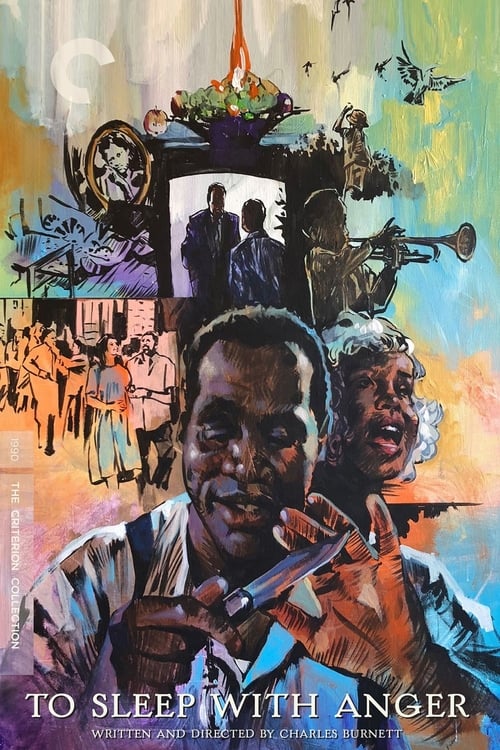
To Sleep with Anger
1990 · Charles Burnett
For when you want a film to chew on for days — a slow-burn family drama with a supernatural shimmer you can't quite pin down. More challenge than comfort, but a deeply rewarding one.
What it's about
A honey-voiced old acquaintance from the South named Harry Mention appears on the doorstep of a settled, middle-class Black family in South Central Los Angeles — and simply stays. Charming, courtly, and full of old-country stories, Harry gradually pulls the household's buried tensions to the surface: between brothers, between generations, between the Southern past the family left behind and the California life they've built. Whether he's a harmless relic or something older and more corrosive is the question the film keeps quietly alive.
The experience
It plays like folklore told at a family kitchen table — unhurried, warm, and slyly funny, with a low hum of menace underneath that keeps tightening. You watch a household come apart in small domestic gestures, and the unease creeps in through superstition and side glances rather than shocks.
Performances
Danny Glover, who also produced, is extraordinary as Harry — all silky charm and Southern courtesy with something unreadable behind the eyes. It's the role that shows what he could do when Hollywood wasn't asking him to carry a buddy movie.
The craft
Charles Burnett writes and directs with a folklorist's ear, braiding blues records against Sunday hymns and Southern superstition against LA comfort until the household itself feels haunted. The drama builds from tiny domestic details — a broom brushed across someone's feet carries real menace here — and the film trusts you to feel the charge without underlining it.
Why it matters
A landmark of the LA Rebellion generation of Black filmmakers, it was barely distributed in 1990, swept Independent Spirit Awards for Burnett and Glover, and has since been rediscovered as one of the great American films of its decade — now in the National Film Registry conversation of essential Black American cinema.
Charles Burnett emerged from the LA Rebellion — the cohort of Black filmmakers trained at UCLA in the 1970s — with Killer of Sheep, and this third feature is his richest: a family drama that plays like folklore. Danny Glover, who also produced, is Harry Mention, a honey-voiced old acquaintance from the South who appears on the doorstep of a middle-class Black family in South Central Los Angeles and simply stays. Whether he is a charming relic or something older and more corrosive is the film's quiet engine. Burnett braids the Great Migration's unfinished business into the household — Southern superstition against California comfort, blues records against Sunday hymns, a world in which a broom brushed across your feet carries real menace. Distributed poorly in 1990, it won Independent Spirit Awards for Burnett and Glover and found almost no audience; its 2019 restoration confirmed what filmmakers had long said privately — that Burnett is among the great American directors, whatever the ledgers claim.
A Deleuzian reading
A broom goes across somebody's feet.
The full Deleuzian reading of To Sleep with Anger →
Reception
It won a Special Jury Prize at Sundance in 1990 and swept the Independent Spirit Awards, then died in theaters — Burnett has said it was never properly marketed to Black audiences. Now it's National Film Registry (2017), Criterion Collection (2019), and a fixture on best-of-the-90s lists.
How To Sleep with Anger was received, from release to now →
Influences: the films it descends from and the films it influenced
- Killer of Sheep (1978) — Burnett's own template: scoring quotidian Black Los Angeles life with a diegetic-feeling stream of blues and gospel needle-drops (Paul Robeson, Dinah Washington) and building narrative through elliptical, near-plotless domestic vignettes rather than causal plot — the exact grammar carried into To Sleep with Anger's household.
- My Brother's Wedding (1983) — Burnett's dry run at the same craft problem — the tragicomedy of South-rooted values colliding with settled California Black-middle-class respectability, staged almost entirely inside a single family home with tonal swerves between folk humor and sudden death.
- Boudu Saved from Drowning (1932) — The structural blueprint for Harry: a disruptive, appetite-driven guest who invades a bourgeois household and exposes its hypocrisies from within, the interloper allowed to sprawl through domestic space in deep-focus long takes until the family's order dissolves around him.
- Teorema (1968) — The ambiguous-stranger allegory as method — an unexplained visitor whose mere presence acts as a catalyst that unravels each family member in turn, deliberately withholding whether he is angel or devil so the household's own repressions supply the menace.
- Nothing But a Man (1964) — Location-shot naturalist Black domestic drama built on an understated, non-melodramatic performance register and unforced everyday texture — the neorealist ethic of dignity-in-the-mundane that Burnett applied to a settled family rather than a striving couple.
- Ganja & Hess (1973) — Folkloric Black supernatural embedded in domestic realism and scored to spirituals and gospel — treating myth and the sacred as ambient forces inside the home rather than as horror spectacle, a precedent for To Sleep's superstition-as-menace threaded through hymns.
- Bicycle Thieves (1948) — The Italian-neorealist model Burnett absorbed at UCLA: ethical drama drawn from ordinary economic life, non-actor-inflected performances, and a refusal of plot mechanics in favor of accumulated observation of a family under pressure.
- Bless Their Little Hearts (1984) — Burnett matures the same observational domestic-realist mode into a fuller ensemble drama, retaining the naturalistic performance register and attention to household ritual seen in the film he shot for Woodberry.
- Personal Problems (1980) — Carries forward the gathering-of-kin domestic drama and folk-inflected observational staging into a more composed register.
- Eve's Bayou (1997) — Extends the Southern Black-gothic domestic drama where hoodoo, second sight, and folk superstition are woven matter-of-factly into a bourgeois family's daily life, the ambiguous conjure-figure functioning exactly like Harry as a catalyst that surfaces buried family rot.
- Beloved (1998) — Makes literal the ancestral haunting Burnett keeps ambiguous — a folkloric intruder who installs herself in a Black household and detonates its repressed history, scored and staged around spirituals and Migration-era memory.
- Atlantics (2019) — Threads West-African spirit folklore (djinn/possession) through unshowy realist drama of migration and displacement, honoring Burnett's move of letting the supernatural inhabit an ordinary community without genre signposting or explanation.
- His House (2020) — Migration-and-superstition menace lodged inside a single domestic space — a folkloric entity (the apeth) whose presence indexes the family's guilt and displacement, updating Burnett's ambiguous-menace-in-the-home structure into overt horror.
- Us (2019) — Builds a Black family home invaded by an uncanny doppelgänger-intruder whose folkloric menace exposes the household's fault lines, and scores dread with vernacular Black-American musical texture — a genre-forward heir to Harry's trickster-in-the-parlor threat.
- Moonlight (2016) — Jenkins openly inherits Burnett's elliptical, tender realism of Black interior life — narrative built from quiet domestic fragments, expressive musical scoring, and a refusal of melodrama — extending Killer of Sheep/To Sleep's observational grammar to a coming-of-age register.
- Bush Mama (1979) — Fellow LA Rebellion work from the same UCLA cohort — community-rooted Black realism using expressionistic sound design and a rejection of Hollywood coverage, sharing Burnett's mandate to render Black interior life outside genre convention.
- Daughters of the Dust (1991) — The closest LA Rebellion sibling: folklore-mode storytelling where ancestral memory and Gullah superstition are dramaturgical forces, sound built from spirituals, and Great-Migration displacement (island-to-North vs. South-to-California) is the underlying wound.
- Sankofa (1993) — LA Rebellion folklore mode taken to its ancestral extreme — the past reaching into the present through ritual and spirit, using the same conviction that African diasporic myth is not metaphor but an operative reality within the frame.
Similar films
- Killer of Sheep (1978) — influence & lineage
- Eve's Bayou (1997) — influence & lineage
- Sankofa (1993) — influence & lineage
- Bless Their Little Hearts (1984) — shared sensibility
- Ride with the Devil (1999) — shared sensibility
- Mississippi Masala (1991) — shared sensibility
- Cries and Whispers (1972) — shared sensibility
- Sling Blade (1996) — shared sensibility
All the films related to To Sleep with Anger →