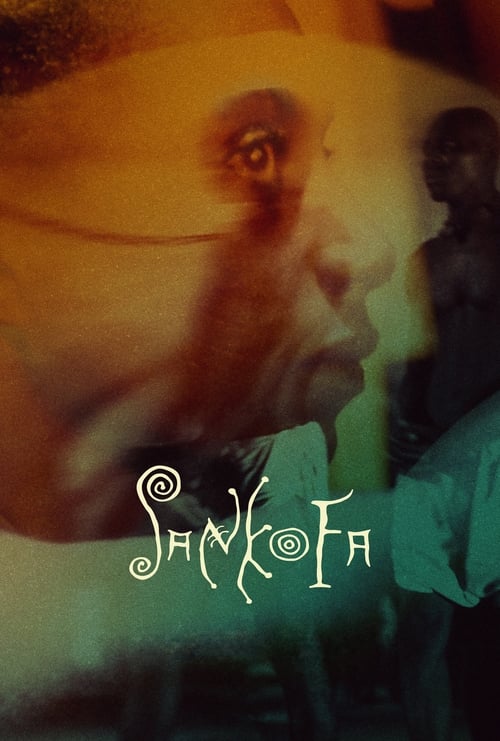
Sankofa
1993 · Haile Gerima
For when you're ready to be confronted, not comforted — a film to watch with full attention and talk about afterward, ideally with someone else in the room.
What it's about
An American fashion model on a photo shoot at a former slave fort in Ghana is confronted by a drummer for posing glamorously at the site of a catastrophe. Wandering into the fort's dungeons, she is seized by the past and wakes as a house slave on a sugar plantation in the Americas, living the ordeal her ancestors survived. The title comes from an Akan proverb: it is not taboo to go back and fetch what you forgot.
The experience
Solemn, harrowing, and deliberately unsparing — this is witness-bearing cinema, paced like a ritual rather than a thriller. It asks a lot and it stays with you; many viewers describe it as an experience closer to a reckoning than a night at the movies.
The craft
Gerima frames the plantation not as backdrop but as a world — drums, chants, and spirituals woven through the sound design, and a structure that moves like ceremony, guided by ancestral memory rather than conventional plot mechanics. Made independently over roughly a decade, its rough edges are inseparable from its power.
Why it matters
When no American distributor would touch it, Gerima released it himself, city by city, through Black churches, bookstores, and community groups — a legendary act of self-distribution that made it a touchstone of independent Black cinema and a defining work of the movement of Black filmmakers who emerged from UCLA in the 1970s.
Snapshot
Sankofa is the film Haile Gerima spent roughly a decade trying to get made and then, when no American distributor would touch it, released himself — theater by theater, city by city, on the strength of Black churches, bookstores, sororities and community organizations. It takes its title from the Akan concept rendered in the Adinkra symbol of a bird looking backward while moving forward: it is not taboo to go back and fetch what you forgot. The film enacts that proverb as narrative mechanism. Mona, an African American fashion model posing for a white photographer on the ramparts of Cape Coast Castle in Ghana, is harangued by a drummer for playing at the site of a catastrophe; she wanders into the slave dungeon, is seized by the hands of the dead, and surfaces as Shola, a house slave on a sugar plantation in the Americas.
What follows is not a time-travel film in any technological sense. The mechanism is possession, and the film never explains it, never builds a mythology around it, never returns to it as a puzzle. Gerima's interest lies entirely on the other side of the threshold: in the texture of plantation life, the plural forms resistance took, and the specific injury Christianity inflicted on the enslaved. It stands as one of the most uncompromising films ever made about Atlantic slavery, and — because of how it reached its audience — one of the most consequential objects in the history of Black independent distribution.
Industry & production
Gerima had by 1993 been making films for over twenty years and had never had a conventional distributor. Bush Mama (1975), Harvest: 3,000 Years (1976) and Ashes and Embers (1982) circulated through festivals, museums, campuses and the distribution company he founded with his wife and collaborator Shirikiana Aina, Mypheduh Films. Sankofa was assembled the way African and Third Cinema features of the period often were: from a patchwork of national and institutional sources rather than a single financier. Its credits span the United States, Ghana, Burkina Faso, the United Kingdom and Germany, with support drawn from state cultural bodies and European television money alongside Gerima's own Negod-Gwad Productions; Aina produced. The precise financing structure has never been documented in detail in English-language scholarship, and Gerima has more often described the difficulty of raising the money than its final arithmetic.
Production was itself Pan-African in geography: Ghana for the castle and the framing sequences, the Caribbean for the plantation, with post and finishing handled abroad. Shooting inside Cape Coast Castle — a functioning UNESCO-listed monument and pilgrimage site — meant working within a real dungeon rather than a set.
The distribution story is the one that matters historically. Gerima has consistently recounted that American distributors passed, telling him the film had no market. He responded by four-walling it: renting theaters outright, beginning in Washington, D.C., where he had taught at Howard University since the mid-1970s, and building each city's run through advance organizing with community institutions. The film played for months in some markets. Because it bypassed the conventional reporting apparatus, its total gross has never been reliably established; figures cited in the press vary and should be treated with caution. What is not in doubt is that the campaign worked, and that it became the reference case for the proposition that a Black audience exists for a film the industry has declared unmarketable.
Technology
Sankofa is a photochemical film, shot on 35mm and finished for theatrical exhibition at a moment when that remained the only serious option for a feature seeking festival competition slots. Its most demanding technical problem was light: the dungeons at Cape Coast are stone chambers with minimal openings, and the film wanted them as they are. The generation of high-speed tungsten negative available by the early 1990s made it feasible to shoot such interiors with a modest lighting package — an enabling condition for a production of this budget working in a protected historical site.
The film's second technological life was on videotape. Through Mypheduh, Sankofa circulated for years on VHS sold in Black bookstores, screened in classrooms, churches and community centers — a distribution stack in which the cassette, not the print, was the primary object. Gerima and Aina eventually anchored this in a physical institution, the Sankofa Video Books & Café near Howard's campus.
Its third life is digital. In 2021 the film was restored in 4K and released by Ava DuVernay's ARRAY on Netflix, part of a package bringing Gerima's work back into circulation. The restoration recovered the density of the plantation photography, which had been badly served by generations of tape dubs, and the streaming release made a film that had been an act of pilgrimage into something available on demand — a shift with real consequences for how it is now read and taught.
Technique
Cinematography
Augustin Cubano's photography operates in two clearly divided registers. The present-day Ghana material is high-key, hot, over-lit — white stone, white sand, a body arranged for a fashion camera. The plantation is desaturated, earth-toned, close. The change is not a stylistic flourish; it is the argument. The tourist light is the light of a place whose history has been made legible and safe; the other light is what the place actually contains.
Inside the past, the camera works predominantly in close and medium shot, and it positions itself within the enslaved community rather than surveying it. There is very little of the establishing-shot grammar the plantation film usually depends on — the long view down the allée, the great house framed against sky — because that grammar belongs to the proprietor's eye. Gerima and Cubano hold instead on faces: eyes, mouths, scarred and branded skin, hands. Violence is filmed at duration and at proximity, but almost always from the position of those made to watch it, so that the whipping is a communal event rather than a spectacle of the flayed back. Slow motion is reserved for ascension and for death, marking the passage between registers of reality.
Editing
Gerima cut the film himself, consistent with his practice across his career, and the editing carries the burden of the film's structural claim. The shape is circular: it opens and closes at the castle, and the return is a return rather than a resolution. The threshold into the past is not managed with the dissolves and ripple effects of time-travel cinema; it is a violent, abrupt seizure — hands out of darkness, a cut.
Within the plantation narrative the film accumulates rather than escalates. Gerima has written and spoken at length against Aristotelian dramatic construction and its Hollywood inheritance, arguing for a storytelling in which the audience is a participant rather than a consumer of catharsis; his essay "Triangular Cinema, Breaking Toys, and Dinknesh vs Lucy," collected in Questions of Third Cinema (1989), sets out the position directly. The editing follows: refrains — the buzzard, the sea, Nunu's face, the drum — recur as punctuation rather than as plot beats, and the film cuts on sound at least as often as on action.
Mise-en-scène / staging
The castle is used as itself, including its most damning architectural fact: the chapel built directly above the male dungeon. Gerima does not need to stage that irony; he only needs to shoot it.
The plantation is a working landscape — cane, the boiling house, the quarters, the great house held at a distance — and the staging insists on labor as the ground of everything else. Nunu's domain, with its herbs and burial rites, is the film's counter-space, the place where an African cosmology survives in fragments. Costume carries the film's central substitution: Mona's gold and beads and sunglasses, a body dressed for commodity photography, are stripped and replaced by coarse cloth and a brand. The fashion shoot and the auction block are staged as the same operation separated by centuries.
Sound
The drum is the film's organizing sound and, unusually, also a character. Casting Kofi Ghanaba — the Ghanaian master percussionist known earlier as Guy Warren, whose mid-1950s recordings were among the first serious attempts to put African drumming into conversation with American jazz — as the divine drummer at the castle gate collapses the film's historical distances into one body. His playing functions simultaneously as diegetic sound, as summons, and as score.
The soundtrack refuses linguistic homogenization: English shares space with Akan, with Caribbean speech, with chant and untranslated invocation, registering the fact that the enslaved did not arrive sharing a language. An invoked voice-over calling on the lingering spirits of the dead frames the film at both ends. Notably, Gerima largely withholds conventional emotional scoring from the violence, leaving cane, wind, chain and breath.
Performance
The acting register is deliberately non-naturalistic — declamatory, frontal, closer to oral performance and political theater than to the interiorized realism of the American mainstream. This is the single element most often mistaken for crudeness by viewers reading the film against a naturalist standard it is not attempting to meet.
Oyafunmike Ogunlano carries the double role of Mona and Shola; her filmography is small and the biographical record on her is thin. Alexandra Duah's Nunu supplies the film's gravity, a stillness against which the other performances move. Mutabaruka, the Jamaican dub poet, plays Shango in the cadence of his own art form, so that the Caribbean-born rebel speaks in a prophetic, rhythmic register that links plantation revolt to Rastafari and to reggae's political vocabulary. Nick Medley's Joe — Nunu's son by rape, raised into the Catholic priesthood's orbit — enacts the film's most disturbing thesis, and does so at a pitch of religious hysteria that the film treats as the accurate representation of a mind colonized.
Narrative & dramatic mode
The architecture is a frame narrative built on possession. Mona's journey is not a quest; for most of its length she is a witness, not an agent, and the film withholds heroic action from her until very late. Around Shola, Gerima arranges an ensemble of positions on survival: Nunu's spiritual continuity and healing, Shango's insurrectionary refusal, Joe's catastrophic identification with his oppressors, and Shola's own initial accommodation to the house. These are not character arcs so much as arguments placed in relation.
The film's cruelest passage — Joe's killing of his mother in a seizure of religious terror — is its clearest statement: colonial Christianity's deepest damage was not the whip's ally but the severance of the child from the ancestor. The ending refuses escape as a category. Liberation arrives as flight and return, drawing on the diaspora folklore of the flying Africans, and the film closes not with freedom won but with Mona rejoining a gathering of the diaspora at the castle wall. Remembrance, not rescue, is the resolution. There is no sympathetic white character and no redemptive white ally, an omission that is itself a structural choice.
Genre & cycle
TMDB's "science fiction" tag registers the time-slip and misses the point: there is no device, no anomaly, no rules. The film's supernatural belongs to ritual and to fantasy in the older sense of folkloric truth — the same tradition Julie Dash had drawn on two years earlier in Daughters of the Dust (1991), where the flying-Africans material of the Igbo Landing story surfaces from the same body of collected Gullah oral tradition.
As a plantation film, Sankofa is written directly against the American plantation genre — the lineage from The Birth of a Nation (1915) through Gone with the Wind (1939) that Gerima has repeatedly named as the object of his refusal — and at a slant to the televisual family-saga model established by Roots (1977). Its closer relatives are outside the United States: Tomás Gutiérrez Alea's The Last Supper (1976) on religion as plantation instrument, Carlos Diegues' Quilombo (1984) on maroon self-government, Sembène's Ceddo (1977) on faith and captivity.
It arrived inside a Black American film cycle — Daughters of the Dust, Malcolm X (1992), later Amistad (1997) and Beloved (1998) — but stands apart from it in address and in economics: independently financed, Pan-African rather than nationally African American, and speaking to the diaspora as a whole.
Authorship & method
Gerima was born in Gondar, Ethiopia, in 1946, the son of a playwright and teacher whose traveling theater work he has often cited as his first model of narrative. He came to the United States in 1967, studied drama in Chicago, and entered UCLA's film school, where he became part of the cohort later named the L.A. Rebellion. His method has been consistent since: control the means, teach, distribute your own work, treat the audience as a collaborator rather than a market.
His key collaborators here are Shirikiana Aina as producer and long-term creative partner; Augustin Cubano as cinematographer; Gerima himself as writer and editor. Ghanaba's drumming functions as a compositional voice in its own right; the film's composed score has attracted little scholarly attention and the record on its authorship and construction is genuinely thin. What is clear is that percussion, not orchestration, is the film's musical logic.
Movement / national cinema
Sankofa sits at the intersection of two lineages. The first is the L.A. Rebellion — the group of Black filmmakers at UCLA from the late 1960s into the 1980s that included Charles Burnett, Julie Dash, Billy Woodberry, Larry Clark, Ben Caldwell, Barbara McCullough and Zeinabu irene Davis — whose shared commitment was to reject Hollywood's grammar of Black representation and to build an alternative one from documentary, African cinema and Third Cinema models. The UCLA Film & Television Archive's restoration and exhibition project of 2011 and the 2015 volume L.A. Rebellion: Creating a New Black Cinema did much to consolidate the group's historiography.
The second is African cinema proper. Gerima has always occupied a genuinely double position — an Ethiopian filmmaker who made Harvest: 3,000 Years in Amharic and Teza (2008) about Ethiopia's Derg years, and simultaneously a foundational figure in African American independent film. Sankofa's financing and shooting geography make that doubleness literal. His thirty-plus years teaching at Howard University constitute a third, institutional form of authorship whose influence is difficult to quantify and impossible to ignore.
Era / period
1993 was three years into a studio-driven boom in Black American filmmaking that was overwhelmingly contemporary and urban in setting. Sankofa is the boom's counter-argument: historical, diasporic, and financed entirely outside it. Its arrival also coincided with a wider public argument about Afrocentrism in American education and letters, and with the beginnings of organized diaspora pilgrimage to Ghana's slave castles — PANAFEST, the Pan African Historical Theatre Festival, had been inaugurated in Ghana in 1992, and the framing conceit of a Black American arriving at Cape Coast as a visitor was drawn from a real and growing phenomenon. The film speaks directly into that moment and, in the figure of Mona's photo shoot, is sharply critical of its shallower forms.
Themes
Memory as obligation is the governing theme, and the title states it as a proverb. Around it: the continuity between the commodified Black body of the present and the chattel body of the past, staged as literal substitution; Christianity as an instrument of subjugation, embodied in the priest and diagrammed in the chapel above the dungeon; lineage and motherhood, with Nunu as ancestor and her killing by her own son as the diaspora's self-inflicted wound; the plurality of resistance, from herbal knowledge and burial rite through sabotage and poison to maroonage and armed revolt; and the gaze itself, with the film setting its own camera against the photographer's.
Naming runs beneath all of it — Mona becomes Shola and returns changed — as does the question of whether return is possible at all. The film's answer is characteristically hard: you cannot go back, and you must.
Reception, canon & influence
Looking backward, the film's inheritances are unusually legible. Ethiopian oral narrative and his father's theater gave Gerima the circular, participatory structure he theorized against Hollywood. Third Cinema — Solanas and Getino's manifesto, the FEPACI tradition, Sembène and Med Hondo above all — gave him the political grammar of an oppositional cinema addressed to a specific people. The Black Arts Movement and the collective ethic of the L.A. Rebellion supplied the working method. And the neo-slave narrative in fiction had already broken this ground: Margaret Walker's Jubilee, Octavia Butler's Kindred (1979) with its Black woman pulled bodily into the antebellum South, Sherley Anne Williams' Dessa Rose (1986), Toni Morrison's Beloved (1987). The flying-Africans material comes from folklore collected in the Georgia Sea Islands and published in the 1940 WPA volume Drums and Shadows.
Contemporary critical reception split along a predictable fault line. The film had its international premiere at the 1993 Berlin International Film Festival and screened at FESPACO in Ouagadougou. Mainstream Anglophone reviews were divided, with recurring objections to didacticism and to the non-naturalistic performance register; the Black press and the emerging body of Black film scholarship — the work associated with Clyde Taylor, Ntongela Masilela, Manthia Diawara, Ed Guerrero and Jacqueline Bobo — treated it immediately as a landmark. The more meaningful reception was the theatrical one, where sold-out community screenings functioned as the verdict that the distributors' market research had gotten wrong.
Forward, its influence runs along two tracks. The first is aesthetic and pedagogical: Sankofa became a fixture of Black studies and film syllabi, the standing counter-example to the Hollywood slavery film, and a reference point for later work that treats the plantation as a haunted rather than a historical space — the temporal-collapse conceit has resurfaced repeatedly since, from the screen adaptation of Kindred to genre films built on the same slip, though direct lines of causation are rarely documented and should not be overstated.
The second track is institutional and, arguably, larger. Gerima's four-walling campaign demonstrated the existence of an audience that the industry's distribution logic could not see, and the model — organize the community first, then rent the room — has been consciously cited since by Black independent filmmakers and distributors. ARRAY, DuVernay's distribution collective, functions as its clearest institutional heir, which gives the 2021 restoration and Netflix release a certain closing symmetry: the film that had to invent its own distribution was returned to circulation by an organization built on the principle it proved.
A Deleuzian reading
A chapel sits directly on top of the male dungeon at Cape Coast Castle.
The full Deleuzian reading of Sankofa →
Reception
In 1993 every US distributor passed on it — so Gerima rented theaters himself and it became a word-of-mouth phenomenon in Black communities, selling out runs for months. Nearly three decades later, Ava DuVernay's ARRAY put a restoration on Netflix (2021), completing its journey from industry reject to canonized landmark.
How Sankofa was received, from release to now →
How to watch Sankofa: what to notice on a first viewing
- Notice the chapel sitting directly above the dungeon. Gerima shows you the same stone holding a chapel on one floor and the chained on the floor below, without ever cutting between them to explain it. The building itself makes the argument before any character speaks it.
- Notice the light change when the film shifts eras. Present-day Ghana is shot hot, bright, and overexposed. The plantation is desaturated, earth-toned, and close, a completely different visual register for a completely different kind of seeing. The light itself tells you which version of this place is shown to tourists and which is real.
- Notice you never get a wide shot of the plantation. Gerima and Cubano hold close and medium shots from inside the enslaved community instead of the sweeping view down the allee that plantation films usually open with. You never get the owner's eye view of this place, only the workers'.
- Listen for the drum doing three jobs at once. Kofi Ghanaba's drumming works as something characters hear, as a summons, and as the film's score, all in the same beat. The music is a character in the story, not commentary on it.
- Watch actors speak outward to you, not just to each other. The performances are deliberately frontal and declamatory, closer to oral storytelling and political theater than to the interior naturalism most American films use. The style is a choice, not a limitation, built for testimony rather than imitation.
The whole guide to watching Sankofa, with the keys for a rewatch →
Influences: the films it descends from and the films it influenced
- Harvest: 3,000 Years (1976) — Gerima's own template for anti-Aristotelian construction: scenes built as durational blocks of labor rather than causal beats, and a 'madman' chorus figure who declaims history directly at the camera — the performance register Nunu and the Sankofa drummer inherit wholesale.
- Bush Mama (1979) — Establishes the handheld-proximity grammar — camera pressed to the actor's face with no establishing wide to orient the viewer — plus the layered non-diegetic voice track (welfare bureaucracy, radio, interior monologue) that Sankofa reworks as its multilingual soundscape.
- Ashes and Embers (1982) — The grandmother-as-ancestral-conscience scene structure: an elder interrupts the protagonist's present tense with unbroken address, and memory intrudes as full-scene displacement rather than as a marked flashback — precisely the mechanism that drops Mona into Shola.
- Killer of Sheep (1977) — The L.A. Rebellion working method Sankofa runs on: crew-as-collective, non-professional and semi-professional performers held in long static frames, and scenes entered mid-action with the establishing shot deliberately withheld so space is assembled from fragments.
- Ceddo (1977) — Sembène's griot-and-drum apparatus: percussion functions as a narrating agent that comments on and times the action rather than scoring it, and the film stages ideological conflict as frontal palaver — declamation over psychology — the exact register Sankofa's plantation debates use.
- Soleil Ô (1970) — Hondo's fragmented, non-continuous montage and his baptism/catechism sequence — colonial Christianity filmed as a machine for manufacturing obedience — supply both the structural license to abandon linear causality and the treatment of the priest as instrument of capture.
- West Indies (1979) — The slave ship built as a single stylized set with the hold as a permanent stage: Middle Passage rendered through choreographed, sung and declaimed bodies rather than realist reconstruction, licensing Sankofa's non-naturalist hold and dungeon sequences.
- La hora de los hornos (1968) — The Third Cinema formal proposition Gerima theorized against Hollywood: the film as an act built for a specific audience, structured to interpellate rather than absorb the spectator — realized in Sankofa as the drummer's direct address bracketing the narrative.
- La última cena (1976) — Alea's foot-washing sequence models the film's central device: extended scenes of Christian instruction on the plantation staged so the theology audibly does the work of the whip, with African drum and ritual set against it as the counter-liturgy.
- El otro Francisco (1975) — Anti-illusionist historiography of slavery — the film openly demolishes the sentimental version and rebuilds it, refusing the closed realist plantation drama and treating the enslaved as historical agents, the same rejection of Hollywood's coherent period-world Sankofa enacts.
- West Indies: The Fugitive Slaves of Liberty (1979) — From the same pan-African political-cinema lineage, it stages slavery as a continuous allegorical passage between present and past, the temporal-continuity device made corporeal.
- Nightjohn (1996) — Burnett carries L.A. Rebellion restraint into a slavery narrative made for broadcast: punishment is filmed at oblique angles or off-frame with no score cueing the emotion, and literacy is staged as transmission between generations — Sankofa's unscored-violence discipline scaled to a mainstream commission.
- Beloved (1998) — Adopts the haunted-plantation grammar in a studio production: slavery returns as a physically embodied revenant rather than a flashback, and the Middle Passage is delivered through fractured, half-intelligible incantatory monologue rather than reconstructed action.
- Passage du milieu (1999) — Extends West Indies and Sankofa's hold sequences to feature length: the entire film stays inside the slave ship, dramatic dialogue is replaced by a single ancestral voice speaking from the position of the dead, and the drum carries the time signature of the crossing.
- Teza (2008) — Gerima's own continuation of the device — a returnee's present is repeatedly ruptured by unmarked immersion in the past, with two distinct lighting registers (saturated village daylight vs. cold institutional interiors) separating the temporal strata as the plantation and diasporic registers do here.
- Middle of Nowhere (2012) — Inherits the method rather than the images: DuVernay's AFFRM/ARRAY release replicated Gerima's four-walling model — organize the Black audience first, rent the theater second — the distribution technique Sankofa invented to prove an audience the industry's research denied.
- Atlantique (2019) — Reactivates the Atlantic as an ancestral repository that returns claimants through possessed bodies, and refuses the realist migrant-drama frame for a genre-inflected haunting — the same move of treating the ocean crossing as unfinished business rather than closed history.
- 12 Years a Slave (2013) — Renders New World slavery from inside the enslaved subject's lived experience rather than through a white liberator's arc — the point of view 12 Years centers and refuses to soften.
- Daughters of the Dust (1991) — Drawn from the same Georgia Sea Islands folklore corpus (the WPA-collected material behind the flying-Africans motif), Dash likewise dissolves chronology into circular ancestral time and narrates from an unborn/ancestral position, with tableau composition replacing the establishing shot.
- Quilombo (1984) — Builds its maroon-community epic on percussion as structural spine (Gilberto Gil's drum-forward score) and on frankly non-naturalist ritual staging of orisha and initiation, rejecting realist reconstruction for a mythic register in the same way Sankofa does.
- To Sleep with Anger (1990) — LA Rebellion folklore mode taken to its ancestral extreme — the past reaching into the present through ritual and spirit, using the same conviction that African diasporic myth is not metaphor but an operative reality within the frame.
- Compensation (1999) — Bridges historical past and present through a protagonist crossing timelines, using ancestral memory as structural device — a dual-timeline strategy parallel to Compensation's two eras.
Similar films
- Daughters of the Dust (1991) — influence & lineage
- 12 Years a Slave (2013) — shared sensibility
- Sambizanga (1973) — shared sensibility
- West Indies: The Fugitive Slaves of Liberty (1979) — shared sensibility
- Emitaï (1973) — shared sensibility
- Black Girl (1966) — shared sensibility
- Origin (2023) — shared sensibility
- Camp de Thiaroye (1988) — shared sensibility