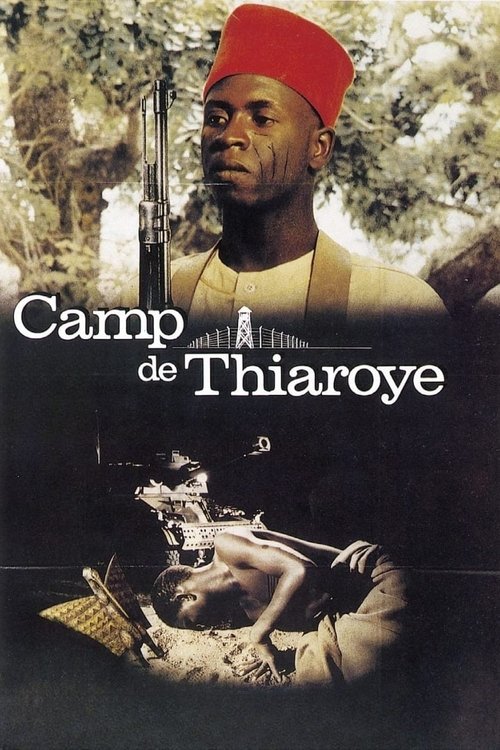
Camp de Thiaroye
1988 · Ousmane Sembène
For when you want cinema that confronts history head-on and you're ready to be angry — demanding, essential viewing, not a comfort watch.
What it's about
Late 1944: a battalion of Senegalese tirailleurs — colonial infantrymen who fought to liberate France — is shipped home and held in a transit camp outside Dakar, behind barbed wire and watchtowers that look queasily like the prison camps some of them survived in Europe. Among them are Sergeant Diatta, Paris-educated with a French wife and child, and a shell-shocked soldier who won't remove a captured SS helmet. As the army stalls on their back pay and degrades their rations, the men begin to grasp what their service was actually worth to the empire.
The experience
A slow, furious accumulation — each indignity small enough to rationalize, until they aren't. It's absorbing, enraging, and it leaves a bruise; the final stretch will stay with you for a long time.
The craft
Sembène and co-director Thierno Faty Sow build the film as a babel — Wolof, officer-class French, the soldiers' improvised camp pidgin — so language itself maps the colonial hierarchy. Made pointedly without a franc of French money, financed by Senegal, Algeria, and Tunisia, its method is patient accumulation of documented detail rather than melodrama.
Why it matters
A cornerstone of African cinema that dragged a suppressed colonial atrocity into the light — France kept the film effectively unseen there for years — and a defining work from the man widely called the father of African film.
In late 1944, a battalion of Senegalese tirailleurs — colonial infantrymen who helped liberate France — is repatriated to a transit camp outside Dakar, where the barbed wire and watchtowers look queasily like the stalags some of them survived. Ousmane Sembène, the dockworker-novelist who became the father of African cinema, co-directed this furious reckoning with Thierno Faty Sow, and made it pointedly without a franc of French money, financed instead by Senegal, Algeria and Tunisia. The method is accumulation: disputed back pay, degraded rations, a shell-shocked soldier who will not remove a captured SS helmet, an assimilated sergeant fluent in Paris and pure jazz discovering what assimilation does not buy. Sembène builds the film as a babel — Wolof, officer-class French, the soldiers' improvised 'français tirailleur' — until the camp becomes an argument about who is permitted to speak, and in whose tongue. It shared the Special Jury Prize at Venice in 1988, then went effectively unshown in France for years — a suppression that grimly confirmed everything the film had to say.
Reception
Won the Special Jury Prize at Venice in 1988 — then was banned in France, the country it indicts, and went largely unseen there for decades. Its 4K restoration finally premiered at Cannes Classics in 2024, completing one of cinema's great suppression-to-vindication arcs.
How Camp de Thiaroye was received, from release to now →
Influences: the films it descends from and the films it influenced
- Emitaï (1971) — Sembène's first dramatization of Senegalese tirailleurs and a Diola village crushed by the French colonial army, establishing the collective-village protagonist and the slow, accumulating tableau-staging of colonial atrocity that Thiaroye completes.
- La Noire de… (Black Girl) (1966) — Pioneered his interiorized study of assimilation and the psychology of the colonized subject, the alienation-of-the-Frenchified-servant that returns as Sergeant Diatta and the mute, damaged Pays.
- Ceddo (1977) — Built the language-and-power method — naming, conversion, translation as instruments of domination — dramatized through long communal-debate tableaux, the same formal signature Thiaroye applies to a military camp.
- Battleship Potemkin (1925) — Sembène trained at Moscow's Gorky Studio; the Odessa Steps model of the state massacring its own people, staged as a montage set-piece with the crowd as protagonist, underwrites the night shelling of the camp.
- Rome, Open City (1945) — Neorealist template Sembène adopts — nonprofessional and near-documentary performance, real locations, a recent historical atrocity reconstructed with reportorial restraint that detonates in a single act of violence.
- La Grande Illusion (1937) — The prison/transit camp as a Babel of tongues and a microcosm of nation and class; its layered multilingual dialogue is the direct precedent for Thiaroye's French-Wolof-English-pidgin soundscape.
- The Battle of Algiers (1966) — Docu-realist reconstruction of colonial repression built by accumulation of incident toward an inevitable eruption, the newsreel-grammar of anticolonial cinema Sembène inherits and slows down.
- Paths of Glory (1957) — The army turning its guns on its own soldiers, staging military injustice as cold institutional machinery — the exact structural engine of the tirailleurs shot by the France they served.
- Sambizanga (1973) — Carries the political-drama-of-colonial-injustice tradition forward with an ensemble nonprofessional cast reconstructing a real atrocity on substitute locations.
- Hyènes (1992) — Extends Senegalese cinema's national-allegory mode — a community's moral reckoning staged as parable — carrying forward Sembène's use of a single locale as a stand-in for the postcolonial nation.
- Lumumba (2000) — Dramatizes anticolonial betrayal with archival rigor and political anatomy, inheriting Thiaroye's method of narrating a suppressed historical crime as forensic reconstruction.
- Bamako (2006) — Literally puts colonialism and its institutions on trial in a courtyard, extending Sembène's courtroom-of-history rhetoric and communal-testimony staging.
- Days of Glory (Indigènes) (2006) — Directly continues the tirailleur subject — colonized soldiers fighting for France then betrayed over pay and rank — picking up the exact grievance Thiaroye's mutiny dramatizes.
- Timbuktu (2014) — Weaves Tamasheq, Arabic, Bambara, French and English into a politically charged multilingual babel where translation marks power, the sound-design inheritance of Thiaroye's polyglot camp.
- Moolaadé (2004) — Its ensemble staging within an enclosed camp, where collective grievance builds through overlapping voices toward defiance, rehearses the choral courtyard dynamics of Moolaadé's women.
- Xala (1975) — Satirical anatomy of the assimilated African bourgeoisie coded through French-versus-Wolof, the same weaponized bilingualism that separates officers from men in the camp.
- Soleil Ô (1970) — Parallel African-authored dissection of assimilation and the psychic toll of imposed Frenchness, sharing the fractured, non-linear indictment of the colonial contract.
- Sarraounia (1986) — Independently, African-financed anticolonial epic reconstructing a colonial-army atrocity with an African collective as protagonist, the contemporaneous companion project to Thiaroye's historical recovery.
Similar films
- The Battle of Algiers (1966) — influence & lineage
- Grand Illusion (1937) — influence & lineage
- Hyenas (1992) — influence & lineage
- Emitaï (1973) — shared sensibility
- Black Girl (1966) — shared sensibility
- De Gaulle: Liberté (2026) — shared sensibility
- Moolaadé (2004) — shared sensibility
- Soleil O (1973) — shared sensibility