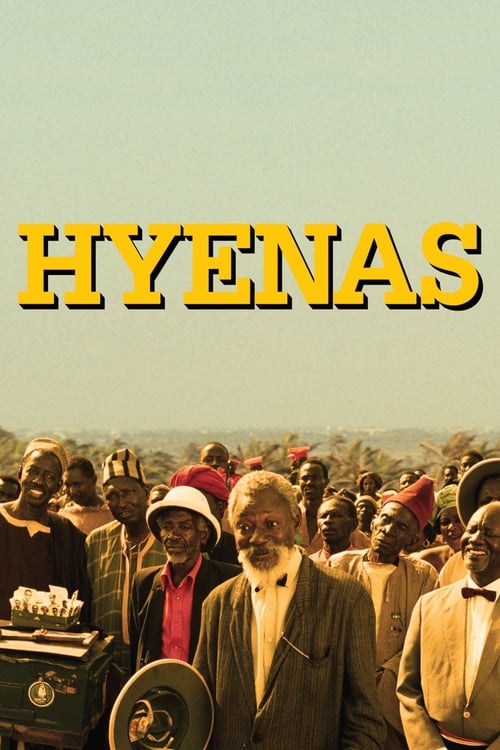
Hyenas
1992 · Djibril Diop Mambéty
For when you want satire with real fangs — a film to chew on for days about money, debt, and what a community will trade for comfort. A challenge, not a comfort watch, but a wickedly entertaining one.
What it's about
A fabulously wealthy woman — 'richer than the World Bank' — returns to the dusty Senegalese town that once cast her out and makes the impoverished residents an offer: her fortune, in exchange for the death of the shopkeeper who wronged her decades ago. The town is scandalized, of course. Then the refrigerators, fans, and yellow plastic sandals start arriving, and everyone begins finding reasons why justice might be served.
The experience
A lacerating comedy — playful, strange, and increasingly chilling as you watch ordinary people talk themselves into the unthinkable. It's funny until it isn't, and the aftertaste is deliberately bitter.
The craft
Djibril Diop Mambéty transposes Friedrich Dürrenmatt's play The Visit to the Senegalese town of his own birth and directs in a carnivalesque, associative style — elephants and vultures cut into the drama, crowds mass like the hyenas of the title, and consumer goods arrive like a slow-motion bribe. It looks and moves like nothing else in the fable tradition.
Why it matters
Only the second feature from African cinema's great renegade, nineteen years after Touki Bouki, and now a cornerstone of the continent's film canon — a parable of neocolonial debt that has only grown sharper.
Nineteen years after Touki Bouki announced him as African cinema's great renegade, Djibril Diop Mambéty returned with only his second feature: a transposition of Friedrich Dürrenmatt's play The Visit to Colobane, the dusty Senegalese town of his birth. A fabulously wealthy woman — 'richer than the World Bank,' the film notes — comes home and offers the impoverished townspeople a fortune on one condition: the death of the shopkeeper who wronged her decades before. Where Dürrenmatt wrote a parable of Swiss complacency, Mambéty makes a lacerating comedy of neocolonialism, watching consumer goods — fans, refrigerators, yellow plastic sandals — arrive like a slow-motion bribe as the town talks itself into murder. His style is carnivalesque and associative: elephants and vultures cut into the drama, the townsfolk massing like the hyenas of the title. It played in competition at Cannes in 1992, and Mambéty conceived it as the second panel, after Touki Bouki, of an unfinished trilogy about power and money. He died in 1998 with only two features complete — both of them essential.
A Deleuzian reading
First the sandals.
The full Deleuzian reading of Hyenas →
Reception
It premiered in competition at Cannes in 1992 to respectful but modest attention, then spent decades hard to see outside cinephile circles — until the 2018 restoration and re-release turned it into a consensus masterpiece of African cinema for a whole new generation.
How Hyenas was received, from release to now →
Influences: the films it descends from and the films it influenced
- Touki Bouki (1973) — Mambéty's own debut supplies Hyenas's grammar of associative, elliptical montage — jump cuts and dislocated sound bridges that yoke unrelated images (livestock, ocean, machinery) into a rhythmic commentary track, and the two films form his diptych on power and madness.
- The Visit (1964) — The prior screen adaptation of Dürrenmatt's play establishes the dramaturgical machine Mambéty rebuilds: a returning, artificially-augmented millionairess buys a town's soul by pricing a single man's death, staged as an escalating chorus of collective complicity.
- Xala (1975) — Sembène's satire of the neocolonial Senegalese bourgeoisie — whose imported luxury goods and appetites are punished by a curse — hands Mambéty the template of consumerism-as-symptom, where new commodities visibly corrupt the frame as the community rots.
- Black Girl (1966) — The founding African-cinema moral fable, distilling neocolonial exploitation into a single allegorical figure and an unadorned parable structure that Mambéty inherits and then inflates to carnivalesque scale.
- Viridiana (1961) — Buñuel's surrealist bourgeois satire — the grotesque banquet, the blasphemous feast of the greedy — models the tableau of a community gorging on ill-gotten plenty while a moral debt is quietly liquidated.
- Amarcord (1973) — Fellini's carnivalesque processions and grotesque provincial chorus supply Hyenas's staging of the townspeople as a festive collective mass, the parade and public spectacle rendering greed as communal pageant.
- Moi, un Noir (1958) — Rouch's disjunctive African-set editing — image and commentary sound deliberately unglued — is the ethnographic-new-wave source of Mambéty's associative montage and improvisatory street texture.
- Strike (1925) — Eisenstein's intellectual montage — cutting slaughterhouse animals against human action to editorialize by juxtaposition — underlies Hyenas's recurring hyena/elephant/vulture inserts that gloss the townsfolk as scavenging predators.
- Hawks and Sparrows (1966) — Pasolini's picaresque Marxist fable, using animal allegory and an itinerant parable to indict material appetite, prefigures Mambéty's mode of political myth carried by talking-beast symbolism.
- Camp de Thiaroye (1988) — Extends Senegalese cinema's national-allegory mode — a community's moral reckoning staged as parable — carrying forward Sembène's use of a single locale as a stand-in for the postcolonial nation.
- Le Franc (1994) — The first panel of Mambéty's late 'Tales of Little People' trilogy extends Hyenas's obsession with money as farce, chasing a winning lottery ticket through the same associative, sound-collaged street comedy.
- La Petite Vendeuse de Soleil (1999) — Mambéty's final film inverts Hyenas's parable — a disabled girl's dignity against the cash economy — completing the trilogy with the same moral-fable clarity and carnivalesque market staging.
- Bamako (2006) — Sissako stages a literal courtyard trial of the IMF and World Bank, extending Hyenas's allegory of money as neocolonial predator into an explicitly juridical parable of Africa versus global finance.
- Timbuktu (2014) — Sissako's lyrical, elliptical tableaux and grave moral weight carried through associative cutting descend directly from Mambéty's fusion of beauty, irony, and parable in a communally observed West African setting.
- Félicité (2017) — Gomis's Senegalese urban drama, structured by musical and associative montage that ruptures naturalism with symbolic interludes, carries forward Mambéty's Dakar lineage of rhythm-driven, non-linear editing.
- I Am Not a Witch (2017) — A caustic parable of a community that collectively scapegoats and exploits one person for gain — the same satirical mechanism of communal complicity Nyoni dramatizes around Shula.
- Guelwaar (1993) — A contemporaneous Senegalese satire indicting foreign-aid dependency and elite complicity, sharing Hyenas's exact target — a community morally hollowed by accepting outside money.
- Tilaï (1990) — Ouédraogo's spare village tragedy, in which communal judgment enforces a lethal moral verdict, works the same allegorical-parable register — the collective as chorus adjudicating one man's fate.
- Yeelen (1987) — Cissé's mythic Malian allegory, translating a moral-cosmic reckoning into imagistic, symbol-laden sequences, shares Mambéty's 1980s–90s project of elevating African cinema into archetypal fable.
- Moolaadé (2004) — Mambéty stages the village assembly as moral theater and allegory, a Senegalese sibling to Sembène's use of the communal gathering as the ethical courtroom of the film.
- This Is Not a Burial, It's a Resurrection (2020) — A returning avenging figure and a whole village's moral displacement told as parable across sun-scorched landscapes — the same allegorical-elegy register applied to communal uprooting.
Similar films
- Black Girl (1966) — influence & lineage · often watched together
- Touki Bouki (1973) — influence & lineage
- The Little Girl Who Sold the Sun (1999) — influence & lineage
- Yeelen (1987) — influence & lineage
- Moolaadé (2004) — shared sensibility
- Camp de Thiaroye (1988) — shared sensibility
- Emitaï (1973) — shared sensibility
- On Becoming a Guinea Fowl (2024) — shared sensibility