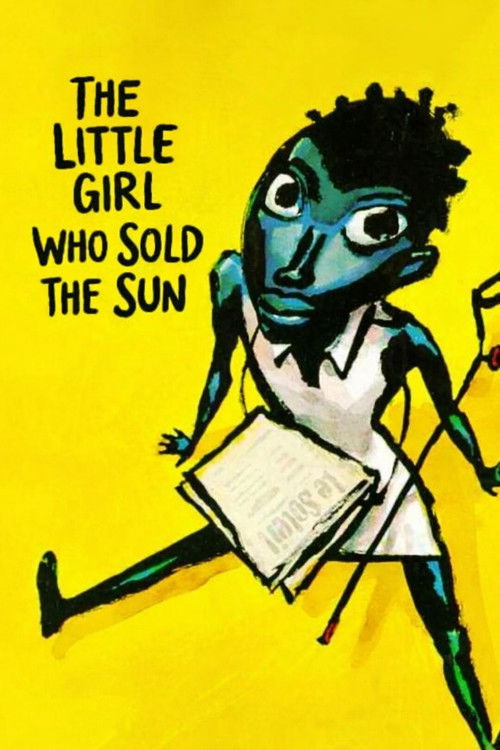
The Little Girl Who Sold the Sun
1999 · Djibril Diop Mambéty
For when you want something genuinely uplifting that isn't sappy — a shot of courage and color in under an hour. A perfect film to lift a heavy day.
What it's about
Sili, a young girl who walks on crutches, arrives in Dakar and decides to sell newspapers on the street — a hustle the boys consider strictly theirs. From that one small act of defiance unfolds a forty-five-minute fable about dignity, commerce, and holding your ground in a city that expects you to yield.
The experience
Luminous and buoyant — it has the clarity of a folk tale and the pulse of a real, teeming city. Short enough to watch on a whim, radiant enough to stay with you far longer than its running time.
The craft
Djibril Diop Mambéty trades the fractured experimentation of his earlier work for a fable's directness: saturated color, faces filmed head-on, the yellow of Sili's dress blazing against the dust of Dakar. Every frame is composed with the confidence of a master working with total economy.
Why it matters
Mambéty's final completed film, released after his death as the second panel of his unfinished trilogy honoring the hustlers and dreamers of the postcolonial street — the testament of one of African cinema's great renegades, dedicated to the courage of street children.
Sili, a girl who walks on crutches, arrives in Dakar and decides to sell newspapers on the street — a trade the boys consider theirs. From that small act of defiance Djibril Diop Mambéty builds forty-five luminous minutes about dignity, commerce, and a city in flux. The Senegalese director of Touki Bouki, African cinema's great renegade modernist, conceived this as the second panel of an unfinished trilogy, 'Tales of Little People,' honoring the hustlers and dreamers at the bottom of the postcolonial economy; he died before completing the third, and the film was released posthumously — his testament, dedicated to the courage of street children. Where Touki Bouki fractured time, here Mambéty works with a fable's clarity: saturated color, direct faces, the yellow of Sili's dress blazing against the dust. The newspaper she hawks is called Le Soleil — the sun, sold daily on the street by a child the world underestimates. Mambéty's niece, Mati Diop, would later carry the family's cinema forward with Atlantics, but this little film remains its most distilled statement: generosity as radical politics.
Reception
Released posthumously a year after Mambéty's death, it arrived already framed as a farewell — and its reputation has only grown since, from festival-circuit tribute to a fixture on greatest-African-films lists.
How The Little Girl Who Sold the Sun was received, from release to now →
Influences: the films it descends from and the films it influenced
- Touki Bouki (1973) — Mambéty's own foundational grammar — elliptical jump-cutting, sun-blasted saturated color, and Dakar's hustle-economy filmed as sensory montage — is the visual language he strips to fable simplicity here.
- Le Franc (1994) — The direct predecessor in the 'Tales of the Little People' trilogy, establishing the template of a single poor Dakarois protagonist chasing a coin/note through the informal economy with picaresque, near-silent-comedy staging.
- Hyènes (1992) — Refines his allegory of money as social poison and his frontal, theatrically composed staging of the poor against a consumerist backdrop — the same moral economy Sili resists.
- Borom Sarret (1963) — The founding text of Senegalese social realism: a single day tracking a poor Dakar laborer through the cash economy, giving Mambéty the model of the dignified indigent as narrative center.
- Mandabi (1968) — Its plot engine — a small sum of money that exposes the whole postcolonial urban economy of exploitation and solidarity — is the direct structural ancestor of Sili's newspaper-selling struggle.
- Bicycle Thieves (1948) — Italian neorealism's method of casting non-professionals and staging a subsistence quest (a stolen livelihood) in real streets underlies Mambéty's use of actual Dakar market locations and untrained children.
- Shoeshine (1946) — De Sica's portrait of street children surviving the informal economy with their own moral code models the performance register Mambéty draws from his cast of Dakar child vendors.
- The 400 Blows (1959) — Establishes the child protagonist observed with unsentimental dignity and the held frontal face as emotional climax — Mambéty's direct-to-camera address to Sili descends from this.
- Pather Panchali (1955) — A parallel Third-Cinema humanism: poverty rendered in lyrical, saturated images with a child's-eye wonder rather than misery, the tonal balance Mambéty strikes with Sili.
- Bamako (2006) — Carries forward Mambéty's project of putting the postcolonial economy itself on trial, blending allegory with documentary street texture and dignified close-ups of the poor.
- Atlantics (2019) — Made by Mambéty's niece: inherits his Dakar of longing and economic precarity, his saturated coastal light and lyrical realism-turned-fable, explicitly extending his authorship.
- A Thousand Suns (2013) — Directly reworks the Mambéty legacy (built around Touki Bouki's star) — a descendant essay-film that continues his elliptical montage and mythologizing of Dakar's dreamers.
- Beasts of the Southern Wild (2012) — A young girl of the dispossessed rendered as fable-heroine through saturated, tactile imagery and a non-professional child performance held in intimate direct-face framing — Sili's craft echoed.
- Yeelen (1987) — African modernism's move to render social truth through fable and myth rather than didactic realism — the same folkloric register (Sili as talisman-like heroine) that structures Mambéty's tale.
- Moolaadé (2004) — Extends the craft of the defiant West African girl/woman as political agent against patriarchal economy, staged with vivid color and communal courtyard blocking akin to Sili's gender defiance.
- La Vie sur Terre (1998) — Contemporary African modernism that films postcolonial economic marginality as gentle, observational fable with frontal portraiture of ordinary faces — the same lyrical-political mode.
Similar films
- Hyenas (1992) — influence & lineage
- Moolaadé (2004) — influence & lineage
- Touki Bouki (1973) — influence & lineage
- Yeelen (1987) — influence & lineage
- The 400 Blows (1959) — influence & lineage
- Pather Panchali (1955) — influence & lineage
- Black Girl (1966) — shared sensibility
- Soleil O (1973) — shared sensibility