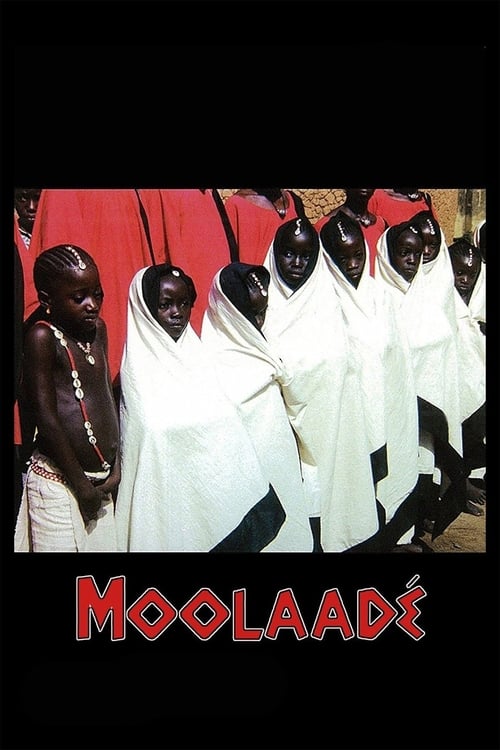
Moolaadé
2004 · Ousmane Sembène
For when you want a film with real stakes that still believes in people — a story of everyday courage that fires you up instead of wearing you down. It asks something of you, but it pays you back.
What it's about
In a village in Burkina Faso, a woman invokes moolaadé — an ancient right of sanctuary — to shelter four girls fleeing ritual genital cutting. Her act of protection pits one tradition against another, and the standoff spreads from her courtyard into every corner of the village: husbands against wives, elders against mothers, custom against conscience. What starts as one woman's refusal becomes a reckoning for the whole community.
The experience
Warmer and funnier than its subject suggests — arguments play out in sunlit courtyards full of color, music, and sharp-tongued neighbors, and the film builds from communal comedy toward real moral force. It leaves you stirred rather than crushed; the anger in it is matched by an unmistakable hope.
Performances
Fatoumata Coulibaly anchors the film as Collé, the woman who says no — steady, wry, and immovable, radiating the kind of ordinary heroism the whole story turns on.
The craft
Ousmane Sembène stages the conflict as open-air communal theater: debates held in public, the village itself the arena, every courtyard alive with pattern and color. The images are direct and vivid rather than ornate — a smoldering pile of confiscated radios beside the mosque says more than any speech. It's filmmaking of remarkable clarity, made by a director in his eighties with nothing left to prove.
Why it matters
The final film of the father of African cinema, and widely considered one of the great African films of its century — a work that carried the fight against genital cutting to audiences worldwide and capped a lifetime of militant, optimistic storytelling.
The final film of Ousmane Sembène — the Senegalese novelist-turned-director universally called the father of African cinema — is a battle of customs waged in a single Burkinabè village. When a woman invokes moolaadé, the ancient right of sanctuary, to shelter four girls fleeing ritual genital cutting, she sets protection against 'purification,' one tradition against another, and the village's whole social order begins to shake. Sembène, then in his eighties, stages this as neither lecture nor tragedy but as vivid communal theater: courtyards alive with color, arguments conducted in the open, a confiscated pile of radios smoldering beside the mosque as the women discover what solidarity sounds like. He called it part of a cycle on 'heroism in everyday life,' and his militant optimism — the belief that Africa's renewal would come from its women — burns through every frame. It won Un Certain Regard at Cannes in 2004 and stands as one of cinema's great acts of advocacy, made by a man who spent fifty years insisting the movies could be, in his phrase, a night school for his continent.
A Deleuzian reading
A pile of transistor radios, confiscated from every compound in the village, left smoldering in the dirt beside the mosque.
The full Deleuzian reading of Moolaadé →
Reception
It arrived already garlanded — winner of Un Certain Regard at Cannes 2004, with Roger Ebert declaring it the best film he saw at the festival — and when Sembène died three years later it hardened into legend: the 81-year-old father of African cinema going out on his masterpiece.
How Moolaadé was received, from release to now →
Influences: the films it descends from and the films it influenced
- Mandabi (1968) — Sembène's first Wolof-language feature establishes the courtyard-and-compound mise-en-scène — women framed in the domestic enclosure — that Moolaadé builds its entire spatial grammar around.
- Ceddo (1977) — Its static, frontal tableau staging of communal palavers, where the village debates faith and custom as if on a theatrical stage, is the direct precursor to Moolaadé's communal-theater blocking of the assembly scenes.
- Xala (1975) — The satirical use of a public communal gathering as an arena to expose the hypocrisy of postcolonial authority carries straight into Moolaadé's confrontations before the men's council.
- Guelwaar (1992) — A single act of principled refusal detonating a village-wide 'tradition-versus-tradition' argument is the exact narrative engine Sembène reuses, replacing a burial dispute with the granting of moolaadé (sanctuary).
- Black Girl (1966) — Sembène's founding social-realist method — a non-professional woman at the center, austere framing, and voiceover as interior resistance — is the authorship DNA Moolaadé extends in his late career.
- Bicycle Thieves (1948) — Italian neorealism's toolkit — location shooting, non-professional casting, and the ordinary person elevated to moral hero — is the imported grammar Sembène Africanized for his everyday-heroism narratives.
- Camp de Thiaroye (1988) — Its ensemble staging within an enclosed camp, where collective grievance builds through overlapping voices toward defiance, rehearses the choral courtyard dynamics of Moolaadé's women.
- Bamako (2006) — Sissako literalizes Sembène's communal-theater device by staging a tribunal against globalization inside a working Bamako courtyard, life and social advocacy sharing the same domestic frame.
- Timbuktu (2014) — Its vivid-color widescreen and portraits of women quietly resisting an imposed, punitive tradition extend Moolaadé's method of dignifying feminine defiance without melodrama.
- Difret (2014) — Its legal-advocacy narrative dramatizing a customary practice inflicted on girls — a lone woman shielding one child to challenge the whole custom — is Moolaadé's sanctuary-and-solidarity structure transposed to Ethiopia.
- Wadjda (2012) — An 'everyday heroism' film in which a girl's small, patient defiance quietly pressures a communal tradition, inheriting Sembène's preference for undemonstrative resistance over polemic.
- I Am Not a Witch (2017) — Sembène's model of African social satire — indicting a communal tradition's cruelty to women from inside the village rather than from a colonial outside — is the polemical spine Nyoni inherits.
- On Becoming a Guinea Fowl (2024) — Women's collective resistance to a gendered ritual abuse, blocked across communal courtyard space so the group itself becomes the subject — the choral-female framing Nyoni uses for the aunts and cousins.
- Lingui, the Sacred Bonds (2021) — Sembène's template of staging a village-level women's rebellion against genital cutting through frontal, didactic-yet-warm mise-en-scène and vivid textile color directly models Lingui's fusion of social-issue advocacy with saturated, dignified imagery of African women.
- Yeelen (1987) — A Malian contemporary sharing the vivid natural-color palette and a plot built on generational tradition and initiation ritual as a site of contested authority.
- Tilaï (1990) — Ouédraogo's spare village drama, where inherited custom collides with individual conscience in the compound courtyard, works the same tradition-versus-conscience terrain in the same staging.
- Hyènes (1992) — Mambéty stages the village assembly as moral theater and allegory, a Senegalese sibling to Sembène's use of the communal gathering as the ethical courtroom of the film.
- Wend Kuuni (1982) — Its oral-storytelling structure and immersion in communal courtyard rhythms model the same griot-inflected, village-centered African cinema Sembène helped legitimize.
- Sambizanga (1972) — A woman's political awakening carried by a single female protagonist's journey makes it the earlier African social-advocacy film centering feminine agency that Moolaadé answers.
- Water (2005) — A contemporaneous social-advocacy drama indicting a specific tradition that maims women's lives, using the same strategy of embedding a single reformer's defiance within a resistant community.
- The Little Girl Who Sold the Sun (1999) — Extends the craft of the defiant West African girl/woman as political agent against patriarchal economy, staged with vivid color and communal courtyard blocking akin to Sili's gender defiance.
Similar films
- Black Girl (1966) — influence & lineage
- Camp de Thiaroye (1988) — influence & lineage
- Yeelen (1987) — influence & lineage
- Hyenas (1992) — influence & lineage
- Emitaï (1973) — shared sensibility
- The Little Girl Who Sold the Sun (1999) — shared sensibility
- Soleil O (1973) — shared sensibility
- Goodbye Julia (2023) — shared sensibility