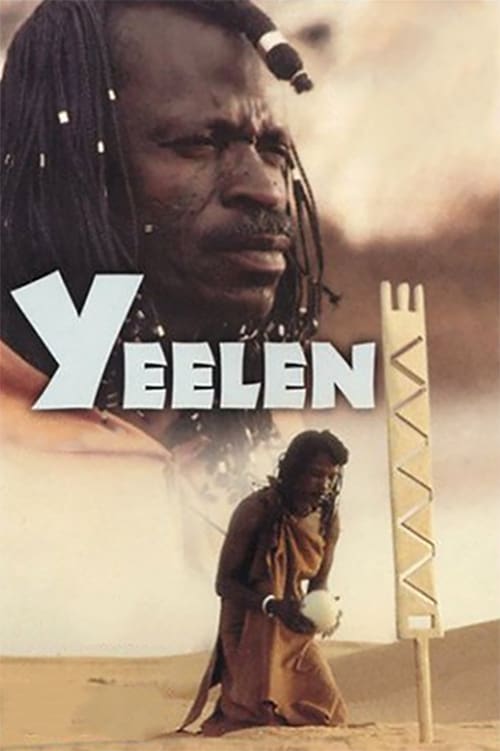
Yeelen
1987 · Souleymane Cissé
For when you want to be transported somewhere cinema rarely goes — an adventurous, patient evening for viewers curious about myth and magic told on its own terms. It asks you to surrender to its rhythm rather than chase a plot.
What it's about
In a mythic, pre-colonial Mali, a young man born with magical powers flees across the land to reach an uncle who can help him face the one hunting him: his own father, a jealous sorcerer of terrifying strength. His journey is a rite of passage through the cosmology of the Bambara people — sacred objects, initiations, and a gathering confrontation between generations. The title means 'brightness,' or 'the light.'
The experience
Stately, strange, and genuinely enchanted — it moves at the pace of ritual rather than plot, and its images of desert, fire, and light have a hypnotic, dreamlike charge. You watch it the way you'd listen to a myth being told.
The craft
Cissé builds his fantasy not from effects but from landscape, ritual objects, and above all light — sun, fire, and radiance carry the story's magic, and the widescreen images of the Malian countryside are ravishing on a big screen. The storytelling draws directly on Bambara initiation rites, giving the film a texture and logic unlike any Western fantasy.
Why it matters
Winner of the Jury Prize at Cannes in 1987, it carried Malian and sub-Saharan African cinema onto the world stage and became a touchstone for filmmakers seeking stories rooted in indigenous cosmology rather than imported conventions.
Snapshot
Yeelen — the word means "brightness" or "the light" in Bambara — is Souleymane Cissé's luminous fourth feature and the film that carried Malian cinema, and sub-Saharan African filmmaking more broadly, onto the summit of the world festival circuit. Drawing on the cosmology and initiatic rites of the Bambara (Bamana) people, it recasts a story of magical succession — a young initiate, Nianankoro, journeys across a mythic pre-colonial Mali to confront the sorcerer father who hunts him — as a parable of generational rupture and renewal. Awarded the Jury Prize (Prix du Jury) at the 1987 Cannes Film Festival, it became one of the most celebrated African films ever made and a touchstone for later filmmakers who sought a cinema rooted in indigenous cosmology rather than in the conventions of European or Hollywood narrative. Its reputation rests on an unusual fusion: an austere, almost documentary attentiveness to landscape and ritual gesture, married to a mythic structure of prophecy, pursuit, and apocalyptic transformation.
Industry & production
Yeelen was made within the fragile ecology of Francophone West African film production of the 1980s, in which national ambition depended heavily on French technical and financial support. Cissé, working out of Mali — a country with almost no commercial film infrastructure — assembled a co-production drawing on Malian resources and French backing, with post-production and laboratory work routed through France, as was standard for the period's African "auteur" cinema. The picture was shot on location in Mali, using largely non-professional and regional performers alongside a small number of experienced actors.
The production was, by Cissé's own later accounts, arduous and protracted, beset by the logistical difficulties of filming in remote locations and by interruptions during the shoot; the film's completion over an extended period is part of its lore, though precise budget figures and a fully documented production chronology are not reliably established in the general record, and I will not invent them. What is clear is that the film's making was itself an act of cultural stewardship: Cissé sought the counsel of Bambara knowledge-keepers regarding the depiction of the Komo, the male initiation society whose secret science stands at the film's center, and the film treads carefully around material that is, within the culture, genuinely esoteric.
Its international life was decisively shaped by Cannes. Selection into competition and the subsequent Jury Prize gave Yeelen a distribution afterlife — art-house theatrical runs in Europe and North America, and enduring circulation through repertory, festival retrospectives, and eventual restoration — that few African films of its generation achieved.
Technology
Yeelen was photographed on 35mm color stock and finished for conventional theatrical projection. Its technological signature is not spectacle but a disciplined reliance on natural light and location resources: the film reads the West African sun — hard midday glare, the long amber rake of late afternoon, the blue of dusk — as its principal lighting instrument. There are no visual-effects set-pieces in the modern sense; the film's "magic" is achieved through profilmic means and editing rather than optical trickery. The famous climactic confrontation, in which paternal and filial powers collide, resolves into an overwhelming burst of white — light as both narrative subject and cinematic material — accomplished through in-camera exposure and cutting rather than elaborate laboratory compositing. This economy is itself a thesis: that the numinous can be rendered by the plainest photographic tools when they are pointed at the right things.
Technique
Cinematography
The cinematography — credited to Jean-Noël Ferragut, with Jean-Michel Humeau also associated with the film's camerawork — is central to the film's power. It favors patient, frequently static or slow compositions in which human figures are set against expanses of savanna, water, red earth, and sky. The palette is dominated by ochres, dusty golds, and deep blues; skin, cloth, and clay are lit to register texture rather than to flatter. Cissé and his cinematographers repeatedly compose in depth and in stillness, allowing ritual objects and gestures to occupy the frame with hieratic weight. The effect is at once ethnographically precise and mythically abstracted: a specific place, filmed with documentary fidelity, becomes a stage for cosmic drama.
Editing
The editing — associated with Andrée Davanture, the French editor who cut a significant body of Francophone African cinema in this era, though readers should confirm the credit against the film's titles — proceeds at a contemplative tempo. Scenes are given time to breathe; ritual sequences unfold with a duration that honors their gravity rather than compressing them for pace. Yet the film is not inert: the cutting sharpens decisively at moments of confrontation and revelation, and the climactic clash gains its force from an accelerating, percussive assembly that culminates in the annihilating flash of light. The rhythm alternates between meditative stasis and sudden intensity, mirroring the narrative's movement between journey and reckoning.
Mise-en-scène / staging
Cissé stages the film with a ceremonial formality. Ritual objects — above all the Komo paraphernalia and the magical pillar/pestle (the kolonkalanni) that the father wields to track his son — are foregrounded as agents in the drama, not mere props. Bodies are frequently arranged frontally or in processional lines, evoking the iconography of ritual itself. The staging withholds spectacle and instead accumulates authority through repetition, symmetry, and the deliberate placement of figures within landscape. Costume, scarification, ornament, and the material culture of Bambara and Fula (Peul) life are rendered with an attentiveness that gives the mythic action an unshakable material grounding.
Sound
The soundtrack blends a spare musical score — credited to the French musician Michel Portal, whose contribution lends passages of woodwind-inflected coloration (readers should verify the exact music credits) — with the ambient sound of the natural world and the chant and percussion of ritual. Incantation is treated as a sonic force: the low recitation of the Komo, the naming of powers, the invocations of the elders. Dialogue is delivered in Bambara and Fula, a decision of enormous cultural significance in a period when African films were often pressured toward French. The interplay of silence, environmental sound, ritual utterance, and sparse music sustains the film's atmosphere of sacred tension.
Performance
Performances are grave, restrained, and frequently non-naturalistic in the Western sense. Issiaka Kane plays Nianankoro, the young man carrying inherited power he only partly understands; Niamanto Sanogo embodies the implacable father, Soma, a figure of terrifying, calcified authority; Aoua Sangaré appears as Attou, and Balla Moussa Keita as the Peul king Rouma Boll. The acting style privileges bearing, gesture, and presence over psychological demonstration, in keeping with the film's mythic register. The father in particular is a monument of menace rendered largely through stillness and voice — power depicted as something one carries rather than performs.
Narrative & dramatic mode
The film's dramatic mode is mythic and prophetic rather than psychological-realist. Its engine is a familiar archetype — the son who must confront and supersede the father — but Cissé stages it as cosmological inevitability. The elder Soma, a master of the Komo's secret knowledge, uses that knowledge to hunt Nianankoro, who flees across the land toward his paternal uncle, seeking the wisdom to survive the encounter. The structure is that of a quest interlaced with a pursuit: forward motion (the journey to the uncle) shadowed by relentless approach (the father's tracking magic). Time in the film is legendary rather than historical; the drama proceeds by omen, ritual, and fated confrontation. The ending — the mutually destructive clash of powers, followed by an image of new life and inheritance passed to the next generation amid the sands — resolves not as tragedy or triumph but as cyclical renewal: an old, hoarded, sterile order consumed so that light may begin again.
Genre & cycle
Nominally a fantasy-drama, Yeelen resists Western genre taxonomy. It is more precisely a work of mythological or cosmological cinema, adapting oral-tradition material into filmic form. It belongs to a strand of 1980s African filmmaking that turned from the overtly political, socially critical mode of earlier post-independence cinema (including Cissé's own Baara and Finye) toward the mythic, the spiritual, and the pre-colonial. Within Cissé's career it marks a decisive pivot inward, toward ancestral cosmology. Alongside works such as the films that would follow it in the "return to the source" tendency of African cinema, it helped define a cycle in which indigenous belief systems supplied not merely subject matter but narrative logic and aesthetic form.
Authorship & method
Souleymane Cissé (born 1940, Bamako) trained in filmmaking in Moscow at the state cinema school VGIK, where he studied under the veteran Soviet director Mark Donskoi — a formation that gave him a rigorous grounding in classical technique which he then bent toward distinctly African ends. His preceding features — Den muso (1975), Baara (1978), and Finye (1982) — engaged contemporary Malian society and its tensions; Yeelen represents his turn to myth. As writer-director he shaped the project from Bambara oral tradition and initiatic lore, working in consultation with cultural authorities to handle sacred material responsibly.
His key collaborators give the film its texture: the cinematography of Jean-Noël Ferragut (with Jean-Michel Humeau); the editing associated with Andrée Davanture, a linchpin figure in the technical support structure of Francophone African cinema; and the musical contribution credited to Michel Portal. (Where these craft credits are concerned, the broadly circulated record is consistent, but specifics should be checked against the film's own titles, as African productions of this era are sometimes inconsistently documented.) The method throughout is one of patient observation wedded to ceremonial staging — a director using the tools of world-class art cinema to make the interior world of Bambara cosmology visible on its own terms.
Movement / national cinema
Yeelen is a foundational monument of Malian national cinema and a peak of the broader Francophone West African film movement that emerged after independence, a movement whose senior figures included Ousmane Sembène of Senegal, often described as the father of African cinema. That movement contended with acute structural constraints — negligible domestic exhibition, dependence on French funding and post-production, and the challenge of addressing both local and international audiences. Within it, Cissé stands as one of the two or three most significant auteurs. Yeelen also exemplifies the "return to the source" impulse — the movement's turn toward pre-colonial heritage, indigenous languages, and traditional belief as the ground of an authentically African cinematic idiom, in deliberate contrast to imported models.
Era / period
Made in the mid-1980s, Yeelen arrived at a moment when African cinema was seeking new directions and new visibility. The decade's economic pressures on the continent coincided with a maturing generation of filmmakers whose international festival presence was growing. The film's 1987 Cannes recognition should be read against this backdrop: a validation, on the world's most prestigious stage, of an African art cinema that no longer needed to explain or justify itself in European terms. Its diegetic "period," by contrast, is deliberately unfixed — a legendary pre-colonial past outside dated history, evoking the era of the old Mali and its ritual orders.
Themes
The film's governing theme is the transmission — and corruption — of knowledge. The Komo's secret science can heal or destroy; in Soma's hands it has become an instrument of jealous domination, power hoarded by an elder caste against the young. The father–son conflict thus figures a larger crisis: the sterility of a tradition that refuses to renew itself. Related themes braid through it: the passage between generations; the tension between destiny and agency; the sacredness and danger of esoteric wisdom; the intimate bond between the human and the natural-cosmic order, with light, fire, water, and earth as active elemental forces. The closing image of eggs and inheritance in the sand crystallizes the film's ultimate subject: renewal through rupture, the necessary death of an old order so that a new light may rise.
Reception, canon & influence
Critically, Yeelen was received in the West as a revelation — praised for the beauty of its images, the integrity of its cultural vision, and its refusal of ethnographic condescension. The Cannes Jury Prize conferred lasting prestige, and the film has since been widely anthologized in critical accounts of world and African cinema, appearing on numerous lists of the greatest African films and undergoing restoration that has kept it in circulation for new audiences.
Its influences backward lie less in prior cinema than in Bambara oral literature, initiatic ritual, and cosmology — the "source" to which the film returns — filtered through Cissé's classical training under Donskoi and his grounding in the socially engaged African cinema of Sembène and his own earlier work. Forward, its legacy is substantial: it stands as a demonstration that a rigorously indigenous mythic cinema could command the highest international regard, encouraging African and diasporic filmmakers to trust their own cosmologies as the basis for form and not merely content. It is frequently cited by later directors and critics as a model of cinema that honors traditional knowledge without exoticizing it, and its reputation has only deepened with time. Precise claims about specific filmmakers who name it as a direct influence should be attributed case by case rather than asserted broadly; what is beyond dispute is its canonical standing as one of the supreme achievements of African cinema and a permanent reference point in any serious map of the medium's global lines of influence.
Reception
It arrived already garlanded — a Jury Prize at Cannes in 1987 — and its stock has only risen since: what was once received as a startling dispatch from Malian cinema is now routinely ranked among the greatest African films ever made, a fixture of world-cinema canons and critics' polls.
How Yeelen was received, from release to now →
Influences: the films it descends from and the films it influenced
- Ceddo (1977) — Establishes the West African template Cissé inherits — precolonial ceremonial staging performed in indigenous language by a largely non-professional cast, treating ritual and traditional authority as narrative structure rather than ethnographic spectacle.
- Earth (1930) — The Soviet lineage behind Cissé's VGIK training — pantheist landscape-in-depth shot in natural light, with agrarian cyclical renewal (death folding into harvest) rendered through static, near-liturgical tableau that Yeelen's cosmology echoes.
- Shadows of Forgotten Ancestors (1965) — Model for filming folk cosmology as ceremonial tableau — non-naturalistic performance and ritual incantation staged with formal frontality, the Soviet-trained approach to indigenous belief that shapes Yeelen's Komo sequences.
- Andrei Rublev (1966) — The contemplative long take that lets elemental phenomena — fire, water, wind, earth — accrue metaphysical weight over time; Yeelen's editing tempo and its treatment of the koré wing/magic as slow-gathering material force descend from this.
- Childhood of Maxim Gorky (1938) — Cissé's own teacher at VGIK — lyrical realism that roots the mythic and the coming-of-age in patiently observed rural texture, the classical grounding Cissé bent toward Bambara material.
- Les maîtres fous (1955) — The observational filming of West African possession trance that Yeelen technically inherits — sustained attention to ceremony and incantation — while deliberately stripping out Rouch's outsider gaze to render the rite from inside its own cosmology.
- Touki Bouki (1973) — A parallel Malinké/Wolof modernist reworking of oral-narrative structure — the quest-journey and cyclical return recast through indigenous-language storytelling, a sibling proof that African myth could dictate cinematic form.
- Emitaï (1973) — Cissé makes indigenous Bambara cosmology a literal diegetic force, following Emitaï's device of dramatizing the Diola gods deliberating on screen rather than as backdrop.
- The Night of Counting the Years (1969) — Cissé stages ancestral ritual and knowledge as slow, sculptural images set against monumental landscape, carrying forward Al-Mummia's fusion of hieratic performance with a national-mythic sense of inherited custodianship.
- Tilaï (1990) — Extends Yeelen's pared Sahelian fable — non-professional cast, ceremonial moral order (a father-son/succession transgression), and landscape-in-depth compositions under hard natural light governing the drama.
- Keïta! l'Héritage du griot (1995) — Makes the transmission of sacred knowledge from elder to son its explicit form — initiatic pedagogy structured as the film itself, the father-to-son succession that Yeelen dramatizes turned into narrative architecture.
- Waiting for Happiness (2002) — Carries forward the contemplative tempo and natural-light landscape-in-depth of Malian art cinema — human figures composed small within luminous Sahelian space, ceremonial stillness over plot.
- Daughters of the Dust (1991) — The diasporic answer to Yeelen's demonstration — trusting an ancestral cosmology as the basis of form, with non-naturalistic performance, ceremonial tableau, and golden natural light making an interior spiritual world visible on its own terms.
- Atlantics (2019) — Gives West African spirit cosmology contemporary cinematic form — possession and the returning dead staged with restraint under natural coastal light, extending Yeelen's project of letting indigenous metaphysics govern the image.
- Daratt (2006) — Distills the father-son succession and reckoning into austere, contemplative Sahelian tempo — ceremonial restraint and long silences carrying the transmission of a moral inheritance, the emotional grammar Yeelen models.
- Lingui, the Sacred Bonds (2021) — Cissé's luminous, sun-saturated cinematography of dark skin against Sahelian light establishes the West African art-cinema chromatics that Mathieu Giombini's color work for Lingui extends.
- Wend Kuuni (1983) — Builds its narrative on the griot's oral-tale grammar — a rural fable told in Mooré, staged in sunlit landscape with pared mise-en-scène, sharing Yeelen's fusion of indigenous storytelling structure and natural-light observation.
- Uncle Boonmee Who Can Recall His Past Lives (2010) — A parallel cosmological cinema — animist reincarnation and spirit visitation rendered matter-of-factly through contemplative tempo and unforced natural light, staging the supernatural as ordinary within its own belief system rather than as effect.
- Moolaadé (2004) — A Malian contemporary sharing the vivid natural-color palette and a plot built on generational tradition and initiation ritual as a site of contested authority.
- The Little Girl Who Sold the Sun (1999) — African modernism's move to render social truth through fable and myth rather than didactic realism — the same folkloric register (Sili as talisman-like heroine) that structures Mambéty's tale.
- Hyenas (1992) — Cissé's mythic Malian allegory, translating a moral-cosmic reckoning into imagistic, symbol-laden sequences, shares Mambéty's 1980s–90s project of elevating African cinema into archetypal fable.
Similar films
- Touki Bouki (1973) — influence & lineage
- Kirikou and the Sorceress (1998) — shared sensibility
- Moolaadé (2004) — shared sensibility
- Emitaï (1973) — shared sensibility
- Black Girl (1966) — shared sensibility
- Camp de Thiaroye (1988) — shared sensibility
- Son of the White Mare (1981) — shared sensibility
- Time of the Gypsies (1988) — shared sensibility