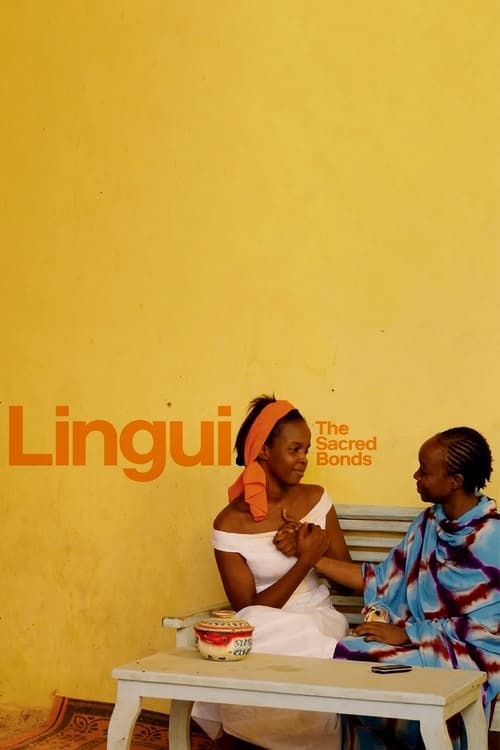
Lingui, the Sacred Bonds
2021 · Mahamat-Saleh Haroun
When you want a window into a life far from yours and a drama with real moral stakes — a film to sit with and talk about after, more nourishing than comfortable.
What it's about
On the outskirts of N'Djamena, Chad's capital, Amina scrapes out a living making cooking stoves from salvaged wire and old tires, raising her fifteen-year-old daughter Maria alone. When she learns Maria is pregnant and doesn't want the child, the two must seek an abortion that both the law and their Muslim community forbid. Their search pulls them through a hidden world of favors, whispers, and female solidarity — the sacred bonds of the title.
The experience
Quiet, steady, and gripping in a low-boil way — the tension comes not from chases but from who can be trusted, and what each ask will cost. It's a hard-subject film that ends up feeling surprisingly warm, because its real story is a mother and daughter learning to see each other.
Performances
Achouackh Abakar Souleymane carries the film as Amina, all contained determination — a woman who has spent years being judged and has learned to move through her city without flinching.
The craft
Haroun shoots with patient, sunstruck compositions that make the dusty streets and courtyards of N'Djamena a full character, and he lets scenes breathe rather than push. The storytelling is lean — barely ninety minutes — with meaning carried in glances, gates, and thresholds as much as dialogue.
Why it matters
A Cannes competition title from Chad's most internationally recognized filmmaker, it brought a rarely heard perspective — women's bodily autonomy inside a devout African community — to the world stage.
Snapshot
Lingui, the Sacred Bonds is a social-realist drama set in the outskirts of N'Djamena, the capital of Chad, following Amina, a devout single mother who scrapes a living by fashioning cooking braziers from salvaged wire and tire, and her fifteen-year-old daughter Maria, whose unwanted pregnancy sets the pair on a search for an abortion that is forbidden by both Chadian law and Muslim custom. The title word — lingui — names the web of obligation and connection that binds a Chadian community together, and the film's central irony is that Amina must summon that same communal solidarity, ordinarily an instrument of conformity and surveillance, to accomplish an act the community condemns. Directed by Mahamat-Saleh Haroun, the most internationally visible filmmaker Chad has produced, the film premiered in competition at the 2021 Cannes Film Festival. It marks a conspicuous turn in Haroun's body of work: after two decades of stories organized around fathers, sons, and the moral residue of civil war, he built a film almost entirely around women, female solidarity, and the politics of the female body.
Industry & production
Lingui is a European-African co-production, financed and assembled across France, Chad, Germany, and Belgium — the standard architecture by which sub-Saharan auteur cinema reaches the festival circuit, since Chad has essentially no domestic production infrastructure or theatrical exhibition sector of its own. Haroun's own company, Pili Films, anchored the production alongside French and German partners; the involvement of Belgian craft and post-production reflects the long-standing Franco-Belgian pipeline that also underwrites the Dardenne brothers' milieu, with which Haroun's collaborators overlap. The precise financing split and budget are not part of the well-documented public record, and I will not invent figures. What can be stated confidently is that the film was shot on location in and around N'Djamena, using largely non-professional or lightly experienced local performers in the leading roles — a production model consistent across Haroun's career, in which the absence of a Chadian star system is turned into an aesthetic of unforced naturalism. The film's international distribution ran through art-house and streaming-forward channels; MUBI handled release in several English-language territories. As with most Haroun films, the project's viability depended on French cultural funding bodies and festival-adjacent co-production markets rather than on any expectation of commercial return in Chad itself.
Technology
Technically, Lingui belongs to the digital-cinema mainstream of its moment: it was shot digitally, in a widescreen format suited to the flat, sun-bleached horizontality of the N'Djamena landscape, and finished through a conventional digital-intermediate color pipeline. The specific camera and lens package is not a matter of prominent public documentation, and I will not fabricate a spec sheet. What is worth noting technologically is less the hardware than the deployment: the film relies on available and naturalistic light, portable rigs that can move through cramped courtyards and clinic corridors, and a color grade that pushes the saturation of fabrics and painted walls to an almost enamelled intensity. This is a film in which digital capture is used not for effects or scale but for mobility and for a heightened, deliberately un-drab rendering of a working-class African cityscape — a rebuke to the desaturated "poverty palette" that Western cinema has often imposed on African subjects.
Technique
Cinematography
The photography — the credited cinematographer is Mathieu Giombini — is the film's most immediately striking formal element. Rather than the muted earth tones that convention associates with African hardship narratives, Lingui is composed in vivid, near-devotional color: the blues, ochres, greens, and reds of the women's wax-print garments blaze against dun walls and dusty streets. Compositions favor the frontal and the patient, holding on faces and on the geometry of walls and doorways that hem the women in. The camera tends to stay at Amina's level and move with her, aligning the viewer's eye with a woman's field of vision as she negotiates a city organized to constrain her. Light is handled to flatter dark skin — a political as much as an aesthetic decision — treating its subjects with a portraitist's care rather than a documentarian's detachment.
Editing
The cutting is unhurried and legible, built for observation rather than propulsion. Scenes are allowed to breathe to their dramatic conclusions; the film accrues its tension through accumulation — repeated rebuffs, closing doors, mounting cost — rather than through montage acceleration. The editing credit belongs to Marie-Hélène Dozo, the Belgian editor closely associated with the Dardenne brothers and a recurring collaborator of Haroun's, and the film bears the hallmarks of that school: a refusal of expository shortcuts, a trust in duration, and a rhythm that lets moral pressure build in real time. (Readers should treat the specific editorial attribution as my best account of the credited record rather than as something I can independently verify here.)
Mise-en-scène / staging
Haroun stages the drama through a repertoire of thresholds and enclosures: the courtyard of Amina's compound, the imam's receiving room, the doctor's office, the mosque, the marketplace. Space is dramatized as permission — who may enter, who is turned away, what a woman may do inside four walls versus in the street. The recurring image of Amina building braziers from wire and rubber is both a naturalistic detail of survival economics and a controlling metaphor: she manufactures the means of domestic sustenance out of literal waste, an emblem of feminine self-reliance improvised at the margins. Costume functions as characterization and as defiance; the women's brilliant dress asserts dignity and presence within a society bent on rendering them silent.
Sound
The soundscape is largely diegetic and environmental — the call to prayer, the scrape of tools, the ambient life of N'Djamena — anchoring the story in a specific, breathing place. Music is used sparingly and pointedly rather than as continuous emotional underscoring. I do not have a reliably documented composer credit to attribute here and will not guess one; Haroun's earlier films drew on scores by Wasis Diop, but I cannot confirm that association for Lingui without risking a fabricated attribution.
Performance
The film rests on two performances of unusual restraint: Achouackh Abakar Souleymane as Amina and Rihane Khalil Alio as Maria. Souleymane plays Amina as a woman of contained ferocity — pious, proud, initially shamed by her daughter's condition, then radicalized by love into acting against everything her faith and community have taught her. Alio gives Maria a sullen, wounded opacity that gradually opens toward trust. The performances avoid melodramatic pitch; their power lies in withheld emotion and in the slow warming of the bond between mother and daughter, which is the film's true subject.
Narrative & dramatic mode
The narrative is a lean, goal-oriented quest structured around a single forbidden objective: procuring a safe abortion in a country where it is criminalized and religiously proscribed. This spine — obstacle after obstacle, each raising the moral and financial stakes — gives the film the shape of a moral thriller conducted at a domestic scale. Around it Haroun braids a second thread, in which Amina's estranged sister's daughter faces genital cutting, allowing the film to widen from one woman's crisis into a broader indictment of the social control of women's bodies and to stage a countervailing sisterhood. The dramatic mode is realist and humanist, but it edges toward the parable: the plot's neat convergences and its arc toward collective female rescue give it a fable-like clarity, and the reconciliation between Amina and her sister completes a design of restored bonds. The film's title concept — lingui — is both its theme and its formal principle, the story engineering a situation in which solidarity is redirected from enforcing orthodoxy to subverting it.
Genre & cycle
The film sits at the intersection of several cycles: African social-realist auteur cinema, the international "abortion-quest" drama (a lineage running through works as varied as Cristian Mungiu's 4 Months, 3 Weeks and 2 Days and Eliza Hittman's Never Rarely Sometimes Always), and the broader festival-era cinema of women's bodily autonomy that gained urgency in the late 2010s and early 2020s. It also belongs to a maternal-melodrama tradition reworked in a realist key. Within Haroun's own oeuvre it inaugurates a female-centered cycle distinct from his earlier father-son films, and within Chadian cinema — a body of work so small it is nearly coextensive with Haroun himself — it functions less as one entry in a genre than as a continued act of national self-representation.
Authorship & method
Haroun is the film's author in the fullest sense: he wrote and directed it, and it extends the moral preoccupations that have defined his work since Bye Bye Africa (1999). His method favors location shooting in Chad, non-professional casts, sparse dialogue, and slow, observational staging, with an ethical seriousness inherited partly from Ousmane Sembène's socially engaged African cinema and partly from European art-cinema minimalism. The key collaborations legible in Lingui are the cinematography of Mathieu Giombini, whose saturated color is central to the film's identity, and — per the credited record — the editing of Marie-Hélène Dozo, whose Dardennian rigor shapes its rhythm. The writing is Haroun's own. Where earlier films drew on collaborators such as composer Wasis Diop, I cannot confirm the specific musical and additional department credits for this title and decline to invent them. The through-line of Haroun's authorship is a preoccupation with individuals forced to choose between social law and private conscience — the revenge-and-forgiveness dilemma of Daratt, the collaborationist guilt of A Screaming Man — here transposed into the female sphere.
Movement / national cinema
Lingui is a landmark of Chadian national cinema, a cinema that Haroun did not so much join as effectively found. Chad has no meaningful film industry, few functioning theaters, and no production apparatus; Haroun's films — made largely with French and European money but shot in Chad, in local languages and Arabic and French, with Chadian faces and streets — constitute the country's presence in world cinema almost single-handedly. The film also belongs to the wider tradition of Francophone sub-Saharan African auteur cinema, heir to Sembène and Djibril Diop Mambéty, sustained by the festival circuit and French cultural funding, and to the Pan-African film culture historically centered on FESPACO in Ouagadougou. Haroun's international breakthrough with A Screaming Man — the Jury Prize at Cannes in 2010, the first Chadian film in the festival's competition — established the platform on which Lingui was received.
Era / period
The film is a product of the early 2020s, a period in which questions of reproductive rights and bodily autonomy carried intense global charge and in which the festival world was actively foregrounding women's stories and non-Western women filmmakers and subjects. Its 2021 Cannes premiere placed it in a competition emblematic of that moment. The film speaks directly to a contemporary Chad — a majority-Muslim society in which abortion is criminalized and female genital cutting remains a live social reality — and it addresses those conditions not as timeless folklore but as present-tense injustices open to change. Its heightened color and its arc toward female solidarity align it with a broader early-2020s art-cinema mood that paired social critique with affirmation rather than despair.
Themes
The film's governing theme is female solidarity as a form of resistance — the redirection of communal bonds from the policing of women toward their liberation. Around this cluster its adjacent concerns: reproductive autonomy and the criminalization of abortion; the persistence of female genital cutting and the intergenerational transmission of harm; the tension between religious devotion and personal conscience, embodied in Amina, who remains a believer even as she defies her faith's edicts; the economics of single motherhood and feminine self-reliance, literalized in Amina's brazier-making; shame, hypocrisy, and the double standard that punishes women for men's acts; and the healing of a mother-daughter bond, and of a fractured sisterhood, as the emotional reward that the ordeal ultimately yields. Haroun frames these not as an argument imposed from outside but as lived pressures on specific women.
Reception, canon & influence
Lingui premiered in competition at the 74th Cannes Film Festival in 2021 and was received, on the whole, as a warm, humane, and visually arresting work — critics singled out its luminous color and its compassionate portrait of female solidarity, while some found its schematic plotting and its hopeful convergences softer and more fable-like than the harder moral ambiguity of Haroun's earlier films such as Daratt and A Screaming Man. I will not attribute specific review quotations, scores, or box-office figures, which are not reliably reproducible here. The influences flowing into the film are legible: Ousmane Sembène's tradition of socially committed African cinema (his own late work Moolaadé directly confronted female genital cutting); the Dardenne-school realism carried by Haroun's Belgian collaborators; and the international abortion-quest drama exemplified by Mungiu and, contemporaneously, Hittman. Its forward legacy is best measured in two registers. Within world cinema, it further consolidated Haroun's standing as the representative voice of Chadian film and strengthened the visibility of African women's stories on the top festival stages. Within Chad and the region, its most concrete ambition was social rather than cinematic — to place abortion and genital cutting into open discussion — and its lasting influence is likely to lie in that advocacy dimension as much as in any school of filmmaking it inspires. Given the youth of the film and the thinness of the scholarly record on very recent Chadian cinema, claims about its long-term canonical position remain provisional, and I flag them as such rather than overstate them.
Reception
Warmly received in competition at Cannes 2021 as Haroun's pivot from father-son stories to women's lives; then its early-2022 US release landed just months before Roe fell, and a film about seeking an abortion in Chad suddenly read as uncomfortably universal.
How Lingui, the Sacred Bonds was received, from release to now →
How to watch Lingui, the Sacred Bonds: what to notice on a first viewing
- Notice the vivid blues and reds of the women's dresses. Haroun and cinematographer Mathieu Giombini shoot the women's wax-print garments in near-devotional color, blazing against the dun walls and dusty streets of the city. Color becomes a form of dignity and presence in a world working hard to keep these women silent.
- Watch the camera stay at Amina's height as she moves. Haroun keeps the camera close to Amina and moving with her through the city, aligning your eye with a woman's field of vision as she negotiates each threshold. You feel the city's constraints the way she does, at eye level, not as an outside observer.
- Watch Amina's hands shape cooking braziers out of scrap wire. The film returns often to Amina fashioning braziers from salvaged wire and tire, a detail of survival economics repeated until it reads as a portrait of self-reliance. She manufactures the means of her own survival out of literal waste, a fact the film never explains.
- Notice how often doorways and thresholds frame who may enter. Haroun stages the drama through a repertoire of courtyards, receiving rooms, and doorways, so that space itself becomes a question of who is let in and who is turned away. The architecture of the city makes visible a permission structure that governs everything a woman can do.
The whole guide to watching Lingui, the Sacred Bonds, with the keys for a rewatch →
Influences: the films it descends from and the films it influenced
- Moolaadé (2004) — Sembène's template of staging a village-level women's rebellion against genital cutting through frontal, didactic-yet-warm mise-en-scène and vivid textile color directly models Lingui's fusion of social-issue advocacy with saturated, dignified imagery of African women.
- Black Girl (La Noire de...) (1966) — Founds the Francophone-African committed-realist mode Haroun inherits — an unadorned observational camera trained on a single woman's constrained agency as an index of social structure.
- Rosetta (1999) — The Dardenne handheld body-tracking of a young woman in economic desperation — camera welded to the protagonist's back and shoulders through a survival quest — is the realist grammar carried into Lingui via editor Marie-Hélène Dozo, the Dardennes' own longtime cutter.
- 4 Months, 3 Weeks and 2 Days (2007) — Defines the modern abortion-quest drama as a real-time procedural of obstruction — the protagonist navigating a hostile bureaucratic and moral gauntlet — the structural spine Lingui transposes to N'Djamena.
- Never Rarely Sometimes Always (2020) — A contemporaneous abortion-quest built on quiet female solidarity and character-aligned camera restraint, extending the same genre in parallel — two women moving through an unaccommodating city toward a clandestine termination.
- Bye Bye Africa (1999) — Haroun's debut inaugurates his method of non-professional Chadian casts and observational staging of thresholds and enclosures, the founding grammar Lingui refines.
- Wend Kuuni (1983) — An early Sahelian parable that models the slow, folkloric quest rhythm and the use of landscape and enclosure to externalize social constraint, a form Haroun continues.
- Yeelen (1987) — Cissé's luminous, sun-saturated cinematography of dark skin against Sahelian light establishes the West African art-cinema chromatics that Mathieu Giombini's color work for Lingui extends.
- Cria Cuervos (1976) — An earlier model of the parable-driven film in which a child/mother dyad and enclosed domestic thresholds carry the weight of social repression through restrained, symbol-laden staging.
- The Kid with a Bike (2011) — Shares editor Marie-Hélène Dozo's rhythmic discipline — long, unhurried takes cut on gesture and movement rather than dialogue — and the Dardennes' unusual embrace of warm color, a bridge to Lingui's departure from gray social-realist palettes.
- A Screaming Man (2010) — Haroun's own prior feature establishes his signature — Chadian location shooting, sparse dialogue, and the moral vise of law versus conscience — here transposed from the collaborationist father to the mother-daughter sphere.
- Daratt (Dry Season) (2006) — Its parable-like quest structure and study of a protagonist caught between social imperative (revenge) and private conscience is the same narrative-moral architecture Lingui inherits from Haroun's authorship.
- Timbuktu (2014) — A fellow Sahelian auteur film pairing painterly saturated color and composed long takes with a compassionate account of women resisting patriarchal-religious law, the closest formal cousin in contemporary West/Central African art cinema.
- Wadjda (2012) — Structures female autonomy as a determined acquisition-quest through a restrictive society, following a girl/woman pair whose small transgressions map larger reproductive and social confinement — the same parable-of-agency engine.
- Mustang (2015) — Extends the female-solidarity drama in which sisters/kin close ranks against enforced patriarchal control of their bodies, sharing Lingui's warm palette and character-aligned intimacy over didactic distance.
- Atlantics (2019) — A contemporary Francophone-African festival work centering a young woman's constrained choice, rendered through saturated, atmospheric color and long-take duration — the same auteur lineage reaching the top festival stages.
- On Becoming a Guinea Fowl (2024) — African women confronting gendered control over the body through quiet, lateral solidarity rather than confrontation — the same insistence that female kinship is the site of resistance.
Similar films
- 4 Months, 3 Weeks and 2 Days (2007) — influence & lineage
- Moolaadé (2004) — influence & lineage
- Goodbye Julia (2023) — shared sensibility
- Happening (2021) — shared sensibility
- The Little Sister (2025) — shared sensibility
- The President's Cake (2026) — shared sensibility
- Left-Handed Girl (2025) — shared sensibility
- All That's Left of You (2025) — shared sensibility