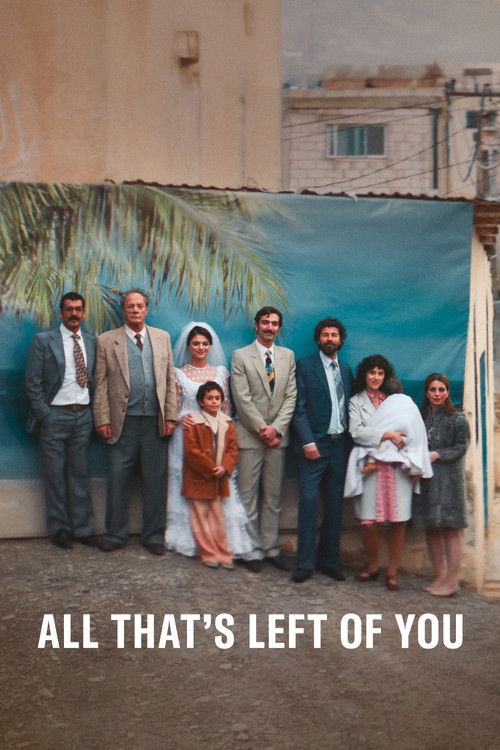
All That's Left of You
2025 · Cherien Dabis
For when you want a big, serious, generational epic that puts a human face on history — a challenge, not a comfort watch, best when you have the emotional room for it. Reach for it when you want to understand a headline conflict as one family's lived story.
What it's about
A Palestinian teenager in the 1980s West Bank is swept up in a protest that upends his family's life — and in its aftermath, his mother Hanan begins telling him the story of how they got there. That story reaches back to 1948, following one family across seven decades of dispossession, exile, and stubborn endurance, from the loss of their home through generations of trying to rebuild a life under occupation.
The experience
It moves like a family saga told at the kitchen table — intimate, patient, and heavy with feeling, building emotional weight generation by generation. Expect grief and tenderness braided together; it's the kind of film that asks you to sit with sorrow rather than look away, and it earns the tears it draws.
Performances
Writer-director Cherien Dabis also plays Hanan, the mother whose storytelling frames the film, anchoring the saga with lived-in warmth and grief.
The craft
Dabis structures seven decades of history as an inheritance — a mother's story passed to her son — which keeps an enormous timespan personal rather than textbook-like. The period recreation across the 1940s, 1970s, and 1980s is ambitious on a scale Palestinian cinema has rarely had the resources to attempt, and that ambition is part of the film's meaning.
Why it matters
A landmark attempt at a full-scale Palestinian national epic — the kind of generational saga other cinemas have long taken for granted — and the boldest step yet in Dabis's career since her debut Amreeka.
Cherien Dabis announced herself with Amreeka (2009), a warm, sharp-eyed portrait of Palestinian immigrant life, then spent a decade honing her craft on series like Ramy. Her return to features is her most ambitious work by an order of magnitude: a seven-decade family saga that begins with the dispossessions of 1948 and narrows, generation by generation, toward a single protest in the 1980s West Bank. Dabis herself plays Hanan, the mother whose act of storytelling frames the film — history recounted not as chronicle but as inheritance, the way a family explains itself to its children. The scale recalls the great national epics other cinemas have long been permitted; Palestinian filmmakers have rarely had the resources or access to attempt one, which is part of the film's point. Its production became its own testament: the shoot, planned for the West Bank, was upended by the outbreak of war in 2023 and completed elsewhere in the region. It premiered at Sundance in 2025, an epic carried to the screen against the odds it depicts.
Reception
Premiered at Sundance 2025 as a moving family epic, then snowballed through the year — audience awards from Sydney to Leiden, Mark Ruffalo and Javier Bardem signing on as executive producers, and a spot on the Oscar shortlist as Jordan's international-feature entry.
How All That's Left of You was received, from release to now →
Influences: the films it descends from and the films it influenced
- Amreeka (2009) — Dabis's own debut established her Palestinian-diaspora domestic drama built on tightly-blocked kitchen-table ensemble scenes and TV-honed scene economy that she now scales into epic form.
- May in the Summer (2013) — Her second feature set the director-as-lead template, casting herself as the returning daughter to anchor a family ensemble from inside the frame.
- The Time That Remains (2009) — Chronicles Palestinian history from 1948 forward as episodic memory-tableaux with the director present as a watchful surrogate — the model for a multigenerational Nakba chronicle carried by an on-screen author.
- Wedding in Galilee (1987) — Founding Palestinian feature that dramatizes occupation and dispossession through the micro-scale of family ritual and contested household space rather than battlefield.
- The Dupes (1972) — The earliest cinematic dramatization of Nakba displacement, using flashback architecture to carry refugee memory as narrative inheritance.
- The Godfather Part II (1974) — Its crosscutting nonlinear structure braids an origin generation against its descendants across decades — the structural template for the multigenerational saga folded around a founding rupture.
- Once Upon a Time in America (1984) — A memory-triggered nonlinear epic in which a framing consciousness collapses past and present, the device Dabis adopts to narrate backward toward 1948.
- Novecento (1900) (1976) — Maps a century of political rupture onto a single lineage, the national-epic-through-family blueprint scaled to generations.
- Salt of This Sea (2008) — Builds dispossession drama around the physical reclaiming of a lost family house, treating 1948 as an inheritance to be walked back into.
- Wajib (2017) — Carries intergenerational Palestinian tension through real-time father-child domestic naturalism, the same confined-family register Dabis expands across eras.
- Paradise Now (2005) — Established Palestinian cinema's internationally-financed, relocated co-production model — the same craft workaround behind this film's relocated shoot.
- Farha (2021) — Dramatizes the 1948 Nakba through one family's confinement and a child witness, part of the same 2020s wave of Palestinian historical fiction.
- Lemon Tree (2008) — Stages dispossession over contested land and property, and shares the casting of Hiam Abbass as immovable matriarch central to Dabis's ensemble method.
- 200 Meters (2020) — Renders political separation through a family split by the wall, the everyday-resistance-as-domestic-drama register of the contemporary Palestinian feature.
- Where Do We Go Now? (2011) — A regionally-financed, TV-honed Arab national allegory in which the director stars inside her own ensemble — the same performer-author national-drama craft.
- The Present (2020) — Compresses occupation into a single family's ordinary errand, the miniaturized-resistance technique whose logic Dabis inverts into epic scale.
Similar films
- Farha (2021) — influence & lineage · same viewing thread
- Palestine 36 (2025) — same viewing thread
- The Voice of Hind Rajab (2025) — same viewing thread
- The President's Cake (2026) — same viewing thread
- My Father's Shadow (2025) — same viewing thread
- No Other Land (2024) — shared sensibility
- Quo Vadis, Aida? (2021) — shared sensibility
- Goodbye Julia (2023) — shared sensibility
All the films related to All That's Left of You →
Watch it with: curated runs of related films
- War Through a Child's Eyes — Watch these in a run for how each sets a small, watchful child in front of a history far too big to understand — occupation, civil war, dictatorship, genocide — so the child's innocence throws the adult brutality into unbearable relief.
- The Countries We Carry — Watch these together when you want recent world cinema about heritage, exile, and family stretched across borders — each one a return to a homeland that no longer quite holds the people who left it.