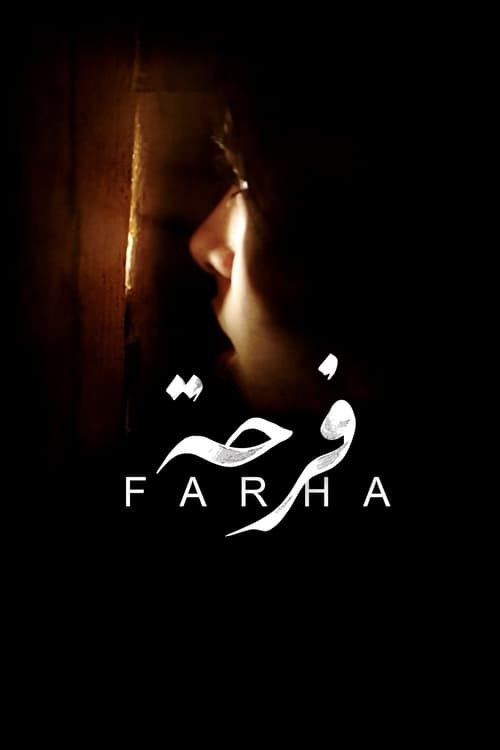
Farha
2021 · Darin J. Sallam
For when you're ready to be challenged, not comforted — a film to sit with and talk about afterward. Not a casual pick; choose it when you want history made personal and immediate.
What it's about
Palestine, 1948, in the final days of British rule. Farha is a bright fourteen-year-old in a small village who wants one thing: her father's blessing to leave for school in the city, an ordinary dream she's on the verge of winning. Then armed forces advance on the village, and her coming-of-age story becomes a story of survival, much of it seen through the eyes of a girl hidden away as catastrophe unfolds outside.
The experience
It begins warm and sunlit — friendship, ambition, a village on the cusp of harvest — and then tightens into something almost unbearably intimate and claustrophobic. Quiet, restrained, and devastating; it trusts what you hear and glimpse over what it shows, and it stays with you.
The craft
Darin J. Sallam's debut builds its power on confinement: for long stretches the camera stays with Farha in a single small space, and cracks of light, offscreen sound, and a keyhole's sliver of view do the storytelling. It's a masterclass in conveying enormous events through one limited, human vantage point.
Why it matters
Drawn from testimony passed down through the director's family, it became one of the most widely seen and hotly debated dramatizations of the 1948 Nakba, bringing that history to a global streaming audience. It announced Sallam as a significant new voice in Arab cinema.
Snapshot
Farha is the feature debut of Jordanian writer-director Darin J. Sallam, a coming-of-age tragedy set during the 1948 Palestinian Nakba. Its heroine is a bookish fourteen-year-old girl in a rural village who has secured her father's reluctant permission to leave for school in the city — an ordinary adolescent ambition that the film systematically forecloses. When Zionist paramilitary forces advance on the village, her father locks her inside a small stone storeroom for safekeeping and promises to return. He does not. For most of its second half the film contracts to that single locked room, and to what Farha can see and hear of the catastrophe outside through cracks in the wall and a keyhole. The picture is grounded in a real account: Sallam has said the story descends from testimony her mother carried out of Palestine about a girl the family knew, and the film is dedicated to that memory. Premiering at the 2021 Toronto International Film Festival and later chosen as Jordan's submission for the Academy Awards, Farha became one of the most internationally visible Palestinian-subject films of its decade — and, upon its Netflix release, one of the most politically contested.
Industry & production
Farha is an independent, multi-territory Arab-European co-production, principally between Jordan, Sweden, and Saudi Arabia, reflecting the funding architecture that sustains most auteur-driven Arab cinema: local production companies stitched together with Gulf festival funds and European public-broadcaster and film-institute money. Sallam produced through her own Jordan-based outfit (TaleBox) alongside producer Deema Azar, with Swedish and Saudi co-producers rounding out the financing. The film was shot in Jordan, standing in for the pre-1948 Galilee village, a common practice given the impossibility of filming such material on the historical locations themselves.
As a debut feature by a woman director working on politically freighted material with a modest budget, Farha is characteristic of a generation of Arab filmmakers who route their first features through the festival-and-fund ecosystem (TIFF, the Red Sea International Film Festival, Gulf and European co-production markets) rather than commercial studio pipelines. Its distribution history is the industrially notable part: Netflix acquired global streaming rights and released the film on 1 December 2022. That release, rather than the festival run, is what turned a small art film into an international news story.
Technology
Farha was shot digitally, the default for a production of this scale and period, and the specific camera and lens package is not something I can attest to from the public record without guessing. What matters technologically is not novelty but constraint: the film's dramatic engine is a confined interior lit largely by whatever light leaks through gaps in stone and wood. That places heavy demands on a digital sensor's latitude in low light and on the ability to expose for a face in near-darkness while preserving the sliver of bright exterior world visible through a crack. The production's technological choices are subordinated to a single design problem — how to make a dark room legible for an entire act without breaking the fiction that its only light sources are accidental.
Technique
Cinematography
The cinematography (lensed by Rachel Aoun, per the film's credits) is organized around a formal rupture that mirrors the story's. The first movement, in the village and fields, is open and mobile: golden exteriors, handheld intimacy following Farha and her friend, a palette of daylight and possibility. Once Farha is sealed in the storeroom, the camera is imprisoned with her. The frame narrows; compositions are built around apertures — the keyhole, the horizontal slats and cracks in the wall — so that the outside world arrives as fragments, letterboxed by architecture. The audience is denied the establishing master shots that conventional war cinema uses to survey atrocity; instead we get partial sightlines, the same restricted verticals and slivers Farha has. This is the film's central visual argument: witnessing is rendered as a function of limited vantage, and the withholding of the full view is itself the horror. Darkness is used as an active compositional element, faces emerging from and receding into black.
Editing
The cutting enforces the same discipline of restriction. In the storeroom passages, the film resists cross-cutting freely into the exterior action; it tends to hold on Farha's face and body, on her listening, and lets sound carry events the camera refuses to show directly. When it does grant a view outside, it is through her framed sightline, so the edit keeps subordinating spectacle to point of view. The pacing shifts markedly between the two halves — the pastoral opening moves with a girl's restless energy; the confinement stretches time, using duration and near-stasis to convey the ordeal of waiting. I can't confidently attribute the editing to a specific editor from memory, and I'd flag that as a gap rather than name one.
Mise-en-scène / staging
Staging is the film's most concentrated achievement, because for a long stretch it must generate drama from a single small set and a single body. The storeroom is dressed as a working village pantry — provisions, jars, tools — objects that become survival instruments and time-markers as the siege drags on. The most discussed staged sequence is one Farha watches through her aperture: the arrival of a fleeing family and their killing by soldiers, an atrocity presented at a controlled distance and partial visibility rather than as graphic spectacle. The decision to keep violence largely at the edge of the frame, mediated by the girl's restricted view, is a moral-aesthetic choice about representation — it refuses to convert massacre into action-cinema legibility. The pre-siege village staging, by contrast, is warm and communal, establishing the ordinary social world precisely so its erasure registers.
Sound
Sound is arguably the film's primary storytelling instrument in its second half. Because the camera is trapped, the war is delivered aurally: gunfire, engines, voices, cries, footsteps, and silences that are as loaded as any image. The sound design has to do the work of an entire off-screen event, and Farha's — and our — interpretation of unseen action depends on it. The score's specific authorship I won't attribute from memory, but the film uses music sparingly against long stretches where diegetic sound and silence carry the tension.
Performance
The film rests almost entirely on Karam Taher as Farha, a newcomer who is on screen nearly continuously and who must sustain the confinement act largely alone, often without dialogue and without a scene partner in frame. The performance moves from adolescent brightness to endurance, terror, and a kind of forced, premature adulthood; its restraint — the refusal to over-emote through a situation that would license melodrama — is what critics singled out. Ashraf Barhom, an established Palestinian actor, plays the father whose protective act of locking her away becomes the film's tragic hinge; his early scenes establish the tenderness and authority whose absence then defines the rest. The supporting ensemble fills in the village world that the film mourns.
Narrative & dramatic mode
Structurally Farha is a diptych: a coming-of-age idyll that turns, at its midpoint, into a confinement thriller of witness. The dramatic mode is subjective and restrictive — the film binds us to a single consciousness and to that consciousness's sensory limits. This is closer to the chamber drama or the survival-in-a-room film than to the sweeping historical epic, and the choice is pointed: rather than narrate the Nakba panoramically, it narrates one girl's inability to see the whole of what is happening to her people, which becomes a figure for historical trauma itself. The film also operates as a "based on true testimony" work, framing itself as an act of transmission — a story handed down orally, now reconstructed — which gives it the moral posture of witness-bearing rather than dramatization for its own sake. Suspense is generated less by "what will happen" than by the agony of restricted knowledge and the collapse of a promised return.
Genre & cycle
The film sits at the intersection of the war drama, the historical film, and the coming-of-age story, but its most useful generic frame is the confinement or "single-location" film crossed with the child's-eye war narrative. In the lineage of children witnessing catastrophe from a compromised vantage — the tradition that runs through films about occupation and genocide told from a young protagonist's limited comprehension — Farha belongs to a cycle of Palestinian and broader Arab cinema that revisits 1948 and its afterlives. Within Palestinian film specifically, it joins a body of work by directors who treat the Nakba and dispossession as foundational subject matter, though Farha is distinctive in filtering that history entirely through adolescent female subjectivity and near-total spatial confinement.
Authorship & method
Farha is a strongly authored debut: Sallam both wrote and directed, and the project is explicitly personal, rooted in a family narrative she has described carrying since childhood — the germ being her mother's account of a real girl's ordeal. Her method here is one of concentration and subtraction: taking an enormous historical event and refusing the epic register, instead staking everything on point of view, a single set, and a single young performer. The key collaborators, as best the public record supports: cinematographer Rachel Aoun, whose restricted-aperture visual scheme is inseparable from the film's meaning; producer Deema Azar alongside Sallam; and lead Karam Taher, whose casting as an unknown was itself a directorial gamble that the film's success vindicated. On the editor and composer I would rather flag uncertainty than misattribute — I don't have reliable enough recall of those specific credits to state them as fact.
Movement / national cinema
The film is a Jordanian production about Palestinian history, and it belongs to two overlapping frames. First, contemporary Palestinian cinema — a national cinema without a conventional national industry, sustained across diaspora and co-production, preoccupied with memory, land, exile, and the 1948 rupture. Second, the recent flourishing of Jordanian and Gulf-financed Arab filmmaking, in which festivals like the Red Sea International Film Festival and regional funds have created infrastructure for first-time Arab directors, and in which women filmmakers have become notably prominent. Farha is emblematic of both currents: a woman-directed, transnationally financed Arab film that treats Palestinian historical memory as living material.
Era / period
The film is set in 1948, at the founding moment of the Nakba, as the British Mandate ends and Zionist forces move against Palestinian villages — the events that produced mass displacement. It was made and released in 2021–2022, a period in which streaming platforms were aggressively acquiring international-language films and in which Palestinian narratives were reaching global audiences at new scale. The collision of a 1948 subject with a 2022 Netflix release is precisely what generated the film's public afterlife: a historical account, delivered through a contemporary global distribution machine, into a charged present.
Themes
The governing themes are witness and its limits; the violence of interrupted childhood; the betrayal — or tragic insufficiency — of protection, since the father's loving act of locking his daughter away is exactly what condemns her to isolation; and the transmission of memory across generations, the film itself functioning as an inherited testimony reconstructed. Restricted sight is both technique and theme: to see partially, to be unable to see the whole, is the film's account of what historical trauma does to those inside it. Food, water, and waiting in the storeroom turn survival into a grinding present tense. And ambition — Farha's dream of education and the city — becomes an elegy for all the ordinary futures the catastrophe cancels.
Reception, canon & influence
Critically, Farha was received as a striking, sober debut, with particular praise for Karam Taher's central performance and for the discipline of the confinement conceit; it circulated through major festivals from its 2021 Toronto premiere onward and was selected as Jordan's official Oscar submission for the Best International Feature category, a significant validation for a first film. Its wider notoriety, however, came with the December 2022 Netflix release, which drew sharp objection from Israeli officials who disputed the film's depiction of the killing of a family by soldiers; the controversy included public condemnations by government ministers and reported pressure around venues screening it. That reaction, widely reported internationally, paradoxically amplified the film's visibility and hardened its status as a flashpoint in the cultural politics of representing 1948.
Influences on the film (backward): the child's-limited-view war narrative and the single-location confinement drama; the tradition of Palestinian cinema built around Nakba memory and dispossession; and, most concretely, the oral family testimony Sallam has cited as the source — an inheritance rather than a cinematic model.
Legacy (forward): because the film is recent, its influence is still forming and any claim of a "school" it founded would be premature. What can be said is that Farha became a reference point in two ongoing conversations — the global-streaming distribution of Palestinian and Arab films to mass audiences, and the debate over how, and whether, platforms should host contested historical narratives. Its most likely durable legacy is as a demonstration that an intimate, formally restrained, woman-directed Arab debut could reach worldwide audiences and provoke state-level response — a template of visibility more than of style.
Reception
Premiered quietly at TIFF 2021, then detonated when Netflix picked it up in late 2022 — Israeli officials condemned the streamer and the film was review-bombed on IMDb, which only sent more people to watch it. It's since settled in as one of the essential narrative films about the Nakba.
How Farha was received, from release to now →
How to watch Farha: what to notice on a first viewing
- Watch the frame narrow as the story moves indoors. The early village scenes are open, mobile, and golden. Later the camera works through small apertures, slats, and cracks, so the outside world arrives only in fragments. Restricting what you can see becomes the film's way of putting you inside one narrow point of view.
- Listen for war arriving as sound before sight. Long stretches let engines, cries, footsteps, and silence carry events the camera does not show directly, so your ear does work your eye cannot. What you cannot see becomes exactly as important as what you can, maybe more.
- Watch the ordinary jars and tools that surround her. Provisions and household objects are dressed into the frame with care, and as the ordeal continues they turn into survival instruments and markers of passing time. Objects that once meant nothing start to measure how long this has gone on.
- Watch Karam Taher's face instead of listening for lines. Taher plays long stretches with little or no dialogue and without a scene partner in frame, carrying the film on restraint rather than outward emotion. The performance refuses to perform the feeling for you, so you have to read it instead of being told it.
- Notice how often darkness eats the edges of the frame. Darkness is used as an active part of the image, with faces emerging from and receding into black rather than being evenly lit. The light rations what you are allowed to see, the same way the story does.
The whole guide to watching Farha, with the keys for a rewatch →
Influences: the films it descends from and the films it influenced
- Come and See (1985) — Establishes the template of war filtered through a single child-witness's degrading sensory field, holding on the young face as the primary register of atrocity rather than depicting the atrocity in wide master shots.
- Ivan's Childhood (1962) — Pioneers framing the front line at a child's height and scale, using duration and stillness so that war is felt as an interruption of a young interior life rather than staged as spectacle.
- Forbidden Games (1952) — Anchors historical mass death to one uncomprehending child's disoriented perception, keeping the adult violence oblique and letting the girl's private ritual carry the horror.
- The Diary of Anne Frank (1959) — Builds suspense from confinement in a single hiding place where menace is conveyed almost entirely through off-screen sound — footsteps, voices, and sirens the hidden must interpret without seeing.
- The Time That Remains (2009) — Grounds Palestinian cinema in familial testimony of 1948, converting inherited family accounts into formally controlled, near-static tableaux of Nakba memory.
- The Zone of Interest (2023) — Extends the same off-screen aural storytelling to its limit, rendering an entire genocide through gunshots, screams, and machinery heard beyond a wall while the camera stays fixed on domestic space.
- The Present (2020) — Continues the confined-POV, restraint-driven Palestinian short-to-feature current, rendering occupation through one bounded viewpoint and withheld violence rather than epic scope.
- Son of Saul (2015) — Shares the restricted-aperture strategy of shallow focus and a boxed-in frame that keeps mass killing at the blurred edge or just off-screen, forcing the atrocity to register on the protagonist's face and in the soundtrack.
- Room (2015) — Confines the drama to a single locked interior and binds the audience strictly to a captive's restricted knowledge, treating the enclosing walls and their gaps as the film's entire visual grammar.
- Pan's Labyrinth (2006) — Routes fascist-era violence through a girl's mediating perspective, glimpsing brutality partially and briefly so that historical terror is filtered rather than fully exhibited.
- Turtles Can Fly (2004) — Casts nonprofessional child leads and scales the entire war down to their eye level, letting a newcomer's unschooled presence carry political catastrophe through restraint.
- Grave of the Fireflies (1988) — Keeps its children in the offscreen margins of the war's battles, dramatizing survival and slow deprivation in enclosed shelters rather than staging the bombing raids as action.
- Paradise Now (2005) — Advances the Palestinian tradition of tonal restraint and tight character focus over polemic, the same disciplined sobriety Sallam adopts to defuse an incendiary subject.
- Salt of This Sea (2008) — Models the woman-directed Palestinian debut built on dispossession and return, staking the film on a first-time-lead's presence as Sallam later stakes Farha on an unknown.
- Wajib (2017) — Demonstrates the small-scale, near-single-setting Palestinian intimacy — few characters, confined space, understated performance — that Farha compresses into one storeroom.
- Wadjda (2012) — Provides the precedent of a woman-directed Arab debut carried by an untrained young girl's performance, proving an intimate, restrained female-authored film could reach a global audience.
- All That's Left of You (2025) — Dramatizes the 1948 Nakba through one family's confinement and a child witness, part of the same 2020s wave of Palestinian historical fiction.
- Palestine 36 (2025) — Routes the 1948 rupture through a single adolescent girl's confined witness — the closest contemporary sibling in the young-witness-onto-national-catastrophe form Jacir uses to enter the revolt.
Similar films
- Paradise Now (2005) — influence & lineage
- Forbidden Games (1952) — influence & lineage · same viewing thread
- Ivan's Childhood (1962) — influence & lineage · same viewing thread
- All That's Left of You (2025) — same viewing thread
- The Voice of Hind Rajab (2025) — same viewing thread
- My Father's Shadow (2025) — same viewing thread
- The President's Cake (2026) — same viewing thread
- Palestine 36 (2025) — shared sensibility
All the films related to Farha →
Watch it with: curated runs of related films
- War Through a Child's Eyes — Watch these in a run for how each sets a small, watchful child in front of a history far too big to understand — occupation, civil war, dictatorship, genocide — so the child's innocence throws the adult brutality into unbearable relief.