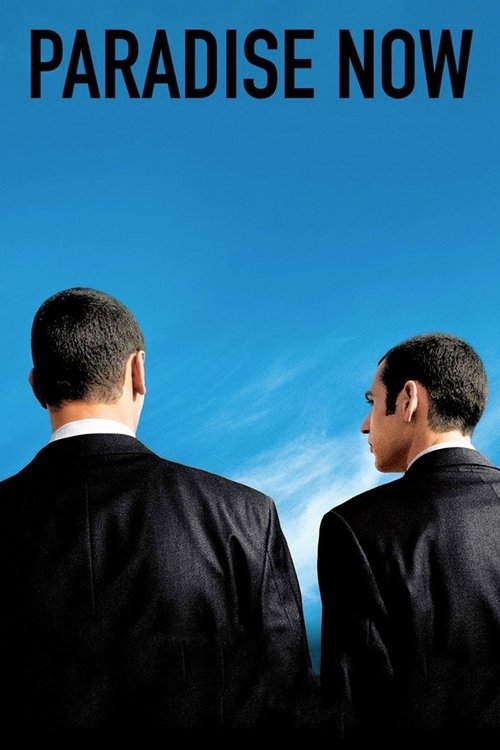
Paradise Now
2005 · Hany Abu-Assad
For when you want a film to chew on for days and debate afterward — this is a challenge, not a comfort watch. Pick it when you're ready to sit inside a perspective most movies refuse to dramatize.
What it's about
Said and Khaled, childhood friends scraping by in the occupied West Bank city of Nablus, are told they've been selected to carry out a suicide bombing in Tel Aviv — and that it happens in forty-eight hours. The film follows those two days: the preparation, the goodbyes they can't explain, a crossing that goes wrong, and the widening crack of doubt between two men who thought they'd already decided.
The experience
A taut, close-quarters thriller that's really a moral argument you can't look away from — tense in its plotting, but the deeper pressure comes from watching two friends reason toward opposite conclusions. It leaves you unsettled and arguing with yourself.
Performances
Kais Nashif and Ali Suliman carry the film as Said and Khaled — two contained, watchful performances that let doubt surface in glances and silences rather than speeches.
The craft
Abu-Assad shoots with a lean, documentary-textured urgency, staging the thriller mechanics — the handlers, the crossing, the countdown — against the ordinary textures of life under occupation, which is where the film's real tension lives. The writing gives both friends full, opposing arguments and refuses to referee.
Why it matters
One of the most internationally visible works of Palestinian cinema, it won the Golden Globe for foreign-language film and earned an Oscar nomination while igniting fierce debate about whether depicting is endorsing.
Snapshot
Paradise Now follows Said and Khaled, two friends from Nablus in the occupied West Bank, across the roughly forty-eight hours after a handler informs them they have been selected to carry out a coordinated suicide bombing in Tel Aviv. Hany Abu-Assad's film compresses recruitment, preparation, a botched crossing, separation, doubt, and reckoning into a taut chamber thriller staged against the textures of daily life under occupation. Its provocation is structural rather than rhetorical: by adopting the point of view of the bombers and treating their deliberation as an argument to be dramatized rather than condemned, the film asks the audience to inhabit a moral position most cinema refuses. It arrived as one of the most internationally visible works of Palestinian cinema, winning a Golden Globe and securing an Academy Award nomination, and it became a flashpoint precisely because it declined the reassurances of both propaganda and liberal moralism. Its lasting significance lies in demonstrating that a small, regionally rooted production could hold a global audience inside a question few films dare to pose seriously.
Industry & production
Paradise Now is a European-financed, Palestinian-set co-production, a configuration typical of Arab and Middle Eastern art cinema of the period, which depended on European public-funding bodies and festival-adjacent producers to reach the screen. The picture was produced by Bero Beyer — who also shares screenwriting credit — through a consortium that drew together Dutch, German, French, and regional partners, with distribution in the United States handled by Warner Independent Pictures, the specialty label then active within the Warner system. This financing architecture placed the film in the transnational art-house economy while its subject and setting remained emphatically local.
The production itself was extraordinarily difficult, and this is one of the better-documented aspects of the film's making. Much of the shoot took place in Nablus, a city under severe strain during the Second Intifada, and Abu-Assad has spoken publicly about the danger the crew faced: proximity to Israeli military operations, the risk of gunfire and missile strikes near the set, and — most consequentially — the abduction of a location manager, an incident that led part of the crew to leave and forced the production to relocate elements of the shoot to Nazareth. These conditions are not incidental trivia; they shaped the film's compressed logistics and lend a documentary charge to its images of a militarized city. I would flag that precise budget and box-office figures are not something I can state reliably, and I will not invent them.
Technology
Paradise Now was made in the mid-2000s, at the tail end of the era in which serious international art cinema still defaulted to photochemical capture, and its aesthetic belongs to that world of grain, available light, and location shooting rather than to the digital-realist wave that would soon follow. The film's technological signature is its embrace of constraint: hand-held camerawork, practical locations, and a refusal of the gloss that larger budgets buy. One genuinely diegetic use of technology sits at the film's center — the camcorder used to record the martyrdom videos — and the film turns consumer video, and its failure, into both a plot mechanism and a source of mordant comedy. Beyond that, the picture makes no ostentatious technological claims; its innovations are those of method and staging rather than apparatus.
Technique
Cinematography
The cinematography, by Antoine Héberlé, favors a restrained realism: hand-held and shoulder-mounted framing that stays close to the actors, natural and available light that renders Nablus in dusty, sun-bleached tones, and a general avoidance of the picturesque. The camera's proximity to Said and Khaled sustains the film's identification with them without editorializing; we are kept at conversational distance, reading faces. A key visual strategy is contrast: the cramped, ochre density of the occupied city against the open, bright, almost seductive expanse of the Israeli side and the Tel Aviv beachfront glimpsed near the end. The film's most discussed image is its final shot — a slow push toward Said's eyes as he sits aboard a bus — which withholds the act itself and locates the film's entire moral weight in a held human gaze rather than in spectacle.
Editing
The editing organizes the film as a countdown, tightening around the forty-eight-hour window and using the mechanics of the operation — the crossing, the separation, the search for the lost partner — to generate suspense from process. The cutting is largely invisible and continuity-driven, serving the performances and the escalating tension rather than calling attention to itself; the film's rhythmic control is most evident in how it modulates between long, dialogue-driven passages of doubt and the sudden acceleration of the border sequence. I do not want to misattribute the editing credit, so I will note only that the film's shaping in the cutting room is one of its clear strengths without naming an editor I cannot verify with confidence.
Mise-en-scène / staging
Abu-Assad stages the film as a series of thresholds and rituals. The two men are given a valedictory "last supper" and dressed in dark suits — groomed to pass as guests at a wedding or as settlers — so that the machinery of martyrdom is rendered through mundane, almost bureaucratic preparation: a haircut, a meal, a change of clothes. The now-famous testimonial scene, in which Khaled records his martyrdom statement while a technical fault forces retakes and a crew member eats during the recording, is a masterpiece of staging that exposes the gap between the sacred rhetoric of the act and its shabby, human execution. The environments — the auto-repair garage where the friends work, cramped apartments, the checkpoint landscape — do the film's political argument without speeches, situating the drama inside occupation rather than lecturing about it.
Sound
The film's soundscape is naturalistic and spare, built from the ambient texture of the city — traffic, the garage, the hum of ordinary life — and it deliberately withholds the swelling non-diegetic score that a conventional thriller would deploy to cue emotion at the climax. This restraint is a deliberate ethical choice: by refusing to musically underline the bombing plot, the film denies the audience an emotional off-ramp and keeps the moral question exposed. I am not able to confidently attribute a composer or confirm the extent of any original score, and I will not fabricate that credit; what is clear from the film itself is its preference for silence and ambience over conventional scoring at its most charged moments.
Performance
The performances are the film's engine. Kais Nashif as Said and Ali Suliman as Khaled build a lived-in friendship whose divergence — Said sinking toward resolve, Khaled toward doubt — carries the drama, and both actors play interiority rather than ideology, letting long silences and small hesitations register the pull of the decision. Lubna Azabal, as Suha — the daughter of a revered martyr who argues for nonviolent resistance — provides the film's explicit counter-voice, and her scenes function as the moral debate made flesh. The naturalistic register of the ensemble, consistent with the film's realist surface, is essential to its refusal of caricature.
Narrative & dramatic mode
The dramatic mode is a ticking-clock thriller welded to a moral-philosophical dialogue. The narrative machinery — a botched first attempt, the men's separation, one partner missing with a bomb strapped to his body — supplies genre propulsion, while the film's real business is conducted in argument: between Said and Khaled, and between the men and Suha, over whether violence against civilians can be justified, what resistance requires, and what "paradise" and dignity mean under occupation. The film stages these positions dialectically without resolving them into a verdict, and its withholding ending refuses catharsis. This fusion of suspense structure with essayistic debate is the film's signature formal achievement: it uses the grammar of the thriller to hold an audience hostage to a question.
Genre & cycle
Formally the film sits at the intersection of the political thriller, the social-realist drama, and the war film, and it belongs to a mid-2000s cycle of works confronting terrorism and asymmetric conflict from inside the perpetrator's experience — a lineage that reaches back to Gillo Pontecorvo's The Battle of Algiers (1966) and forward through post-9/11 cinema's preoccupation with the making of a bomber. Within Palestinian and broader Arab cinema, it participates in a movement away from allegory and toward direct, character-centered engagement with occupation. Its distinctive move within the cycle is point of view: where many terrorism narratives adopt the vantage of the targeted state or the investigator, Paradise Now commits fully to the recruits, which is both its formal innovation and the source of its controversy.
Authorship & method
Hany Abu-Assad, a Palestinian-born filmmaker who worked for years in the Netherlands, is the film's principal author, and Paradise Now consolidated the concerns of his earlier work — including Rana's Wedding (2002) — into an international breakthrough. His method here combines location shooting in a live conflict zone, a realist visual grammar, and a screenplay (developed with producer Bero Beyer, and with additional writing contribution from Pierre Hodgson) built around debate rather than incident. Abu-Assad's authorial stamp is his insistence on treating politically radioactive material through intimate character psychology and dark humor, refusing both glorification and condemnation. His key collaborator in image-making was cinematographer Antoine Héberlé, whose hand-held realism defines the film's look. Abu-Assad would return to comparable terrain — Palestinians caught in impossible choices under occupation — in Omar (2013), which also earned an Academy Award nomination, confirming the thematic throughline of his authorship. Where I cannot confirm specific composer or editor credits, I have declined to guess.
Movement / national cinema
Paradise Now is a landmark of Palestinian national cinema, a body of work that has necessarily developed in exile, under occupation, and through foreign co-financing rather than a domestic industry. It belongs alongside the films of Elia Suleiman and Michel Khleifi in a tradition that gives cinematic form to statelessness and dispossession, though Abu-Assad's register is more genre-legible and less formally ironic than Suleiman's deadpan tableaux. The film's international recognition — and the pointed controversy over how its country of origin should be labeled at the major awards — made the very question of Palestinian nationhood inseparable from the film's reception, so that its status as "national cinema" was itself politically contested in a way few films experience so directly.
Era / period
The film is a document of the Second Intifada, made and set amid the violence, checkpoints, and closures of the early-to-mid 2000s West Bank, and it cannot be separated from that moment. It is equally a product of the post-9/11 global preoccupation with suicide terrorism, arriving when Western audiences and institutions were intensely, often anxiously, engaged with the psychology of the bomber. This double periodization — local to the Intifada, global to the post-9/11 discourse — accounts for both the film's urgency at release and the ferocity of the debate around it. Watching it now, it reads as a time capsule of a specific and grievous phase of the conflict.
Themes
Its governing theme is the moral economy of resistance: what dignity demands under occupation, and whether violence against civilians can ever be reconciled with it. Around this the film organizes several currents — the collapse of the distinction between the political and the personal; the seduction and hollowness of martyrdom rhetoric, punctured by the film's comic exposure of the machinery behind the martyr video; the inheritance of humiliation and the weight of fathers (Said's collaborator father, Suha's martyr father) on the next generation; and the asymmetry of power that structures every choice the characters can make. Crucially, the film thematizes debate itself: it dramatizes disagreement — Suha's nonviolence against Khaled's and Said's fatalism — as the central action, making argument the film's true subject.
Reception, canon & influence
Critically, Paradise Now was widely received as a major and courageous work, praised for its refusal of caricature and its formal control, and it accumulated significant honors: it premiered at the Berlin International Film Festival, where it drew multiple awards, went on to win the Golden Globe for Best Foreign Language Film, and secured an Academy Award nomination in the same category. That nomination generated real controversy — including public campaigns objecting both to the film's country designation and to its sympathetic treatment of would-be bombers — and the film was attacked from opposing directions, condemned by some as an apologia for terrorism and by others as insufficiently militant. This polarized reception is itself part of the film's historical footprint.
Looking backward, the film's clearest influence is The Battle of Algiers, whose interior view of anti-colonial violence and its ethical costs it updates for a new conflict; more broadly it draws on the traditions of European social realism and the political thriller. Looking forward, Paradise Now did much to establish Palestinian cinema as a presence in the international festival and awards circuit, helping open space for later Oscar-recognized work — including Abu-Assad's own Omar and films by other Palestinian and Arab directors — and it remains a reference point in debates about how cinema can represent terrorism without either endorsing or dehumanizing its subjects. Its enduring legacy is less a set of stylistic imitators than a demonstrated proof: that a film can hold an audience inside the perspective of a suicide bomber and turn that vantage into a serious moral inquiry rather than a provocation for its own sake.
Reception
In 2005 it was a lightning rod — protests, op-eds, and a petition (led by a bereaved Israeli father) to revoke its Oscar nomination — while simultaneously winning the Golden Globe; today it's settled into the canon as a landmark of Palestinian cinema, taught, listed, and revisited more than argued over.
How Paradise Now was received, from release to now →
Influences: the films it descends from and the films it influenced
- The Battle of Algiers (1966) — Establishes the perpetrator-POV method Abu-Assad inherits — newsreel-grain handheld that embeds the camera inside the cell and shows the mechanics of planting a bomb from the bombers' own vantage.
- Bicycle Thieves (1948) — Neorealist location shooting in real streets with available light, trailing an ordinary man toward a single desperate act, supplies the realist visual grammar Héberlé's handheld extends.
- The Wages of Fear (1953) — Builds sustained procedural dread from men physically carrying death-freighted cargo, the same countdown-of-the-body suspense Paradise Now uses once the belts are strapped on.
- Z (1969) — Codifies the political-thriller engine that drives ideological argument through procedural momentum — the 'thriller-plus-debate' scaffolding Abu-Assad adopts wholesale.
- Rome, Open City (1945) — Shoots resistance-under-occupation drama in genuinely ravaged locations, treating the ethics of anti-occupation violence with documentary immediacy rather than melodrama.
- Rosetta (1999) — Pins an over-the-shoulder handheld camera to a single protagonist's body in available light, generating moral pressure through relentless physical proximity — the interiority-over-ideology technique of the film's push-ins.
- Rana's Wedding (2002) — Abu-Assad's own earlier location-shot Palestinian feature that turns checkpoints and occupied geography into a spatial-dramatic engine, the workshop for Paradise Now's staging of ritual thresholds.
- Four Lions (2010) — Renders a bombing cell from the perpetrators' POV through dark comedy, including a botched martyr-video shoot that directly answers Paradise Now's camcorder-martyr-tape staging.
- The Attack (2012) — An Arab-authored inquiry into a suicide bomber built from an intimate relational vantage, extending Abu-Assad's refusal of the endorse/condemn binary into the perpetrator's domestic circle.
- Omar (2013) — Same author's thriller-plus-debate of Palestinians forced into impossible choices, deploying informant tension and checkpoint geography with the identical handheld realism and moral economy.
- Bethlehem (2013) — Handheld informant-thriller mapping the transactional moral economy between an operative and his handler across the occupation, inheriting Paradise Now's diegetic-only, procedure-first realism.
- Timbuktu (2014) — Humanizes the foot-soldiers of fundamentalist violence through restraint and dark irony rather than caricature, carrying forward the film's proof that perpetrators can be observed without endorsement.
- Munich (2005) — Dramatizes the moral erosion of politically sanctioned killing through accumulated procedural detail rather than ideological speech, refusing to endorse or dehumanize its operatives.
- United 93 (2006) — Real-time handheld immersion holds hijackers and victims inside one countdown structure toward a foreknown catastrophe, the same withheld-catharsis vise Paradise Now tightens.
- Day Night Day Night (2006) — Tracks a would-be suicide bomber's preparation in near-wordless interiority with ideology deliberately withheld and the ending left unresolved — Paradise Now's exact narrative refusal, isolated to one body.
- Incendies (2010) — Applies a withheld-revelation structure to Middle East sectarian violence, engineering its climax so the moral inheritance detonates only at the end — a cousin to Paradise Now's withheld final frame.
- All That's Left of You (2025) — Established Palestinian cinema's internationally-financed, relocated co-production model — the same craft workaround behind this film's relocated shoot.
- Farha (2021) — Advances the Palestinian tradition of tonal restraint and tight character focus over polemic, the same disciplined sobriety Sallam adopts to defuse an incendiary subject.
Similar films
- Munich (2005) — influence & lineage
- Incendies (2010) — influence & lineage
- No Other Land (2024) — shared sensibility
- It Was Just an Accident (2025) — shared sensibility
- The Voice of Hind Rajab (2025) — shared sensibility
- Waltz with Bashir (2008) — shared sensibility
- Farha (2021) — shared sensibility
- Yes (2025) — shared sensibility