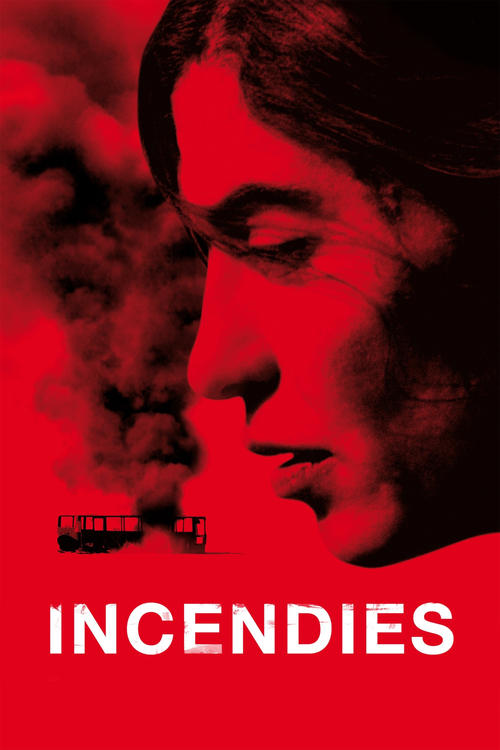
Incendies
2010 · Denis Villeneuve
The "serious sci-fi" standard-bearer whose Dune films made slow, austere blockbusters a mainstream event, and whose hiring to direct James Bond set off a fresh round of "can an auteur save a franchise" debate. Perpetually invoked in arguments about whether spectacle can still be art.
When you want a serious, devastating film that treats you like an adult — something to sit with in silence afterward and think about for days. Choose it for a night when you can give it everything; this is challenge, not comfort.
What it's about
A Montreal notary reads a mother's strange last will to her adult twins: find the father you thought was dead, and the brother you never knew existed. The search sends Jeanne and Simon to an unnamed Middle Eastern country scarred by civil war, where the film cuts between their present-day inquiry and their mother's harrowing past, one buried secret at a time.
The experience
Cold, precise, and relentlessly gripping — a mystery that tightens like a vise as two timelines converge toward something you feel coming and still cannot brace for. It leaves you genuinely shaken.
Performances
Lubna Azabal, as the mother, carries the film's past-tense half with a ferocious, wounded gravity that makes the whole structure hold.
The craft
Denis Villeneuve strips a celebrated stage play down to a dual-timeline procedural, told with scorched landscapes and surgical clarity — the story descends toward its revelation with the inevitability of Greek tragedy. The structural engineering alone is worth studying; the widescreen desert imagery rewards a big screen.
Why it matters
The film that announced Villeneuve to the world and launched his Hollywood career, and a high-water mark for Québécois cinema on the international stage.
Before Hollywood claimed him, Denis Villeneuve made this scorched, mathematically precise tragedy — the film that announced Québécois cinema had produced a world-class formalist. Adapted from Wajdi Mouawad's play, it follows Montreal twins dispatched by their mother's will to an unnamed Middle Eastern country (modeled on Lebanon's civil war) to find a father and brother they never knew existed. Villeneuve strips away the play's theatrical monologues and rebuilds it as a dual-timeline procedural, cutting between the twins' present-day inquiry and their mother's past with the cold clarity of a notary reading a testament — fitting, since a notary literally frames the tale. The structure descends toward a revelation with the inevitability of Greek tragedy; Sophocles is the true source code here. Lubna Azabal's performance as the mother carries decades of war in her carriage. An Oscar nominee for Best Foreign Language Film, it opens on one of the decade's great needle drops: children's heads being shaved to Radiohead's 'You and Whose Army?', a slow zoom into a boy's stare that the whole film spends answering.
A Deleuzian reading
A boy's head under the clippers.
The full Deleuzian reading of Incendies →
Reception
A word-of-mouth arthouse hit and Oscar nominee in 2010, it's since been retroactively canonized as ground zero of the Villeneuve phenomenon — the film cinephiles point to when they say 'he was already great before Hollywood.'
How Incendies was received, from release to now →
Influences: the films it descends from and the films it influenced
- Oedipus Rex (1967) — Supplies the Sophoclean anagnorisis/peripeteia engine Incendies runs on — the investigator discovers she is the answer to her own inquiry, the '1+1=1' recognition that collapses the search into the searcher.
- Chinatown (1974) — Model for a detective procedural whose climax is a taboo-kinship reveal ('my sister, my daughter'), delivered as tragic recognition rather than genre twist — Incendies rebuilds that incest-parentage gut-punch.
- The Battle of Algiers (1966) — Newsreel-textured staging of sectarian and anticolonial atrocity — checkpoints, buses, reprisals — that Incendies borrows wholesale for its Lebanon-coded massacre set pieces.
- Z (1969) — Political-thriller procedural that cross-cuts a present-day investigation against a reconstructed past crime, the dual-timeline dossier structure Incendies inherits.
- Come and See (1985) — The bus/village burning witnessed in unblinking long duration — craft debt for staging atrocity as endurance rather than spectacle, seen through a single overwhelmed witness.
- 21 Grams (2003) — Guillermo Arriaga's braided, withheld multi-strand chronology cross-cut to detonate a late convergence — the editing grammar behind Incendies' interleaved mother/twins timelines.
- Polytechnique (2009) — Villeneuve's own immediate precursor: black-and-white formalism, cross-cut dual perspectives on a single atrocity, and clinical emotional restraint carried directly into Incendies.
- Maelström (2000) — Villeneuve's fable-structured Québécois tragedy driven by fate and an omniscient narrator, prefiguring Incendies' mythic, tragedy-machine architecture.
- Prisoners (2013) — Extends the Incendies procedural into English-language dread — cross-cut investigation, mounting moral rot, and Roger Deakins' slow-building formal control.
- Arrival (2016) — Reuses the Incendies structural device — a withheld reveal that retroactively reorders the film's chronology, recasting apparent flashbacks so the ending reframes everything before it.
- Enemy (2013) — Pushes Incendies' formalism into doppelganger dread — oppressive slow zooms, a sickly monochrome palette, and identity collapse as a puzzle the viewer must reassemble.
- Sicario (2015) — Carries forward the moral-descent procedural into a war-zone borderland, a naïve protagonist led ever deeper into atrocity she cannot control — Nawal's journey in a cartel key.
- Caché (2005) — Formalist static framing and slow-burn excavation of buried civil-war/colonial guilt as inherited trauma — the same cold, withholding rigor Villeneuve applies to the Nawal reveal.
- War Witch (Rebelle) (2012) — Québécois Oscar-nominee centering a woman's endurance amid militia atrocity and child soldiers — the same civil-war-through-a-single-female-body lens as Nawal's ordeal.
- Monsieur Lazhar (2011) — Québécois Oscar-nominated adaptation of a stage play, rendering transplanted trauma and grief in a spare, restrained formal register kindred to Incendies' theatrical source and tone.
- Café de Flore (2011) — Québécois dual-timeline film that cross-cuts two eras braided by a recurring musical motif toward a metaphysical reveal — sibling to Incendies' needle-drop-anchored time-jumping.
- Waltz with Bashir (2008) — Lebanese civil-war memory recovered as a present-tense investigation, climaxing in the Sabra and Shatila massacre — the same buried-atrocity-as-inquiry procedural Incendies stages.
- Brothers (2004) — Cross-cut structure that withholds a war secret until a devastating reveal, manufacturing melodramatic shock through editing architecture the way Brothers braces homefront against captivity.
- Paradise Now (2005) — Applies a withheld-revelation structure to Middle East sectarian violence, engineering its climax so the moral inheritance detonates only at the end — a cousin to Paradise Now's withheld final frame.
Similar films
- Polytechnique (2009) — influence & lineage · same viewing thread · often watched together
- Enemy (2013) — influence & lineage · same viewing thread · often watched together
- Sicario (2015) — influence & lineage · same viewing thread
- Prisoners (2013) — influence & lineage · same viewing thread
- Arrival (2016) — influence & lineage · often watched together
- Waltz with Bashir (2008) — influence & lineage
- Come and See (1985) — influence & lineage · often watched together
- Dune: Part Two (2024) — often watched together
All the films related to Incendies →
Watch it with: curated runs of related films
- Villeneuve's Kingdom of Dread — A run through Denis Villeneuve's dread years — vanished people, buried family secrets, moral rot, and uncanny doubles — best watched in order to feel one director tighten his grip on unease from Quebec art house to Hollywood thriller.