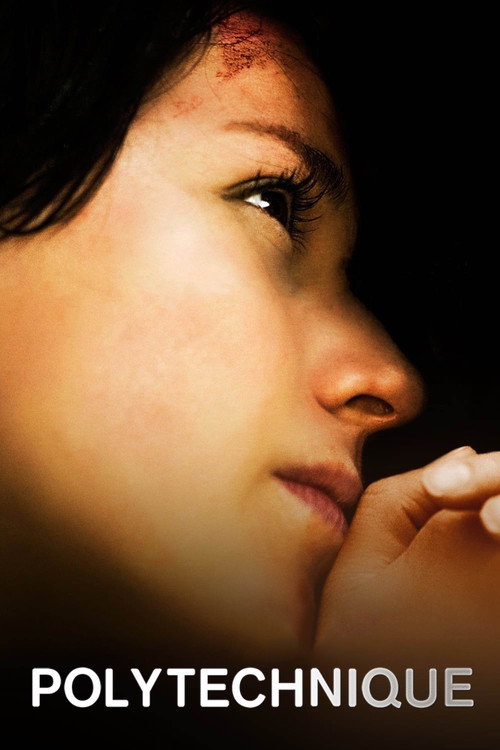
Polytechnique
2009 · Denis Villeneuve
This is a film you choose deliberately, not casually — for when you're ready to sit with a real atrocity treated with rigor and care, and to think about misogyny, grief, and survivor's guilt. Challenge, not comfort; keep a free evening after it.
What it's about
A dramatization of the 1989 massacre at Montreal's École Polytechnique, where a gunman separated women from men in an engineering school and murdered fourteen women because they were women. Denis Villeneuve tells it through two invented composite students — Valérie, a young woman planning her engineering career, and Jean-François, a male classmate — following the day from ordinary morning routine into catastrophe, and tracing what survival asks of those who live through it.
The experience
Stark, hushed, and devastating — shot in black and white, barely seventy-seven minutes, with no score-driven catharsis and no true-crime sensationalism. It's a heavy watch by design: controlled, respectful, and quietly shattering rather than graphic for its own sake.
Performances
Karine Vanasse anchors the film as Valérie with a performance of enormous restraint — she carries the film's grief without a single overplayed moment.
The craft
Villeneuve's choices are all ethical ones: black-and-white photography that refuses spectacle, a fractured timeline that circles the event rather than building suspense toward it, and a pointed decision never to name the killer or dramatize real victims. The compositions are wintry and precise, the sound design spare — its power is in what it withholds.
Why it matters
An early landmark for Villeneuve before his international career, and one of cinema's most serious models for how to depict a mass shooting without exploiting it — a reference point in every conversation about filming real tragedy.
Snapshot
A seventy-seven-minute black-and-white reconstruction of the December 6, 1989 massacre at the École Polytechnique de Montréal, in which a twenty-five-year-old man armed with a semi-automatic rifle separated women from men in an engineering classroom, declared that he was fighting feminism, and killed fourteen women before shooting himself. (The TMDB synopsis dates the event to December 9; the established date is December 6.) Denis Villeneuve's film approaches that history obliquely and austerely: it never speaks the killer's name, never names the real victims, and routes the event through two invented composite students — Valérie (Karine Vanasse) and Jean-François (Sébastien Huberdeau) — whose fictionality is the film's central ethical device. Where a conventional true-crime drama would build toward the shooting, Polytechnique fractures it, circling the same corridors from three vantages and letting the aftermath, not the atrocity, carry the weight. It arrived after a nine-year gap in Villeneuve's feature filmography and functioned as his hinge work: the point at which a stylist of Quebec surrealism became a director of moral gravity, and the immediate prelude to Incendies (2010) and the international career that followed.
Industry & production
The project's origin lies less with the director than with its star. Karine Vanasse — a Quebec actor since Léa Pool's Emporte-moi (1999) — carried the idea for years and is credited as a producer; she brought it to Villeneuve, who by his own repeated account in the Quebec press hesitated for a long stretch before agreeing. That hesitation is the production's defining fact. The massacre is not distant history in Quebec: it produced Canada's National Day of Remembrance and Action on Violence Against Women, it shaped a generation of gun legislation, and its survivors and bereaved families were and are public figures. Any dramatization risked being read as expropriation.
The production responded structurally rather than rhetorically. Survivors and families were consulted during development; the killer is credited only as such; the victims on screen are inventions. Financing came through Quebec and federal channels typical of the period — Remstar, a Montreal distributor that had moved into production, backed the film, with Alliance Vivafilm handling release — and the budget was modest by any standard, the film's ambitions being formal rather than logistical.
One production decision has outsized consequences: the film was shot in both French and English, with scenes performed twice, yielding two distinct versions rather than a dub. This is a specifically Canadian solution to a specifically Canadian problem — a national trauma that belongs to a francophone city but is understood as a national event — and it doubled the coverage burden on a compressed schedule. The film opened in Quebec in February 2009, ahead of the twentieth anniversary year's later commemorations, and screened at Cannes in the Directors' Fortnight sidebar, which gave it a European critical foothold it would not otherwise have had. Public box-office figures for the Quebec release circulate in secondary sources but not reliably enough to quote here.
Technology
Polytechnique is a late-35mm film made at the moment digital capture was becoming viable for low-budget features — the RED One had reached working sets by 2007 — and its choice of photochemical origination is legible as a choice. What is not photochemical is the monochrome: like most black-and-white features of the digital-intermediate era, the film's greyscale was arrived at and controlled in the DI, where contrast, grain structure and the specific silver-to-charcoal tonality of the institutional interiors could be tuned shot by shot rather than fixed at the emulsion. The record on exactly how much was determined at capture versus in the grade is thin in English-language sources, and I won't invent a specification.
The remaining technology is deliberately unglamorous. Steadicam is the film's principal apparatus, used for extended unbroken corridor movement. Visual effects are essentially absent; the violence is achieved practically, and much of it isn't achieved at all, because it happens outside the frame. The 5.1 mix is used for spatial accuracy — the report of a rifle in a stairwell, the distance of screaming through a fire door — rather than for immersive assault. The two-language shoot also created a post-production doubling: two cuts, two mixes, two sets of performances to balance.
Technique
Cinematography
Pierre Gill, a veteran Quebec cinematographer, shoots the school as architecture first and setting second: long, level, wide-frame compositions in which figures are small against corridors, lockers, fluorescent ceilings and stairwells. Black-and-white does two things at once here. It withholds blood — the film can show a body without showing gore — and it historicizes, pushing 1989 into the register of documentary memory and away from the glossy immediacy of contemporary crime drama. The most discussed image is a slow inversion: the camera traveling a hallway while rotating until the ceiling becomes the floor, a purely formal gesture that renders the building itself unmoored. Elsewhere Gill favours the follow-shot from behind the shoulder, a strategy that keeps faces withheld and makes the viewer a trailing presence rather than an eyewitness. The film's few close-ups are therefore enormous by contrast.
Editing
Richard Comeau, who had cut Villeneuve's earlier features, builds the film as a mosaic rather than a chronology. The narrative doubles back, restaging the same span of minutes from Valérie's position, from Jean-François's, and from the killer's, so that information arrives out of order and the audience is repeatedly returned to a moment it has already survived. The effect is not puzzle-box cleverness but something closer to the phenomenology of traumatic memory: the event will not stay in the past tense. Comeau also cuts away with unusual discipline — several killings are elided entirely, the cut landing on an empty corridor or an aftermath. The film's short running time is an editorial position: there is no third act of investigation, trial or explanation, because none of those things would be true to the material.
Mise-en-scène / staging
The staging is built on institutional banality. Photocopiers, mimeographed handouts, a job interview in which Valérie is asked whether she intends to have children, a classroom presentation — the film spends its first movement establishing the ordinary texture of an engineering faculty, including its casual sexism, before anything happens. The killer moves through this space with bureaucratic method, and Villeneuve stages his separation of men from women in the classroom as a procedure rather than a frenzy, which is far more disturbing. Crucially, the film stages the men's compliance: they leave. Jean-François's exit and his failure to intervene are staged without editorial comment and become the film's second subject.
Sound
Benoît Charest — best known for Les Triplettes de Belleville (2003) — supplies a score of extreme restraint, sparse and largely withheld during the violence itself. The dominant sonic material is architectural: footfall, ventilation, the hard reverberant crack of gunfire in tiled rooms, the muffling of sound through doors. Silence is deployed structurally, and the absence of scoring during the killings denies the audience the emotional handrail such scenes usually provide. The killer's suicide letter is heard in voiceover; the real document, which named a list of prominent Quebec women, entered public knowledge when it was leaked to a journalist who was herself on the list, and the film's use of its language is one of the few places it quotes history directly.
Performance
Maxim Gaudette plays the killer as affectless and unremarkable, refusing both the charisma of the movie psychopath and the legibility of a diagnosis. Villeneuve gives him no origin scene and no thesis; the performance is a withholding. Vanasse's Valérie carries the film's forward motion — competence, ambition, and afterward a survivor's flatness — and Huberdeau's Jean-François carries its guilt, a performance built almost entirely on things not said. Gaudette would appear again for Villeneuve as Simon Marwan in Incendies.
Narrative & dramatic mode
The mode is reconstruction rather than drama: closer to United 93 (2006) than to a thriller, and closer still to Gus Van Sant's Elephant (2003) in its refusal of causal explanation. Villeneuve declines the three standard narrative engines of the true-crime film — motive, investigation, and justice — and substitutes duration, repetition and consequence. The film's real dramatic arc belongs to the coda: Jean-François, unable to metabolize his own survival and his compliance, takes his own life; Valérie, pregnant, writes a letter. That ending is invented, but it is not arbitrary — survivors of the massacre did die by suicide in the years that followed, and the film's fiction is designed to hold that fact without attaching it to a real person. The pregnancy is the film's single gesture toward continuance, and it is offered flatly, without uplift.
Genre & cycle
Polytechnique belongs to the post-Columbine cycle of mass-shooting art cinema: Elephant and Zero Day (both 2003), Ilmar Raag's Klass (2007), and later We Need to Talk About Kevin (2011) and Mass (2021). What distinguishes Villeneuve's entry within that cycle is that his killer's stated motive is not opaque. The Columbine films are built around the unavailability of explanation; Polytechnique's killer announced his reason, and the film takes him at his word. This makes it a femicide film as much as a school-shooting film, and aligns it with a separate lineage of cinema about violence against women. Formally it also sits within the reenactment strain that runs from Alan Clarke through Paul Greengrass — procedural, present-tense, hostile to catharsis.
Authorship & method
Villeneuve came out of Radio-Canada's La Course destination monde, won it in 1990–91, and made two features — Un 32 août sur terre (1998) and Maelström (2000) — marked by playful surrealism and narrative gamesmanship. Then nearly a decade of near-silence, broken by the short Next Floor (2008), which won at Cannes Critics' Week and announced a colder, more architectural sensibility. Polytechnique is where that sensibility met a subject that could not be treated as a game. The method is subtractive: remove the name, remove the motive-as-explanation, remove the score, remove the color, remove the chronology.
The key collaborators are Quebec professionals rather than an imported team: Gill on camera, Comeau in the cutting room, Charest on score, screenwriter Jacques Davidts developing the script with Villeneuve, and Vanasse as both lead and producer-instigator. Villeneuve would carry different collaborators forward — André Turpin shot Incendies — but the working principles established here recur across Prisoners, Sicario, Arrival and the Dune films: architecture as dread, withheld information, sound design as the primary emotional instrument, and violence that is more felt than shown.
Movement / national cinema
The film sits inside the Quebec cinema that emerged in the 2000s — internationally ambitious, formally confident, and increasingly willing to address the province's own history. Its clearest ancestor is Michel Brault's Les Ordres (1974), which reconstructed the October Crisis detentions through composite characters and used monochrome as a documentary claim; the parallel is close enough to read as deliberate inheritance. Behind that stands the Office national du film's direct-cinema tradition and its ethic of observational restraint. Institutionally, Polytechnique is a product of the Telefilm/SODEC funding architecture that makes such non-commercial national self-examination possible at all, and the dual French/English production is that architecture's cultural politics made literal.
Era / period
Two contexts shaped the film's arrival. The first is proximity: the Dawson College shooting in Montreal in September 2006 had reopened the wound less than three years before production, and the Virginia Tech killings followed in 2007. The second is legislative. Canada's long-gun registry was created in the massacre's aftermath, and by 2009 it was under sustained parliamentary attack; it was abolished in 2012. A film released into that argument, twenty years after the event, could not be politically neutral regardless of its formal reticence — and its refusal to pathologize the killer as simply "psychotic," insisting instead on the misogyny he himself articulated, was itself a position in a live national dispute about what the massacre had meant.
Reception, canon & influence
Critical reception in Canada was strong and, in Quebec, close to consensus: the film swept the 2010 Genie Awards with nine wins, including Best Motion Picture and Achievement in Direction, and was similarly honored at the Jutras. International reviews, following the Cannes screening, were largely admiring, with the recurring reservation being whether any aesthetic distance can justify restaging a real atrocity. That debate had preceded the film — objections were raised in Quebec while it was still in production, from families and commentators who felt the event should not be dramatized at all — and the film's design is best understood as an argument made in advance against that charge. Some survivors, having seen it, spoke publicly in its support; the reaction was not uniform, and the honest account is that the film divided the community it depicted.
Backward, its influences are traceable: Elephant for the corridor-tracking grammar and the refusal of psychology, Alan Clarke behind that, Les Ordres for the national-trauma reconstruction in monochrome, and Greengrass's procedural reenactment mode. Forward, its DNA is visible in the European reenactment films of the following decade — Erik Poppe's Utøya 22 July and Greengrass's 22 July (both 2018), Justin Kurzel's Nitram (2021) — which share its problem, if not always its answers: how to film a massacre without becoming its publicist.
Its largest legacy, though, is career-shaped. Polytechnique established Villeneuve as a filmmaker who could hold catastrophic material without flinching or exploiting, which is precisely the reputation that Incendies converted into an Academy Award nomination and an American career. Within Quebec, it remains the reference point for how the massacre is represented on screen — a film that chose to make its victims fictional so that the real ones would not have to perform their deaths again.
A Deleuzian reading
A camera moves down a school hallway and, as it moves, it turns over.
The full Deleuzian reading of Polytechnique →
Reception
Fiercely debated in Quebec before it even opened — was it too soon, and should the 1989 massacre be dramatized at all? — it landed to strong reviews, swept the Genies with nine wins including Best Picture, and is now read as the film that relaunched Villeneuve after a near-decade silence and kicked off his Incendies-to-Dune run.
How Polytechnique was received, from release to now →
How to watch Polytechnique: what to notice on a first viewing
- Watch the hallway shot that rotates until the ceiling is the floor. The camera travels an empty corridor while turning completely over, unmooring the building itself before anything happens in the frame. The formal gesture tells you architecture, not action, is what this film is actually studying.
- Notice that the whole film is shot in black and white. The monochrome withholds blood from view and pushes the 1989 setting into the register of documentary memory rather than crime-drama immediacy. The choice keeps the film from ever looking like entertainment, even in its quietest scenes.
- Watch the ordinary classroom business before anything else happens: handouts, a presentation. The film spends its first stretch on photocopiers, a job interview, a class presentation, establishing the everyday texture of the school, including its casual sexism. The ordinariness is deliberate. It gives the film nowhere to hide an explanation later.
- Listen for how little music plays under the film's tensest scenes. Charest's score stays sparse and is largely withheld entirely during the violence, leaving footfall, ventilation, and reverberant sound in its place. The absence of a score refuses to give you an emotional cue for how to feel.
- Notice how often the film cuts away before the worst moments. Comeau's editing elides violence outright, landing repeatedly on an empty corridor or an aftermath rather than the act itself. What the film withholds from view becomes part of how it treats what happened with restraint.
The whole guide to watching Polytechnique, with the keys for a rewatch →
Influences: the films it descends from and the films it influenced
- Elephant (1989) — Clarke's near-wordless Steadicam walk-ups to eighteen sectarian killings, each shot held on the emptied space after the body drops, is the originating grammar of filming a massacre as repeated architectural approach with motive withheld entirely.
- Elephant (2003) — Harris Savides' Steadicam trailing shots down school corridors combined with a looped structure that replays the same minutes along different characters' paths — the exact device Villeneuve converts into his nonlinear mosaic of Valérie, Jean-François and the killer crossing one another.
- Les Ordres (1974) — The Quebec template for reconstructing national trauma through characters openly declared as composites assembled from real testimony, with monochrome and color switched as a moral register rather than a stylistic flourish.
- Bloody Sunday (2002) — Procedural reenactment that cross-cuts victims, bystanders and authorities across a compressed single-day timeline with no expository narration or psychological framing — the mode Villeneuve adopts while stripping out Greengrass's handheld urgency.
- United 93 (2006) — Casting unknown faces (and real personnel in their own roles) so that no star recognition can attach to an atrocity, and holding music out of the event itself — the anonymity principle behind Villeneuve's unnamed, uncredited-in-effect killer.
- The Shining (1980) — Garrett Brown's Steadicam gliding through corridors inside symmetrical architectural wides, making the building itself the agent of dread — the direct formal model for Polytechnique's institutional geometry and its 180-degree corridor inversion.
- In Cold Blood (1967) — Conrad Hall's black-and-white restaging of an actual massacre in the actual rooms, with the killings elided until a late fragmented flashback and the perpetrators played as affectless surfaces rather than explained cases.
- The Battle of Algiers (1966) — Newsreel-grain monochrome plus composite protagonists standing in for real participants — reconstruction as a form that claims documentary authority precisely by refusing individual biography.
- Funny Games (1997) — Fixing the camera on the room while a killing happens offscreen, so the spectator's appetite for the image becomes the film's real subject — the ethics of elision Villeneuve applies to every gunshot in the classroom.
- Irréversible (2002) — Benoît Debie's untethered camera rolling and inverting through corridors as a purely spatial assault on orientation — the vertiginous device Villeneuve compresses into one slow corridor inversion at the moment the building stops being a school.
- Next Floor (2008) — Villeneuve's own immediate precursor: a single escalating ritual staged in one architectural volume with no psychology and no explanation, marking the turn from Maelström's narrative gamesmanship to a cold, framing-driven sensibility.
- Incendies (2010) — The method carried directly forward one year later — withheld information as structure, an atrocity (the bus burning) built from sound and aftermath rather than depiction, and a score held back so silence carries the worst reveals.
- Sicario (2015) — Separation-as-procedure scaled to an institution: characters partitioned by protocol and glass, with Jóhann Jóhannsson's sub-bass functioning as sound design rather than melody — the principle established when Polytechnique made Charest's score nearly absent.
- Utøya 22. juli (2018) — An unbroken 72-minute Steadicam bound to a single composite victim, with the perpetrator kept offscreen and unnamed — Polytechnique's victim-side camera and refusal of the killer's viewpoint pushed to a formal absolute.
- 22 July (2018) — The procedural reenactment mode Villeneuve borrowed from Bloody Sunday returned to the same problem, cross-cutting attack, survivor rehabilitation and courtroom to deny the shooter the film's center.
- Nitram (2021) — An affectless perpetrator observed without diagnosis or motive, and a cut that ends the film at the doorway before Port Arthur — Villeneuve's elision of violence taken to the point of omitting the massacre altogether.
- Mass (2021) — Institutional banality as the whole set — a church annex with folding chairs and bad coffee — and a shooting reconstructed entirely through speech, extending the post-Columbine cinema of withheld imagery Polytechnique helped define.
- We Need to Talk About Kevin (2011) — A mosaic non-chronology organized by survivor guilt rather than event order, with the massacre withheld to the final minutes and delivered through aftermath, offscreen space and sound design in place of score.
Similar films
- Incendies (2010) — influence & lineage · same viewing thread · often watched together
- Sicario (2015) — influence & lineage · same viewing thread
- Irreversible (2002) — influence & lineage
- Elephant (2003) — influence & lineage
- Enemy (2013) — same viewing thread
- Prisoners (2013) — same viewing thread
- Diabolique (1955) — often watched together
- Enemy (2014) — shared sensibility
All the films related to Polytechnique →
Watch it with: curated runs of related films
- Villeneuve's Kingdom of Dread — A run through Denis Villeneuve's dread years — vanished people, buried family secrets, moral rot, and uncanny doubles — best watched in order to feel one director tighten his grip on unease from Quebec art house to Hollywood thriller.