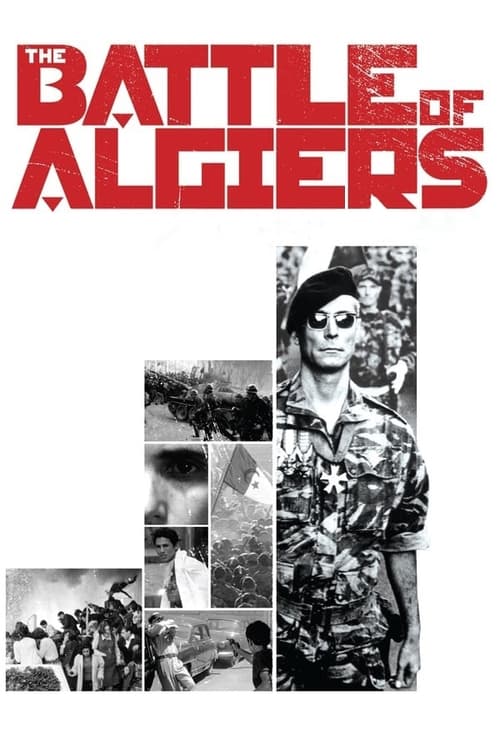
The Battle of Algiers
1966 · Gillo Pontecorvo
When you want a film to chew on for days — a challenge, not a comfort, but one that grips like a thriller the whole way through.
What it's about
Algiers in the 1950s: the Algerian National Liberation Front wages an urban guerrilla campaign against French colonial rule from the alleys of the Casbah, and France sends in paratroopers under a hardened colonel to crush it. The film follows both sides — a petty criminal turned resistance leader and the soldier hunting him — as bombings, checkpoints, and reprisals escalate through a whole city.
The experience
It looks so much like newsreel footage that the filmmakers had to open with a disclaimer that none was used — the effect is electric and unnerving, like watching history happen live. Tense, fast, and morally unsparing toward everyone; it leaves you shaken and arguing with yourself.
The craft
Gillo Pontecorvo shot on location in the actual Casbah with mostly non-professional actors, in grainy black and white built to mimic documentary — the technique is so convincing it changed what political filmmaking could look like. The crowd scenes and street-level camerawork still feel shockingly immediate.
Why it matters
One of the most studied political films ever made — screened by both revolutionaries and counterinsurgency planners — and the benchmark against which films about occupation and resistance are still measured.
Snapshot
A film that looks like journalism and functions like philosophy, The Battle of Algiers reconstructs the urban guerrilla campaign waged by the Algerian FLN against French colonial authority in the Casbah of Algiers between 1954 and 1957, then appends a coda touching on the popular uprising of 1960 that preceded independence. Shot on location in the Casbah with mostly non-professional actors, its surface mimicry of newsreel footage is so persuasive that the film opens with the disclaimer: "Not one foot of newsreel or documentary film has been used." Despite originating as an Algerian-commissioned account of a liberation struggle, the film distributes its moral weight across both sides with a severity that defies propaganda. It is among the most studied films in the history of political cinema and has never ceased to be operationally relevant: the United States military screened it at the Pentagon in August 2003 as the Iraq insurgency began to take shape.
Industry & Production
The Battle of Algiers was produced as an Italian-Algerian co-production between Igor Film (Rome) and Casbah Films (Algiers). The Algerian party was represented by Yacef Saadi, the former FLN commander who had led the Casbah network during the actual events depicted — a circumstance with no real precedent in political filmmaking. Saadi had survived the battle, was briefly imprisoned, and following Algerian independence in 1962 sought to put his own story on film. He initially approached Pontecorvo with a preexisting script that Pontecorvo found inadequate; Pontecorvo and his long-standing screenwriting partner Franco Solinas undertook a complete reconception. The resulting production was thus both a political commission from a recently independent state and the fully independent artistic project of a European filmmaker with his own left-political commitments — a productive tension the finished film never resolves.
The budget was modest and the shoot demanding. Pontecorvo and the crew worked in the actual streets and interiors of the Casbah, a dense hillside quarter of narrow alleys whose geography the film transforms into a character in its own right. The Algerian government provided logistical support and extras in quantity; the French military was, needless to say, absent as a production resource, and all French forces are played by Italian and other non-French performers. Saadi himself appears in the film as El-hadi Jafar, a lightly fictionalized version of his own historical role.
Technology
Cinematographer Marcello Gatti shot on black-and-white 35mm, employing a deliberate battery of techniques to simulate the grain, contrast, and instability of news and documentary footage without using any. Film stocks were selected and printing processes manipulated to push contrast and introduce grain. Telephoto and long-focal-length lenses were used extensively, compressing space, apparently catching subjects unaware, and producing the optical signature associated with news cameras of the period. Hand-held camera is deployed throughout chase sequences and crowd scenes, but also in interiors — even moments that could have been shot conventionally are slightly unsettled by camera movement that implies an observer rather than a director. The result is a systematic study in constructed verité: the technology does not merely record but performs the condition of documentation.
On the soundtrack, Pontecorvo and Ennio Morricone composed a score that deliberately integrated Algerian vocal music — ululation, traditional chant — alongside Morricone's orchestrations, so that the sonic world refuses the European conventions of war-film scoring. The two men reportedly worked in close collaboration on the musical ideas before Morricone developed them formally, making the authorship of the score genuinely shared to a degree unusual even between Morricone and his other collaborators of the period.
Technique
Cinematography
Gatti's images are among the most imitated in world cinema. The core strategy is what might be called productive instability: every shot carries a slight suggestion that it might have been obtained under difficult conditions, by a camera present at an event rather than staging one. Wide shots of the Casbah rooftops establish geography with an anthropological eye; close-ups during the torture sequences are held at a distance that implicates the viewer without sensationalizing the act. The decision to use telephoto lenses even for scripted scenes creates a pervasive sense that intimacy has been stolen rather than granted. Because no actual documentary footage is present, all of this is achieved through discipline of form rather than appropriation of archive.
Editing
The editing, credited to Mario Morra and Mario Serandrei, operates on two tempos. Action sequences — bombings, the parachutist cordon-and-search operations — are cut with the staccato rhythm of newsreel compilation, images arriving faster than they can be fully processed. Political sequences, interrogations, and the film's structural transitions move at a more deliberate pace that allows argument to accumulate. The film's macro-structure employs a nested analepsis: it opens in the moment of Ali la Pointe's final hiding place, then drops back to 1954 before proceeding more or less chronologically. This framing gives the narrative the fatalism of historical retrospect — the ending is known before the story begins — while stripping the deaths of anything resembling triumph.
Mise-en-scène / Staging
Pontecorvo stages crowd sequences with the density and apparent chaos of documentary, yet every important narrative element is legible within them — a feat of blocking that only becomes visible on repeated viewing. The Casbah itself functions as a topographic argument: French surveillance technology (checkpoints, aerial photography) encounters a human geography that resists mapping. The film's most discussed staging decision concerns the bomb-planting sequence, in which three Algerian women disguise themselves as French women to pass through checkpoints. Pontecorvo cuts from the bomb being placed — intercut with close-ups of the families at the café who will die — to the explosion itself. The sequence refuses to let the viewer remain comfortable on either side. No editorial judgment is offered; the sequence is constructed to produce the viewer's discomfort as a structural effect, not a moral instruction.
Sound
The integration of diegetic and non-diegetic sound is constant and sophisticated. Crowd noise from demonstrations bleeds into and out of Morricone's score in a way that makes the source of the music uncertain. Arabic ululation, which in Western musical conventions carries no obvious dramatic code, is used at moments of both triumph and mourning — the convention-breaking forces the listener to abandon established reflexes. The sounds of the Casbah — muezzin calls, children, market sounds — establish a world that is already fully present before French military authority enters it.
Performance
Jean Martin as Colonel Mathieu is the film's sole professional French actor and, in retrospect, one of the finest performances in European political cinema of the decade. Mathieu is constructed as intelligent, methodical, and free of personal sadism — a technocrat of colonial order rather than its monster, which makes him far more chilling than a more obvious villain would be. His press conference scenes, in which he defends the logic of torture with impeccable rational calm, are among the film's most devastating passages precisely because no argument is offered against him in the immediate scene. Brahim Hadjadj as Ali la Pointe, a non-professional cast from the Algerian streets, brings a physical presence and authenticity that Pontecorvo calibrated carefully, understanding that Hadjadj's very inexperience would read as inhabitation rather than performance.
Narrative & Dramatic Mode
The Battle of Algiers is structured as a chronicle that resists the conventions of the individual biographical film while using Ali la Pointe as a focal human figure. Ali's arc — from street criminal to politicized fighter — maps the film's argument about how colonial conditions produce their own resistance. But the film repeatedly pulls back from his perspective to occupy, with equal attention, the perspective of the French military command. Colonel Mathieu is given his own dramatic logic: he understands counterinsurgency as a technical problem, and the film grants him the intelligence to be partially right. What Pontecorvo and Solinas refuse is any synthesis or reconciliation between these perspectives; the film ends not with resolution but with continuation — the uprising of 1960 succeeds the suppression of 1957, not as triumph but as history proceeding with or without individual agency.
Genre & Cycle
The film belongs to no genre it does not also critique. As a war film it refuses military heroism; as a thriller it refuses cathartic resolution; as a biopic it subordinates its protagonist to collective forces. It inaugurated — or more precisely crystallized — what would be retrospectively theorized as Third Cinema: politically militant filmmaking that addresses its audience not as consumers of spectacle but as historical actors. In this it was directly cited by Fernando Solanas and Octavio Getino in their manifesto "Towards a Third Cinema" (1969), though Solanas and Getino radicalized its implications beyond what Pontecorvo himself would have endorsed. More proximately, it belongs to a cycle of European political films that would include Costa-Gavras's Z (1969) and State of Siege (1972), which borrowed its structure and its confidence that political argument could be conducted through cinema form.
Authorship & Method
Gillo Pontecorvo had been a communist militant before becoming a filmmaker — he participated in the Italian Resistance — and his political formation is inseparable from his formal choices. He came to features from documentary and short film, which equipped him for the neorealist-derived techniques he brought to Algiers. His directing style was reportedly demanding and meticulous to a degree that strained relations on set; the precision of the finished film reflects extended rehearsal and conceptual preparation.
Franco Solinas was among the most politically committed screenwriters working in Italian cinema, later writing the scripts for Costa-Gavras's State of Siege and other explicitly political films. The screenplay for Battle of Algiers is constructed to function as argument: characters are given the words of their actual historical positions (Mathieu's dialogue draws on real statements by French commanders during the period), and the dramatic structure is designed to produce ideological pressure rather than emotional catharsis.
Marcello Gatti's contribution cannot be overstated. The visual strategy was not merely cosmetic — the grammar of documentary he constructed gave the film its claim to historical authority. Ennio Morricone's score, unusual within his enormous output in its integration of non-Western musical idioms, remains one of his most politically specific.
Movement / National Cinema
The film occupies an anomalous position as simultaneously a work of Italian political cinema and a foundational text of Algerian national cinema — indeed one of the few films that could reasonably make that second claim, given how little fiction filmmaking infrastructure Algeria possessed in 1966. Within Italian cinema it belongs to the tradition that runs from neorealism through the political films of the late 1960s and 1970s — Elio Petri, Francesco Rosi, Bernardo Bertolucci's The Spider's Stratagem — but it exceeds the national frame by addressing an explicitly colonial and international subject. It is also a primary reference point for Third Cinema as a theoretical and practical category, though Third Cinema was largely a Latin American phenomenon and Pontecorvo himself remained European in his production base.
Era / Period
The film was made in 1965–66, four years after Algerian independence and in the midst of global decolonization. The Algerian War (1954–62) had been among the most violent and morally contested of the anti-colonial conflicts; France had employed systematic torture, the word itself long avoided in official French discourse, and the war had contributed to the collapse of the Fourth Republic. By 1966 the war was politically raw in France but historically settled enough in Algeria for Saadi to look back. Internationally, the film arrived into a political moment defined by Vietnam, the Cuban Revolution, and a proliferating series of liberation movements: it was immediately legible as speaking to all of them simultaneously. The Black Panther Party, the Provisional IRA, and various other revolutionary organizations reportedly studied the film as a practical document.
Themes
The film's central preoccupation is the logic of political violence under colonial conditions — not its morality in the abstract but the specific rationality it acquires when one population is structurally excluded from legitimate political expression. Pontecorvo and Solinas present this not as endorsement but as analysis: violence is shown to produce counter-violence in an escalating cycle that both sides enter with their own internal coherence. Torture is depicted as a systemic practice, not individual aberration, and the film refuses the consolation of bad individual actors. Surveillance — the French attempt to map, identify, and neutralize the Casbah network — is presented as a technology of colonial power that fails not through incompetence but because it cannot address the social conditions that generate resistance. The film is also, quietly, about the body: the bodies of women used as disguise, the bodies of bomb victims, the body of Ali la Pointe concealed behind a wall. Colonial power is exercised on and through bodies, and resistance passes through them.
Reception, Canon & Influence
Influences on the film. Roberto Rossellini's wartime neorealism — Rome Open City (1945) and Paisà (1946) — is the primary formal ancestor: the use of non-professional actors, location shooting, and the aesthetics of documentary witness are all inherited from Rossellini and the neorealist tradition he helped create. The French cinéma vérité of Jean Rouch and Edgar Morin provided a contemporary reference for hand-held observational camera. Francesco Rosi's Italian political cinema of the early 1960s, particularly Salvatore Giuliano (1962) — which also reconstructed a recent historical event using some non-professional actors — is a close structural parallel and almost certainly a direct influence on the project's conception.
Critical reception. The film won the Golden Lion at the Venice Film Festival in 1966, a recognition that established its prestige before its commercial release. It received three Academy Award nominations — for Best Foreign Language Film, Best Director, and Best Original Screenplay — acknowledging it within the Hollywood system without assimilating it. French authorities effectively suppressed commercial distribution in France for several years following release, a response to pressure from veterans' groups and right-wing organizations who regarded the film as defamatory; it did not reach French screens commercially until the early 1970s. This suppression itself became part of the film's meaning, demonstrating the political sensitivity of what it depicted.
Legacy. The film's influence runs in several directions simultaneously. As a formal model, it established the grammar of the political thriller and the political docudrama that Costa-Gavras systematized and popularized in the following decade. As a political object, it was studied by liberation movements worldwide and, in a supreme irony, by the militaries those movements were fighting: its analysis of insurgency and counterinsurgency is so precise that both sides of any given conflict have found it useful. The Pentagon screening of 2003 — a seminar advertised within the Defense Department on the continuing relevance of its counterinsurgency analysis — is the most documented instance of this double utility. Steven Spielberg has cited it in the context of Munich (2005); Ken Loach's political filmmaking is unthinkable without it; the tradition of docudrama it established runs through Paul Greengrass's work and into contemporary prestige television. Its greatest influence may be methodological rather than stylistic: the demonstration that political cinema need not simplify its subject to be politically effective — that rigor and argument can coexist with, even require, formal intensity — remains its most durable contribution to the art.
A Deleuzian reading
A long lens finds a face in a crowd.
The full Deleuzian reading of The Battle of Algiers →
Reception
It won the Golden Lion at Venice in 1966 — where the French delegation walked out — and was effectively banned in France until 1971. Once contraband, it's now near-universal canon: routinely called the greatest political film ever made.
How The Battle of Algiers was received, from release to now →
Influences: the films it descends from and the films it influenced
- Rome, Open City (1945) — Pontecorvo directly inherits Rossellini's three-part neorealist grammar — nonprofessional cast, occupied-city location shooting, available-light photography — treating them not as stylistic choices but as epistemological claims: the rough image is the authentic image, and the authentic image confers political authority on the fiction.
- Paisà (1946) — The multi-episode reconstruction of recent historical violence using a mixed professional/nonprofessional cast dispersed across actual sites of conflict models the docudrama form Pontecorvo adopts for his intercut FLN and French army sequences, establishing that fiction can claim documentary authority through structural dispersal across real locations and real faces.
- La Terra Trema (1948) — First systematic deployment of a total nonprofessional cast drawn from the actual community being filmed — Sicilian fishermen playing themselves with their own dialect — establishing the methodological standard Pontecorvo follows by casting actual Algerian FLN members and French-Algerians whose faces carry the texture of lived political experience the camera cannot fabricate.
- Chronique d'un été (1961) — Rouch and Morin codified the handheld observational grammar and direct-sound record of cinéma vérité that Pontecorvo and Marcello Gatti deliberately simulate with a fiction crew — the aesthetic signature Gatti worked against and toward simultaneously, producing a false-documentary texture whose grain and camera instability is a studied performance of witnessing rather than witnessing itself.
- Salvatore Giuliano (1962) — The nested analepsis structure — entering the narrative through the aftermath of the protagonist's death, then reconstructing events through fragmented timelines that return to the same material from different perspectives — is the direct formal model for Pontecorvo's dual-timeframe construction, establishing that political reconstruction can proceed through argument rather than linear causality.
- Battleship Potemkin (1925) — Pontecorvo explicitly modeled the film's crowd choreography, non-professional actors deployed as mass typage, and handheld penetration of political demonstrations on Potemkin, translating Eisenstein's Black Sea proletariat collective protagonist into the Casbah's FLN cell structure within an Italian neorealist documentary register.
- Strike (1925) — Pontecorvo cast non-professional Algerian participants as themselves, choreographed mass crowd sequences as collective political bodies, and intercutted colonial authority with resistance in the same dialectical structure Strike deploys between management and workers.
- The Human Condition I: No Greater Love (1959) — Moral-realist treatment of colonial exploitation built on documentary-grade environmental realism, refusing to let either oppressor or resister off the ethical hook.
- Sabotage (1937) — The café-bombing sequence extends Sabotage's template of everyday terrorism, cross-cutting a planted device against oblivious civilians to make the audience complicit in a ticking-bomb it cannot stop.
- Pitfall (1962) — Carries neorealist documentary texture forward into overtly political fiction, proving on a larger canvas Pitfall's premise that a factual-looking, non-heroic surface can be engineered into pointed social critique.
- Queimada (1969) — Pontecorvo's own continuation of the counterinsurgency-as-system analytical framework, testing whether the moral-neutrality-construction device survives when one side employs a recognizable star (Brando as British agent Walker) — and demonstrating through the film's commercial and critical failure that the device depends on the leveling effect of nonprofessional faces; stardom reasserts hierarchy where the method demands equivalence.
- Z (1969) — Costa-Gavras systematizes Pontecorvo's political docudrama grammar — rapid telephoto intercutting, location-based urgency, procedural reconstruction of political assassination — into a commercially reproducible genre template; Z is effectively the industrialization of Battle of Algiers' methodology, packaging its telephoto-surveillance aesthetic and dual-tempo editing for mainstream political cinema.
- State of Siege (1972) — Written by Franco Solinas — the same screenwriter as Battle of Algiers — deploying an identical counterinsurgency-as-system analytical architecture and technocrat-villain construction: the American AID torture instructor Santore is Mathieu's transatlantic equivalent, and the film's structural argument about institutional violence is the direct continuation of the Solinas method.
- Hidden Agenda (1990) — Loach applies Pontecorvo's dual-perspective moral-neutrality construction to British counterinsurgency in Northern Ireland — depicting both the IRA's operational logic and the RUC's shoot-to-kill policy without resolving the moral question — directly extending the structural commitment that the dossier identifies as Pontecorvo's most durable formal contribution: political rigor that refuses simplification.
- The Wind That Shakes the Barley (2006) — The dual-perspective rupture — splitting the film's moral axis along the Treaty divide to show both the logic of continued armed resistance and the logic of pragmatic settlement — is the most direct transposition of Battle of Algiers' moral-neutrality-construction device into British political cinema, staging ideological argument as fraternal tragedy rather than docudrama procedure.
- Caché (2005) — Haneke systematically deploys the surveillance/telephoto-lens aesthetic as both visual grammar and ideological argument — the static camera that watches without explanation literalizes the colonial gaze — while the Algerian War massacre of 1961 is the specific historical substrate beneath the protagonist's guilt; the film is in direct formal dialogue with Battle of Algiers' surveillance-camera language and its analysis of who watches whom.
- Munich (2005) — Spielberg explicitly cited Battle of Algiers in the context of Munich's design; the procedural counterterrorism reconstruction, the technocrat-handler figure (Ephraim as Mathieu's Mossad equivalent), and the moral-neutrality staging of targeted assassination — showing the operational logic of both sides without adjudicating — are direct methodological inheritances Spielberg named rather than concealed.
- Bloody Sunday (2002) — Direct adoption of the simulated-verité handheld grammar and pushed high-contrast grain to reconstruct a real political massacre in quasi-real-time; Greengrass's entire docudrama methodology — urgency through camera instability, authenticity through grain, moral weight through nonprofessional faces caught in motion — is the Battle of Algiers grammar applied to British political violence and stripped of the narrative's retrospective framing.
- Zero Dark Thirty (2012) — Inherits the counterinsurgency-as-system procedural framework and docudrama verité grammar to depict the CIA torture apparatus with the same analytical coldness Pontecorvo applies to Mathieu's parachutists — producing the identical moral-neutrality-construction effect: the audience understands the operational logic of each technique without receiving either condemnation or absolution from the film's structure.
- The Voice of Hind Rajab (2025) — Founding model of the Maghreb anti-colonial reconstruction docudrama, using newsreel-grade verisimilitude and non-professional faces to restage real events with the authority of documentary.
- Amores Perros (2000) — Pontecorvo established 16mm blown up to 35mm as a formal strategy for grafting documentary grain and compressed contrast onto theatrical exhibition — the precise technical procedure Rodrigo Prieto adopted for Amores Perros, citing it as the antecedent for his deliberately imperfect, over-determined image texture.
- The Celebration (1998) — Constructs documentary authenticity through grainy handheld imagery shot on location without supplemental lighting, establishing the grammar of visual roughness as a truth-claim in dramatized fiction; the conceptual model behind Dogme's embrace of video grain and available light as simultaneously ethical and aesthetic choices.
- La hora de los hornos (1968) — Solanas and Getino's Third Cinema manifesto explicitly builds on Battle of Algiers' demonstration that simulated-verité grammar and non-theatrical exhibition can constitute a political weapon; where Pontecorvo uses the aesthetic as argument within a narrative form, Solanas deploys the same grammar in a direct-address essay structure that theorizes what Pontecorvo practiced.
- I Am Cuba (1964) — Pontecorvo's faux-newsreel handheld coverage of revolutionary crowds as a collective emblematic mass pursues the same fusion of agitprop allegory and documentary immediacy from the opposite, grainy-realist pole.
- Tora! Tora! Tora! (1970) — Newsreel-legible cinematography, anti-star ensemble, and even-handed dual-perspective reconstruction of documented events—a contemporaneous model of docudrama objectivity granting both sides authorial standing.
- Emitaï (1973) — Its reenactment of anticolonial struggle through a nameless popular collective, cast largely from nonprofessionals, is the same craft of dramatizing history without a star-hero.
- Shame (1968) — Deploys handheld, newsreel-textured black-and-white to make conflict feel unstaged and immediate — the same documentary-grave texture Nykvist gives Shame's chaos passages.
- The War Game (1966) — Grainy pseudo-newsreel reconstruction of recent history with non-professional cast, shot and processed to read as captured actuality — the same 'this footage exists' illusion arrived at independently the same year.
- Lion of the Desert (1981) — The opposite stylistic pole of the same anti-colonial project: Pontecorvo pursues resistance through newsreel-grain, non-professional immediacy where Akkad pursues it through monumental roadshow scale.
- Edvard Munch (1974) — Independently pursues newsreel-grain handheld reconstruction of history staged with non-professionals playing versions of themselves, the same docudrama fusion of reportage and re-enactment.
- The Land (1970) — Third-cinema crowd choreography and collective protagonist rendered through documentary-inflected montage of mass action under colonial repression.
- The Organizer (1963) — Extends the same craft into insurrection: black-and-white near-documentary monochrome and crowd choreography treating a mobilized mass, not a named leader, as the film's true agent.
- Marighella (2021) — The avowed template for the armed-struggle procedural: cell structure explained through the staging of operations themselves (weapons handoffs, safe-house discipline, the ladder of names), newsreel-grain handheld shot at eye level inside the action rather than observing it, and torture presented as an administrative method with its own steps rather than as spectacle.
Similar films
- Paisan (1946) — influence & lineage · often watched together
- Z (1969) — influence & lineage
- Salvatore Giuliano (1962) — influence & lineage
- A Man Escaped (1956) — same viewing thread · often watched together
- The Wind That Shakes the Barley (2006) — influence & lineage · same viewing thread
- Bloody Sunday (2002) — influence & lineage · same viewing thread
- Lion of the Desert (1981) — same viewing thread
- The Great War (1959) — same viewing thread
All the films related to The Battle of Algiers →
Watch it with: curated runs of related films
- The Futility of War — A run of films about ordinary men fed into war's machinery — from the trenches to the Casbah to the Warsaw sewers — where the futility and human cost rhyme across a century and a dozen conflicts.
Film essays and courses that include it
- From Riot to Trial: A Century of Banned Cinema
- The Art of the Assault: How Cinema Stages War
- Camera on the Street: Italian Neorealism and the World It Made
- The Camera at War: A Century of Reinvention
- Witness: Cinema's Century of War and Its Wound
- Men Under Orders: Cinema's Century at War
- Revolt in the Frame: Revolutionary Cinema 1925–2006
- What the Frame Cannot Hold: Cinema's Long Reckoning with Off-Screen Atrocity
- The Film They Tried to Stop: A Century of Festival Scandal