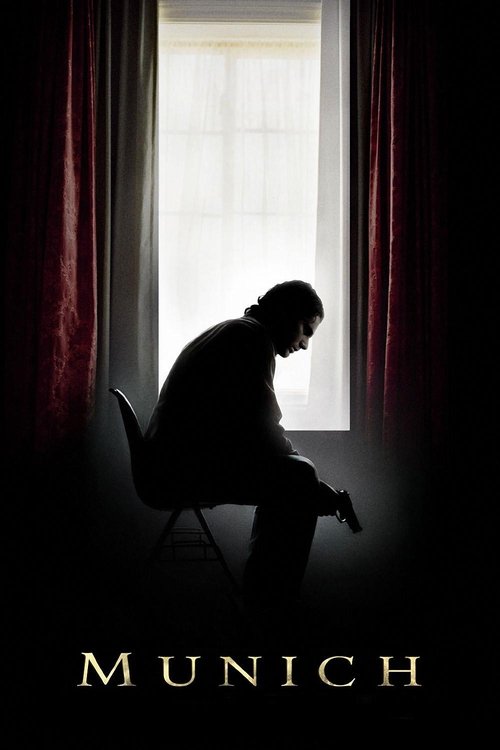
Munich
2005 · Steven Spielberg
For when you want a serious, adult thriller that treats you like a grown-up — something to wrestle with rather than escape into. Demanding, and worth the demand.
What it's about
After Palestinian militants murder eleven Israeli athletes at the 1972 Munich Olympics, Israel assembles a covert Mossad team to hunt down and kill the men held responsible. The film follows the squad's leader, a young operative pulled away from his pregnant wife, as the mission moves from safe house to safe house across 1970s Europe — and as each assassination gets harder to square with the certainty that launched it. It's a thriller about revenge that keeps asking what revenge does to the people carrying it out.
The experience
Tense and mournful at once — the hits are staged with nail-biting precision, but the film's real pressure is moral, and it accumulates until you feel it physically. Long, heavy, and gripping; you come out arguing with it.
Performances
Eric Bana gives a haunted, slow-burn performance as the team leader whose conviction erodes in real time; the squad around him — including a young Daniel Craig — is uniformly strong.
The craft
Spielberg directs the suspense sequences with his full arsenal — bombs that won't behave, phone lines, hotel corridors — shot in grainy, paranoid 1970s textures by Janusz Kamiński, with a mournful John Williams score. Tony Kushner's screenplay keeps interrogating the mission even as the film delivers as a thriller.
Why it matters
Released at the height of post-9/11 debate over terrorism and state response, it stands as Spielberg's most politically confrontational film and drew fire from all sides — proof of how squarely it hit a nerve.
Snapshot
Steven Spielberg's Munich reconstructs the aftermath of the Black September attack on Israeli athletes at the 1972 Olympic Games and the covert Mossad operation — codenamed "Wrath of God" — that sought to eliminate those responsible. Written by Tony Kushner and Eric Roth from George Jonas's disputed 1984 account Vengeance, the film follows a fictionalized Mossad operative, Avner Kaufman (Eric Bana), as he leads a five-man team across Western Europe systematically assassinating Palestinian targets. Spielberg positions the operation not as heroic espionage but as a moral descent — the state's logic of retributive violence consuming the men it employs. Released in December 2005 at the height of post-9/11 anxiety about terrorism and state response, Munich stands as Spielberg's most politically confrontational film and one of Hollywood's most ambitious engagements with the Israel-Palestine conflict. It received five Academy Award nominations, including Best Picture and Best Director, without winning.
Industry & production
Munich was produced by DreamWorks and Universal Pictures, with Spielberg, Kathleen Kennedy, and Barry Mendel sharing producer credits. The project moved with unusual speed: Spielberg committed to the material and pushed through production and post-production within a compressed timeframe, achieving a December 23, 2005 release — a deliberate awards-season positioning that also exploited the film's cultural urgency. The rapid schedule was partly a creative and political choice: Spielberg has spoken of feeling that the subject demanded immediacy rather than extended development.
Tony Kushner had no prior major theatrical-film screenplay credit — his adaptation of Angels in America for HBO (2003) was his most prominent screen work before this — and his hiring signaled that Spielberg wanted a writer known for intellectual rigor and moral seriousness rather than commercial action mechanics. Eric Roth, a more experienced studio collaborator (he had written Forrest Gump and Ali), co-wrote to balance Kushner's more architecturally rhetorical instincts with narrative momentum.
The production filmed largely on location in Malta, Hungary, France, and other European countries, with various cities doubling for Rome, Beirut, Paris, and Amsterdam — the real locations being logistically or politically unavailable. The Israeli government declined to cooperate with the production, which was both a practical obstacle and, in retrospect, a thematic emblem: the film operates on contested, uncertain ground.
Technology
Kamiński shot Munich on anamorphic 35mm using a combination of normal and Super 16mm elements to achieve tonal variation and period texture. The film's palette was deliberately desaturated in the digital intermediate stage to evoke the grain and fading of 1970s photochemical stock — documentary footage from the era, including ABC News coverage of the Munich Games, was studied closely and partially integrated. The color science of Munich is cooler and more sallow than Kamiński's work on Spielberg's more openly heroic films; shadow detail is compressed, faces often partially obscured.
The production made selective use of handheld rigs to punctuate the verité register of the assassination sequences, contrasting with more composed, almost classical framings in scenes of political and ethical deliberation. The editorial pipeline under Michael Kahn integrated Super 16 material, news archival footage, and standard anamorphic without attempting seamless invisibility — some joins are purposely rough, emphasizing the film's interest in historical construction over illusionistic transparency.
Technique
Cinematography
Kamiński's work here marks a significant departure from the burnished, emotionally pitched compositions of Schindler's List and the tactical grandeur of Saving Private Ryan. The visual grammar of Munich draws on the European political cinema of the late 1960s and 1970s — especially the work of Costa-Gavras and Gillo Pontecorvo — in its preference for underlit interiors, unstable framings, and a studied refusal of visual heroism. Wide shots of European cities often feel surveilled rather than celebrated; tight close-ups, particularly during killings, register shock without aestheticizing violence in the manner of genre action cinema. The film's most technically complex sequence — the Rome double assassination — is staged as a claustrophobic procedural, the camera itself seemingly uncertain of where to look.
Editing
Michael Kahn, Spielberg's editor since Close Encounters of the Third Kind, constructs the film around a fundamental juxtaposition: the operational logic of the assassinations (planning, execution, aftermath, guilt) against intrusive memories of the Munich hostage crisis itself. The film withholds the full, direct depiction of the massacre until its most controversial editorial gesture: a cross-cut climax in which Avner's sexual reunion with his wife — itself coded as a reclamation of ordinary life — is spliced against images of the hostages' final moments. The sequence has drawn extensive critical debate. Its purpose appears to be the argument that trauma cannot be discharged through violence, that the private and the political remain inextricably interwound, but its tonal risks are real and have been disputed both aesthetically and ethically.
Mise-en-scène / staging
Spielberg's staging in Munich prioritizes moral geometry over kinetic spectacle. Many of the film's most important scenes are dialogue-centered standoffs: the recurring parleys with Louis (Mathieu Amalric) and Papa (Michael Lonsdale), the team's nocturnal debates about the justice of what they are doing. Spielberg places characters across distance, uses doorframes and architectural thresholds to mark exposure and enclosure, and orchestrates scenes so that physical comfort — a shared meal, a rented apartment — becomes a kind of moral irony. The single most striking staging decision may be the extended Rome apartment sequence, which forces two assassination operations to overlap spatially and temporally, exposing the arbitrary contingency of death in ways genre conventions normally paper over.
Sound
John Williams's score is among his most restrained and least conventionally heroic. Where his work for Spielberg typically provides emotional signposting, Munich uses sparse instrumentation — solo cello, woodwinds, sparse percussion — and Middle Eastern tonal colorings that resist triumphalism while refusing cheap atmospherics. The score withholds melodic resolution in a way that mirrors the narrative's ethical withholding. Sound design by Gary Rydstrom's team (Spielberg's longstanding collaborator) emphasizes the material reality of violence: gunshot acoustics, the sounds of death in enclosed spaces, the ambient noise of European cities that continues indifferently after each killing. The contrast between the mundane sonic world and the violence occurring within it is a consistent and deliberate strategy.
Performance
Eric Bana's Avner is a study in inward erosion, a performance built on suppression rather than expression. Bana, then known primarily from Hulk (2003) and Troy (2004), works against the action-hero grain, letting confidence drain visibly across the film's running time. The ensemble is carefully differentiated: Ciarán Hinds's Steve is pragmatic, even eager; Mathieu Kassovitz's Robert is idealistic and brittle; Hanns Zischler's Hans bookish and increasingly remote; Daniel Craig's Carl is hard and serviceable. Geoffrey Rush brings patrician control to the intelligence handler Ephraim, embodying the state's capacity to instrumentalize and then discard its agents. Michael Lonsdale's Papa — the patriarch of the fictionalized French intelligence broker family — creates a counterweight of civilizational continuity against which the team's crisis registers more sharply. Ayelet Zurer, in the smaller role of Avner's wife Daphna, carries enormous weight in relatively brief screen time.
Narrative & dramatic mode
Munich works structurally as a classic descent narrative: a protagonist granted a mission by a legitimate authority progressively loses confidence in both the mission's justice and his own moral coherence. This structure is familiar from the post-Watergate American political thriller, but Kushner and Roth complicate it by insisting on a double pressure: Avner's internal erosion is paralleled by the operational failures and accidental killings that accumulate around the team. The film is not interested in the procedural pleasures of the spy genre except to subvert them — competence does not produce satisfaction or closure. The dramatic mode is closer to tragedy than thriller, in the Aristotelian sense that the protagonist's qualities (loyalty, professionalism, mission-focus) are precisely what destroy him.
The screenplay makes frequent use of formal debate — characters articulate opposing positions on violence, justice, and statehood with theatrical clarity — which has been both praised (as intellectual seriousness) and criticized (as stagy, Kushner-esque rhetorical display). The Palestinian militant who argues his position at length in a Paris safe house is the most notable instance: a scene with no precedent in mainstream American studio filmmaking of the period.
Genre & cycle
Munich belongs to the American political thriller tradition whose canonical texts emerged from the early 1970s: The Parallax View (1974), Three Days of the Condor (1975), All the President's Men (1976). Like those films, it uses the apparatus of espionage and conspiracy to examine the mechanisms of institutional power and their deforming effects on individuals. Within the specific post-9/11 cycle to which it belongs — alongside Syriana (2005) and The Battle of Algiers' return to theatrical circulation — Munich is distinguished by its Hollywood production scale and its creator's canonical status, which gave its moral ambiguity unusual visibility and cultural weight.
Authorship & method
Spielberg's late-career turn toward films of explicit historical and moral gravity — initiated with Schindler's List (1993), continued through Amistad (1997), Saving Private Ryan (1998), and Munich — represents one of mainstream American cinema's most sustained attempts to reconcile the demands of commercial entertainment with the obligations of difficult history. Munich is arguably the furthest point on this trajectory, the film where the ethical discomfort is most deliberately preserved rather than resolved.
Kamiński has shot every Spielberg feature since Schindler's List, and their collaboration on Munich is marked by Kamiński's willingness to actively work against his own virtuosity — the film's DPs-credit could easily be misattributed to a European art-cinema practitioner. Kahn's editing partnership with Spielberg is among the longest director-editor relationships in Hollywood history, and Munich's formal risks — particularly the climactic intercut sequence — could not have been attempted without that accumulated trust. John Williams's score completes the picture of a director working almost exclusively with long-term creative partners while pushing each relationship into unfamiliar territory.
Kushner's contribution is probably more philosophically central to Munich than any single screenwriter's input on a comparable studio production. His background in political theater — his characteristic mode is argument staged as drama — gives the screenplay its most distinctive quality: the refusal to allow any character, including Avner, to claim unchallenged moral high ground.
Movement / national cinema
Munich is emphatically American cinema in its industrial context, but it engages centrally with Israeli national identity and its contradictions. The film positions Avner's crisis as, among other things, a crisis of Zionist ideology — the idea that Jewish safety requires a Jewish state willing to exercise lethal power — and does so from within American Jewish cultural life in a way that was unprecedented in a major studio production. Spielberg has identified his own Jewishness as inseparable from his investment in the material, and the film can be read as a product of a specific American Jewish post-Holocaust consciousness encountering the moral costs of Israeli statehood.
The film's European settings and its debts to European political cinema also give it a transnational texture unusual for Hollywood; it feels, at moments, more like Costa-Gavras's Z (1969) or Pontecorvo's The Battle of Algiers (1966) than it does like a standard studio thriller.
Era / period
Munich is legibly a post-9/11 film. Spielberg has stated that the project felt urgent in the specific political climate of 2004–2005, when American and Israeli state violence were both being debated in terms of necessity and proportion. The film's final image — Avner on the Brooklyn waterfront, the World Trade Center towers visible across the river in the film's only deliberate anachronism — makes the connection explicit: Munich 1972 is positioned as a genealogical ancestor of September 11, 2001, and the film's argument about retributive violence as self-perpetuating is intended to speak to both moments.
Themes
The film's central preoccupation is the ethical corrosiveness of institutionalized killing — the idea that violence undertaken by states does not remain cleanly bounded but permeates and transforms those who carry it out. Home recurs as the counterweight to mission: Avner's displacement from his pregnant wife, the team's makeshift domesticity in rented apartments, the final return to Brooklyn that cannot restore what has been lost. The film also engages with memory and historical construction — the way states and individuals narrate violent acts to themselves — and with the specific burden of Jewish historical consciousness, where the imperative "never again" becomes the justification for actions that replicate the logic of persecution.
Reception, canon & influence
Critical reception was divided along lines that often tracked the viewer's prior political commitments. Admirers, including Roger Ebert, praised the film's moral seriousness and its refusal of easy resolution. Detractors — including some Israeli officials and commentators — argued that its "moral equivalence" (placing Palestinian militant perspectives alongside Israeli grief) distorted historical reality and humanized perpetrators inappropriately. The charge of false equivalence was disputed by Kushner and Spielberg, who maintained that understanding a position is not endorsing it.
Influences on the film are traceable to the European political cinema Kamiński and Spielberg consciously studied: The Battle of Algiers is the most frequently cited antecedent, both for its documentary visual texture and its willingness to present political violence from multiple perspectives. Costa-Gavras's work — particularly Z and State of Siege (1972) — provided a template for the politically engaged thriller that neither aestheticizes nor neutralizes violence. Within Spielberg's own filmography, Schindler's List provides the moral and aesthetic template; Munich can be read as its counterpart, exploring not Jewish victimhood but Jewish power and its costs.
Legacy is more diffuse and harder to trace definitively. The film helped create the conditions for subsequent Hollywood engagement with morally compromised counterterrorism operations — Kathryn Bigelow's Zero Dark Thirty (2012) is its most obvious successor in terms of thematic terrain and its similar willingness to court controversy by refusing moral simplicity. Daniel Craig's performance contributed to his selection as James Bond in Casino Royale (2006), which itself reinvented the Bond franchise along harder, morally ambiguous lines that Munich arguably influenced in sensibility if not directly in causation. Within Spielberg's career, the film remains somewhat apart — admired more often by critics and scholars than by general audiences, and representing a mode of address he has not returned to in quite the same form.
A Deleuzian reading
There is a moment in Rome.
The full Deleuzian reading of Munich →
Reception
Landed in 2005 to heated controversy — attacked from both political directions and debated more as an op-ed topic than a movie — and underperformed for a Spielberg film. Two decades on, it's been firmly reappraised as one of his very best, the crown jewel of 'dark Spielberg.'
How Munich was received, from release to now →
Influences: the films it descends from and the films it influenced
- Z (1969) — Kamiński and Spielberg inherit Z's syntax of agitated zoom lenses, underlit location interiors, and a procedural editing rhythm that strips political violence of heroic framing — Munich's assassination sequences follow Z's specific template of operational chaos over choreographed clarity, including the use of tight close-ups that register shock without aestheticizing the act.
- State of Siege (1972) — Costa-Gavras's formal device of embedding philosophically explicit arguments about the legitimacy of political violence inside a procedural thriller framework — characters debating ethics while executing the operation — is the direct structural model for Munich's recurring standoff scenes where Avner and his team argue the justice of assassination in real time.
- The Battle of Algiers (1966) — Pontecorvo's pseudo-documentary grammar — synchronized location sound, non-studio grain, and the structural device of showing an operative's domestic humanity before and after acts of violence without privileging either side's moral claim — establishes the ambivalence template Munich applies to the Israeli-Palestinian context, including the specific refusal to score violence musically.
- The Day of the Jackal (1973) — Zinnemann's meticulous procedural staging — operational preparation (weapon acquisition, target surveillance, safe-house logistics) given equal screen time to execution, without generic suspense inflation — prefigures Munich's procedural-overlap approach, in which the administrative mechanics of assassination are dramatized at the same moral pitch as their human consequences.
- The Conversation (1974) — Coppola's use of diegetic ambient sound as the primary moral carrier — location noise that cannot be fully controlled or interpreted, mixed at levels that refuse emotional cuing — prefigures Munich's restrained-score strategy, where silence and room tone do the work a conventional thriller score would externalize; both films also structure professional expertise as the mechanism of the protagonist's psychological destruction.
- All the President's Men (1976) — Gordon Willis's deep-focus, underlit interior photography — using architectural depth and partial shadow to suggest surveillance and institutional entrapment — is the direct visual ancestor of Kamiński's safe-house and hotel-room staging in Munich, where characters are positioned within frame as if already potentially watched by forces beyond the scene.
- The Spy Who Came in from the Cold (1965) — Oswald Morris's high-contrast desaturated photography and Richard Burton's signature inward-erosion performance — a professional discovering that the state's moral logic destroys its own operatives — establish both the visual template Kamiński deracinates from black-and-white into sallow color and the performance model Bana follows: containment over breakdown, exhaustion over anguish.
- The Parallax View (1974) — Pakula's convention of filming protagonists as if they are already under surveillance — wide-angle framings that place figures at the edge of institutional space rather than at its center — and his descent narrative in which investigation becomes self-destruction directly supply Munich with its visual-political grammar of a man consumed by the apparatus he trusted.
- Army of Shadows (1969) — Spielberg adopts Melville's episodic chapter structure for clandestine operations and his moral framework in which solidarity demands sacrifice — each mission extracting more of the operative's civilian self, cell loyalty becoming liability — translating Army of Shadows's Resistance ethics into a post-1972 state-violence context.
- One Day in September (1999) — Directly dramatizes Operation Wrath of God using One Day in September as an acknowledged primary source document; Spielberg's narrative film fictionalizes what Macdonald's documentary narrates — the lineage is unusually traceable because Spielberg and Kushner named the film explicitly.
- The Sum of All Fears (2002) — Extends the cross-cut, dramatic-irony rendering of retaliation cycles into a post-9/11 meditation on catastrophe-by-retaliation, inheriting the seed's interest in consequence and escalation over heroics.
- Marathon Man (1976) — Methodical hunter-and-hunted structure built on withheld convergence and moral ambiguity in the pursuit of Nazi-era reckoning, extending the cycle's suggestion-over-depiction approach to violence.
- Waltz with Bashir (2008) — Folman's animated documentary deploys trauma-intercutting — fragmented recovered memories erupting into present-tense scenes — as its central formal device, and culminates by cutting from animation into actual archival news footage of the Sabra and Shatila massacre, enacting Munich's archival-integration strategy in reverse: from subjective reconstruction into documentary reality, forcing the same ethical rupture Munich achieves with its cross-cut climax.
- Carlos (2010) — Assayas's five-and-a-half-hour procedural directly extends Munich's period-accurate visual texture (grain, desaturation, location dressing that codes European cities as operational rather than touristic) and its descent structure — a politically motivated operative whose ideological identity is progressively voided by operational logic — using the same arc Munich maps onto Avner Kaufman but tracing it across a decade of real history.
- The Hurt Locker (2008) — Barry Ackroyd's multi-rig handheld approach — several cameras filming simultaneously at different focal lengths without pre-choreographed coverage — extends Munich's assassination-sequence grammar into the Iraq War, and Bigelow's sound mixing strategy (ambient explosive pressure over score, diegetic radio chatter as the primary emotional channel) is a direct application of Munich's diegetic-violence-realism sound design.
- Zero Dark Thirty (2012) — Bigelow's procedural inherits Munich's diegetic violence realism — torture and tactical violence staged without score cushioning, at ambient audio levels — and refuses the same moral resolution: the final shot of Maya unable to name a destination mirrors Avner at the film's close, a specialist from whom the operation has extracted whatever civilian self remained, leaving performance inward erosion as the only honest ending available.
- Tinker Tailor Soldier Spy (2011) — Hoyte van Hoytema's shadow-compressed, desaturated palette — achieved through a digital intermediate process that suppresses highlight detail in the same register as Kamiński's Munich color science — combined with Gary Oldman's performance of inward erosion through containment rather than breakdown extends Munich's specific visual and performance grammar into Cold War institutional betrayal.
- Sicario (2015) — Villeneuve and Roger Deakins extend Munich's moral geometry staging — the use of architectural thresholds, corridor framings, and checkpoint lines to mark the protagonist's progressive loss of operative agency — into the US-Mexico border context, with Emily Blunt's descent structure mirroring Bana's: a legitimate agent whose moral authority is systematically stripped by the institutional logic she was recruited to serve.
- Eye in the Sky (2015) — Hood's real-time formal-debate structure — characters across multiple locations arguing the ethics of a drone strike while it is simultaneously being executed — directly extends Munich's dialogue-centered standoff staging, in which moral argument and operational irreversibility occupy simultaneous screen time, so that deliberation itself becomes a form of complicity.
- Casino Royale (2006) — The post-9/11 intelligence operation rendered as moral reckoning; violence that accrues psychological cost rather than offering catharsis establishes the emotional register Casino Royale imports into the Bond franchise — killing as wound rather than resolution.
- Anthropoid (2016) — Spielberg's special-operations procedural on a state-sanctioned targeted killing uses deferred moral reckoning — the operatives' psychological cost accumulating across the operational sequence rather than declared in dramatic confrontation — as its moral grammar, which Ellis directly inherits for the Anthropoid team's controlled interiority.
- Killers of the Flower Moon (2023) — Eric Roth's screenplay structure for large-scale historical crime — moral compromise accumulating incrementally across a complicit protagonist without cathartic confession — is carried directly into Killers' script architecture, the same writer applying the same moral-accumulation method.
- A House of Dynamite (2025) — Geopolitical procedural staging of state-sanctioned violence with an ensemble competence-under-duress register and a deliberately unresolved moral architecture in which the institutional logic of each operation is rendered legible while its ethical valence is withheld.
- A Most Wanted Man (2014) — Post-terror espionage stripped of heroism, where intelligence work corrodes its agents morally and ends in exhaustion rather than victory — the morally-ambivalent war-on-terror frame the film descends from.
- Syriana (2005) — Released the same year and drawing on the same post-9/11 urgency, Syriana constructs an overlapping procedural structure — multiple operational timelines converging through elliptical editing rather than causal exposition — and deploys Robert Elswit's surveillance-flat desaturated palette as a parallel formal response to the question Munich also poses: how does cinema represent state violence in the Middle East without the conventions of heroic genre.
- United 93 (2006) — Greengrass's integration of archival broadcast footage with 16mm verité reconstruction — including deliberate editorial roughness at the join between news material and dramatized action — extends Munich's archival-integration strategy into the 9/11 event itself, treating historical footage as morally charged material that resists seamless absorption into narrative cinema rather than as authenticating texture.
- Inside Man (2006) — Deploys the same uniformed/anonymized operative crew whose individual identities dissolve into collective function — the moral-ambiguity-via-costume logic Inside Man uses for the boiler-suit robbers — and sustains the same formal tension between procedural genre efficiency and an indictment of institutional violence that the genre surface cannot cleanly resolve.
- Schindler's List (1993) — Spielberg and Kamiński apply the same available-light handheld grammar and the morally ambiguous protagonist-in-transformation structure developed in Schindler's List to post-Holocaust Israeli state violence — the accumulative crosscut structure across multiple assassination threads mirrors the Kraków liquidation's accumulative editing logic, now applied to perpetrator rather than victim perspective.
- Argo (2012) — Political-operational thriller built on countdown mechanics and parallel cross-cutting between mission timelines, using Super 35 period-authentic texture and docudrama legitimacy to authorize a morally ambiguous covert narrative — the structural template Argo compressed and accelerated.
- The Man Standing Next (2020) — The functionary-as-moral-subject procedural: a male institutional ensemble implementing state violence in unglamorous spaces, the dramatic architecture of procedural complicity where moral clarity dissolves through operational proximity—the same ethical terrain Woo maps onto the KCIA directorate.
- Number 24 (2024) — Spielberg rendered the administrative and logistical dimensions of covert targeted operations through surveillance-tempo editing and bureaucratic procedure as thriller mechanics — the same organizational dimension of resistance work that Sønsteby's biography and Number 24 foreground over physical action.
- The Baader Meinhof Complex (2008) — A period-reconstructed thriller reckoning with terrorism's moral cost, staging operations and reprisals as procedural set-pieces within a thriller form.
- Body of Lies (2008) — A contemporaneous prestige espionage procedural that dramatizes the moral cost and grubby mechanics of state-sanctioned covert operations, sharing the realist-tradecraft register and globe-hopping operative structure.
- Operation Mincemeat (2022) — An intelligence-operation drama centered on the moral cost of sanctioned deception, carried by banked, interior performance over plot pyrotechnics.
- War of the Worlds (2005) — Released the same year, it shares the desaturated Kamiński photography and the project of turning a major star toward morally uncomfortable, anti-heroic ends within a trauma-saturated frame.
- Four Days in September (1997) — A political-violence thriller built on deliberate moral even-handedness and cross-cut parallel action between operatives and targets, refusing to let either side stand uncomplicated.
Similar films
- Zero Dark Thirty (2012) — influence & lineage
- The Hurt Locker (2008) — influence & lineage
- United 93 (2006) — influence & lineage
- September 5 (2024) — shared sensibility
- One Day in September (1999) — shared sensibility
- Schindler's List (1993) — shared sensibility
- Bridge of Spies (2015) — shared sensibility
- Paradise Now (2005) — shared sensibility
All the films related to Munich →